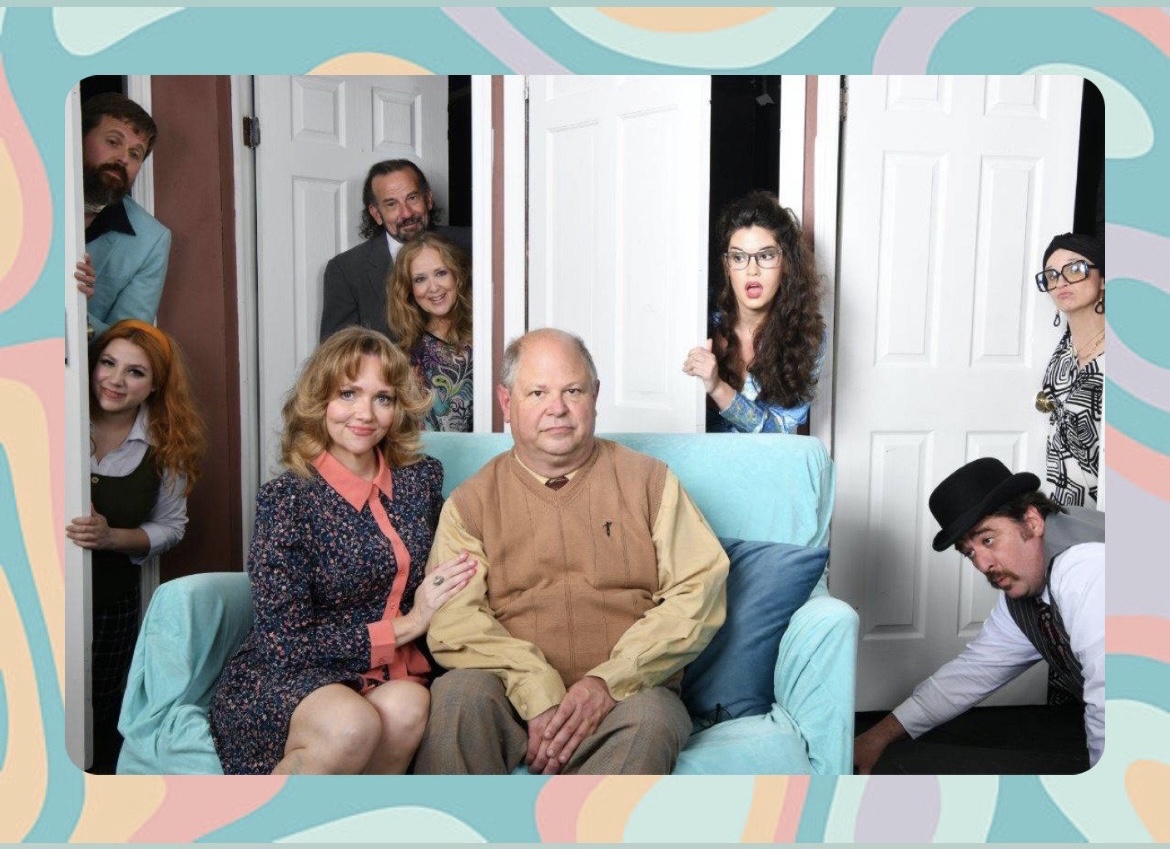
Recently, during their final days of rehearsal, I had the opportunity to chat with cast members of Playhouse 615’s latest presentation, Move Over Mrs. Markham. A British farce written by Ray Cooney and John Chapman as directed by Playhouse 615’s Joel Meriwether, the show opens Friday, August 4 and running through August 20. Among the cast are Beth Henderson as Miss Olive Harriet Smythe, Craig Hartline as Henry Lodge, Eric Crawford as Phillip Markham and Lindsey Patrick-Wright as Joanna Markham. What follows are my conversations about their characters, the show, company and more.
—————
RAPID FIRE 20Q WITH CAST OF PLAYHOUSE 615’s MOVE OVER MRS. MARKHAM
 RAPID FIRE WITH BETH HENDERSON, MOVE OVER MRS. MARKHAM’S MISS OLIVE HARRIET SMYTHE
JHPENTERTAINMENT: Not being all that familiar with Move Over Mrs. Markham myself, I got my hands on the script. Move Over Mrs Markham seems like its somewhere between Billy Wilder’s The Apartment and the bed-hopping farce within the farce of Noises Off. Do you think that’s a fair assessment?
BETH HENDERSON: It definitely has elements of both. It has The Apartment’s plot line of the flat being used for multiple trysts. And it shares Noises Off’s farcical elements of slamming doors and ladies in nighties. But, what really makes this show funny is everyone pretending to be someone else in order to persuade a very prudish and clueless author that they are just the wholesome upright publishing company she wants to sign with.
JHPENTERTAINMENT: Speaking of said author, what can you tell me about Miss Olive Harriet Smythe?
BETH HENDERSON: She’s a rather prudish and proper children’s book author who is outwardly appalled by sex (although I think she secretly relishes in it, at times). She’s also pretty flighty and constantly saying things that come across in a completely unintended way. Oh, and she’s completely obsessed with dogs.
JHPENTERTAINMENT: Audiences will surely recognize you from you most recent role as Mrs.Wingfield in Playhouse 615’s The Glass Menagerie, or perhaps 2022’s Trip to Bountiful, two classic dramatic roles. Now, with Miss Smythe, you’re fully immersed in farcical comedy. Do you prepare differently for comedy as opposed to a more dramatic role?
BETH HENDERSON: I can’t really say that I prepare for them differently. For me, whether it’s a comedy or a drama, the first and most important thing to do is get to know the character beyond the covers of the script: their history, what makes them tick, how they feel about things, etc. However, I will say that in comedy, more often than in drama, finding my costume can really help create the character. That was 100% the case in this show.
JHPENTERTAINMENT: You’ve not only been part of several productions at Playhouse 615, but you’re also on the company’s Board of Directors. How long have you been on the board and what does that entail?
BETH HENDERSON: I’ve only been on the board for about five months, so I’m pretty new. I’ve been fortunate enough to have been on the boards of several Nashville theaters over the past 15 years, so it’s nice to bring that experience to a newer theater that’s just starting to take off.
JHPENTERTAINMENT: If you weren’t playing Miss Smythe, what other role would you enjoy, whether you’re “right for the part” or not, and why?
BETH HENDERSON: They’re all such fun roles, so it’s hard to say. Maybe Alistair, because of his cheekiness. And Linda pretending to be Helga would be such over-the-top fun.
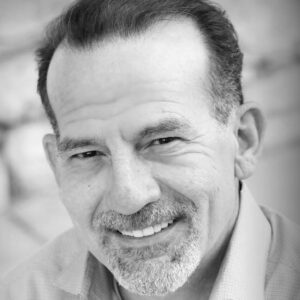 RAPID FIRE WITH CRAIG HARTLINE, MOVE OVER MRS. MARKHAM’S HENRY LODGE
JHPENTERTAINMENT: Who is Henry Lodge to you?
CRAIG HARTLINE: Henry Lodge to me is a bit of a spoiled little boy, pretending to be a man. He has had some success in the children’s book business, but he spends his time and money, pursuing women for his own pleasures. He’s a bit of a cad, lovable, but a cad.
JHPENTERTAINMENT: Henry is a children’s book publisher. If you were to write a children’s book, what would it be about?
CRAIG HARTLINE: Wow, that is a tough question. It would probably be about a puppy who grows up with two smart parents who try to teach him about the world around him. However, he is more interested in chasing butterflies and playing in mud puddles to listen. It’s only when he moves into the real world, that he discovers, he should have listened more. In the end, he finally achieves the life his parents wanted for him after remembering what lessons they tried to teach him.
JHPENTERTAINMENT: You were last seen onstage at Playhouse 615 in Sex Please, We’re Sixty, and now, just two months later, you’re back for your second production with the company. What is it about the company that brought you back so quickly?
CRAIG HARTLINE: I have thoroughly enjoyed working with Playhouse 615. The Board Members are determined to achieve what actors in Nashville and the surrounding counties have been looking for, a place where actors can stretch their wings, so to speak and build on their craft. The actors I have had the privilege to work with are hard working and dedicated to their craft. I look forward to the chance to come back and work again with this production company.
JHPENTERTAINMENT: As Henry Lodge, you have two leading ladies. Anne Street-Kavanagh plays Henry’s wife, Linda, while Em Genovese plays…um…how shall I put this?..NOT his wife, Miss Wilkinson. How much fun are you having sharing the stage with these two?
CRAIG HARTLINE: These two lovely ladies are a thrill to work with. Anne is a funny and talented lady who brings out the best in each and every role she is in. Her dedication to her craft inspires me to be better. Anne and I created a chemistry together in Sex Please, We’re Sixty, that brings a smile to my heart. I believe we bring the same chemistry on stage in Move Over, Mrs. Markham.
This is the first time I have worked with Em, but I surely hope it is not the last. She has been acting for many years, and despite her young age, she is a true professional. Her ability to understand the character, taking the words written on the page and bringing it to life, is a true testament to where I believe her career will go. If I were the audience, I would make a strong mental note of the name, Em Genovese, she well may be the next name you see on the “telly”.
JHPENTERTAINMENT: What is it about slamming doors and farcical comedy?
CRAIG HARTLINE: The action of slamming doors is a large part of the action in this comedy. The chaos of characters coming in and going out of each scene adds to the rapid fire action from the actors. The timing of those opening and slamming doors is crucial to the play. Without that action, the play would be rather tame and loose that rapid fire of lines between the actors.

RAPID FIRE WITH ERIC CRAWFORD, MOVE OVER MRS. MARKHAM’S PHILLIP MARKHAM
JHPENTERTAINMENT: What do we need to know about Phillip Markham?
ERIC CRAWFORD: Philip is the antithesis of farce. He would be totally appalled at the thought of being involved in any shenanigans.
JHPENTERTAINMENT: Move Over Mrs. Markham marks your Playhouse 615 debut. Was it the role or the company that prompted your interest in auditioning for the role of Phillip?…Or a combination of the two?
ERIC CRAWFORD: A bit of both. I’m in an online theatre group and a couple of folks had been in different productions and all had a blast. I’m new to this theatre company but Nashville is a pretty small acting community so I already knew a couple of folks that were auditioning and had done multiple performances with 615.
JHPENTERTAINMENT: The show is set in a posh top floor London flat, so let’s talk about accents and dialect. One of my pet peeves as a theatre reviewer is when the accents don’t ring true. Was a dialect coach brought in to assist the cast with honing their accents?
ERIC CRAWFORD: Yes, we were very fortunate to have a wonderful dialogue coach. A first for me. We had some online group and private coaching sessions. I like performing with accents, so a coach was a real treat.
JHPENTERTAINMENT: What is it about a farce that keeps audiences interested?
ERIC CRAWFORD: Two things. Never a dull moment and the unpredictability of where the wrong turns will lead you.
JHPENTERTAINMENT: Has there ever been an occurrence in your own life that you think might make for a good farcical comedy?
ERIC CRAWFORD: Well it started at birth…. I grew up thinking Lucy Ricardo had the right idea attitude towards life so I think all of the ironies of growing up in the Missouri boot-heel, getting a doctorate in genetics, and having a deep seated need to perform is somewhat farcical in itself.
 RAPID FIRE WITH LINDSEY PATRICK-WRIGHT, MOVE OVER MRS. MARKHAM’S JOANNA MARKHAM
JHPENTERTAINMENT: What is your favorite aspect of Joanna as a character?
LINDSEY PATRICK-WRIGHT: Joanna has been so much fun to play because she has truly been thrown into the madness of this evening through no fault of her own and she continues to just roll with the punches. I think Joanna is a genuinely caring person and wants the best for the people around her even when their behavior is less than admirable. Also, Joanna’s willingness to lie for her friends while being really lousy at it, has been a particularly juicy part of the role!
JHPENTERTAINMENT: Move Over Mrs. Markham is set in the late sixties/early seventies, which usually indicates some groovy fashions. Who’s the costumer for the show and do you have a favorite look, whether it be your own or that of a fellow cast mate?
LINDSEY PATRICK-WRIGHT: I think we were all so excited about costuming, we all just dove into finding costumes for our characters. Denese Evans helped us fill in any gaps for hard-to-find items. Since I spend most of the show in various stages of undress, I would have to say that Alistair’s (Jonathan Wilbur) suit is “really with it” as Joanna says in the show, so it is probably my favorite! I personally LOVE this time period and would say that at least half the set is made up of furniture and decor from my own home – including the Big Eye Girl painting in Joanna’s bedroom.
JHPENTERTAINMENT: I have a confession…I had never heard of this play before Joel told me it was coming to Playhouse 615, but I had heard of Ray Cooney, who, along with John Chapman wrote the script. Cooney having written nearly twenty plays including Run for Your Wife, which ran for many years on The West End. Were you familiar with the show before auditioning?
LINDSEY PATRICK-WRIGHT: No! Not at all! I was able to get my hands on a script before auditioning and I believe this is exactly what I said to Joel after reading it “This show is absolutely ridiculous. I love it!”
JHPENTERTAINMENT: Typical for farces, the laughs usually run the gamut from subtle to outlandish. I’d imagine rehearsals have been quite fun. Who’s the biggest cut-up among the cast?
LINDSEY PATRICK-WRIGHT: While we all have our moments of cutting up, I think that Eric Crawford and Craig Hartline, playing best buds Phillip and Henry respectively, cut up the most. They have been known to continue on, in character, after the scenes end doing their own two-man improv show for us. I think even Ray Cooney himself would admit their behind-the-scenes, in-character antics are hilarious. Everyone in this cast has such great comedic chops that we have had a blast during rehearsals.
JHPENTERTAINMENT: What is it about farces, and Move Over Mrs. Markham in particular that you think will appeal most to Playhouse 615 audiences?
LINDSEY PATRICK-WRIGHT: Having just come from acting in Playhouse 615’s last show The Shadow Box (a moving play about death, dying, and the stages of grief) this play is a very different kind of catharsis. Move Over Mrs. Markham, like other farces, is fast-paced, energetic and just pure FUN. I told my family and friends to BYOT (bring your own tissues) to this show, too, because if they are anything like me in rehearsals, they will be crying from laughing.
—————
Move Over Mrs. Markham opens Friday, August 4 at Playhouse 615 (11920 Lebanon Road, Mt. Juliet, TN 37122). The show runs through Sunday, August 20 with 7:30pm performances Fridays and Saturdays and Sunday matinees at 2:30pm. Tickets are $18. Call the Box Office at 615.319.7031 to reverse tickets or CLICK HERE to purchase them via the company’s Eventbrite page. Tickets may also be purchased in person at the theatre just prior to showtime.
Next up at Playhouse 615 is The Sugar Bean Sisters, running September 8-24. For more on these shows and to keep up with Playhouse 615, check out their website or find them on Facebook.
As always, if you wanna follow JHPEntertainment to find out who I’m chatting with for my next Rapid Fire Q&A, or for my take on the latest local and national theatre, music and movie offerings, find us at JHPEntertainment on Facebook, JHPEntertainment on Instagram and JHPEntertainment on Twitter.
Got an event or show we should know about, drop us a line at the Contact tab. Till then, #GoSeeTheShow!
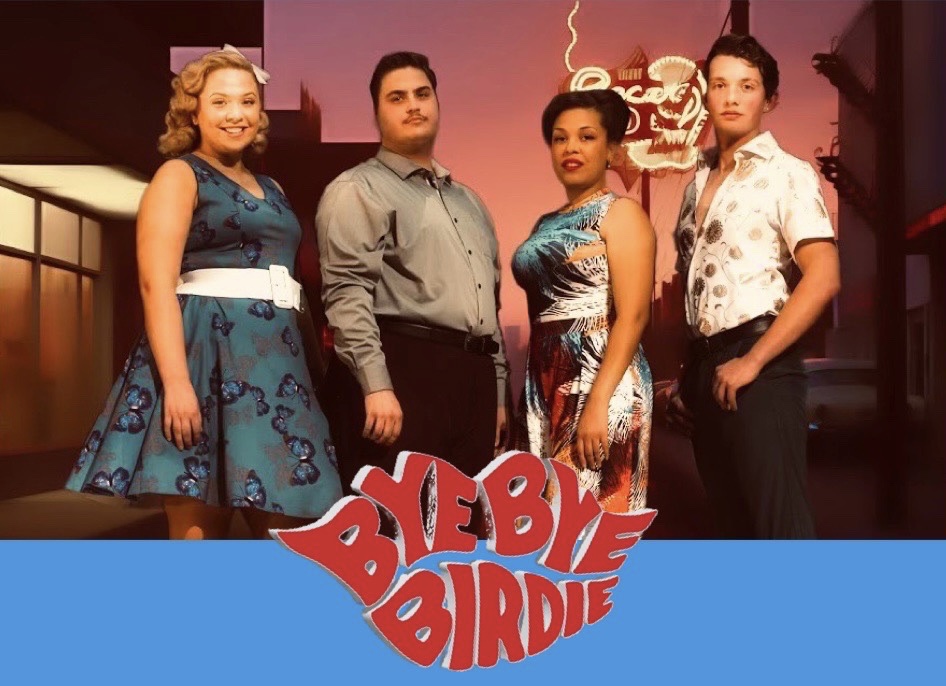
 RAPID FIRE WITH CAROLINE MONROE, KIM McAFEE IN BYE BYE BIRDIE
 RAPID FIRE WITH BAILEY DAUGHERTY, CONRAD BIRDIE IN BYE BYE BIRDIE
 RAPID FIRE WITH
  RAPID FIRE WITH LESLIE ROBERTS, ROSIE ALVAREZ IN BYE BYE BIRDIE
 RAPID FIRE Q&A WITH LAURIE VELDHEER, MARIA IN THE SOUND OF MUSIC
 RAPID FIRE Q&A WITH JOHN-MARK McGAHA, CAPTAIN von TRAPP IN THE SOUND OF MUSIC
 RAPID FIRE Q&A WITH JENNIFER WHITCOMB-OLIVA, SISTER BERTHE IN THE SOUND OF MUSIC
 RAPID FIRE Q&A WITH BRIAN CHARLES ROONEY, MAX DETWEILER IN THE SOUND OF MUSIC
 Further isolating Kevin, his parents are never seen in the play, and only his Mom’s voice is heard from off-stage from time to time. As the play begins, the audience gets their first glimpse at the show’s only set, the attic. Brilliantly created by Scenic Designer Anna Louizos with assistance from D. Craig M Napoliello, with lighting by Alessandra Docherty and assistant Isabella Gill-Gomez, the attic is easily recognized as both the family’s preferred storage area for seasonal decoration and Kevin’s former childhood playroom/teenage hangout. With pop culture relics from the far-distance 1980s, the attic set design is cleverly littered with things like a discarded GameBoy, an old Chineses Checkers boardgames and what appeared to be a single right Nike Air. But it’s the shrine to everyone’s favorite Country Music Songbird, Dolly Parton that’s most impressive…and I must admit relatable. I mean, switch all the Dolly posters, magazine pictures and photographs covering the walls for, say The Bionic Woman’s Lindsay Wagner, and you’d have my childhood bedroom.
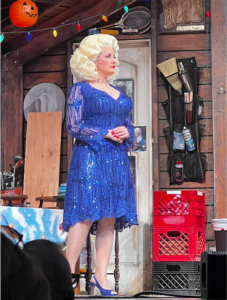 While most of the songs featured were written by Dolly, even the prolific singer/songwriter occasionally records tunes penned by others. Why’d You Come in Here Lookin Like That, Sing For the Common Man and the Dolly Parton/Kenny Rogers megahit, Islands in the Stream are all prefect placed and wonderfully sung. Interestingly, Islands, written by the Bee Gees, is followed by a funny, but very un-Dolly bit of snark courtesy Vilanch’s script.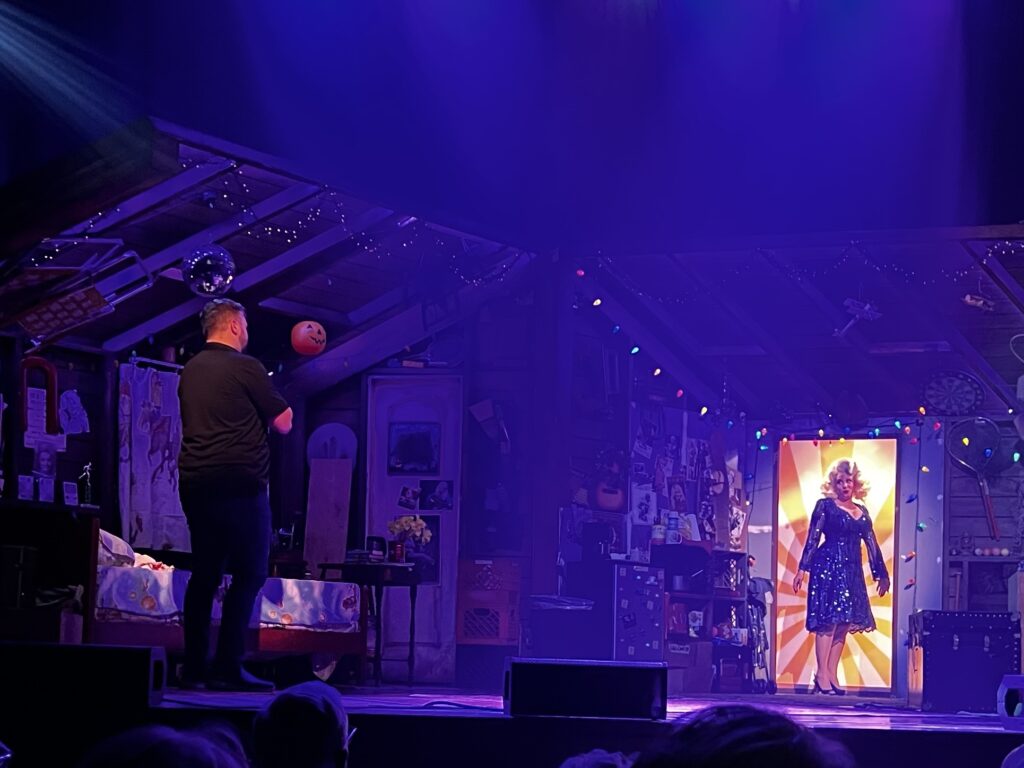

 RAPID FIRE Q&A WITH LISTEN TO YOUR MOTHER’s JOY TILLEY PERRYMAN
 RAPID FIRE Q&A WITH LISTEN TO YOUR MOTHER’s ROBIN WALLACE
 RAPID FIRE Q&A WITH LISTEN TO YOUR MOTHER’s TABITHA BOZEMAN
 RAPID FIRE Q&A WITH LISTEN TO YOUR MOTHER’s BILLY JENKINS
 RAPID FIRE Q&A WITH AMANDA DEL VALLE, EVITA in BALLET HISPÁNICO’s DOÑA PERÓN
 JHPENTERTAINMENT: Speaking of the creative team behind Doña Perón, costumer Mark Eric has created dozens of costumes for the show. Exactly how many costume changes do you have, and what are your favorite costumes among them?
 RAPID FIRE Q&A WITH CHRIS BLOOM, JUAN PERÓN in BALLET HISPÁNICO’s DOÑA PERÓN
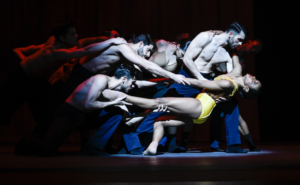 JHPENTERTAINMENT: For those who do get the chance to see Ballet Hispánico’s Doña Perón, whether via the PBS special, or live as the tour continues, what do you hope audiences take from the experience?
 RAPID FIRE WITH KINKY BOOTS DIRECTOR BRADLEY MOORE
  RAPID FIRE WITH KINKY BOOTS’ CHARLIE, NICK CULP
 JHPENTERTAINMENT: With words and music by legendary 80s Pop Goddess, Cyndi Lauper, Kinky Boots’ soundtrack is filled with such great music. Among my favorites…and not just because I’m talking to you…is Charlie’s Step One. Are there certain musical moments in the show, whether yours or someone else’s that just ‘get you’ every time?
 RAPID FIRE WITH KINKY BOOTS’ SIMON/LOLA, MICHAEL FARGAS
 JHPENTERTAINMENT: RuPaul famously says, “We’re all born naked and the rest is drag”. Do you agree? AND what’s a quote you, yourself reflect on from time to time?
 RAPID FIRE WITH KINNKY BOOTS’ LAUREN, TAYLOR KROOP
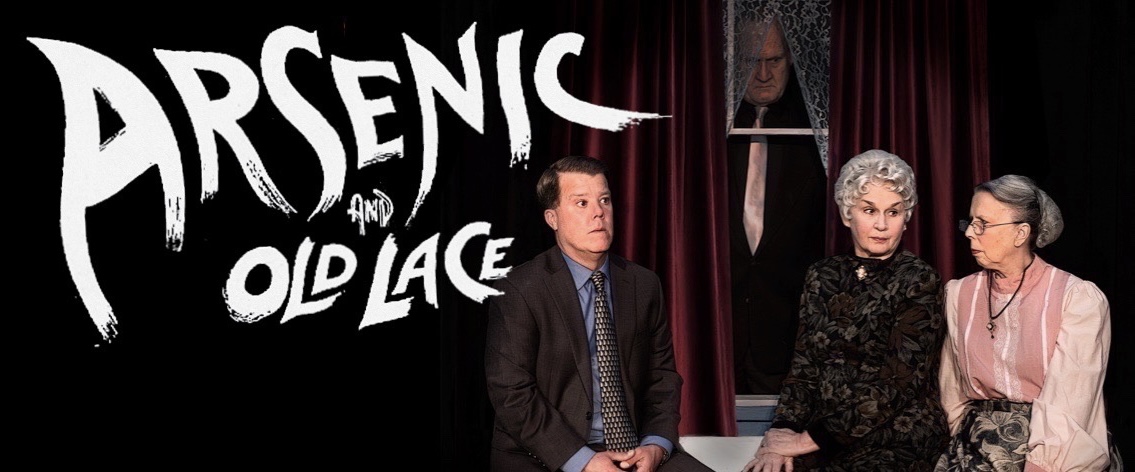
 RAPID FIRE WITH MATT SMITH, ARSENIC AND OLD LACE’s MORTIMER BREWSTER
 RAPID FIRE WITH LINDA SPEIR, ARSENIC AND OLD LACE’s ABBY BREWSTER
 RAPID FIRE WITH ADELE AKIN, ARSENIC AND OLD LACE’s MARTHA BREWSTER
 RAPID FIRE WITH BRAD MORGAN, ARSENIC AND OLD LACE’s TEDDY BREWSTER
 RAPID FIRE WITH THE CURIOUS INCIDENT’s NAT MCINTYRE
 RAPID FIRE WITH THE CURIOUS INCIDENT’s LAUREN BERST
 RAPID FIRE WITH THE CURIOUS INCIDENT’s ERIC D. PASTO-CROSBY
 RAPID FIRE WITH THE CURIOUS INCIDENT’s JR ROBLE

 RAPID FIRE WITH MATTHEW CARLTON, STANLEY SANDERS IN SMOKE ON THE MOUNTAIN
 RAPID FIRE WITH MEGAN MURPHY CHAMBERS,
  RAPID FIRE WITH DOUGLAS WATERBURY-TIEMAN, DENNIS SANDERS IN SMOKE ON THE MOUNTAIN
 RAPID FIRE WITH MELISSA SILENGO, JUNE SANDERS IN SMOKE ON THE MOUNTAIN