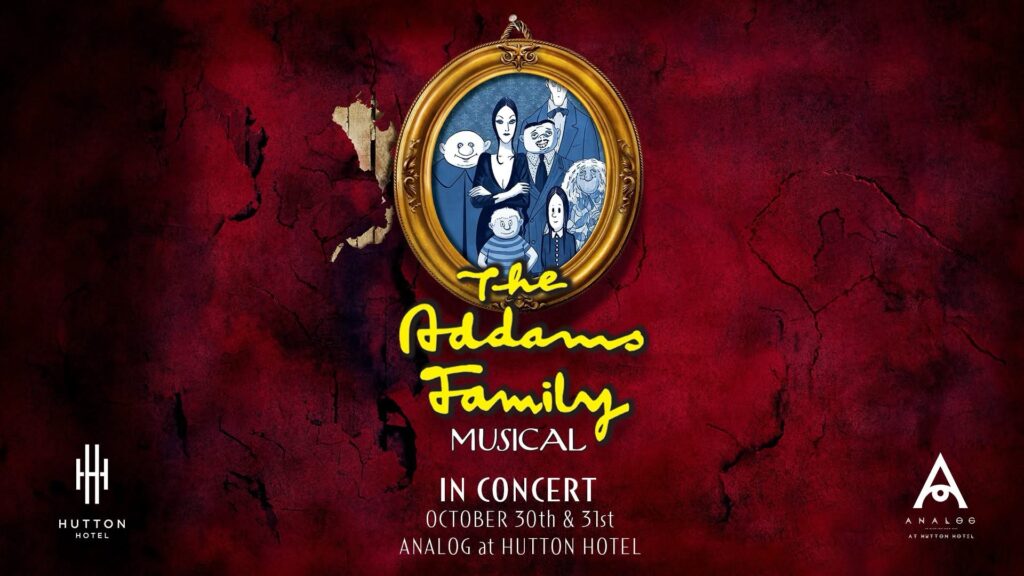
After six installments that have brought Broadway favorites, themed musical celebrations and a distinctly New York cabaret vibe to Nashville, Rachel Potter’s Off-Broadway at Analog at The Hutton marks its one-year anniversary with a production that puts a creepy, kooky, mysterious, spooky spin on the latest installment just in time for the Halloween holiday season. On Friday and Saturday, October 30 and 31, Analog at The Hutton transforms into an altogether ooky hunted mansion when the Addams family moves in — and they’re bringing the entire musical score with them.
The Addams Family Musical in Concert brings together an impressive collection of performers with ties to the beloved musical, including Sara Gettelfinger, who starred as Morticia Addams in the first National Tour; Premiere tour star, Brian Justin Crum, reprising his connection to Wednesday’s unlikely beloved, Lucas Beineke from his time with the National Tour; Andrew Metzger as Uncle Fester, having portrayed the quirky chrome-domed romantic a number of times; and Nashville-based performer Jeremy Parrish as Lurch. Joining them will be Off-Broadway at Analog‘s host/emcee and former Wednesday Addams, Rachel Potter; Brian Charles Rooney as Gomez and Nashville’s own Carrie Brewer as Grandma. Rounding out the primary cast will be Megan Murphy Chambers and Geoff Davin fresh from their roles as Alice and Mal Beineke, having just wrapped a hugely popular run at Studio Tenn. Adding another special dimension to the festivities, original composer and lyricist Andrew Lippa will be on hand for this two-night musical celebration.
Unlike the previous Off-Broadway installments, which have explored a variety of songs connected by a common theme, this time around Potter and company are taking audiences through the complete score of The Addams Family Musical, sung through from the opening number to the finale. And with Lippa in the room, there’s even the tantalizing possibility of a Halloween treat: performances of songs originally created for the show but cut from its Broadway run. Consider our curiosity officially piqued.
The series has quickly become a destination for musical theatre lovers seeking something beyond the traditional concert experience. With Broadway talent sharing the spotlight with Nashville’s extraordinary local performers, Off-Broadway at Analog at The Hutton has carved out its own little corner of Music City’s entertainment scene — one that feels equally at home in the intimate cabaret rooms of New York and the increasingly diverse theatrical landscape of Nashville.
For this special anniversary celebration, we caught up with four members of the Addams clan for our latest Rapid Fire 20Q. From Gettelfinger’s long history with Morticia and Crum’s return to a role from his original national tour days to Metzger’s ongoing love affair with Fester and Parrish’s thoughtful approach to the famously taciturn Lurch, these performers have plenty to say about revisiting the material, reconnecting with fellow Addams alumni, Halloween traditions and the enduring appeal of Andrew Lippa’s score.
So, put on your blackest attire, prepare to move toward the darkness and join us as we go Rapid Fire 20Q with Sara Gettelfinger, Brian Justin Crum, Andrew Metzger and Jeremy Parrish.
RAPID FIRE 20Q WITH CAST MEMBERS OF THE ADDAMS FAMILY IN CONCERT
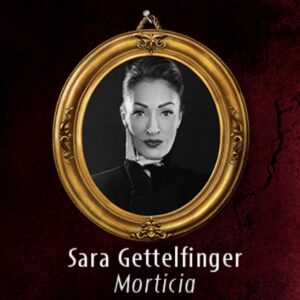
RAPID FIRE WITH THE ADDAMS FAMILY IN CONCERT‘s MORTICIA ADDAMS, SARA GETTELFINGER
JHPENTERTAINMENT: Morticia has been a part of your theatrical life for quite a while now — from the first National Tour in 2011 to Broadway at Music Circus in 2023 and, most recently–earlier this month–your three-day run with Sugar Loaf Arts Collective. What is it about slipping into that black dress and embracing your inner Addams that keeps calling you back to the family? And…was it an immediate YES when Rachel Potter reached out to invite you to be part of this concert event?
SARA GETTELFINGER: Growing up, I was always intrigued with the character of Morticia- Her look, her quick wit and deadpan humor, and her mysterious, “less is more” fabulousness. As far as the musical- I have always idolized Bebe and MANY of the roles she’s originated or played were on my bucket list, so it was an honor to get to carry that torch, but also have the opportunity to go back into the room with all of the original creatives, and make changes and develop new material for the tour, which would end up being the version that was licensed. There’s nothing I enjoy more than being able to create something new, but also inevitably draw from those who’ve inspired and shaped me as an artist, so in this case, I quite literally had the best of both worlds. Morticia is a role that allows one to be beautiful, smart, funny, and truly dance- so I’ll return to it whenever and for as long as I can.
JHPENTERTAINMENT: Morticia gets some of the show’s most deliciously dark musical moments, from “Just Around the Corner” to “Tango de Amor.” Is there a particular lyric that captures her philosophy on life, love and the occasional family dysfunction — and one you find yourself enjoying a little more with every return?
SARA GETTELFINGER: It’s interesting because in “Just Around the Corner”, even though the lyric describes how much she is looking forward to “Death”, the song, along with so many of the others in the show, is really about making the most of the time we have and existing as one’s most fearless and authentic self. “When You’re an Addams,” “Secrets,” “Live Before We Die,” “Move Toward the Darkness,” and really the overall message of the show, are about the importance of embracing and celebrating who and ALL that you are, regardless of what others may think, and the beauty and power that comes with acceptance, love and forgiveness of oneself and for others.
I was going through an incredibly difficult time on that first tour, and by the end was at probably one of the lowest and unhealthiest points of my life. So in the years since, to have not only been fortunate enough to survive and still be here, but manage to come back stronger than ever, and be given the gift of returning to the role, as well as setting the show multiple times, is something for which I will always be profoundly grateful, and becomes more meaningful every time: “Only at our lowest, can we rise above…Move toward the darkness and love…”
JHPENTERTAINMENT: Here’s a reunion worthy of an Addams family portrait: you’re getting ready to share the stage again with Brian Justin Crum, who played Lucas during your time as Morticia on the original National Tour. What memories from that first tour are you bringing with you into this Halloween homecoming?
SARA GETTELFINGER: It’s funny because while Lucas is the subject of several scenes between Gomez and Morticia and she is very concerned about him as far as her daughter’s future, the 2 characters actually have very little direct interaction in the show. But Brian was always fabulous onstage- Beautiful, funny, with the most spectacular voice, and the chemistry he shared with Cortney Wolfson, who played Wednesday, was just wonderful.
JHPENTERTAINMENT: Do you have a favorite Halloween tradition, a memorable costume from childhood, or a spooky-season ritual that would earn Morticia’s enthusiastic approval?
SARA GETTELFINGER: Over the years, depending on where I was living, I used to love setting up a pretty elaborate “Haunted Cemetery” in the front yard. Headstones spattered with blood or spiders and cobwebs, with funny names and “HERE LIES” descriptions, along with scattered bones and in a few spots dug holes and partially buried and posed skeletons so it looked like they were trying to escape their graves.
I also watch Disney’s Original Legend of Sleepy Hollow and Something Wicked this Way Comes every year- those old school movies from the late 70’s/early 80’s were AMAZING and there was ZERO concern about potential nightmares or traumatizing kids LOL!
JHPENTERTAINMENT: You’ve inhabited Morticia in full productions, but this concert puts the music and lyrics front and center, with original composer and lyricist Andrew Lippa joining the festivities. What intrigues you most about revisiting the score in this stripped-back format, and what does it mean to have one of the show’s original creative minds on hand for this special occasion?
SARA GETTELFINGER: As I mentioned earlier, because we were lucky enough to go back into the room with the creative team in revising and preparing for the tour, I’ve known Andrew for over 15 years now, and he is as equally brilliant and wonderful a friend and human being as he is an artist, and I cannot WAIT to see and get to revisit this material with him. And again, regarding the music and lyrics, the show and its message, both professionally and personally, becomes more and more meaningful and resonates more deeply with me in every opportunity that I’m lucky enough to have had to revisit it, and with every year I’m lucky enough to still be living 😉🖤
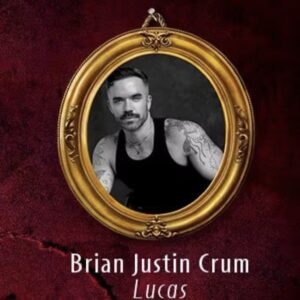
RAPID FIRE WITH THE ADDAMS FAMILY IN CONCERT‘s LUCAS BEINEKE, BRIAN JUSTIN CRUM
JHPENTERTAINMENT: You were part of the original National Tour of The Addams Family as Lucas Beineke, the supposedly normal young man who falls head over heels for Wednesday Addams. Returning to the show all these years later, what memories of that original adventure have stuck with you — and given your life and career post-Addams, do you still relate to Lucas’s earnest attempts to fit into a family that makes normal look positively terrifying?
BRIAN JUSTIN CRUM: My time with Addams Family was so special. I made lifelong friends that I’m still in touch with today.
Playing Lucas was always a bit of a challenge for me in that, I’m much more of a Wednesday. I had a hard time connecting with that earnest good boy trait. That’s what’s fun about musical theatre we get to drop ourselves into these characters that are so unlike us and find ourselves in them.
JHPENTERTAINMENT: Lucas gets to unleash his inner wild man in “Crazier Than You,” a number that takes youthful rebellion and romantic commitment to wonderfully unhinged extremes. I understand that while you and Rachel Potter never crossed paths onstage as Lucas and Wednesday, the two of you first met in your early New York days occasionally performing in the same concerts in the city. How much convincing did Rachel have to do to get you to come to Nashville to be part of The Addams Family In Concert?
BRIAN JUSTIN CRUM: I actually remember when Rachel got cast! I was doing Next to Normal on Broadway at the time and she and I had become friendly doing things around NYC. I went and saw her in the show and visited with her in her dressing room after. It was so exciting! We’ve both gone on to make our music and made careers as solo artists. When she asked me to do this, it was a no-brainer! We never got to do it together – this is a full circle moment for us both!
JHPENTERTAINMENT: Speaking of reunions: you’re returning to The Addams Family with Sara Gettelfinger, your original touring Morticia. Before you even had a chance to rehearse together, what excited you most about reconnecting after all these years, and what do you remember most fondly about sharing the road with her?
BRIAN JUSTIN CRUM: Sara is a such a special performer and kind soul. Life has been crazy since then and so many ups and downs and we lost touch after the tour. I’m thrilled to see her and have her back on the Broadway stage where she belongs!
She perfectly captures Morticia and I’m excited to see what she does with it now after so many years!
JHPENTERTAINMENT: We’re talking Halloween Eve and Halloween night, so let’s get personal. When you were a kid, were you the spooky, spooky-adjacent or decidedly unscary costume type? What’s your all-time favorite Halloween costume you’ve worn, and is there a fictional character you’d still love to dress up as?
BRIAN JUSTIN CRUM: I’ve always been a “let’s see what I can pull off at the last second” kind of Halloween costume guy. During Covid I ordered a bunch of random stuff off Amazon and turned myself into a beautiful Merman! I like anything mythical and fabulous!
JHPENTERTAINMENT: With Andrew Lippa himself joining this concert, you’ll have the rare opportunity to perform a score in the presence of the person who created its music and lyrics. Does knowing he’ll be in the room change how you think about approaching Lucas this time around, and is there something about Lippa’s writing you’ve come to appreciate even more since your original tour?
BRIAN JUSTIN CRUM: I was always a huge Lippa fan. “Wild Party” was THE staple in my household as a kid learning to sing. I’m excited to see him and catch up!
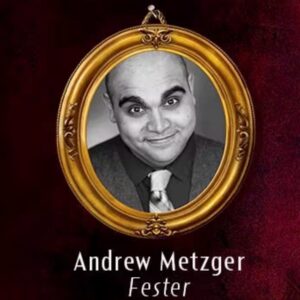 RAPID FIRE WITH THE ADDAMS FAMILY IN CONCERT‘s UNCLE FESTER, ANDREW METZGER
JHPENTERTAINMENT: You’ve been moonlighting as Uncle Fester since your 2017 community-theatre outing in Simi Valley, followed by the Welk Resort in 2019 and 5-Star Theatricals in 2022. That’s a pretty impressive résumé for a man whose romantic life revolves around the moon! What keeps drawing you back to Fester, and how has your relationship with this wonderfully eccentric character evolved over the years?
ANDREW METZGER: Uncle Fester fits like a glove for me, he’s such a fun character to play, and when Halloween time comes around I always enjoy the prospect of getting an opportunity to do it again. Actually, I was set to join the cast of the most recent national tour last year in the fall, as a replacement for the outgoing performer playing Fester towards the end of their itinerary, but unfortunately I was going through a complicated medical situation with my father and the passing of my mother, which forced me to have to bow out. As Fester, you get to be broad and wacky, but also have moments of warmth while trying to meet the expectations of that the audience has, as he’s truly such an iconic character that has been portrayed in so many mediums but such legendary performers (and heroes of mine) such as Christopher Lloyd, Kevin Chamberlain, and of course Jackie Coogan. I’ve always thought that it was such a great idea to make Fester the narrator of the show, kind of a “gateway” for the audience to travel into the Addams Family world, as he is able to be irreverent but charming at the same time, as he basically declares that at the center of the creepy and kooky show, we’re going to see a tale about love (“Let’s not talk about anything else, but love!”). Plus, breaking the fourth wall is always such a guilty pleasure of mine. It’s been such a joy to get to revisit this role and this show, while trying to find ways to bring something new to each outing.
JHPENTERTAINMENT: “The Moon and Me” is Fester’s big, heartfelt declaration of love to a celestial body that never has to meet the family. What do you love about that number, and how do you strike the balance between playing the comedy of Fester’s obsession and letting the audience feel the genuine romance underneath it all?
ANDREW METZGER: That song is such a rollercoaster. You absolutely have to play into the absurdity, while also treating it as a genuine love ballad. First you start off with this lovely little intimate and charming introduction, and it transforms into this abstract and bombastic proclamation of his love for the literal moon, which usually takes on a personality of itself in the number depending on how it’s staged. Which speaking of staging, it really can be the trickiest and most technically challenging moment in the show, as you have so many moving pieces! The stage is usually almost completely dark, with very specific lighting, as you wear a bodysuit with puppet legs attached with the puppeteers behind you as you climb up stairs on wheels (in the dark!) to simulate flying through the stars…and yet it’s such a blast! It can also be a challenge vocally, as you need to stay true to Fester’s clenched-throat character voice that the audience has become familiar with, but also make sure to hit the notes that show off Andrew Lippa’s brilliant writing. I absolutely adore it.
JHPENTERTAINMENT: You’ve performed Fester in several full productions, but this time you’re diving into the show in concert with barely a rehearsal before the curtain goes up. What are you most excited to revisit about Fester, and how does having played him across several productions shape your anticipation for this latest outing?
ANDREW METZGER: With each opportunity, I like to think I’ve brought something new that I’ve gained from my experiences as a performer (and as a person) each time I slip into the brown coat. I’ve also had the chance to perform with so many lovely talented artists both on the stage and behind the scenes, with some of my closest friendships having started from being in this show. In the last production I did with 5-Star Theatricals, I got to work alongside Teri Hatcher as Morticia (she just made her debut on the West End!) who was such a pleasure to work with, and that will always be a such a special moment for me in my career. Honestly, I’m just so honored to be joining fellow Addams “alumni” who have been a part of this show’s journey, it’s daunting but exciting to share the stage with these folks who’s resumes are so impressive. I mean obviously there’s Rachel Potter, who made her own impact on the character of Wednesday that has trickled into the DNA of the show over the years since she played it on Broadway, and she’s at the helm of putting together what will be such an amazing tribute to this show.
JHPENTERTAINMENT: Fester has a gift for finding beauty where other people might see something a little… unusual. In honor of Halloween, what’s your favorite spooky-season tradition or childhood costume memory? And if you could invite any Addams Family character to your Halloween party, who would make the guest list — and who would absolutely have to leave early?
ANDREW METZGER: Honestly, one of my favorite memories as a child was when my dad helped me make my idea a reality to transform our garage into a full pirate cave with skeletons and treasure piles and a fog machine…all just to pass out candy to families walking by! It’s one of those examples of my father’s love and support for me, and I’ll always hold onto that. Currently, my Halloween tradition involves watching movies with my fiancé, stuffing our faces with pizza and candy, and putting our dog in a costume he hates having on. If I was going to invite some of the Addams clan over…I’d definitely want to invite Cousin It, he seems like a fun guy. As far as I’d ask to leave early…probably Grandma, as she…has a tendency to leave a mess behind (if you’ve seen the show you understand!).
JHPENTERTAINMENT: Having Andrew Lippa in the room for this concert must be a special prospect for someone who’s spent so much time living inside Fester’s world. What are you most looking forward to about performing his work with him present, and is there anything about Lippa’s music or lyrics that has taken on a different meaning for you over the years?
ANDREW METZGER: Oh I’m just hoping he enjoys my interpretation of the character. He’s literally a living icon of the musical theatre world, and it’s daunting to even think I’ll be singing his work with him next to us on stage. It’s also such a testament to his talent that each character brings their own unique flavor and identity, such as Wednesday being more pop-rock while Gomez has the fun Spanish flair, but somehow he melds it all together without the audience even questioning it. Fester lives more in a classic Vaudeville-sound for most of the show, but when we get to “Moon and Me”, it’s such a gift because as a broad character performer, you get to show off your more affectionate side with such a lovely melody, evoking a Jim Henson-like vibe while also being wonderfully haunting towards the end (with almost a nostalgic 90’s movie score sound). It’s seemingly completely insane that he’s in love with the moon, but through Lippa’s lyrics, the audience sees how genuine that love really is, as it’s not defined by what is considered “normal,” which as I’ve come to learn, is a wonderful representation of what the show is essentially about.
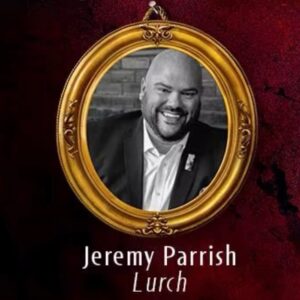 RAPID FIRE WITH THE ADDAMS FAMILY IN CONCERT‘s LURCH, JEREMY PARRISH
JHPENTERTAINMENT: Lurch is a man of few words, but when he does speak — or sing — the entire room tends to pay attention. How do you approach creating a character whose presence, timing and physicality can say so much without saying very much at all? And is playing the silent, towering butler secretly liberating for someone who doesn’t have to memorize pages of dialogue?
JEREMY PARRISH: I think that having the opportunity to create a “silent” character like Lurch is truly unique one. I feel like Lurch is almost like the Greek chorus of the story. While he is physically involved in the in-the-moment action; his facial reactions, comically timed non-verbal or unintelligible reactions, and ultimate musical outburst are often saying the unspoken subtext of a scene. He is often the first one in on the joke, the silent voice of reason, and ultimately delivers one of the core messages of love and togetherness in the show. It’s a unique challenge because when you have pages of text, your answers are there… you just shape them with your own choices as an actor. With a character like Lurch, it all has to be developed with nuance, a strong backstory, and physical choices. It’s a huge and fascinating challenge as an actor! I think that’s why he ultimately breaks into song… he just HAS to get the core message out that everyone else has been dancing, or tangoing, around.
JHPENTERTAINMENT: Both currently being Nashvillians, You and Rachel Potter have previously worked together at a few events around town. How did she talk you into stepping on stage as Lurch for this two-night in concert performance?
JEREMY PARRISH: Rachel and I have done a few concert versions of shows around Nashville over the years after we both relocated here from NYC, so it didn’t take much convincing to rejoin her for the Addams Family. I was in callbacks for the original Broadway production a few times, and I had several friends in the original company; so, getting the chance to perform in Nashville with this unbelievable collection of talents was an incredible opportunity. I have also been obsessed with Andrew Lippa as a composer since my Belmont days when I basically wore his version of the WILD PARTY out. So, to get to perform in one of his shows with him present… with this company… this felt like a Nashville full-circle moment! I may have hung up my proverbial tap shoes in pursuit of theater being my sole career… but once an actor, always an actor. So when the subject came up I, of course, agreed to join with a ready grunt!
JHPENTERTAINMENT: Your day job as a Lux Spirits portfolio consultant with Gallo gives you a rather different set of ingredients to work with than a typical actor. So, let’s put that expertise to the test: if you were creating a Lurch-inspired cocktail, what would go into it, what would you call it, and would it be served shaken, stirred or with one very ominous “You rang?”
JEREMY PARRISH: Well, I feel like Lurch’s gin martini game is strong behind the bar for sure. Something tells me that the Addams’ like a stiff drink! Am I wrong? But for Lurch to BE the cocktail? I think that I’d go with a riff on Ramos Gin Fizz meets a tequila sour, that perhaps Lurch’s slow & steady approach to movement gives the time for the cocktail to be well crafted and deliciously foamy. I’d use Don Fulano Añejo tequila, something naturally crafted & dry with a good bit of age and baking spice, in an egg white Sour, cut with a bit of soda water and shaken with fresh citrus and a wine-based amaro, like Lo-Fi Gentian Amaro that uses hibiscus or Amaro Pasubio that uses blueberry. Served as a highball to honor Lurch’s classic height; it would be deep in color, with a thick foam cap, garnished with lime and a nice drippy brandied cherry skewer for a touch of the macabre and a nod to Lurch’s frequent fencing spars with Gomez. The Lurch Fizz is a bit like the butler himself, tall, strong, mysterious… and requires a bit of patience but is, deep down, a delight!
JHPENTERTAINMENT: Hmmm. Wonder what happens when I order a Lurch Fizz at Analog this weekend? Ok, so, Halloween Eve and Halloween night seem tailor-made for an Addams Family celebration. What’s your favorite Halloween tradition or childhood costume memory? And if you could raid the Addams Family wardrobe for one costume to wear to a party, would you go full Lurch, or is there another member of the family whose look you’d love to borrow?
JEREMY PARRISH: Some of my favorite Halloween memories were from a few years in NYC when I was waiting tables and bartending between shows. The staff would collaborate, and all of our costumes would piece together to tell a story, and we’d end up creating scenes throughout the night with customers. It was fun and gave us all an idea to build a costume. From the Addams’, Gomez for sure! Stylish facial hair and a beautiful, well-cut suit… not to mention a fencing foil for panache!
JHPENTERTAINMENT: The Addams Family Musical in Concert marks the one-year anniversary of Rachel Potter’s Off-Broadway at Analog at The Hutton. In addition to Broadway stars, Rachel has once again tapped into the local Music City talent pool to round out the cast. Of previous installments in this continuing residency, I’ve compared the events to New York’s 54 Below and Jim Caruso’s Cast Party at Birdland. As a Nashville resident, and as someone in the food and beverage industry, how lucky is Music City to have Rachel and Off-Broadway at Analog at The Hutton?
JEREMY PARRISH: I am consistently amazed by the talent that exists in Nashville. I am grateful that Rachel uses her vision and reach to create opportunities to show that Nashville is more than just a hub for country music. There are incredible, multi-talented performers in Music City that can mingle seamlessly with NY talent if given the opportunity, and she’s doing just that. I also am in awe of the immensely talented folks that seem all too ready to grace the stages in Nashville as well. I also love that Rachel continues to advocate for musical theater’s place here in Nashville… to bring “Broadway” to audiences that are chock-full of folks who love the genre, and people who are experiencing it in a new, more approachable way and I’m so grateful that she is. Even in NYC; cabaret and concert venues, like 54 Below & Birdland, give stage performers an opportunity to be more intimate, approachable… to show their individuality and creativity in a way not strictly dictated by a script. Shows like what Rachel and Analog are doing with the Off-Broadway series bring audiences in for a bespoke experience, but it also gives interested bartenders an opportunity to create unique experiential cocktails. And the old “2 drink minimum” is a staple for cabaret, so that helps those of us in the bar world for sure! I only hope to be able to continue to be involved… both working with Analog in the cocktail world, as well as with Rachel onstage!
For those hoping to spend Halloween with The Addams Family, there’s a little urgency to the invitation. As of this Rapid Fire 20Q publication, the Friday, October 30 first night of this two-night event is already SOLD OUT, with limited tickets remaining for Halloween night, Saturday, October 31.
Presented as part of Rachel Potter’s continuing Off-Broadway at The Hutton residency, The Addams Family Musical in Concert takes place at Analog at The Hutton (1808 West End Avenue, 2nd Floor Nashville, TN 37203). Standing Room General Admission tickets are $35. Reserved Seating is $60. VIP Upgrade of $75 (valid only with purchase of Standing Room GA or Reserved tix) includes pre-show lounge with meet and greet. Premium VIP Seating for $150 adds front row seating to the VIP Upgrade. CLICK HERE to purchase tickets. Pre-Show VIP perks begin at 6pm before general admission or regular reserved attendees arrive.
With the complete musical score performed from beginning to end, familiar Addams Family favorites, Broadway & Music City talent and Andrew Lippa himself in attendance, this promises to be a particularly memorable Halloween gathering. And if those rumored songs that never made it into the Broadway production do make an appearance? Well, that would be the sort of treat that even Wednesday might crack a smile over. And remember, when you’re an Addams, you do what Addams do or die. Happy Halloween!
To keep up with all happenings at Analog at The Hutton, CLICK HERE or follow them on Facebook and Insta.
As always, if you wanna follow JHPEntertainment to find out who I’m chatting with for my next Rapid Fire Q&A, or for my take on the latest local and national theatre, music and movie offerings, visit JHPENTERTAINMENT.com or find us on Facebook, Insta and X. In the meantime… #GoSeeTheShow!
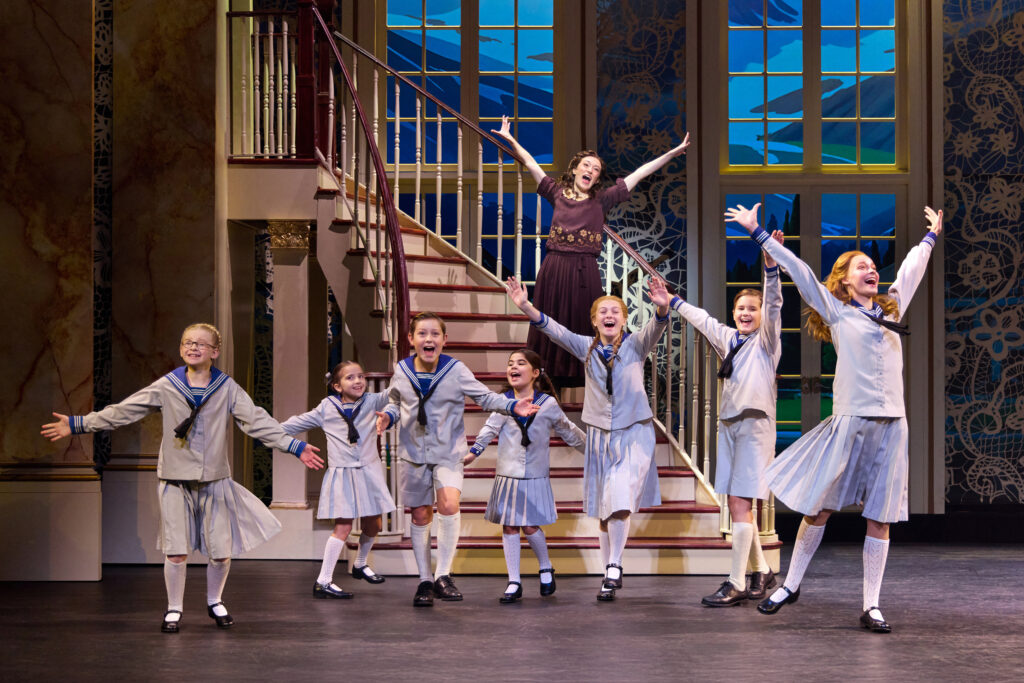
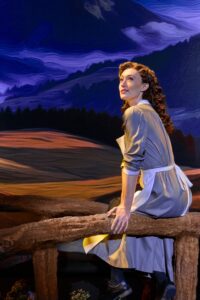 At the center of it all is Cayleigh Capaldi as Maria, the spirited postulant whose restless nature and love of music make her a less-than-perfect fit for convent life. Perhaps looking more like our ideal of Beauty and the Beast‘s Belle than the embedded Julie Andrews image many have of Maria Rainer, Capaldi brings an appealing freshness to the role, capturing Maria’s exuberance, vulnerability and determination without turning her into a one-note bundle of sunshine. Her vocals are lovely. More than lovely, she approaches the beloved tunes with vitality and she handles the score’s familiar melodies with warmth and clarity, Immediately making Maria her own. Whether she’s introducing the von Trapp children to the joys of singing or discovering that her own heart has plans she never anticipated, Capaldi makes Maria’s journey feel sincere and relatable. There’s a reason this character has enchanted generations of theatergoers, and Capaldi gives us plenty of reasons to fall for her all over again.
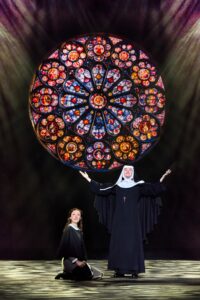 Then there’s Lisa Howard as the Mother Abbess. Having only recently joined the tour last month, Howard brings a commanding presence and goosebump-inducingly beautiful vocal power to the role. Howard understands that the Abbess is more than a wise spiritual guide who appears to dispense a bit of well-timed advice. She is a woman who recognizes Maria’s gifts and knows that a life of faith sometimes requires trusting the path that leads beyond the convent walls. Howard’s “Climb Ev’ry Mountain” is a stirring showcase, delivered with the kind of soaring, full-bodied vocals that make you want to sit back and let the music wash over you. It’s one of those numbers that reminds you why hearing a great musical performed live is an experience no movie soundtrack can quite duplicate. I have a confession for the Mother Abbess. Listening and watching her command that stage…and the audience in one of the show’s more personal moments, I was awash with emotion, so much so that my “eyes began to sweat”.
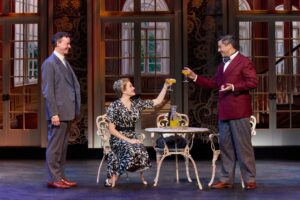 As Elsa Schraeder, Kate Loprest brings welcome dimension to the Baroness, Georg’s sophisticated, gorgeous and wealthy romantic interest. In the hands of lesser talent, Elsa could easily be played as the obstacle standing between the captain and Maria, but Loprest gives her intelligence, polish and a very human understanding of what she wants from life. There’s a believable charm to her performance, and she makes Elsa more than a convenient plot device. Nicholas Rodriguez is also a delight as Max Detweiler, the charming, opportunistic family friend whose wit and social savvy provide some welcome comic relief. Rodriguez gives Max plenty of personality, balancing his playful nature with an awareness of the increasingly dangerous political climate surrounding them. Perhaps it’s my own observation, but as presented this go-round, Max’s flamboyance is giving closeted, making his political leanings yet another layer. It’s also most hidng in plain sight or if you can’t be ’em, join ’em vibe. Still another mirror to today’s world and the ever-perplexing Log Cabin Republican.
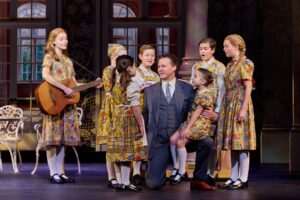 And what would The Sound of Music be without the rest of the von Trapplings? (YES, I completely stole that moniker from my recent chat with Earley who used it in reference to his young costars in my latest
 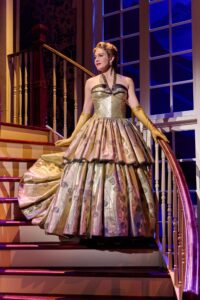 Even the use of projected backdrop imagery is woven into the scenery so seamlessly that it never feels like a technical shortcut; instead, it deepens the atmosphere and makes each setting feel wonderfully alive. One particularly beautiful touch comes inside the Abbey chapel, where shafts of smoky, ethereal light appear to stream through the stained-glass windows. The effect is so convincing and so naturally integrated into the scene that you could easily mistake it for actual light filtering through real glass rather than a carefully crafted theatrical illusion. It’s a lovely example of how the work happening behind the scenes can create a little stage magic without ever calling attention to itself. It’s also a testament to the advances in technical aspects made since the show debuted on stage more than 65 years ago, and how they are being used to bring this story to modern audiences. That’s not to downplay Natasha Katz’s actual lighting. Katz’s skilled traditional lighting effects, blended with the latest advances in tech add dimension and atmosphere, enhancing both the intimate moments and the production’s larger theatrical images, Jane Greenwood’s costumes help establish the characters and their world, from the formal elegance of the adults–I’m looking at you Baroness–to the practical, playful outfits that become part of Maria’s transformation of the children’s lives. Under O’Brien’s direction, the various elements work together to create a polished, engaging production that understands the importance of spectacle while never losing sight of the people at the center of the story.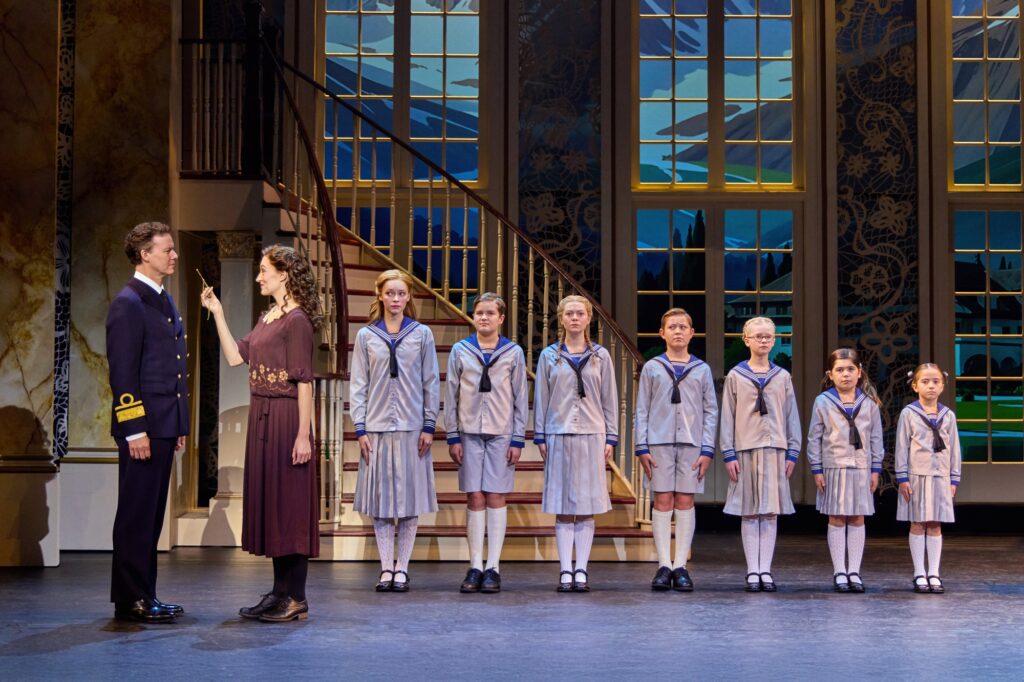
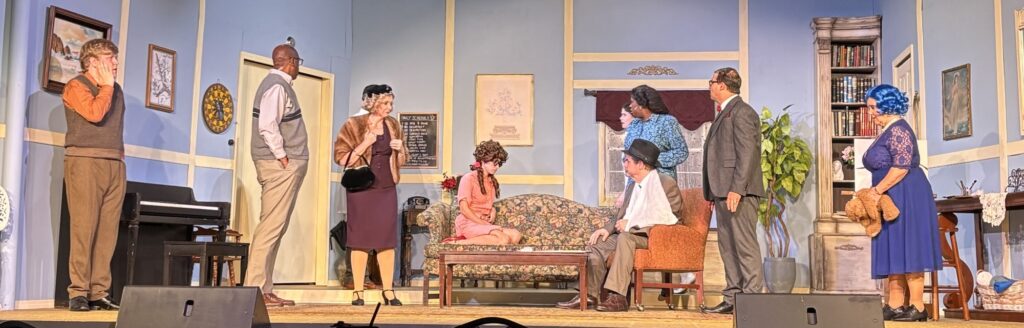
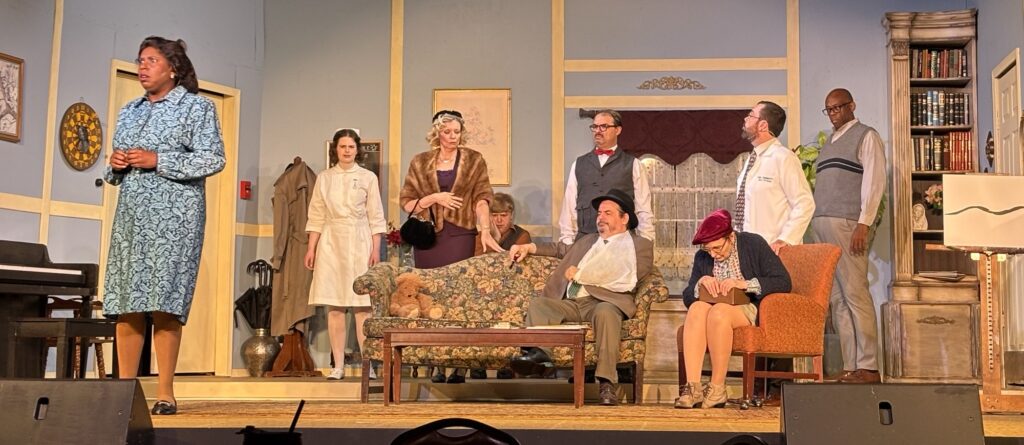
 Ann Street-Kavanagh’s Ethel Savage is, to borrow a phrase, a performance of “tenacious mediocrity unhampered by taste.” I kid, I kid. (See the show and you’ll get the joke.) Seriously, this might be Street-Kavanagh’s shining moment in local theatre. She seems to have been born to play Ethel Savage, balancing the character’s whimsical nature with a quiet determination that makes her impossible to dismiss. She is the heart of the production, and watching her navigate Ethel’s determination to live life on her own terms is a genuine pleasure. The night I attended, Street-Kavanagh’s mic pack slipped from her dress mid-scene. Without missing a beat, she simply grabbed it, held it in her hand, and finished the scene like a pro. It was an impressively unfussy bit of theatrical problem-solving that demonstrated exactly the kind of composure you want from a seasoned performer.
 Among the residents of The Cloisters, Brittany Mask brings gentleness and humanity to Florence, the grieving mother who carries a doll she believes to be her young son, John, lost to illness five years previous. In researching to chat with some of the cast for my recent Rapid Fire 20Q, I discovered that some recent productions have chosen to portray the child as presence throughout the play, but The Keeton’s presentation follows the original 1950 production’s approach, allowing the doll to represent Florence’s son as she understands him. It’s a choice that keeps the focus squarely on Florence’s emotional reality, and Mask handles the character with tenderness rather than turning her grief into a cheap laugh. Her performance brings an affecting humanity not only to Florence but to the play itself, reminding us that the residents’ eccentricities often have deeply personal roots.
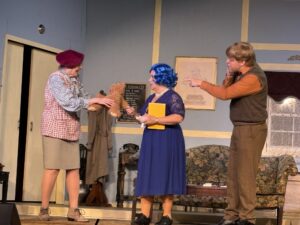 Riley Basner’s Jeffrey is notable for his perfectly presented shyness. An all-too-young war veteran carrying emotional scars, Jeffrey is a character whose reticence speaks volumes. Basner’s understated approach provides a welcome contrast to some of the production’s broader comic personalities, giving Jeffrey space to be vulnerable without pushing the sentiment too hard.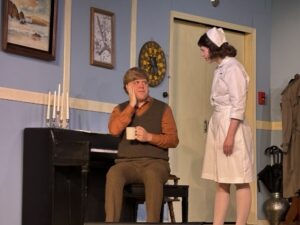
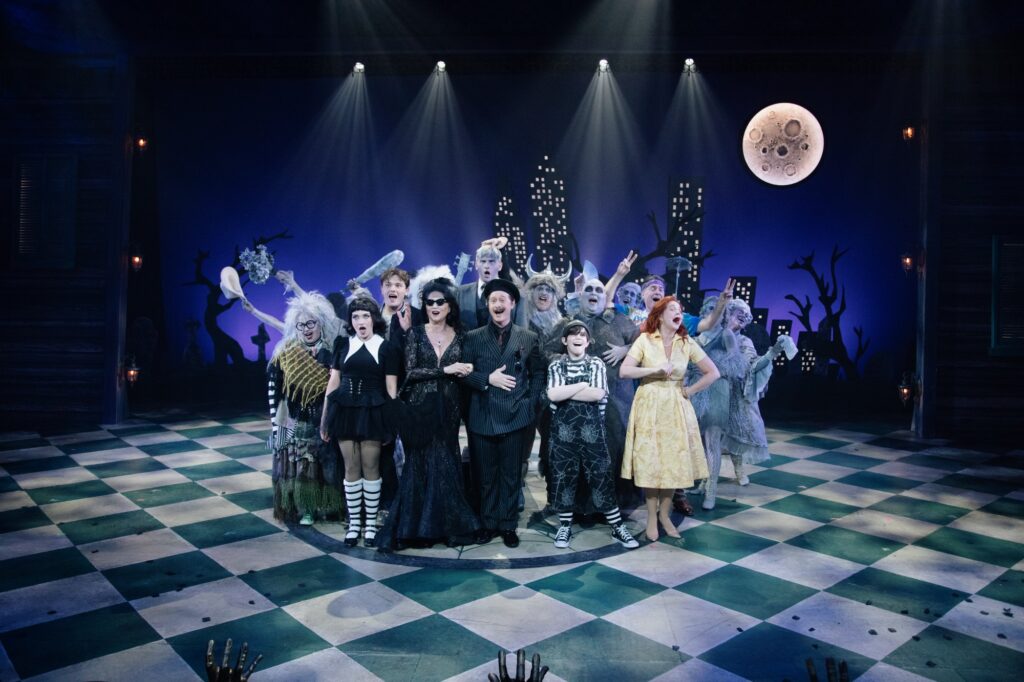
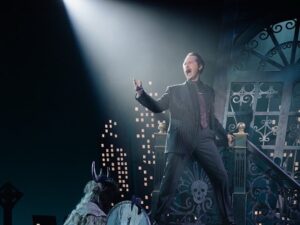 As Gomez Addams, Brian Michael Jones is the consummate master of ceremonies for this gloriously peculiar household. Familiar to Studio Tenn audiences, Jones marks his fourth production with the company, and his turn as the amorous, quick-witted patriarch is another welcome addition to that relationship. Gomez must balance his devotion to Morticia with his protective instincts as a father, all while navigating the family’s increasingly complicated affairs. Jones handles the character’s comic timing and romantic sincerity with ease, giving Gomez the charm and theatrical flair the role demands. He makes it clear that, beneath the pinstripes and the mischief, this is a man who adores his family—even when that family makes his life considerably more complicated.
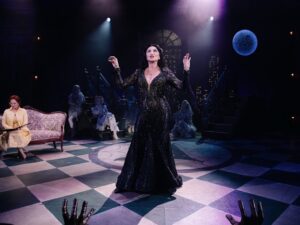 Sandra Allen’s Morticia Addams is a vision of dark glamour and commanding theatricality. Allen possesses a voice that is every bit as alluring as Morticia herself, and she uses it to glorious effect throughout the production. Her movement is equally impressive, particularly in “Tango de Amor,” where she brings the character’s sensuality and precision together in a number that practically sizzles. And then there’s that dress. Yes, that dress, cut down to Venezuela! It’s a jaw-dropping bit of costuming that would make even Morticia’s famously expressive eyebrows arch in approval. Allen understands that Morticia’s power lies in her composure, her wit, and her ability to command a room without appearing to exert the slightest effort. She is the very definition of dark elegance, with a vocal presence and physical confidence that make every entrance an occasion.
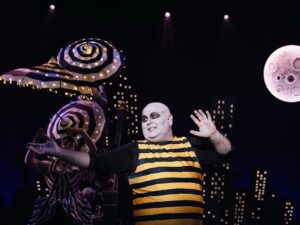 Jacob Waid’s Uncle Fester is an absolute delight, combining vocal strength, romantic exuberance, and an endearingly off-kilter sincerity that makes the character impossible not to love. Fester’s devotion to the moon is one of the musical’s most wonderfully ridiculous romantic conceits, and Waid embraces it with the enthusiasm of a man who has finally found his celestial soulmate. During “The Moon and Me,” he looks positively the bee’s knees in his swimsuit, an unexpected visual treat that only adds to the number’s goofy charm. But Waid’s performance is more than a collection of laughs and eccentricities. His commitment to Fester is evident in every detail, right down to the transformation required for the role. Usually quite hirsute, Waid has shaved his head AND his lumbersexual beard to become the bald, delightfully peculiar Fester. That’s dedication, folks! His performance once again backs up why he was named Best Stage Actor in Nashville Scene’s recently announced annual Best of issue. Between the vocals, the physical comedy, and the sheer joy he brings to the role, Waid makes a compelling case for the honor all over again.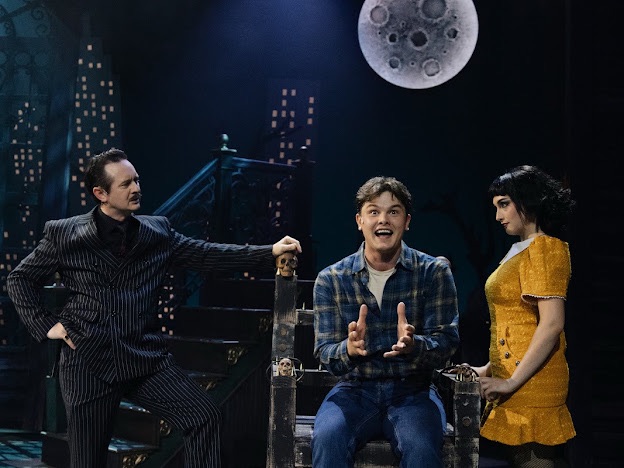
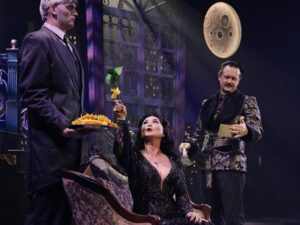 As Lurch, Scott Patrick Wilson breathes life—and a generous helping of heavy sighs—into the Addams family’s towering butler. Lurch is a character whose impact often depends on stillness, timing, and the occasional perfectly placed vocalization, and Wilson understands the assignment. His imposing presence and unhurried delivery provide a terrific counterpoint to the household’s more animated personalities. But don’t mistake his near-silent demeanor for a lack of theatrical contribution. Spoiler alert: Wilson is front and center in the show’s “Move Toward the Darkness” finale, proving that he’s not just a tall drink of Acrimonium. His contribution to the closing number is a particularly satisfying payoff for audiences who have watched this seemingly stoic servant hover in the background.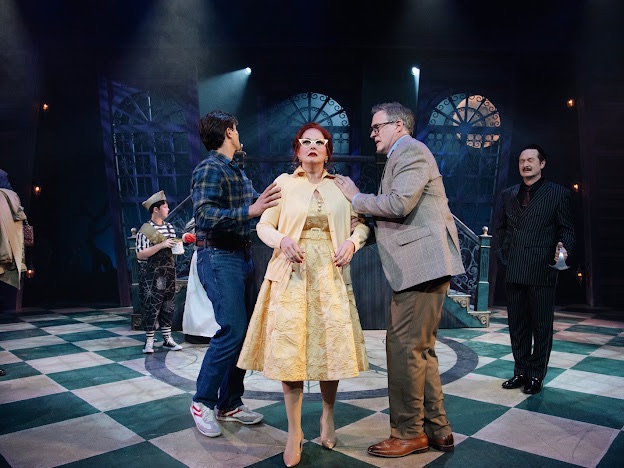
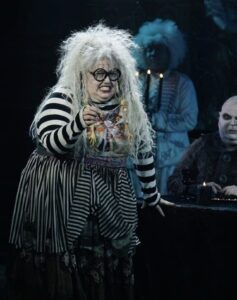
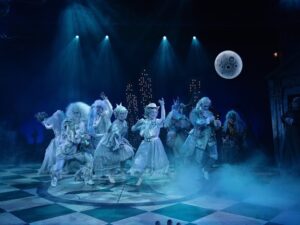 Rounding out the cast as the Addams Ancestors is a virtual who’s who of area up-and-comers and established favorites: Kelsey Brodeur, Maria Logan, Ryann Katherine Perkins, Meggan Utech, O’Neal Black, Alex Dee, Jonah M. Jackson, and Douglas Waterbury-Tieman. They provide the production with much of its visual richness and theatrical energy, helping establish the sense that the Addams family’s eccentricities stretch far beyond the living. The ancestors are more than atmospheric decoration; they contribute to the musical’s sense of tradition, history, and delightfully unconventional family values. Their collective presence gives the ensemble sequences added dimension and helps make the world of the show feel fully populated.
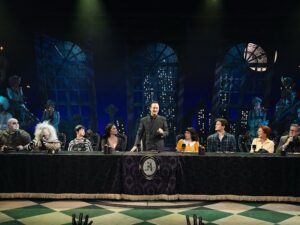 What impresses most about Studio Tenn’s THE ADDAMS FAMILY is the way it balances spectacle with character. The familiar black-and-white iconography, the dark humor, and the outrageous family dynamics are all present, but they’re supported by performances that understand the people beneath the eccentricities. Gomez and Morticia are devoted partners. Wednesday is a young woman discovering that love may be more complicated than she imagined. Lucas is a romantic caught between affection and bewilderment. Alice and Mal must confront the distance between the lives they present and the lives they actually lead. Even Pugsley’s desperate attempts to keep his sister close spring from a recognizably human fear of being left behind.
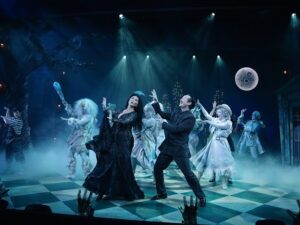 Studio Tenn’s THE ADDAMS FAMILY MUSICAL is a terrific showcase for a talented local company working at the top of its game. Cassidy’s assured direction, the cast’s spirited performances, the sumptuous costumes, the polished production values, and the score’s infectious theatricality combine to create an evening that feels every bit as ambitious and entertaining as the material deserves. From Allen’s show-stopping Morticia to Waid’s irresistible Fester, Jones’ winning Wednesday, and a supporting company that makes every corner of the Addams universe feel alive, this production delivers the goods.
 RAPID FIRE WITH THE SOUND OF MUSIC‘s CAPTAIN GEORG VON TRAPP, KEVIN EARLEY
  RAPID FIRE WITH THE SOUND OF MUSIC‘s ELSA SCHRAEDER, KATE LOPREST
 RAPID FIRE WITH
  RAPID FIRE WITH THE SOUND OF MUSIC‘s HERR ZELLER, DANIEL ROBERT SULLIVAN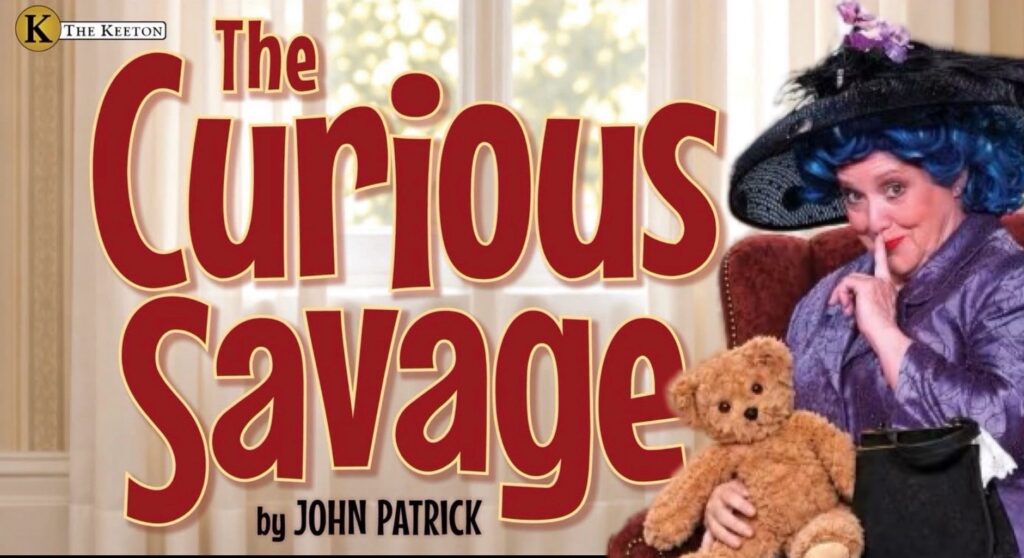


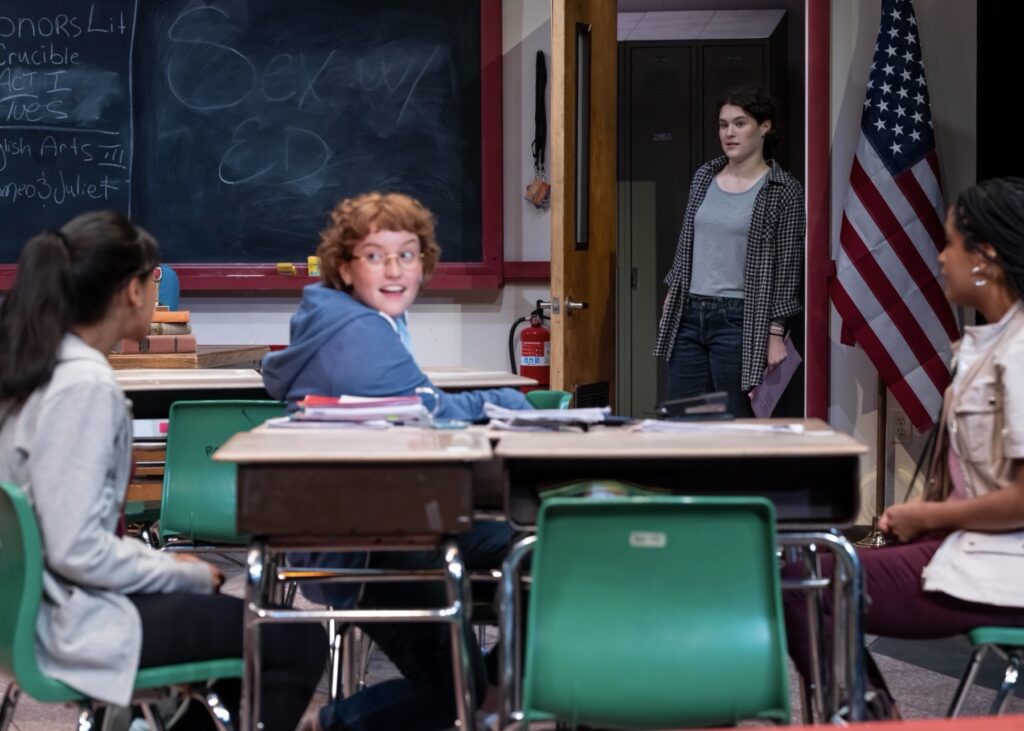
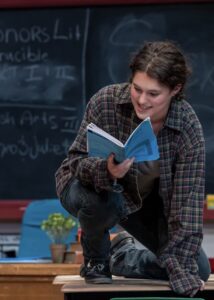 Norah Younger’s Shelby Holcomb might not be in the opening scene, but once onstage, immediately commands attention. Younger gives Shelby an appealing intelligence and quickness, but wisely show restraint and uncertainty. There is something more complicated happening underneath Shelby’s rapid-fire observations, and Younger gradually reveals those layers with an impressive combination of confidence and vulnerability.
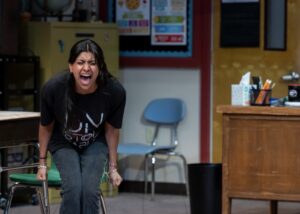 Advika Ravishankar’s Raelynn Nix is equally compelling. Ravishankar finds the humanity in a character who has spent much of her young life navigating expectations—expectations about who she should be, how she should behave and what her relationships should look like. Watching those assumptions begin to crack is one of the production’s more affecting journeys, and Ravishankar handles that evolution with considerable sensitivity. One of my personal favorite Raelynn moments comes early on in the play when she fires off a rapid succession monologue of exposition to catch up Nell, the newest student, she ends the fast-paced info dump with “and that’s what you missed on Glee”—taking a cue from the intro phrase from the iconic teen-driven TV series that always started each episode.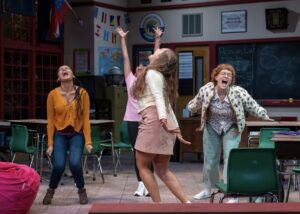
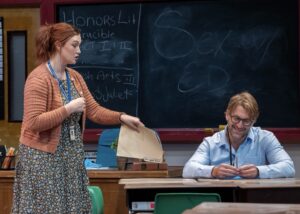 And then there are the adults of the piece Lucas Calhoun as Mr. Carter Smith and McKenna Steel as Ms Bailey. Lucas Calhoun’s Carter Smith, who finds just the right balance in the production’s adult male presence. As the English teacher and faculty advisor to the girls’ newly formed feminism club, Carter occupies an interesting position within the story. Calhoun doesn’t make him a conveniently enlightened adult who always knows exactly what to say. Instead, there is a humanity to his performance that allows Carter to listen, learn and occasionally realize that the most useful thing he can do is get out of the way. That makes Calhoun’s performance considerably more interesting—and considerably more believable. Calhoun’s Mr. Smith is the teacher we all remember from high school. Just a little older than the students, good looking, interested, but not hovering…again reference Glee, think Matthew Morrison as Mr. Will Schuester.
 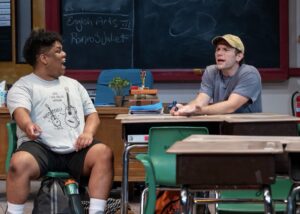 Rounding out the cast and reppin’ the boys, Lorenzo Rivera’s Mason Adams and Brent Bentley’s Lee Turner provide some of the production’s lighter moments without ever allowing their characters to become broad caricatures. In the hands of less skilled young actors, both roles could easily be stereotypes…Mason the jokester, Lee the cocksure jock, but as played by Rivera and Bentley, they reveal layers of uncertainty, self-doubt and eventual understanding, not only of themselves but of their female counterparts. Don’t get it twisted though, this play is about the young women. That said, it is an impressive company from top to bottom.
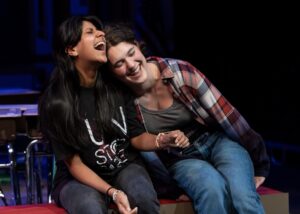 Because Belflower’s play is ultimately about authenticity. It’s about the difference between the story we’ve been handed and the story we experience ourselves. It’s about the danger of accepting a narrative simply because it has become familiar. It’s about the uncomfortable realization that the people we have been taught to admire may not always deserve our admiration—and that people we’ve been taught to dismiss may have considerably more to say than we ever bothered to hear.
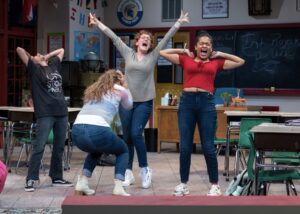 Belflower’s writing is smart enough to leave room for disagreement, while Shouse’s direction keeps that disagreement rooted in character rather than turning the production into a lecture. And that’s an important distinction. This isn’t a play telling an audience what to think. It’s a play encouraging an audience to think.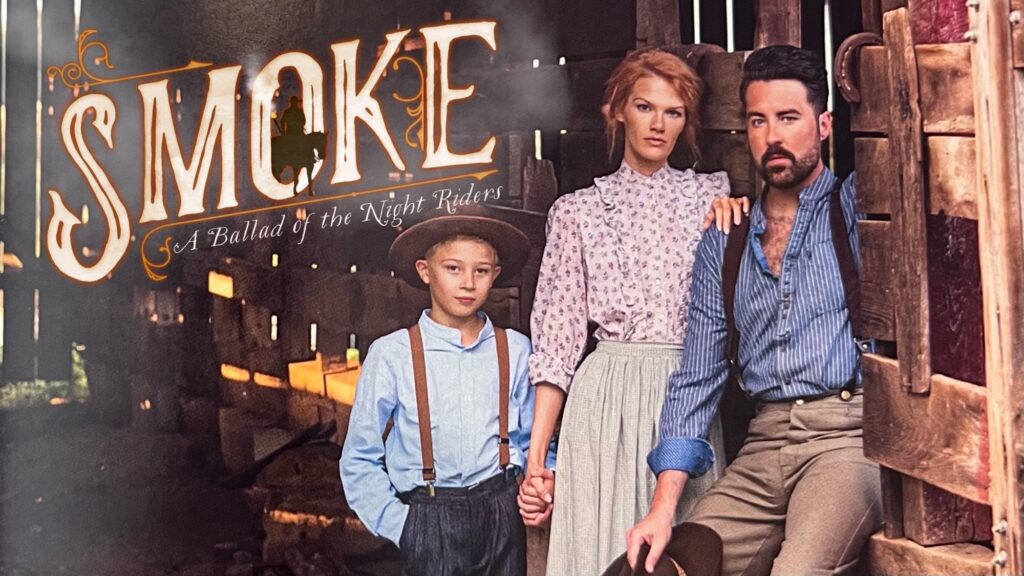
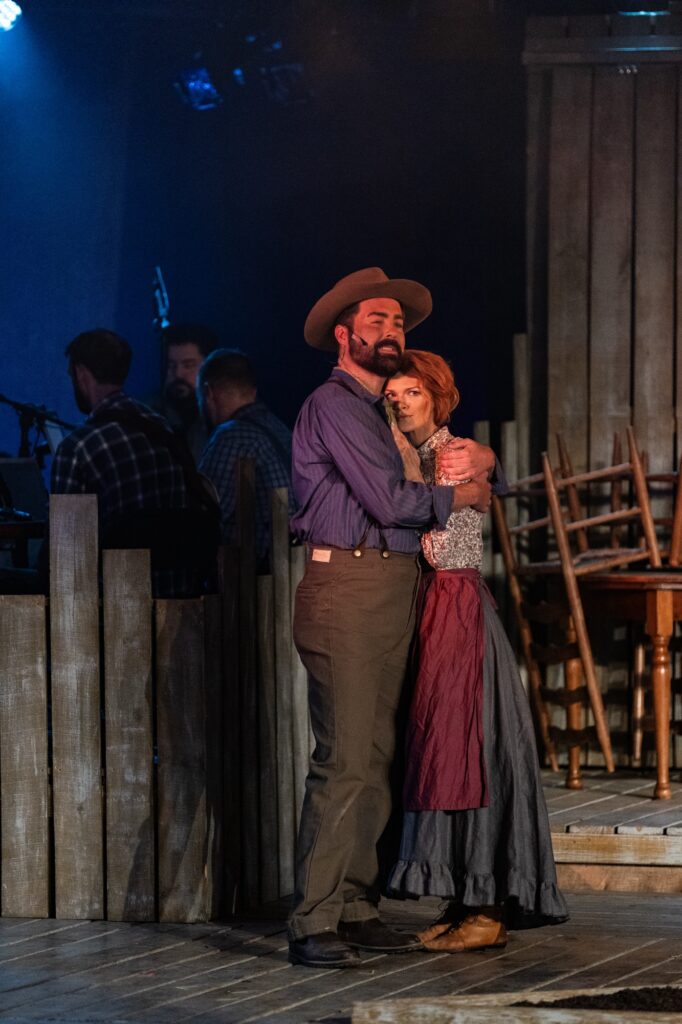
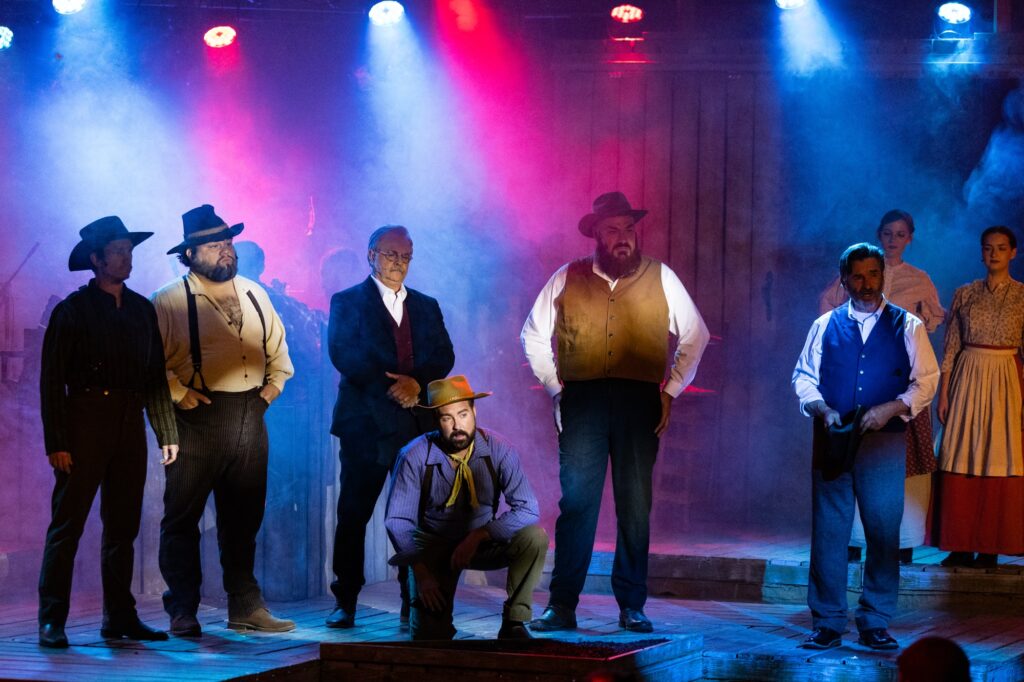 The thread connecting the personal drama to the larger historical elements is masterfully presented by Matthew Carlton’s Storyteller. As with any show in which he appears, Carlton’s presence assures those familiar with his work that they’re in for quite the performance. His Storyteller keeps the audience grounded in the broader story without turning the production into a some sort of yawn-fest history lesson. OK, OK, I admit it. History was never my strong suit, but with this cast and this story, it’s just as much an evocative tale as it is a tale of yesteryear as well as a bit of a cautionary tale of the plight of today’s agricultural foundation in homegrown products far beyond the scope of the tobacco industry.
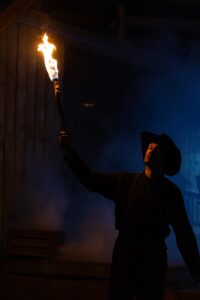 Playwright David Alford, who also wrote the music and lyrics, has created a Broadway-worthy bluegrass score with a dark side.
 Following SMOKE, the
 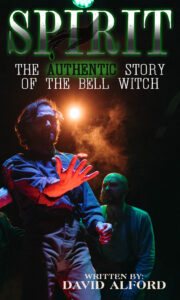 The Bell Witch Fall Festival then culminates October 22–31 with the annual presentation of David Alford’s spellbinding SPIRIT: The Authentic Story of the Bell Witch, presented on the hallowed grounds where the legendary Bell Witch is said to have roamed. Festival grounds open nightly at 6pm, with seating at 7pm and the show at 7:30pm, giving visitors time to explore vendors, grab dinner and settle in for an evening of history, entertainment and a little supernatural intrigue. SPIRIT tickets range in price from $27.38 to $43.14.
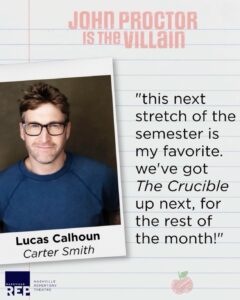 RAPID FIRE WITH JOHN PROCTOR IS THE VILLAIN‘s LUCAS CALHOUN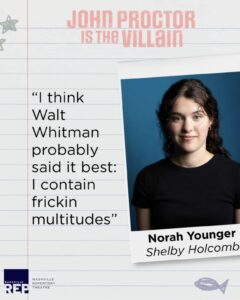
 RAPID FIRE WITH JOHN PROCTOR IS THE VILLAIN‘s
 RAPID FIRE WITH JOHN PROCTOR IS THE VILLAIN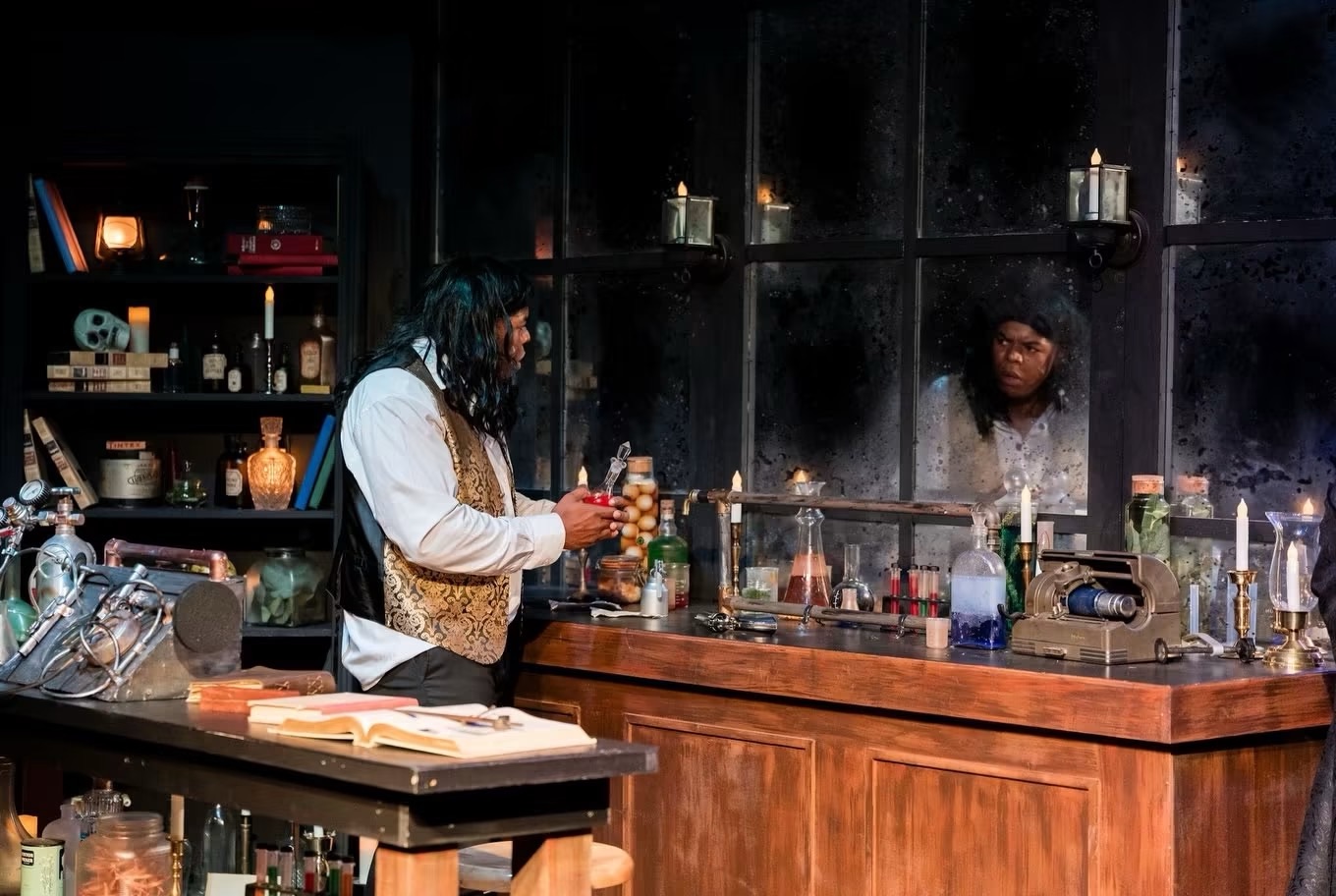
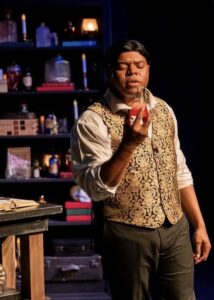 And then there are the three people at the center of that world. DéYonté Jenkins, as Henry Jekyll and Edward Hyde, takes on one of musical theatre’s great dual-role challenges and makes the transformation between the two personalities feel like an actual psychological unraveling rather than a theatrical gimmick. With the seemingly simple act of letting down his hair, increasing his audible breathing, snarling and yes, a bit of sweat and snotting, Jenkins transforms from Jekyll to Hyde in a scarily brilliant manner. Jekyll’s idealism, desperation and obsession gradually give way to Hyde’s darker liberation, and Jenkins makes that descent increasingly compelling. Again, the intimacy of this venue works with the show, not against it. Let’s not sleep on Jenkins’ vocals either. From Jekyll’s first musical number “Lost in the Darkness” to his final public transformation during “The Wedding”, whether as the meek and smooth as silk voiced Jekyll or the growling, guttural Hyde, Jenkins’ vocal control is enchanting. Those familiar with the musical can rest assured when Jenkins tackles “This is The Moment”, it’s not just a song title, it is the truth.
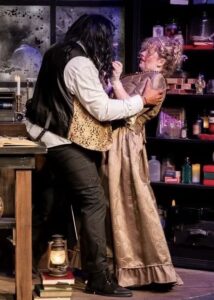 As Emma Carew, Dr. Henry Jekyll’s intended, Rebekah Joy brings an emotional strength to the production that keeps the character from becoming merely the devoted woman waiting for the troubled man she loves to come to his senses. There is genuine resilience beneath Emma’s affection, and Joy gives that emotional journey considerable weight. Vocally, Joy puts the opera in gothic opera. “Take Me As I Am”, Emma and Jekyll’s Act 1 duet showcases Joy’s control and power as a vocalist and as an actress. During this number you could have heard a pin drop in the sold out audience as Joy’s Emma hit that final note. Same goes for her Act 2 showstopper, “Once Upon a Dream”—goosebumps.
 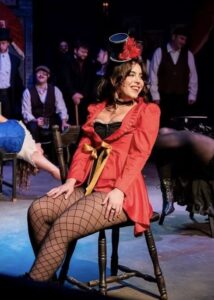 Then there is Francesca Noe as Lucy Harris, whose performance may be the production’s most heartbreaking. Noe gives Lucy vulnerability without ever making her fragile, allowing us to see a woman desperately searching for a way out of a world that has offered her precious few choices. Let’s face it, Lucy is the OG Pretty Woman, a hooker with a heart. Matching her co-stars note for note Noe’s vocal performance is gorgeous, but it is the emotional storytelling underneath those vocals that makes Lucy so affecting. From the rousing, rambunctious “Bring On the Men” to the Act 1 11 o’clock showstopper, “Someone Like You” Noe’s Lucy is stunningly captivating.
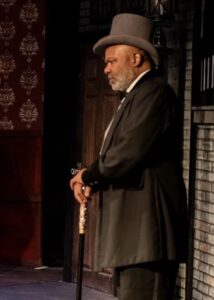 Skillfully aiding our lead as he navigates the uncertainty of his transformation is Elliott Robinson as Gabriel John Utterson, who initially serves up a bit of narrative exposition. Not gonna lie…knowing Robinson was among the cast was reason enough for me to check out this production. As he has done with any role he has taken on over the last two decades that he’s been a staple of area theatre, Robinson, simply by his presence, elevates the production. While this production doesn’t necessarily need any extra help in elevation, Robinson’s Utterson is the perfect unexpected ally to Jenkins’ troubled duality. Early on, Robinson’s Utterson joins the crowd for ‘Facade’ where he sings the telling line, “Each man you meet in the street isn’t one man, but two!” And how! It’s a simple phrase that could easily be lost if uttered by a lesser performer, but in Robinson’s capable hands, you’re like…Damn right.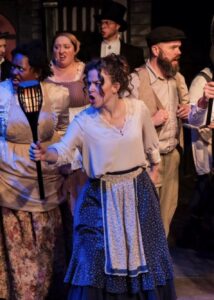
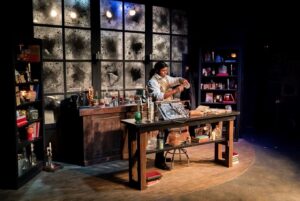 From the spooky frothing magic potion that turns Jekyll to Hyde to those candles that light the lab and books that become almost unnoticeably more disheveled and chaotic as the transformations become more frequent and uncontrolled…it’s those little touches by the set, scenic and props crew that bring you in this gothic world, and keep you there. Oh, and be sure and take notice of the handbills, notices and posters pasted to the wall just to the right of the main stage. My companion for the evening and I had fun during intermission figuring out what classic London lore each one represented. Nice touch! There’s also a fun, albeit completely out of place nod to our own skyline mixed in amongst the 1880s London skyline.