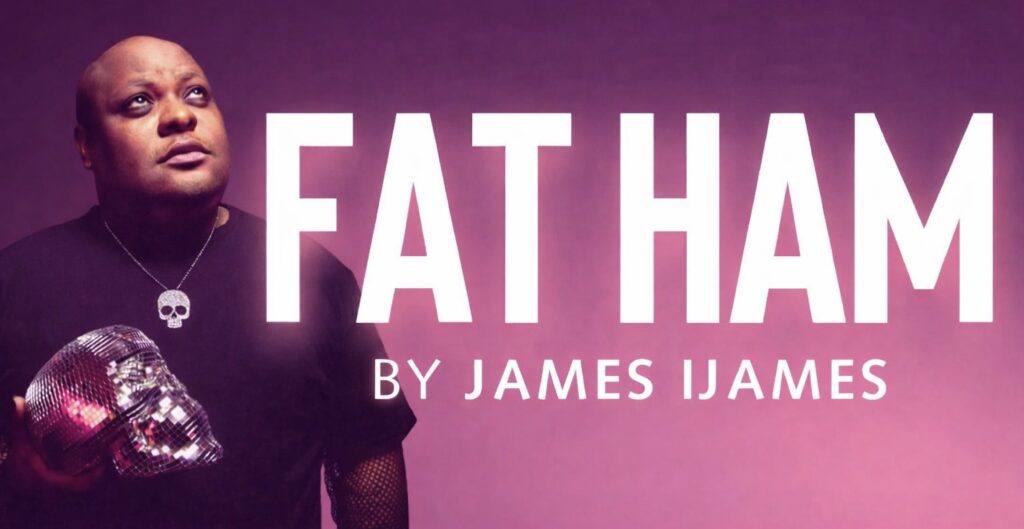
Okay, okay, I’ll admit it. When I was assigned to read Shakespeare‘s Hamlet in high school and again in college, I read the Cliff’s Notes instead of diving in to the full text. Even if I had read the play, nothing could have prepared me for just how relatable and uniquely enjoyable playwright James Ijames‘ take, Fat Ham is, especially in the hands of Nashville Rep‘s current production directed by Mikael Burke, featuring a truly stellar cast and co-presented by Nashville Shakespeare Festival; on stage at TPAC‘s Johnson Theatre thru Sunday, February 22.
Yes, I know the basic themes: familial strife, loyalty, deceit, treachery and death, but my Hamlet knowledge lies more in that episode of Gilligan’s Island in which the castaways turn The Bard’s classic into an unintentionally comedic musical than in the original text. Here’s the cool thing though…you don’t have to be a literary elitist to understand or fully revel in this Pulitzer Prize-winning adaptation.
Over the past 400 years or so, Hamlet has been presented in settings from war zones to psychiatric wards. IJames’ Fat Ham, not only modernizes it, but takes some brilliant liberties . Flipping the script by peppering the dialogue with quick comebacks, modern references and hot topics while also including clever nods to familiar soliloquies. Nashville Repertory Theatre’s co-production with Nashville Shakespeare Festival brings the story to vibrant life for the regional premiere.
The Bard’s Elsinore Castle now replaced by the everyman kingdom of a backyard cookout in the American South. There’s a grill smoking, table and chairs set for an impromptu wedding celebration, and the low hum of family history hanging in the air. At the center is Juicy—a young, Black man haunted not only by the ghost of his recently deceased father, but also a few internal battles ranging from his own sexuality and what his future holds to protective feelings towards his mother and disdain of his uncle. Early on, The ghost insists he was murdered by Juicy’s uncle, who is now celebrating his engagement to Juicy’s mother. The parallels to Hamlet are unmistakable—but the lens is entirely new.
While I myself as probably considered as white as Wonder Bread, so many of Ijames’ themes, ideals and plot devices resonate with me in the best, most unexpected ways. Through that unmistakable Southern family bond, the familiar rhythms of a backyard gathering, Ijames reframes the story not as a tragedy of indecision, but as a meditation on inherited trauma and the radical act of choosing something different, all with a darkly comedic twist.
The production leans into that communal spirit. The humor lands with knowing precision, the shade draws audible reactions, and the audience feels invited into the rhythm of the gathering.
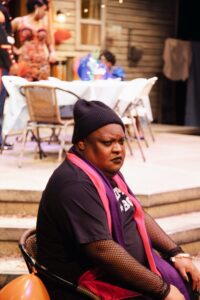 As Juicy, this retelling’s Hamlet, Julian “Joolz” Stroop delivers a performance that is instantly mesmerizing. Dressed in black, but with flare that lets us know they’re their own person deep down, Stroop’s Juicy is a stark contrast to the bright, bustling energy around them, Stroop embodies what it means to feel different within your own family. Their Juicy is wickedly sarcastic, deeply unsure of themself, yet painfully self-aware. Where Shakespeare’s Hamlet spirals toward destruction, Juicy wrestles with whether violence is the only inheritance available. Stroop captures the tension between rage and restraint with remarkable control. You can see the weight of expectation pressing in—the desire to prove themself to a father who was cruel in life and demanding in death. Stroop’s performance reflects the universal burden of feeling unseen, and when ultimately questioning the necessity of revenge, it lands with emotional clarity. Whether performing a telling karaoke number at the BBQ, sharing a laugh with friends, a more intimate moment with a lifelong crush or tense scenes with parental figures, Stroop steps up and shows out in a memorable Nashville Rep debut performance.
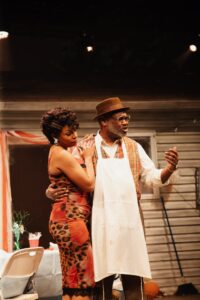 Tamiko Robinson Steele’s Tedra, the Queen Gertrude counterpart, is a sheer joy to behold from her first entrance on. She exudes sensual confidence and the unapologetic energy of a woman determined to find happiness on her own terms. One of my longtime favorite regional actresses, Robinson Steele masterfully reveals the emotional compromises beneath that surface. Like Gertrude, Tedra aligns herself with the new man quickly—but here, the choice feels rooted in survival and stability rather than simple obliviousness. Robinson Steele balances humor and depth beautifully, embodying a mother navigating grief, desire, and the societal pressures that center men in her world. And did I spot a bit of gold in that megawatt smile? A fun nod to Queen Gertrude and Tedra’s own status at the Queen of her castle. Nice touch.
Speaking of royalty, the aptly named Bakari J. King indeed commands the stage in the dual roles of Rev (Claudius) and Pap’s ghost (the Ghost of King Hamlet). As Rev, he radiates the swaggering authority of a man who believes the world revolves around him. Think George Jefferson…on steroids. As Pap, he shifts into something sharper and more unsettling. Gotta love that toothbrush shiv sticking out of his neck. King’s ability to transition between the earthly manipulator and the glittering, vengeful apparition is a testament to his range. In scenes with Stroop, the tension between the two is a thick as the accompanying fog machine—he generational trauma thickening the air like the aroma of pork shoulder on the grill. King grounds both roles in recognizable patriarchal power, avoiding caricature while leaning fully into the characters’ egos.
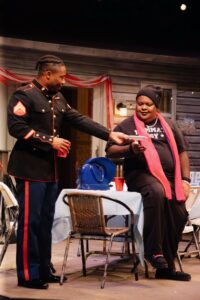 As Larry, the Laertes counterpart, Michael A. McAllister-Spurgeon initially leans into bravado and expected masculinity. But as the story unfolds, he allows vulnerability to seep through the cracks. Like Laertes, Larry is poised to embrace retaliation—but McAllister-Spurgeon reveals the insecurity driving that impulse. His performance underscores how young men inherit scripts of aggression without ever being asked whether they want them. The nuance he brings elevates Larry from stereotype to fully realized human being. And that finale reveal….YAAAAAAS!
Candace-Omnira reimagines Ophelia through Opal with warmth, wit, and agency. Unlike Shakespeare’s more fragile Ophelia, this Opal is emotionally grounded and self-aware. She perfectly balances buoyancy with sincerity, creating a character who feels refreshingly modern. Her chemistry with Stroop is honest and believable, offering Juicy a glimpse of something healthier than the violent expectations placed upon him. Candace-Omnira’s comedic timing shines in ensemble scenes, but it’s her emotional steadiness that leaves a lasting impression.
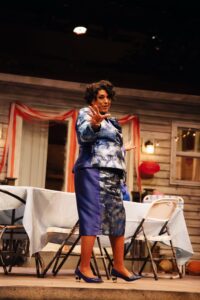 Persephone Felder-Fentress steps into a gender-switched Polonius role as Rabby, Larry and Opal’s mother, with sharp comedic precision. While Shakespeare’s Polonius is verbose and meddlesome, Rabby feels more direct and grounded. Felder-Fentress handles the humor effortlessly, but she also brings a relatable maternal complexity to the role. You know that female relative who always pinched your cheeks as a kid and inevitable asks “when are you getting yourself a girlfriend?” That’s Felder-Fentress’ Rabby. The dynamic between Rabby, Larry, and Opal textbook good christian family facade masking those things we don’t talk about beneath the surface. Y’all, during Rev’s pre-feast prayer, when I noticed Felder-Fentress’s Rabby clicking her bejeweled heels together in prayerful agreement to each thing Rev mentioned, I knew I longed for an invitation to the cookout!
 Rounding out the players is Gerold Oliver’s Tio, the Horatio character. Though his stage-time is limited, he is a delight as usual. His comedic timing, pulled facial expressions and overall demeanor a joy to watch. Yet Oliver ensures Tio is more than comic relief. In a climactic, albeit alter-state-induced monologue that begins like a muchie-fueled rambling, but soon climaxes into something unexpectedly profound. Oliver lands the humor and the wisdom with equal finesse as Tio reminds the audience of the play’s core truth: “Far as we know, we are in the only place in the cosmos that welcomes our particular brand of life. Why waste it trying to be miserable cause it’s gonna make somebody else happy?”
Behind the scenes, the crew of Fat Ham is just as stacked. From the beginning, it’s evident that director Mikael Burke understands the world of this play down to its bones. There’s an easy authenticity to the staging that makes the backyard feel lived-in and immediate. Director Burtke’s stage direction keeps the audience’s attention and the action moving, while never becoming too chaotic. The show’s more intimate moments are perfectly choreographed down to the most dramatic sneer or the subtlest caress.
Once again Nashville Rep’s resident Scenic Designer Gary C. Hoff’ has created a set I could live in. With what appears to be a modular home set on a brick-o-block basement—complete with grill, patio furniture, and a sliding glass door (complete with time-worn smudges) offering a glimpse into the house, and even the inclusion of fallen leaves on the rooftop— it feels less like a theatrical construct and more like an actual family gathering you’ve stumbled into. I absolutely loved the little detail of the “Happy” half of an old “Happy Birthday” banner hanging with balloons as the last-minute party decor, while the “Birthday” half of the banner is visible discarded in the trash can by the basement door, just another way in which this set looks lived in and real, not simply constructed for the show. Ijames’ script heightens the immersive aspect by including a few fourth-wall breaking lines like “what are you telling them” as actors nod toward the audience in acknowledgement. The echoes of real-life cookouts: home-cooked food and fun with a side order of judgment from elders, unlocking palpable memories.
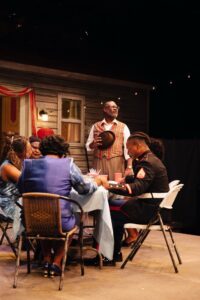 Amber Whatley’s lighting brilliantly shifts from warm afternoon glow to something cooler and more spectral when Pap’s ghost appears, then changing throughout from the familiarity of a family gather to the intensity of truths revealed. Nivedhan Singh’s sound design underscores both the humor and the haunting without overwhelming the text and lifting the mood when called for.
Melissa K. Durmon’s costume, hair, and makeup design ground each character in specificity—these are people you recognize, rendered with care and intention. Gotta love Durmon’s attention to detail fully on display in the color palate of each cast member’s wardrobe. Tedra and Rev are regal and grounded in traditions of marriage and conformity in shades of red and earth tones, while Tedra’s more animalistic urgers are represented in the addition of an animal print. Juicy’s uncertainty is isolation visually present in his monochromatic wardrobe, but his love of his mother, a message literally emblazoned across his chest, while his sarcasm and flair evident in an added accessory. Rabby’s family ties are representing in all three members in shades of blue, a symbol of loyalty and nobility. Durmon again highlights individuality among these three from Larry’s rigid uniform and Opal’s subtle defiance pairing a forced dress with combat boots, while the matriarch presents authority and perceived (or hoped-for) regality in her royal blue ensemble complete with matching church lady hat, purse and bejeweled heels. Then there’s Tio, whose casual colorful style remind us all that there is lightness around, we just have to be willing to see it.
What makes Fat Ham so powerful, and ultimately relatable to modern audiences is its refusal to follow Shakespeare to the grave. Where Hamlet ends in bloodshed, Fat Ham asks whether that ending is inevitable—or merely inherited. By centering Black culture, queer identity, and the specificity of a backyard cookout, Ijames expands the original rather than replicating it.
Fat Ham treats Shakespeare as a blueprint, a playbook—ripe for reinterpretation, reclamation, and joy. A great reminder that the themes of revenge, masculinity, grief, and identity are universal, whether played out in Danish castles, Elizabethan stages or right in our own back yard. Themes that are found in every backyard, every family, every life. Like I told my friend who accompanied me to Nashville Rep’s Opening Night of Fat Ham, “Who knew Willie Shakes could be so fun?”
Nashville Rep‘ and Nashville Shakes‘ co-production of FAT HAM continues with performances through Sunday, February 22. CLICK HERE for tickets. Next up at Nashville Rep will be SISTER ACT April 10-19. Closing out the season will be Amy Tofte‘s BLOOD SUCKING LEECH, as part of Nashville Rep‘s New Works: Next Stage, after having presented a staged reading of Tofte’s work just last season. CLICK HERE to purchase tickets.
As always, check out Nashville Rep online and follow them on Facebook, X, YouTube and Instagram.
If you wanna follow JHPEntertainment to find out who I’m chatting with for my next Rapid Fire Q&A, or for my take on the latest local and national theatre, music and movie offerings, find us at JHPEntertainment on Facebook JHPEntertainment on Instagram and JHPEntertainment on Twitter. Got an event or show we should know about, drop us a line at the Contact tab. Till then, #GoSeeTheShow!