If you’ve never read Robert Lewis Stevenson’s gothic novella The Strange Case of Dr. Jekyll and Mr. Hyde, first published in 1886, upon which Steve Cuden and Frank Wildhorn conceived the musical Jekyll and Hyde (now onstage at Hendersonville Performing Arts Company through Sunday, October 4) with book and lyrics by Leslie Bricusse and music by Wildhorn—it’s the tale of a Victorian doctor so desperate to find answers about his father’s mental illness who creates a serum which isolates and presents one’s darker side as an almost separate being. Unable to find test subjects, the doctor takes the serum himself, but soon discovers he can’t control when his evil persona comes out of the darkness to wreck havoc on the streets of London—OR…in our current clickbait headline society, and through a slightly sarcastic lens, perhaps the plot of Jekyll and Hyde could easily be mistakenly interpreted as Bipolar Gothic Musical Fever Dream. Ok, so I’m joking, about that last part, but seriously, Jekyll and Hyde is one of a handful of musicals—most of them from the 80s and 90s—that I think I don’t like…until I see them again. HPAC’s current production definitely fits into that category. And, dang, was I wrong about not liking it. I loved it.
HPAC’s presentation helmed by director Marsalis Turner and music director Matthew Marcus marks my third time seeing this gothic musical, following the original pre-Broadway National Tour at TPAC in 1995, Circle Players’ 2010 production. After seeing Jekyll and Hyde three times over the course of more than 30 years, I walked into HPAC knowing the story, knowing the score and knowing exactly what happens to Henry Jekyll. While each production has had its own personality, what I didn’t know was that this production would leave me thinking I had just witnessed something extraordinary. HPAC’s Jekyll & Hyde doesn’t simply stand shoulder to shoulder with those previous productions—it just might be the best locally produced musical I’ve seen in my 20 years of covering theatre and my half century as an audience member. That is not a statement I make lightly.
Through Turner’s guidance, this production understands that Jekyll & Hyde requires more than strong voices and a familiar score. It needs atmosphere, danger, romance, desperation and just enough theatrical excess to make the gothic melodrama work. Turner delivers all of that while making remarkably effective use of HPAC’s performance space. And that space becomes part of the experience.
There is a wonderful sense of movement throughout the production, and I’m not just talking about the revolving circular cutout section of HPAC’s stage. Turner, alongside choreographer Allee Williams present a clear vision and keen eyes while staging the show and its two dozen plus ensemble with direction, placement and movement that makes the theatre feel considerably larger than the intimate space it occupies. Interestingly, when the plot calls for it—Jekyll’s transformation, a crowded street, the angry mod—the space also becomes uncomfortably crowded, but in the best way. Having been seated on the front row, there were scenes when Hyde’s snarling seemed frighteningly aimed directly at those of us in the audience within eyeshot. Conversely, there were moments when Lucy and the dancehall girls gave audience members a flirtatious glance. The result is a production that never feels confined by its surroundings, but invites its audience in. It’s a bit of unexpected immersive theatre.
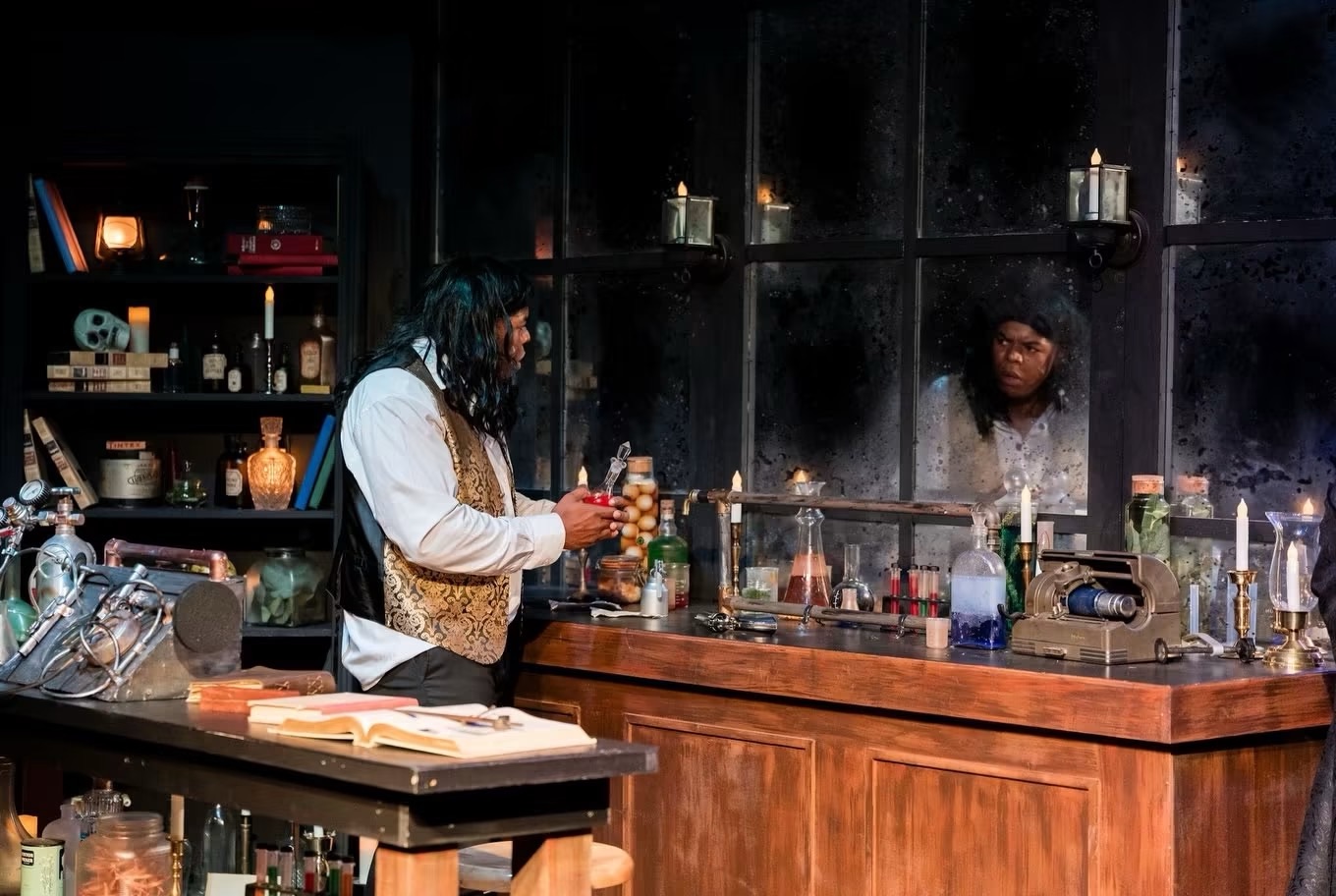
One of the biggest surprises of the evening is just how ambitious this production looks. The set design by Dr. Andrew Armstrong and Britt Burkey is truly breathtaking, with Jekyll’s laboratory standing out as a particular triumph. Spookily illuminated and beautifully integrated into the action, the laboratory becomes more than scenery—it feels like an extension of Jekyll’s increasingly fractured mind. Spoiler Alert: When that turntable section of the stage rotates to reveal the laboratory (and if you didn’t read the word laboratory hearing a mad scientist’s voice in your head, what’s wrong with you?) there were approving audible gasps. It’s that gorgeous.
That atmosphere is heightened by Will Scoggins’ lighting design, which understands that Jekyll & Hyde is a story built in shadows. The lighting doesn’t simply illuminate the action; it helps create the world in which these characters are trapped. Gotta love a flooding of red light washing over the entire set when Hyde claims prey. A truly cinematic moment.
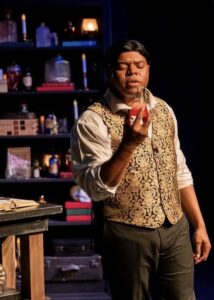 And then there are the three people at the center of that world. DéYonté Jenkins, as Henry Jekyll and Edward Hyde, takes on one of musical theatre’s great dual-role challenges and makes the transformation between the two personalities feel like an actual psychological unraveling rather than a theatrical gimmick. With the seemingly simple act of letting down his hair, increasing his audible breathing, snarling and yes, a bit of sweat and snotting, Jenkins transforms from Jekyll to Hyde in a scarily brilliant manner. Jekyll’s idealism, desperation and obsession gradually give way to Hyde’s darker liberation, and Jenkins makes that descent increasingly compelling. Again, the intimacy of this venue works with the show, not against it. Let’s not sleep on Jenkins’ vocals either. From Jekyll’s first musical number “Lost in the Darkness” to his final public transformation during “The Wedding”, whether as the meek and smooth as silk voiced Jekyll or the growling, guttural Hyde, Jenkins’ vocal control is enchanting. Those familiar with the musical can rest assured when Jenkins tackles “This is The Moment”, it’s not just a song title, it is the truth.
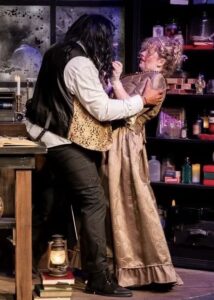 As Emma Carew, Dr. Henry Jekyll’s intended, Rebekah Joy brings an emotional strength to the production that keeps the character from becoming merely the devoted woman waiting for the troubled man she loves to come to his senses. There is genuine resilience beneath Emma’s affection, and Joy gives that emotional journey considerable weight. Vocally, Joy puts the opera in gothic opera. “Take Me As I Am”, Emma and Jekyll’s Act 1 duet showcases Joy’s control and power as a vocalist and as an actress. During this number you could have heard a pin drop in the sold out audience as Joy’s Emma hit that final note. Same goes for her Act 2 showstopper, “Once Upon a Dream”—goosebumps.
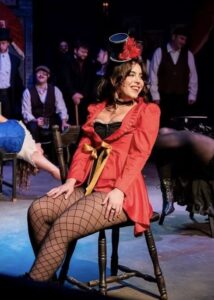 Then there is Francesca Noe as Lucy Harris, whose performance may be the production’s most heartbreaking. Noe gives Lucy vulnerability without ever making her fragile, allowing us to see a woman desperately searching for a way out of a world that has offered her precious few choices. Let’s face it, Lucy is the OG Pretty Woman, a hooker with a heart. Matching her co-stars note for note Noe’s vocal performance is gorgeous, but it is the emotional storytelling underneath those vocals that makes Lucy so affecting. From the rousing, rambunctious “Bring On the Men” to the Act 1 11 o’clock showstopper, “Someone Like You” Noe’s Lucy is stunningly captivating.
Together, Jenkins, Joy and Noe create something particularly effective: three people surrounded by others while carrying their own profound sense of isolation. It is that shared loneliness that gives the story much of its emotional power.
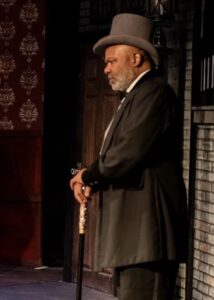 Skillfully aiding our lead as he navigates the uncertainty of his transformation is Elliott Robinson as Gabriel John Utterson, who initially serves up a bit of narrative exposition. Not gonna lie…knowing Robinson was among the cast was reason enough for me to check out this production. As he has done with any role he has taken on over the last two decades that he’s been a staple of area theatre, Robinson, simply by his presence, elevates the production. While this production doesn’t necessarily need any extra help in elevation, Robinson’s Utterson is the perfect unexpected ally to Jenkins’ troubled duality. Early on, Robinson’s Utterson joins the crowd for ‘Facade’ where he sings the telling line, “Each man you meet in the street isn’t one man, but two!” And how! It’s a simple phrase that could easily be lost if uttered by a lesser performer, but in Robinson’s capable hands, you’re like…Damn right.
The supporting cast features Lewis Walling, Alex Brazil, Jennifer Agatte, Tristan Graves, Noah Evitts, Ben Teal Davis, Adam Lang, Anthony Leverenz, Ezra High, Grace Montgomery, Brian Traughber, James Pevahouse and Kristen Pevahouse, Listen, thanks to their shared last name…
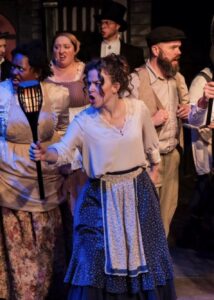
and their playbill bios…I now know that James and Kristen are married in real life, but even before I read that little tidbit, I noticed their playful chemistry as the brutish Spider and the spiritedly seductive Nellie.
The ensemble includes Francine Green-Thomas, Rachel Kell, Mary Mayhugh, Mack Overfelt, Jaime Riley, Savannah Villines, Genevieve Weaver and Sarah Fye (who also serves as assistant choreographer…wait! is that why she was the only dance hall girl wearing white lace-up ankle jacks when all the other Red Rat girls wear black?). Each and every member of the cast contributes to the production’s sense of place, helping create a world that feels populated beyond whatever scene is immediately unfolding.
Marsalis Turner, pulling double duty as director and Sound Designer, deserves particular praise, along with Markis Turner and Music Director Matthew Marcus, for the sound mixing. The score sounds full without swallowing the singers, allowing the vocal performances to remain front and center while still giving the orchestra the room it needs to create the musical’s dramatic sweep. Another subtle touch that deserves recognition: the use of reverb on several of the show’s key solo numbers. It gives those voices an almost ghostly quality, enhancing the haunting sense of aloneness that all three leads unknowingly share. It is a relatively small technical choice that adds considerable emotional depth to the production.
Marcus’ work as Music Director also helps keep the show’s demanding score moving with the dramatic urgency it requires, while the ensemble and supporting cast provide the Victorian world surrounding our central trio.
The production’s sound design makes that feeling even more pronounced. This is only my second show at Hendersonville Performing Arts Company, and while I thoroughly enjoyed HPAC’s previous production of Merrily We Roll Along, I recall the orchestra occasionally overpowering the vocals.
That problem has been remedied beautifully for Jekyll and Hyde. The 12-piece orchestra is located across the hall from the theatre space, allowing the sound team to control and blend the instrumentation with the vocals rather than having the orchestra compete with the performers. The difference is immediately noticeable.
There is also plenty happening behind the scenes to make the Jekyll and Hyde world work. Melissa Harris’ costume design helps establish the period and social distinctions of the characters without overwhelming the performers, while Melissa Kelly, as Assistant Costume Designer, contributes to that visual cohesion. If I could offer one tiny nitpicky note: steam those gorgeous gown fully. What can I say? I was distracted by a crease in one of Emma’s early outfits. Oh, and what was up with those mismatched argyles one of the male ensemble was sporting…YES, when a production is this great, you notice very minor imperfections).
While there was no one listed in the playbill credited for wigs/hair, it’s another element that lends authenticity and professionalism to this production. I was indeed impressed with, in particular, the ladies of the cast and their period authentic hairstyles. As for the good doctor, Jenkins opts for a, shall we say, smooth operator look in real life, so for Jekyll/Hyde he dons a wig. Yes, production could have sprung for a less-synthetic one—it did get kind of tangled during one key transformation scene and seemed to present a slightly lower hairline during Act 2, but again…when the rest of the show is so stellar, I’ve gotta mention the tiniest flaws, otherwise my own Jekyll/Hyde reputation as an honest reviewer might be tainted.
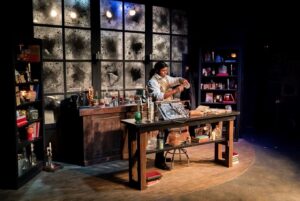 From the spooky frothing magic potion that turns Jekyll to Hyde to those candles that light the lab and books that become almost unnoticeably more disheveled and chaotic as the transformations become more frequent and uncontrolled…it’s those little touches by the set, scenic and props crew that bring you in this gothic world, and keep you there. Oh, and be sure and take notice of the handbills, notices and posters pasted to the wall just to the right of the main stage. My companion for the evening and I had fun during intermission figuring out what classic London lore each one represented. Nice touch! There’s also a fun, albeit completely out of place nod to our own skyline mixed in amongst the 1880s London skyline.
What makes all of this especially satisfying is discovering how much talent exists inside a company that could easily be overlooked by Nashville audiences. This incredibly ambitious theatre company is unassumingly tucked away in a newly revitalized strip mall just 15 miles outside Nashville in nearby Hendersonville. You could drive right past it. Don’t.
If Merrily We Roll Along was my introduction to what HPAC could do, Jekyll and Hyde is the production that has made me sit up and pay considerably closer attention. Because there is a difference between a community theatre production that successfully puts on a musical and a production that makes you momentarily forget where you are. HPAC achieves the latter.
There are moments during Jekyll and Hyde when the combination of Jenkins, Joy and Noe, the orchestra, the lighting, the sound design and that spectacular laboratory create an atmosphere that feels far bigger than the address on the marquee would suggest. And that’s ultimately what theatre is supposed to do.
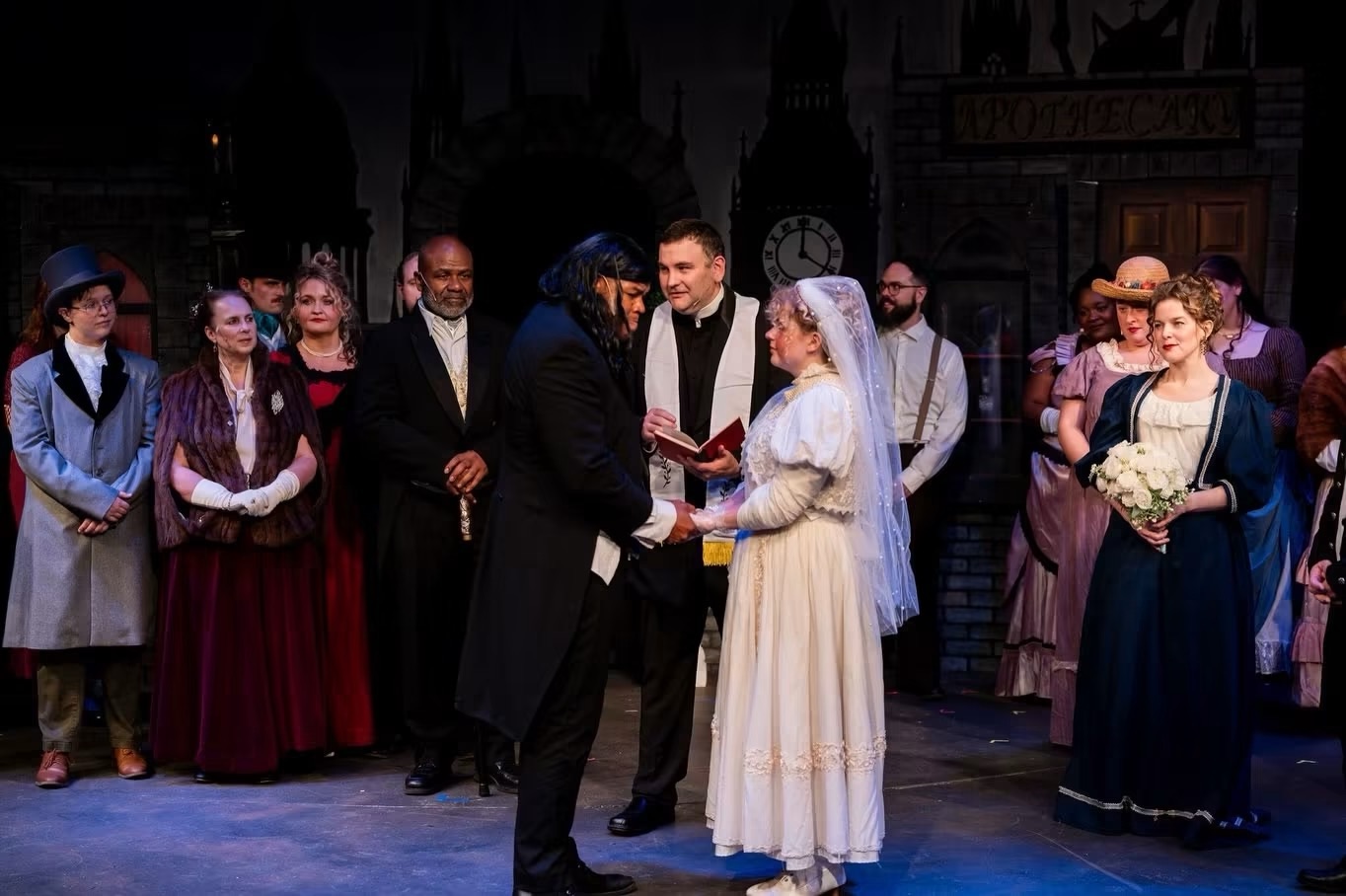
Marsalis Turner and his cast and creative team have created a production that is ambitious without being pretentious, atmospheric without becoming overdone, and emotional without losing the deliciously melodramatic spirit of the material. For a musical about a man attempting to separate the good and evil within himself, HPAC has found the perfect balance between the two. There is the spectacle. There is the darkness. There is the romance. There is the madness. And, at the center of it all, there are three remarkable performances and two dozen more supporting players that make us care about the people underneath the gothic theatrics. After 20 years of covering theatre and 50 years of sitting in the audience, I don’t throw around “best locally produced musical” casually. But this production makes a very convincing case for the distinction. HPAC’s Jekyll and Hyde isn’t simply a production worth discovering. It’s a production worth talking about. So don’t sleep on this company. Don’t let the unassuming address fool you. And don’t wait for Hyde to come looking for you. Go find him yourself.
Jekyll and Hyde: The Musical promises HPAC patrons a suitably sinister and thoroughly entertaining way to ease into the Halloween season. Jekyll and Hyde wraps its three week run at Hendersonville Performing Arts Company (260 West Main Street Suite 204, Hendersonville, TN 37075) with performances through Sunday, October 4. Performances are at 7:30pm Thursdays-Saturdays with 2pm matinees on Sundays. Tickets are $25/Adults and $22/Students and Seniors. All tickets are reserved seating. CLICK HERE to purchase tickets. For ADA accommodations, please call the box office at 615.826.6037. Please note: Jekyll and Hyde is rated PG-13 for violence, dark themes, sexual content and frightening scenes.
 That may be the greatest compliment I can give
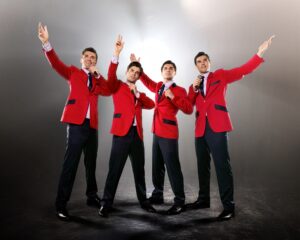
 As Frankie Valli,
  Peyton Schoenhofer
 Harry Sperduto
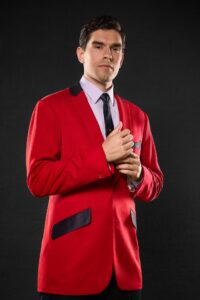 Owen McCredie
 The remarkable thing about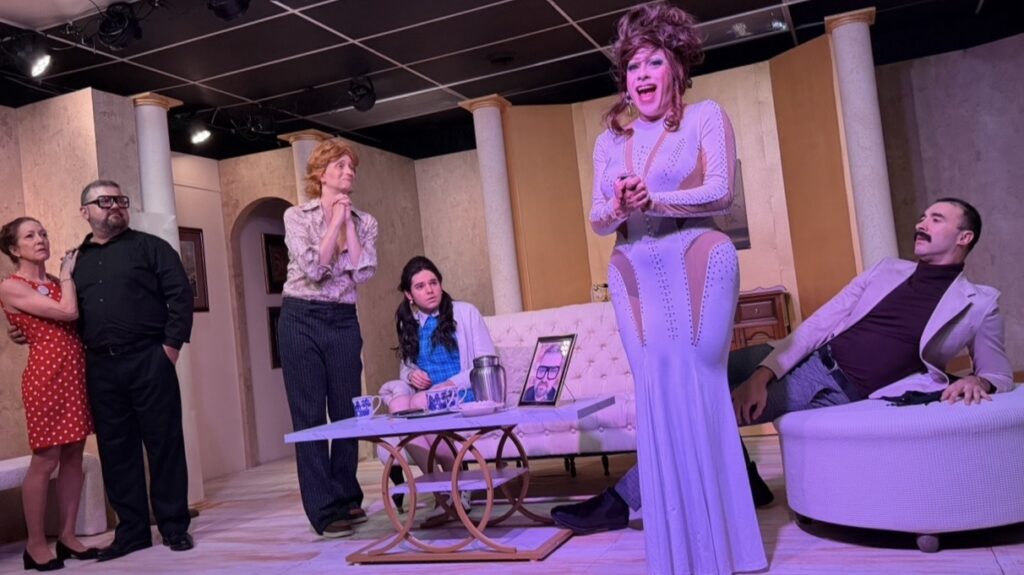
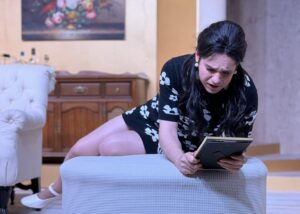
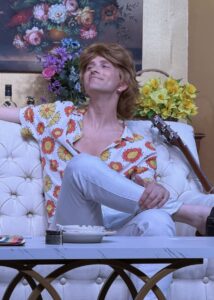
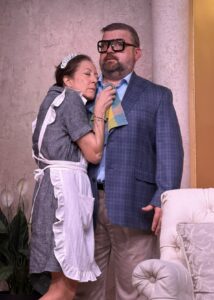
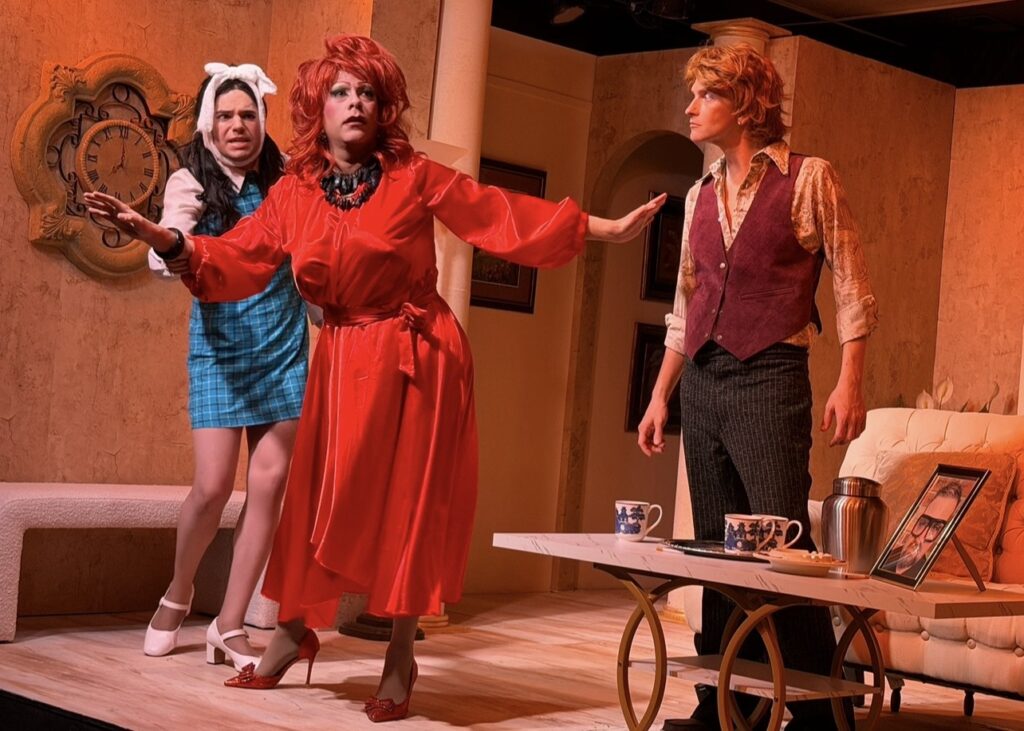
 Electronika, who, in recent years has appeared in pretty much every drag-related production at Playhouse 615, proves effective as Angela Arden Sussman. Having been a fan favorite amongst Nashville’s drag community for nearly a quarter of a century (she knows I love her, it just reads cattier that way) whether she’s reading to kiddies at drag story hour–literacy…it’s SO controversial–hosting a charity event, lobbying for LGBTQIA+ rights, performing a drag show or appearing in a theatrical production, you know you’re gonna get a bit of the diva that is Veronika Electronika, especially if that’s how she’s credited in the playbill. Such is the case with Veronika as Angela. She’s larger than life, self-indulging, wickedly self-important, and thanks to Veronika’s own wardrobe doubling for Angela’s, dressed to the mother-fuckin’ nines–or at least sixes, because that’s how many wardrobe changes I counted, not including at least two outer layer discardings revealing more fashion underneath–while chewing on every inch of that decadent scenery. Yes, per Busch’s script you’ll find aspects of many a great diva including, but not limited to Bette Davis, Joan Crawford, and even Mama Rose, but make no mistake about it, it’s Music City diva Veronika Electronika who’s most present in this portrayal of Angela Arden Sussman.
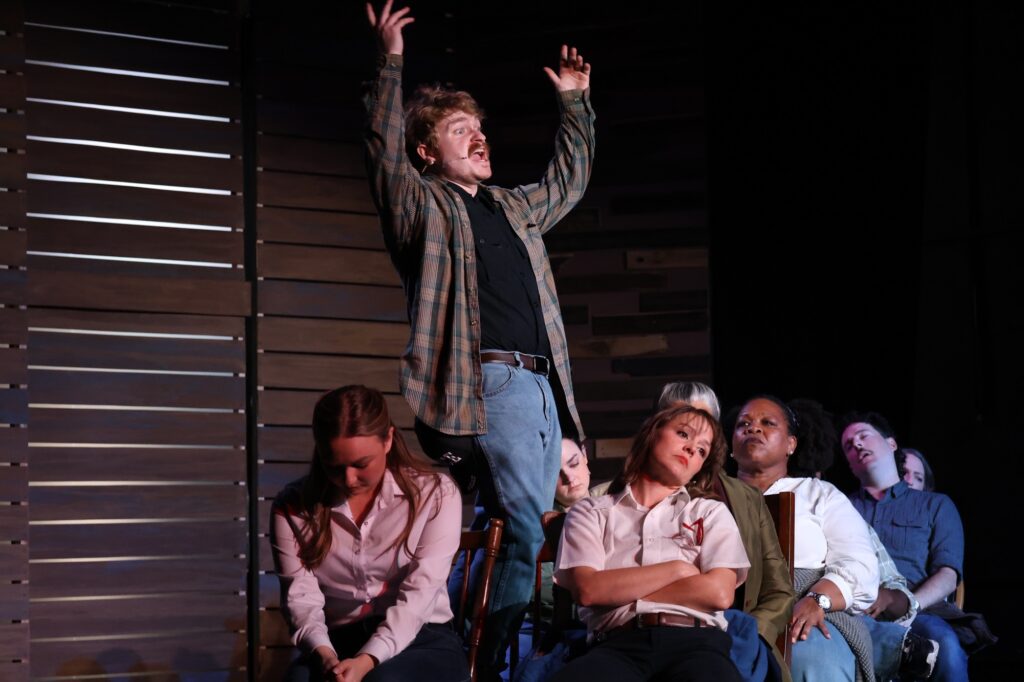
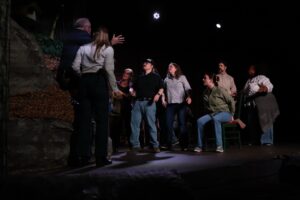 With an obvious nod to the original Broadway run’s scenic design by Beowulf Boritt, for The Keeton’s production, Kevin Driver and his scenic team (Abby Waddoups, Donna Driver, Aras Alexander, Eric Bradley and Crystal Liles) construct a seemingly simple but successful set. The backdrop, a stripped-down horizontal slat wall that beautifully plays with Jesse Watts’ lighting design. Also reminiscent of the original set design, Keeton’s stage is flanked on either side by tall, thin but sturdy trees that extend out of sight above the action. Driver and company nicely represent the play’s locale with the added touch of downstage rock formations, giving just a hint of a rocky-shored island vibe. No need for elaborate set pieces or projections representing the various scene locations. Throughout the action of the piece, a chair can represent a seat on a plane, a place at a table, a passenger waiting for answers or simply another piece of the constantly shifting landscape. To that end, the choreography by Mckenna Driver works hand-in-hand with that concept, keeping the ensemble in perpetual motion and allowing the story to move with the same speed and urgency as the characters’ rapidly changing circumstances. Here, chairs become airplanes one moment, a bus headed to parts unknown the next, and then a crowded airport filled with weary strangers who somehow become fast friends. If you read my column with any regularity, you know I love a bit of chairography (blame Sweet Charity’s Shirley MacLaine or Janet Jackson if you want) and in Come From Away, chairography—a wonderfully inventive use of the simplest theatrical object to create an entire world—is key.
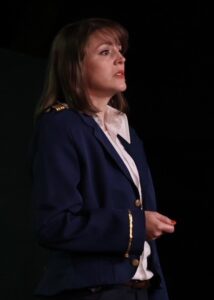 There may be twelve cast members, but the way Come From Away is presented, each cast member plays at least two roles: those of the displaced passengers and crew of the diverted planes and the townspeople of Gander, Newfoundland. At the center of the ensemble is Melissa Silengo, whose performance as Beverly Bass is nothing short of a powerhouse. Silengo brings an impressive combination of authority, vulnerability and warmth to the role of the pioneering female pilot. Her rendition of “Me and the Sky” is one of the production’s defining moments, taking Beverly from a young girl captivated by the possibility of flight through the challenges of becoming a pilot and ultimately into the extraordinary circumstances that put her leadership to the test. Silengo never plays Beverly simply as a heroic figure; she gives her humanity, making the character’s determination all the more affecting.
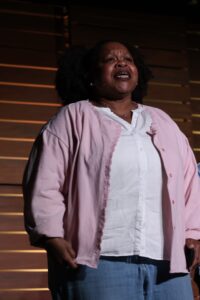 As for the passengers, Yolanda Treece’s Hannah, is equally heartbreaking. Her story, particularly as she waits desperately for word about her son, gives the production some of its most emotionally devastating moments. Treece allows Hannah’s grief to unfold with restraint rather than melodrama, making the quiet moments every bit as powerful as the big ones. When the characters gather in prayer, the scene becomes a poignant reminder that despite differences in religion, nationality and circumstance, there are some fears and hopes that belong to all of us.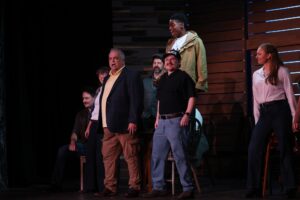

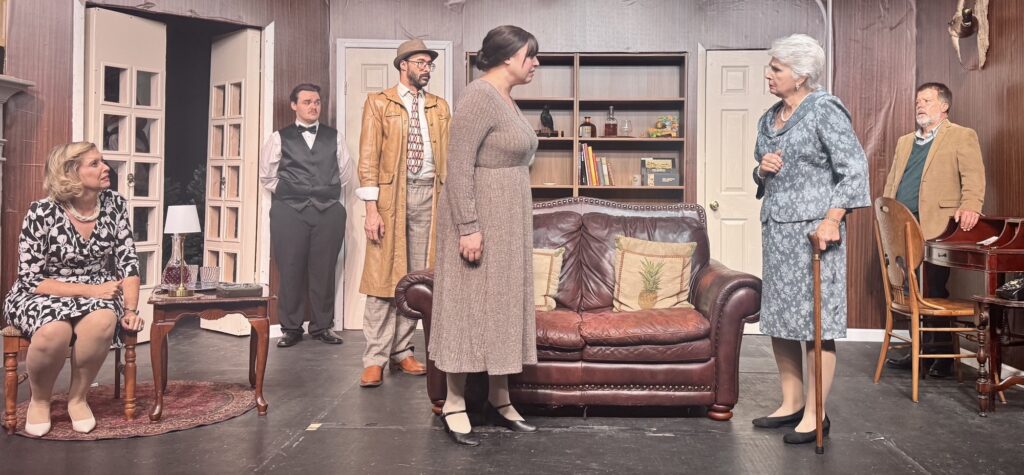
 It seems only fitting that one of the grande dames of Nashville community theatre should portray the grande dame of this troubled estate. Linda Speir is perfectly cast as Mrs. Warwick, carrying herself with the unmistakable air of someone who has spent decades believing everyone else exists merely to disappoint her. Speir expertly mixes aristocratic self-importance with dismissive disdain for nearly everyone she encounters, yet wisely avoids making the character simply cold or cruel. In fleeting moments—a softened glance, a quieter line delivery, the slightest crack in an otherwise rigid exterior—she reveals the forgotten gentler woman buried beneath years of grief, pride and disappointment. Those subtle glimpses make Mrs. Warwick far more interesting than the stereotypical overbearing matriarch she could have easily become.
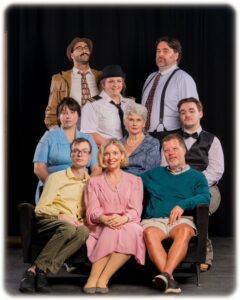
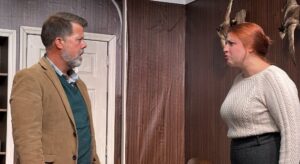 Rounding out the cast Emma Reinbold is, on the surface, a steady, reassuring presence as the devoted Ms. Bennett, grounding many of the play’s more emotionally charged moments with quiet sincerity. But of course there’s more to her long-tenured devoted presence. Rich Moses lends Julian an affable confidence that keeps audiences guessing exactly where his loyalties lie. Andrea Coleman’s police Sergeant provides some of the nights’ more comical moments. She and her on-stage superior, Rezende’s Inspector, trade eye-rolls and seemingly unscripted, adlibed barbs, giving the Sergeant more range of character than the calm professionalism with which the role is typically presented. Kamron Smith rounds out the ensemble as Angell, offering up the tried and true embodiment of the age-old mystery trope that raises the question, did indeed the butler do it? OK, so Angell isn’t a butler, but he is a male attendant to the murder victim, but you get the gist.
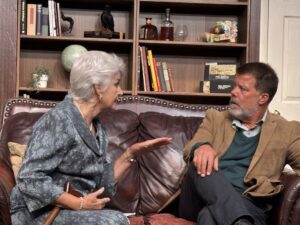
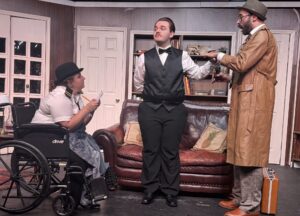 His investigative process becomes theatrical in all the best ways. Whether employing the murder weapon as a visual aid, incorporating a fruit snack into his deductions, or somehow turning a bit of knitting into investigative tool, Rezende constantly finds inventive bits of business that not only earn laughs but reinforce the notion that this Inspector’s mind is always several clues ahead of everyone else. A prime example come in the aforementioned investigation of Speir’s Mrs. Warwick. As the Inspector invites the elder matriarch to join him on the sofa for a little chat, he nonchalantly takes out his knitting needs, and yarn. He nonchalantly tosses the yarn into Mrs. Warwick’s lap, which she quickly and calmly removes from her lap a sets the yarn between them. It’s a simple but effective scene. The Inspector is either trying to equate the humdrum hobby of knitting with the senior suspect, or he’s establishing dominance by assuming she’ll hold the yarn as he coaxes her to weave her tale of the events of the murderous night. Either way, in the hands of Rezende–with an able assist from Speir–it’s one of the most inventive Christie moments you’re likely to encounter on a local stage.
 As is the case with most mysteries, there’s that uncomfortable moment when difficult facts are presented. It is in that spirit that the usual suspects of technical issues within Playhouse 615’s production need be addressed. While the majority of the Welsh accents were certainly serviceable, several wandered throughout the evening, occasionally drifting toward a more generic British sound before finding their way back again.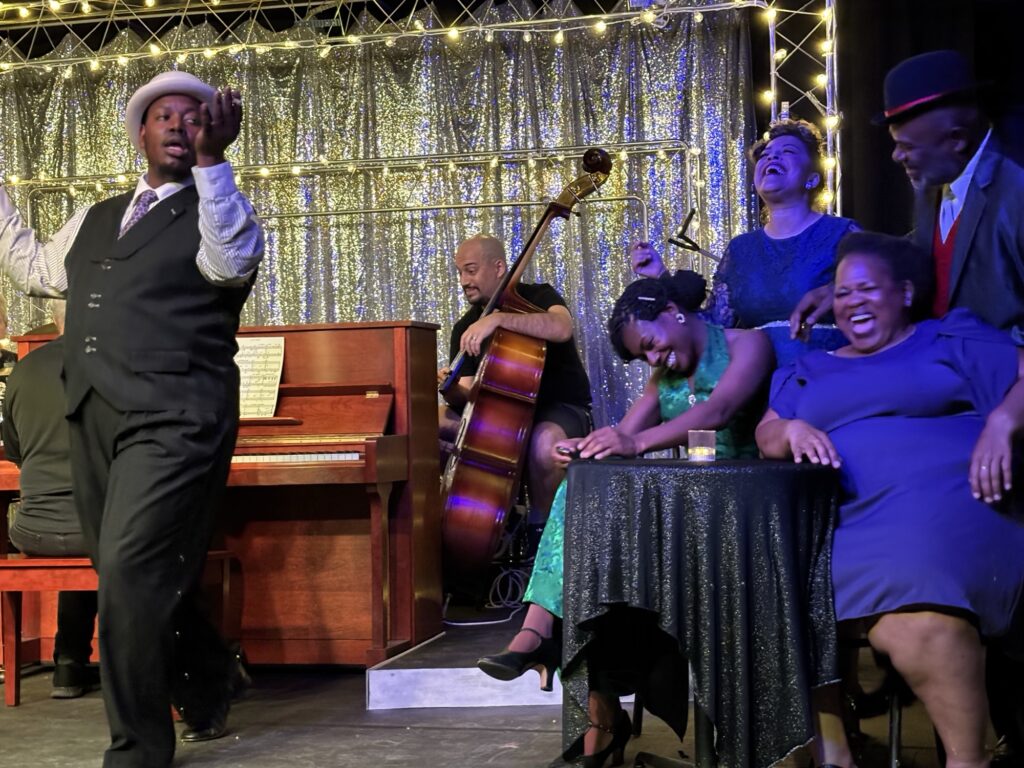
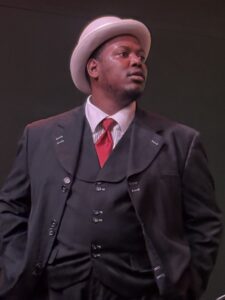 Isiah Rankin, pulling double duty behind the scenes as the show’s music director helps shape a score that feels authentic, alive and wonderfully spontaneous. Performing as Andre, Rankin brings an easygoing best-friend, wing-man energy to nearly every scene he inhabits. Whether leading the slyly playful “T Ain’t Nobody’s Biz-ness If I Do,” joining the delightfully flirtatious “How Ya Baby,” or bringing swagger to “The Viper’s Drag,” he consistently demonstrates both vocal confidence and magnetic stage presence.
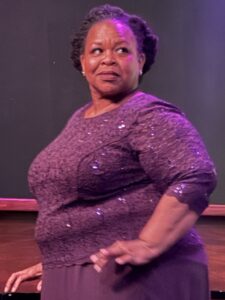 Yolanda Treece, performing as Nell, emerges as one of the production’s most engaging personalities. Possessing a remarkable ability to connect with the audience through nothing more than a wink, an eye-roll or a flirtatious grin, Treece makes every moment feel personal. Her spirited rendition of “Cash for Your Trash” earns plenty of laughs, while “Mean to Me” reveals a deeper emotional vulnerability. By evening’s end, it becomes clear she knows exactly how to work a room…and we’re all better for it.
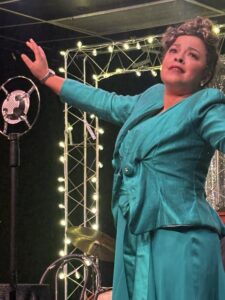 Lisa Graham’s Armelia is powered by boundless energy and a voice capable of effortlessly navigating Waller’s jazz-infused melodies. Her playful “Squeeze Me” is an Act 1 standou, while later numbers such as “Find Out What They Like”, alongside Treece showcase both her comic timing and vocal precision. Graham consistently finds fresh colors within each song, making every appearance memorable.
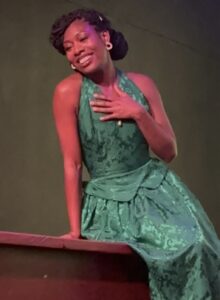 Raven Buntyn proves herself the show’s most versatile performer. One moment she’s the provocative, self-assured Charlaine commanding attention during “Yacht Club Swing.” The next she’s leaning into a more innocent, delightfully ditzy persona. Buntyn handles every shift seamlessly, while her heartfelt “Keepin’ Out of Mischief Now” offers one of the evening’s loveliest vocal moments.
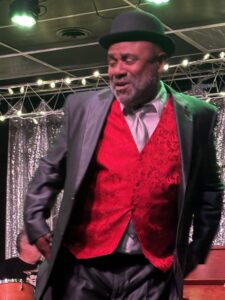 As Ken, Elliott Robinson demonstrates remarkable ease navigating both sides of Waller’s catalog. He is equally comfortable delivering laugh-out-loud comedic lyrics as he is tackling material with deeper emotional resonance. His charming performance of “Honeysuckle Rose” helps establish the production’s playful tone early on, while “I’m Gonna Sit Right Down and Write Myself a Letter” becomes one of Act Two’s most satisfying highlights.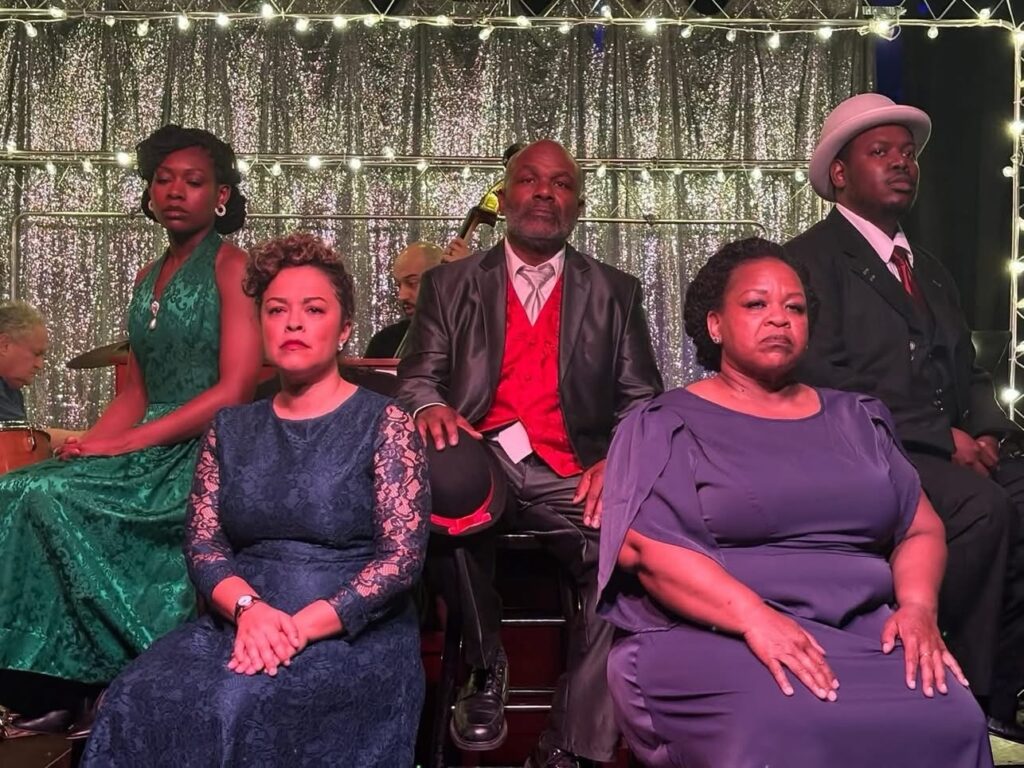
 The decision to position the musicians directly onstage pays immediate dividends.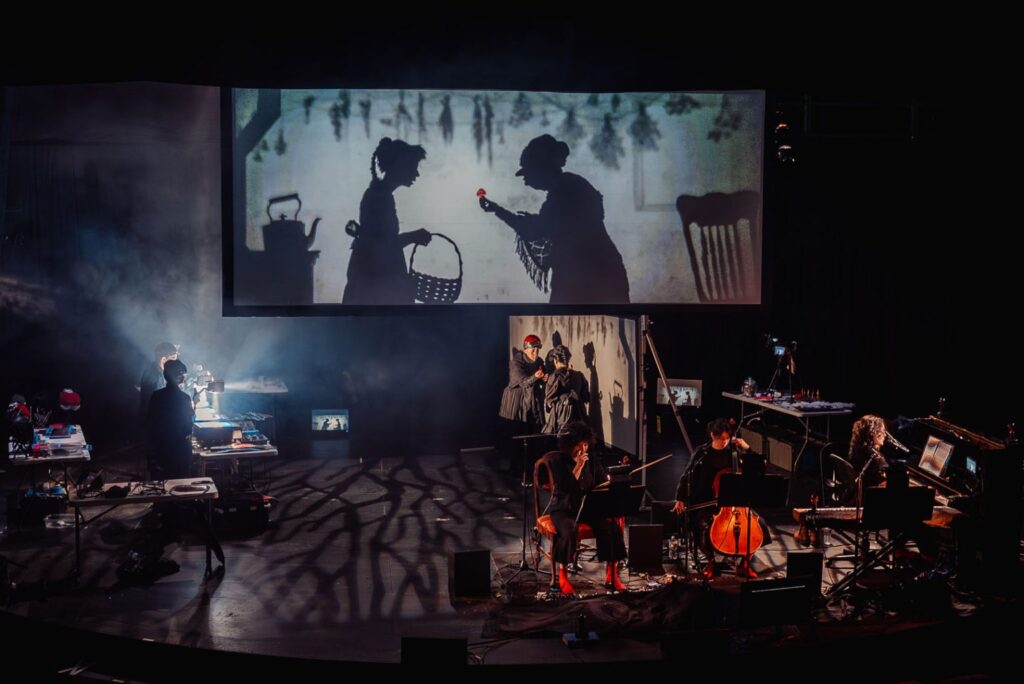
 Founded in 2010 by Drew Dir, Sarah Fornace, Julia Miller, Ben Kauffman, and Kyle Vegter–all five share co-artistic director credits–Manual Cinema has built an international reputation for pushing the boundaries of storytelling. The 4th Witch may be their most ambitious creation yet. Rather than simply retelling Macbeth from the perspective of kings, warriors, or even Shakespeare’s famous trio of witches, the production introduces audiences to a young girl whose life is forever altered by the violence occurring around her. What begins as a story unfolding in the shadows of Shakespeare’s tragedy gradually becomes a deeply human exploration of loss, survival, identity, and the choices we make when confronted with cycles of violence.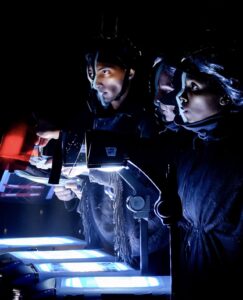
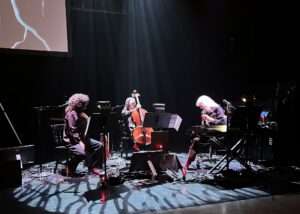 Equally deserving of recognition is the magical yet anything but witchy trio of musicians positioned in full view of the audience throughout the performance. Alicia Walter‘s vocals and keyboard work, joined by Lucy Little‘s violin and vocals and Erica Kremer‘s cello and vocals, create a lush, cinematic score that frequently serves as the emotional engine of the story. Their contributions elevate the production beyond a technical marvel into something genuinely moving, underscoring moments of wonder, danger, grief, and hope with remarkable sensitivity.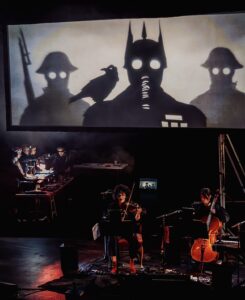
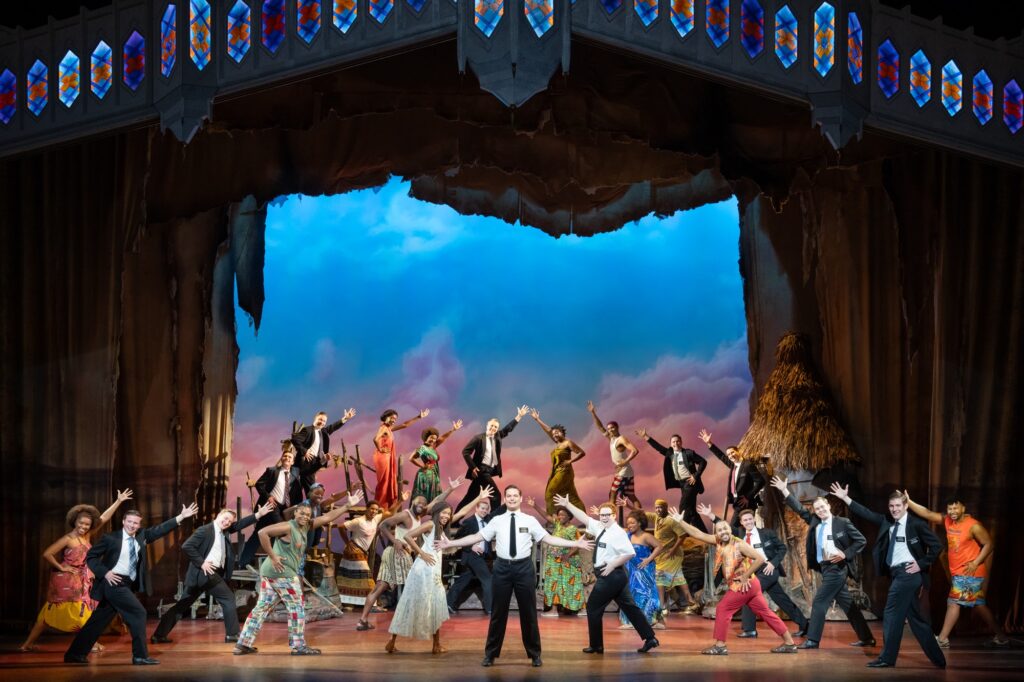
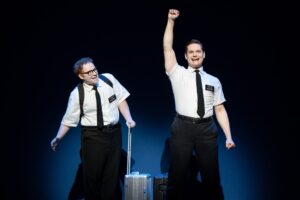 Leading the charge is Ethan Davenport, who takes on the pivotal role of Elder Price in this engagement. As Elder Price, Davenport embodies the character’s confidence, ambition and occasional arrogance with effortless charm. Blessed with a powerful Broadway tenor and an all-American leading man presence, he delivers “You and Me (But Mostly Me)” and the Act Two anthem “I Believe” with the kind of vocal confidence that anchors the entire production.
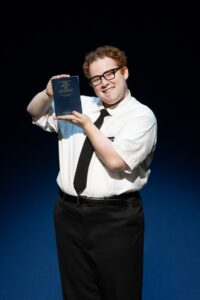 Opposite him, Jacob Aune’s Elder Cunningham is everything the role demands—awkward, lovable, wildly inappropriate and impossible not to root for. Cunningham is essentially a walking collection of half-remembered science fiction plots, social anxiety and misguided optimism & a bit of a walking, talking South Park character in human form, and Aune embraces every glorious second of it.
 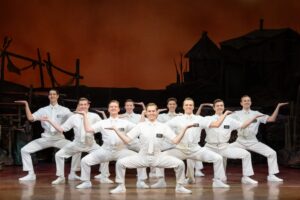 Yet it’s Craige Franke as Elder McKinley where Franke truly steals scenes. His performance of “Turn It Off” is a masterclass in comic timing, complete with dazzling choreography, impeccable facial expressions and enough jazz hands to illuminate Broadway itself. Heck, the featured ensemble during “Turn It Off” is simply tap-tactic. Having spent years with the company in multiple capacities, Franke understands this material inside and out, and it shows. His cheeky, campy cameo in “Scary Mormon Hell Dream”, helps make it a
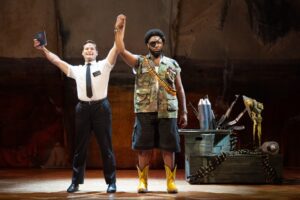 As The General, Shafiq Hicks delivers one of the production’s most commanding performances. Possessing a booming stage presence and undeniable authority, Hicks makes an immediate impression from the moment he appears. His performance of “Hasa Diga Eebowai” earns exactly the reaction one hopes for from first-time audiences: gasps, nervous laughter and a collective realization that The Book of Mormon intends to push every button it can find. Yet Hicks doesn’t just play the role as a caricature. Instead, he grounds the character in a reality that gives the surrounding comedy greater impact.
 What continues to impress most about The Book of Mormon, however, is how successfully it balances satire with sincerity.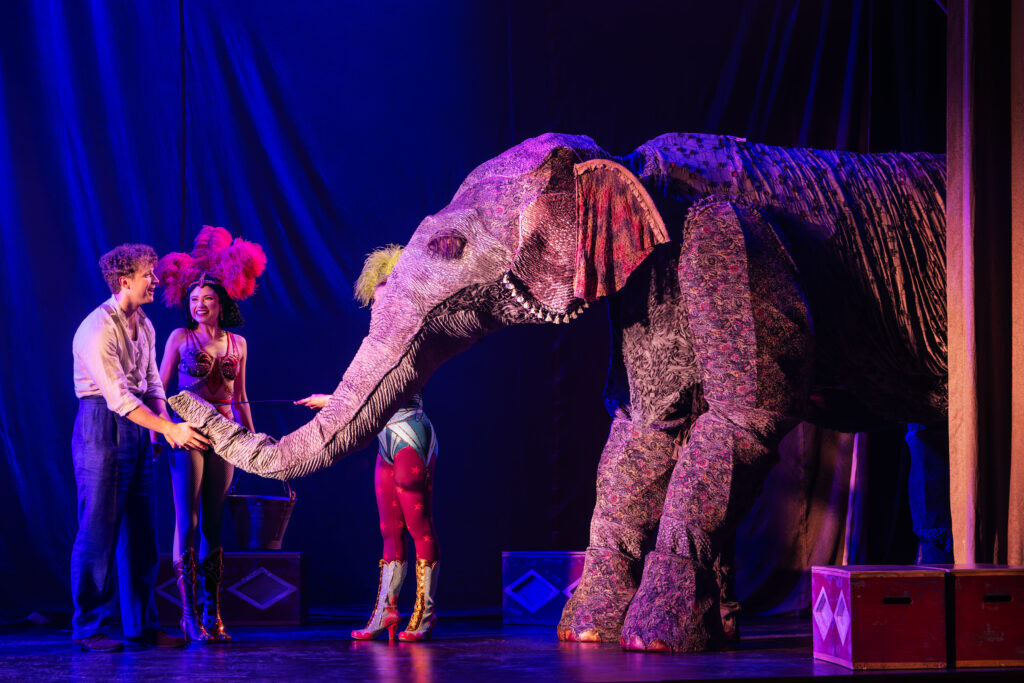
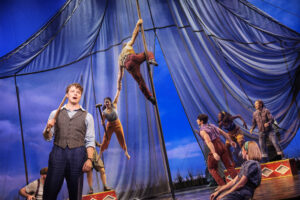 At the center of the production is Zachary Keller as Jacob Jankowski, the grieving veterinary student who impulsively abandons his former life and jumps aboard the Benzini train. Keller anchors the production with a grounded sincerity and a soaring vocal performance that gives emotional weight to Jacob’s internal struggle between safety and risk, logic and passion. His voice carries a warm ache throughout the evening, particularly in moments when Jacob wrestles with the moral compromises surrounding the circus and his growing connection to Marlena. There are moments within Keller’s performance that the entire audience falls in love with his Jacob. Heck, there are moments his near-perfect pitch vocals fill the venue so melodically that you even wonder if he needs a mic. A true testament to his skills and those of the show’s sound designer Walter Trarbach and the entire technical team.
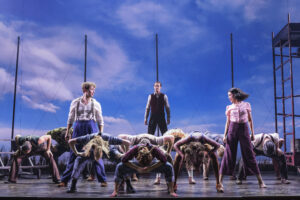 Opposite Keller (and Tully), Helen Krushinski delivers a luminous performance as Marlena, the circus star trapped inside an increasingly dangerous marriage. Krushinski possesses the kind of voice that cuts cleanly through the orchestrations without ever losing emotional nuance. She brings both fragility and fierce determination to Marlena, avoiding cliché and instead presenting a woman desperately searching for dignity and freedom amid chaos. Like so many of her ensemble cast mates, Krushinski also demonstrates a bit of impressive arial skills, adding a literal and figurative extra layer to her performance.
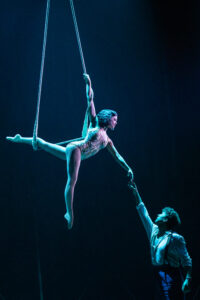 And yes — the aerial and acrobatic work is extraordinary. This production understands that circus artistry should not simply interrupt the narrative; it should become the narrative. Silks, balancing acts, lifts, and gravity-defying choreography emerge organically from the emotional life of the story. The transitions feel seamless rather than showy for the sake of applause. From the jump, as the circus ‘crew’ is setting up shop at their latest stop, even the pounding of the tent-stakes into the ground and the raising of the tent becomes a cadenced ballet of movement, acrobatics and mind-boggling balance and strength. This elegance of motion and bodily discipline becomes another character throughout.
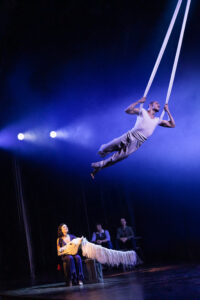 Particular praise belongs to Yves Artières, whose physical performance as Silver Star, Marlena’s beloved show horse, becomes one of the evening’s unexpected emotional centerpieces. Through movement alone, Artières creates personality, loyalty, exhaustion, and tenderness in a way that feels almost impossibly expressive. In a key scene when Silver Star reaches his untimely end, the visual of his spirit leaving his body, by way of Artières ascending silks hanging from the rafters above the stage, then dramatically unfurling the silks as he descends to return to the earth–simply breathtakingly beautiful. The puppetry/animal work throughout the production is remarkably inventive, but Silver Star’s presence lingers long after curtain call.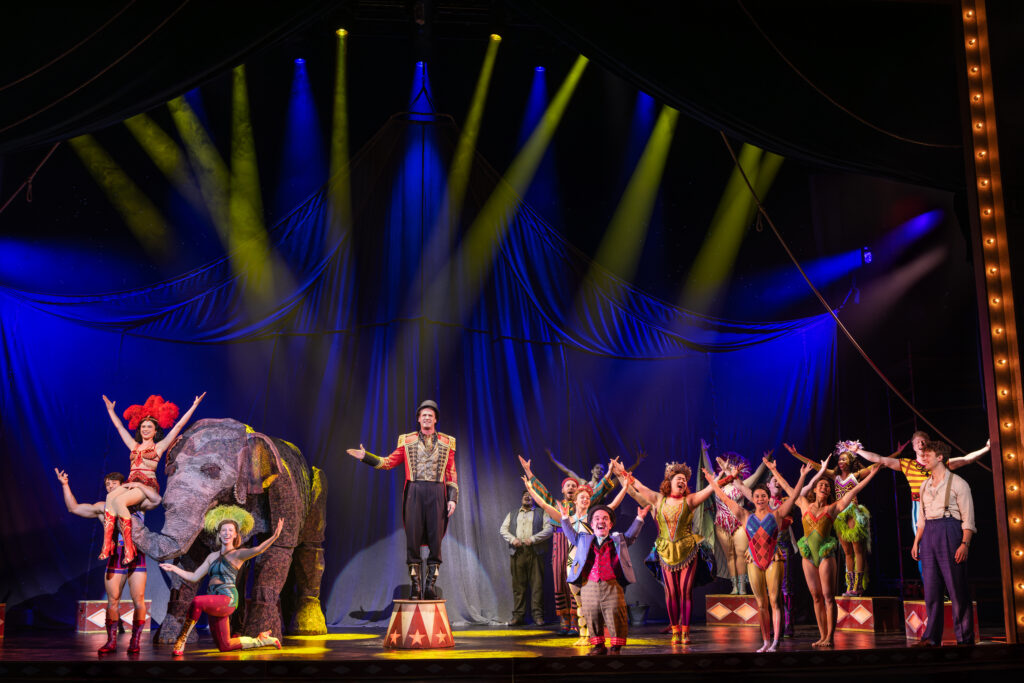
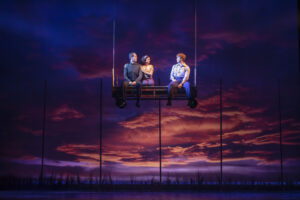 The lighting design deserves enormous credit for shaping the show’s emotional landscape. Warm ambers, smoky blues, and stark silhouettes constantly shift the atmosphere from romance to danger to wonder. Combined with a richly textured sound design that captures both the intimacy of whispered confessions and the thunder of circus chaos, the technical package immerses the audience completely without ever feeling excessive.
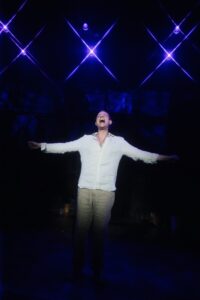
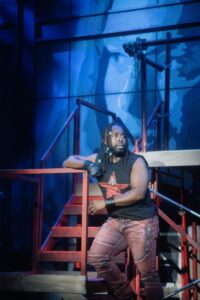 Opposite him, Grammy nominee Mykal Kilgore delivers a mesmerizing Judas. From the opening notes of “Heaven on Their Minds,” Kilgore refuses to portray Judas as a simple villain. Instead, his Judas feels conflicted, frightened, frustrated, and heartbreakingly human as he watches events spiral beyond anyone’s control. His powerhouse vocals soar effortlessly through the score, but it is the emotional vulnerability beneath the performance that lingers longest.
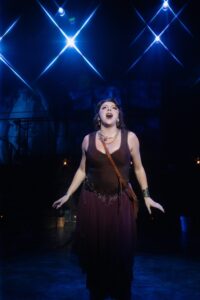 As Mary Magdalene, powerhouse vocalist Olivia Valli comes by her talents naturally. Granddaughter of The Four Season‘s founding member Fankie Valli, she’s a legacy entertainer. As Mary Magdalene, Valli brings warmth and aching sincerity to the role. Early on During “Everything’s Alright,” Valli’s calming presence provides a needed emotional balance amid the increasingly chaotic atmosphere surrounding Jesus. Soon after, her rendition of “I Don’t Know How to Love Him” avoids unnecessary theatrics in favor of emotional honesty, allowing the heartbreak within the song to quietly unfold. Under Cassidy’s direction, Valli explores the often-avoided attraction between Mary the woman and Jesus the man, once again offering yet another layer to the humanity of the piece.
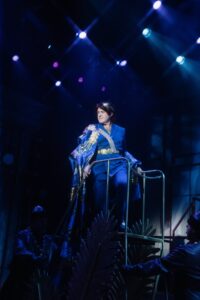 As Pontius Pilate, Geoffrey Davin offers one of the evening’s smartest tonal shifts . Presented as a gaudy, self-important joke of a man sporting an intentionally terrible hairpiece (kudos to the show’s wig designer Meredith Schieltz for just simply going for it), Davin leans fully into the absurdity of performative power. The portrayal initially earns plenty of laughs, but underneath the comedy lies another sharp reflection of the production’s larger themes—people desperate to appear more important than they truly are. His “Pilate’s Dream” balances nervous humor with growing dread, while sinisterly daunting presence during “Trial Before Pilate/39 Lashes” becomes genuinely unsettling.
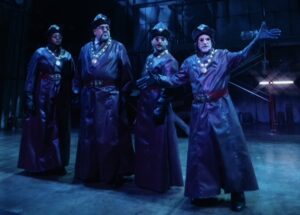 W. Scott Stewart’s thunderous bass vocals as Caiaphas roll in like a deep fog, brilliantly setting the stage for the dread and darkness to come. Robert Parker Jenkins‘ Annas perfectly snarky glances peering over those disturbingly small, dark glasses, brings an unspoken self-righteousness to his role as a high priest. As other members of Caiaphas’ doom squad, Garris Wimmer‘s sinister voice and Jennifer Whitcomb-Oliva‘s snide presence all come together perfectly to present a united and terrifying quartet who initiate the plot to end Jesus.
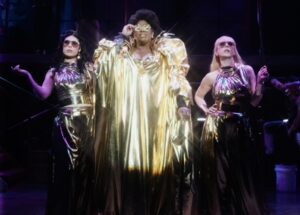 Then there’s the most intriguing of Whitcomb-Oliva’s multiple roles, her dazzlingly, gloriously commanding presence as King Herod. Landing somewhere firmly between Tina Turner’s Auntie Entity from Mad Max: Beyond the Thunderdome and Elton John’s Pinball Wizard from yet another rock opera, Tommy, Whitcomb-Oliva’s Herod is the true definition of the villainous character we know we’re not supposed to love, but we just can’t help ourselves. Combine the stage presence and spectacular wardrobe with Whitcomb-Oliva’s undeniable talents and you’ve got yourself a show-stopping performance and another of Studio Tenn‘s Jesus Christ Superstar‘s truly magical cast members. There is no role this mega-watt talented performer can’t handle and she proves it show after show after show.
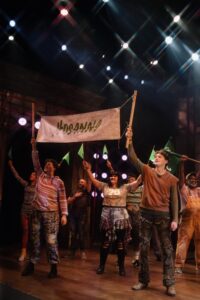 Other ensemble members like Bakari King, Garris Wimmer, Maya Antoinette Riley, Matthew Hayes Hunter, Savannah Stein, Lane Adam Williamson, Victoria Griffin, Emma Rose Williamson, Connor Adair, Nikki Berra, Christina Ledbetter and Patrick Jones each contribute to the overall energy, emotion and beauty of the piece. From the full ensemble Act 1 favorite, “What’s the Buzz’ to a shining, glittering all-in late-hour moment, the entire cast brings everything they’ve got, resulting in a feast for the eyes, the mind, the heart and soul.
 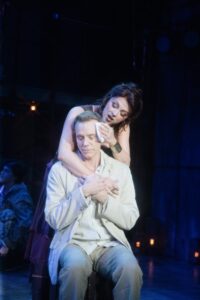 Likewise, Joi Ware’s choreography injects continuous movement and urgency into the production. There are moments where subtle Bob Fosse-inspired isolations seem to collide with flashes of Michael Jackson-inspired movement during larger ensemble sequences, creating choreography that feels simultaneously nostalgic and contemporary. Even those ensemble moments reinforce the power-in-numbers juxtaposed to the isolation of one theme found throughout the piece. Coupled with Cassidy’s direction, Ware’s choreography fills the stage with passionate movement, whether the entire company is on stage for a group number, or the action slows for a solitary moment from Pascal, Kilgore or Valli.