From the moment the lights dim at Turner Theatre at The Factory in Franklin and shadowed members of the ensemble began their hypnotic whispered “the blood is the life” mantra, Studio Tenn’s production of DRACULA (on stage through Sunday, October 26) takes a firm hold of its audience with a smart and tight grip. Under former Nashville Ballet artistic director Paul Vasterling’s direction, expertly aided by costume genius and set design phenom, Matt Logan, this staging of William McNulty’s adaptation (first made available in 2008) strides confidently between classic Gothic terror and gorgeous modern theatrical immediacy.
McNulty’s version—while drawing on the legacy of Deane & Balderstone’s earlier stage dramatizations of Bram Stoker’s 1897 novel—makes clear that DRACULA is not meant to be the one-dimensional romantic antihero so often seen in television and film adaptations, but equally a predatory force. In the playwright’s own notes, the Count is emphatically a predator, not a lover. That conception is borne out vividly here. From start to finish, this is a show that relies equally on precision, mood, and theatrical craft.
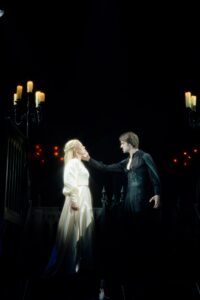 Jay Sullivan is chilling as Count Dracula. He doesn’t simply linger in darkness or seduce with tropes and languid charm; he strikes, unsettles, and stalks. Director Vasterling’s background in artistic movement are ever-present in Sullivan’s Dracula. Not only does he enrapture the beautiful Mina (Savannah Stein) in a spell-binding dance early on, but with every jump-scare stage entrance, Sullivan’s Dracula moves with purpose. And yes, just for fun, there’s even a fully cloaked cape-tossing moment or two mixed in. Throughout, Sullivan’s Dracula’s presence is truly commanding. While he could easily fit the bill of the stereotypical matinee idol fanged icon, Sullivan is never merely handsome—remaining always horrifying.
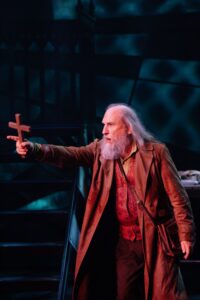 Opposite him, Sullivan’s performances is beautifully balanced by Brian Webb Russell who gives a gravely controlled performance as Abram Van Helsing, anchoring the heroic opposition with clarity of intent and moral weight. Russell’s Van Helsing offers the perfect amount of sharp intellect and righteous urgency. His verbal sparring with Sullivan’s Dracula are electric—two forces circling each other in a battle of will and belief.
Morgan-Ellene Davis (Lucy Westphal) delivers one of the show’s most affecting arcs: her descent from bright innocence into vampiric torment is staged with heartbreaking clarity. Davis’ Lucy, once bitten, switches from demure to demonic with ease and believability.
As previously mentioned Stein’s Mina is simply breathtaking. As the Count’s earlier victim before the action of the play, Stein’s Mina is as enchanting as she is enchanted. A later scene involving Mina and The Child (Emily Stephens) is chillingly portrayed, evoking terror and tenderness as the undead Mina and The Child form a undead maternal bond that equally heartbreaking and horror.
Andrew Johnson (Dr. Thomas Seward) and Nathan Quay Thomas (Jonathan Harker) each ground the story in human urgency; their moments of fear, confusion, and resolve feel earned.
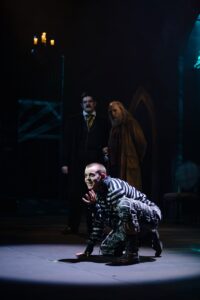 The trio of Lane Adam Williamson’s Renfield, DéYonté Jenkins’ Norbert Briggs and Catherine Gray’s Margaret Sullivan are tasked with carrying a bit of dark humor that helps temper the heavy suspense.
Williamson’s Renfield is the right mix of mania and pathos. Adding much-needed and unexpected light moments to the piece, Williamson’s Renfield is an absolute delight as he bounds around the stage in some sort of manic merriment. Truly a tour de force making the most of a role that is often portrayed simply as a fly-ingesting whack job, Williamson’s Renfield doesn’t just steal every scene he’s in, he steals it, strips it down for parts, rebuilds it and sells it to you again!
Jenkins and Gray also shine as employees of Dr. Seward, offering a bit of fun and frivolity in their relationship. When (Spoiler Alert) Margaret falls under the Count’s spell, her maniacal side takes over and Gray plays it like that one bipolar friend who’s off her meds. Additionally, Jenkins’ Briggs, when interacting with the bothersome Renfield is quite fun to watch.
On the subject of trios, the trio of brides—Savannah Stein, Jordan Tudor, and Emily Stephens—are ghostly and intoxicating. Their choreography, shifting entrances, and chilling harmonious wailings lend the production a spectral elegance.
Jonah M. Jackson as The Monster (the manifestation of Dracula’s cursed power) makes an audacious and visceral impression. His physicality in the climactic confrontation is bone-chilling, indeed.
Even the stagehands, cloaked in hood black, add to the seasonal spooktacular vibe.
From a design aspect, Matt Logan is simply a wunderkind. As mentioned above, Logan wears dual hats as scenic and costume designer, and his aesthetic is one of controlled Gothic minimalism. Rather than busying the stage with heavy, ornate wooden furniture, Logan has chosen to present a relatively stripped-down set design. Throughout the action, a pair of rolling stair units are easily moved for each scene change by the aforementioned cloaked stagehands, each with a lighted candelabra for effects. More candle-esque lighting is seen hanging high above the stage. Upstage is draped with a velvety fabric that reflects the light and seems to change color as the action (and Stephen Moss’ lighting cues) intensifies. Immediately in front of the drape Logan has designed a seemingly simple but effective stained glass backdrop reminiscent of oversized windows often seen atop a grand staircase in gothic castles of days gone by. Rather than present it as a typical pattern of multicolored glass, Logan’s stained glass appears to be translucent and iridescent shards in a circular pattern, not unlike a spider’s web. Perhaps yours truly is just too into the vampire lore, but I fancied Logan’s backdrop symbolic on many levels. The shards of glass represent the broken lives affected by the Count’s reign. The spiderweb-like pattern, a nod to the web of deceit the Count inflicts upon his victims. The iridescent glass, perhaps a call-back to the age-old notion that vampires cast no reflection.
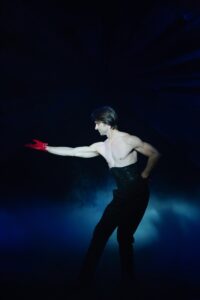 Then there’s Logan’s costumes. Every costume a work of art. The female cast members regal and radiant in finery fitting the period of the action. Van Helsing’s leather wardrobe, perfectly fitting for battle. Renfield’s asylum attire tattered and torn, but with a hit of glamour by way of some blinged-out blood spots. But it’s Dracula’s wardrobe that is truly glamorous and entrancing. From his first appearance bare-chested, but corseted in black to a black jacket accented with blood-red beaded erratic epaulets when he returns from a mysterious night right. (Gotta love that this particular look gets no mention within the context of the play, but is a jarring visual clue to the most astute audience member). The beauty of that costume not without merit, my personal favorite is yet another black jacket and pants combination. The jacket, from one side appears nothing special as the hem hits just below the actor’s waist, but from front view, its asymmetrical as the other side is more the length of a morning coat. Perhaps another visual clue of the duality of the wearer? Just when you think Logan’s used up his bag of costume tricks, in the final scene Dracula appears the most sparkly transfixing figure yet, but I’ll let you experience that on your own.
Elsewhere among the creatives behind the scenes, Stephen Moss’ lighting (with contributions from Rylee Hickey) is a constant revelation: pools of cold moonlight, abrupt slashes of red, deep shadows that swallow actors whole. Danny Northup’s sound design magnifies the small — a footstep, the soft drawn breath, the low hum in a crypt, mysterious howls in the night — and turns them into moments of tension. Eric Pasto-Crosby’s fight choreography delivers fight sequences that are not merely stagey but grounded: scrambles in dim light, body’s crashing violently (and realistically) against walls and tables, accentuating both subtle and substantial power shifts. Nettie Mae Craft’s work as dialect coach ensures an authenticity to the time the action takes place. Meredith Schieltz and the wig and makeup team and dressers intensify the look without theater-of-the-grotesque excess, sustaining consistency even through blood and transformation. Props by Charlie Webb, scenic artistry by Lauren Walters, and the carpentry under Brandon Penry all contribute quietly but indispensably—when a creature of the night beckons, a window smashes, or the coffin appears, you believe it.
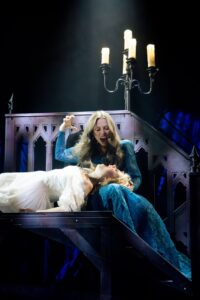 What impresses most about this DRACULA is how it leans into its horror while refusing sentimentality. McNulty’s choice to portray Dracula as predator (not tortured romantic) is honored here. That clarity gives other elements room to breathe: the trauma of Lucy’s affliction, Mina’s struggle with memory and agency, Van Helsing’s moral burden, Seward’s scientific disbelief challenged by the impossible.
The play’s structure (multiple fast scene changes, eerie transitions, raising stakes) is handled deftly. The pacing is smart: you never lose tension, but you’re given moments to breathe, to register dread, before it ratchets upward again. The final confrontation is, yes, wild and shocking — and fully satisfying.
Studio Tenn has earned a reputation for ambitious, emotionally rooted theater, and this DRACULA fits right in. It reminds me of their earlier presentations of Frankenstein and The Elephant Man. The earlier pieces ask “how do we see others?” While DRACULA asks “what does it mean to be unseen, to prey and be preyed upon?” Each, done exceptionally well, move past spectacle into something more haunting. In DRACULA, they pivot to horror, but retain that same appetite for theatrical integrity.
The fact that The Elephant Man and Frankenstein focused on what it means to be seen, to be judged by appearances—and DRACULA similarly addresses what is hidden, what preys beneath the surface—makes them complementary bookends in Studio Tenn’s always forward-moving trajectory.
Studio Tenn’s DRACULA is a production about control—control of terror, of space, of silence, and finally, of life and death. Its success lies in restraint and focus: the cast, led by Sullivan and Russell, deliver committed and precise performances; Logan’s design and the entire technical team generates atmosphere that lives in your spine; and Vasterling’s direction always keeps more in shadow than in full reveal. After all, it’s what we don’t see that scares us the most.
If you’re looking for a Halloween theater experience that is both smart and visceral, Studio Tenn’s DRACULA is more than just a seasonal thrill—it’s a dark, disciplined piece of art. CLICK HERE for tickets and showtimes.
Following the drama of DRACULA, Studio Tenn lightens the mood with a PINK GOES GOOD WITH GREEN: A Cabaret Fundraiser for Studio Tenn at TPAC on November 8. Broadway stars Carrie St. Louis and Teal Wick, who both spent time on The Great White Way in the mega-hit WICKED, as Glinda and Elphaba, respectively, will headline this one-night-only event. CLICK HERE for tickets or more info. Then, it’s a decidedly different holiday offering when Studio Tenn‘s Season 16 resumes as they present IRVING BERLIN’s WHITE CHRISTMAS, which happens to be my personal favorite musical…not just holiday musical, but my favorite musical of any genre and any era! CLICK HERE for tickets or more information.
Wanna keep up with the latest from Studio Tenn? Be sure to check out Studio Tenn online at StudioTenn.com or on social media at Facebook, Instagram and X.
Interested in coverage for your latest entertaining endeavor? Click the contact page and drop me a note. You can also follow JHP Entertainment on Instagram and Facebook. Until then, #GoSeeTheShow!

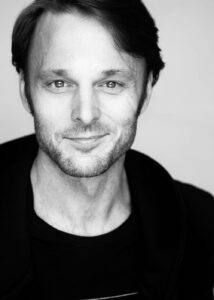

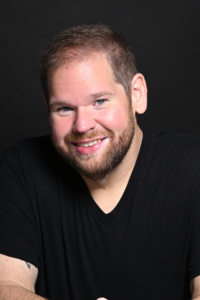 Rapid Fire with Robert Coles, Mina and others in Dracula: a Comedy of Terrors
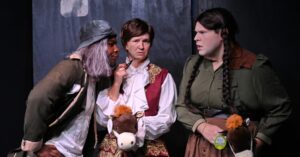 JHPENTERTAINMENT: Ann Street-Kavanagh is directing Dracula. Recently, you’ve worked with her as a co-star during Sordid Lives, as playwright and cast member for Aunt Sally’s Wild Ride and now as director and cast member in Dracula. How does the fact that you both are as adept on stage as behind the scenes affect your working relationship?
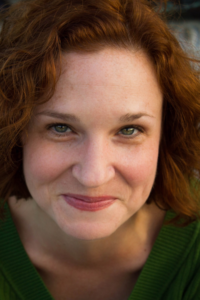 Rapid Fire with Beth Henderson, Renfield and others in Dracula: a Comedy of Terrors
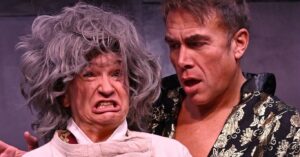 JHPENTERTAINMENT: One thing I noticed during the opening night performance was that the audience was laughing so hard there were instances we missed what I’m sure where some equally guffaw-inducing lines. To that end, how imports is audience reaction to the energy of the cast when performing comedy?
 Rapid Fire with Katie Fraley, Lucy and others in Dracula: a Comedy of Terrors
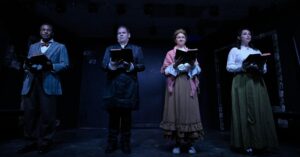 JHPENTERTAINMENT: In addition to Lucy, you also play a couple other roles, including the carriage driver and the elderly housekeeper. For the most part, your characters are the “straight men” to the more outlandish comic antics of some of the others. What’s the most challenging aspect of playing it straight in such an uproarious comedy?
 Rapid Fire with Jonathon Joyner, Harker and others in Dracula: a Comedy of Terrors
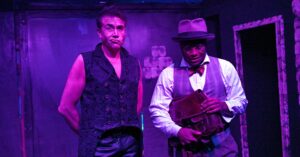 JHPENTERTAINMENT: Speaking of names, I love the fun name drops peppered throughout the script, including the ship being named the SS Stoker, a nod to Dracula author, Bram Stoker. Is there a scene or line in the show that you find particular amusing?
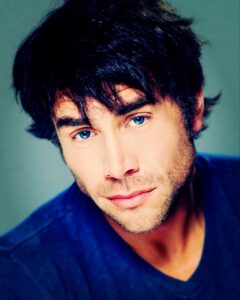 Rapid Fire with Jeremy James Carmichael, Dracula in Dracula: a Comedy of Terrors
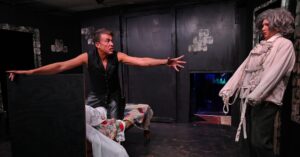 JHPENTERTAINMENT: Why should folks come see Dracula: a Comedy of Terrors. AND After seeing Dracula: a Comedy of Terrors, what do you hope they come away thinking of long after those two mysterious blood spots fade on their necks?