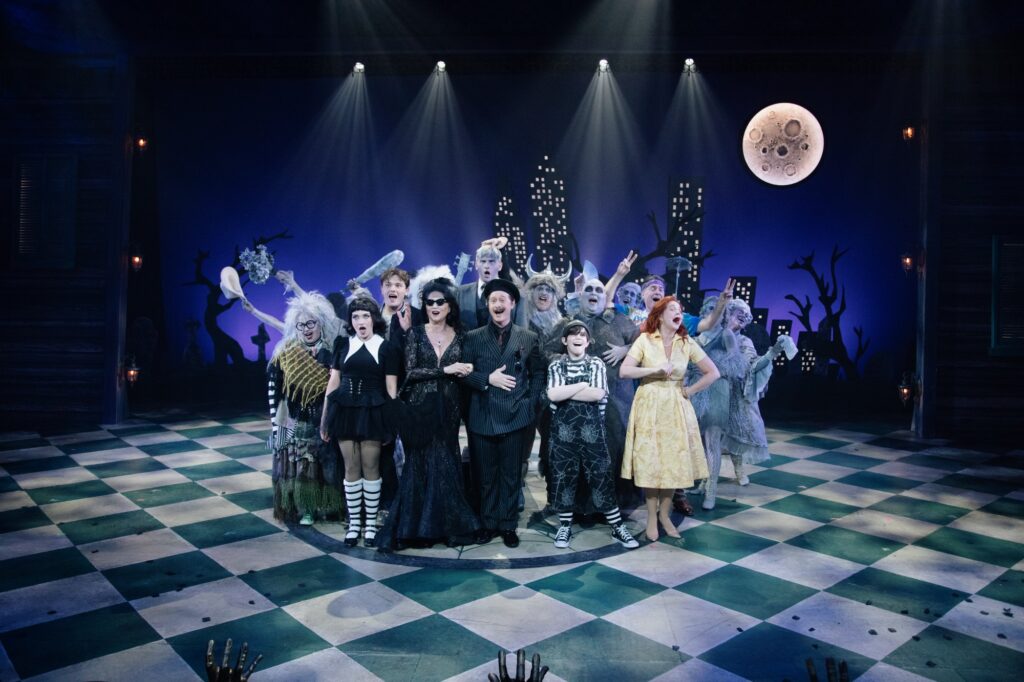
They’re creepy, they’re kooky, they’re altogether spooky, and they’ve arrived in Franklin looking better than ever. Studio Tenn’s production of THE ADDAMS FAMILY MUSICAL, on stage through Sunday, October 25, at The Turner Theater inside The Factory at Franklin, is a wickedly entertaining reminder that when it comes to theatrical spectacle, impeccable casting, and deliciously dark comedy, this beloved family knows how to make an entrance. With Broadway-worthy production values, eye-popping costumes, powerhouse vocals, and director Patrick Cassidy keeping the macabre merriment moving at just the right pace, this is one family reunion you won’t want to miss.
Based on the iconic characters created by Charles Addams, with a book by Marshall Brickman and Rick Elice and music and lyrics by Andrew Lippa, THE ADDAMS FAMILY MUSICAL finds Wednesday Addams (Anna Jones) in the unfamiliar territory of being in love. Her chosen beau, Lucas Beineke (Dylan James), is a perfectly respectable young man from a perfectly respectable family. Naturally, Wednesday’s idea of domestic bliss involves introducing him to her delightfully dysfunctional clan, while asking her parents to keep their more unusual tendencies under wraps. What could possibly go wrong? Well, when Gomez (Brian Michael Jones), Morticia (Sandra Allen), Uncle Fester (Jacob Waid), Grandma (Rachel Agee), Pugsley (James Hodgin), and Lurch (Scott Patrick Wilson) are involved, practically everything—and that’s precisely the fun of it.
At the helm, Cassidy understands that the trick to a successful ADDAMS FAMILY isn’t simply to deliver a parade of familiar characters and macabre sight gags. The comedy works because the characters are played with conviction, the relationships feel genuine, and the absurdity is never treated as an excuse to phone in the performances. Cassidy’s direction allows the physical comedy, romantic entanglements, and musical numbers to coexist without one overwhelming the others. The result is a production that feels polished, purposeful, and gloriously larger than life. There’s a confidence to this staging that recalls the kind of professional sheen audiences associate with Broadway, and the company delivers on that promise.
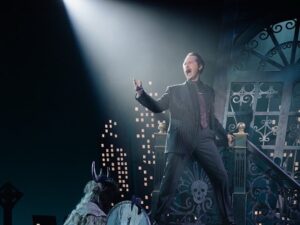 As Gomez Addams, Brian Michael Jones is the consummate master of ceremonies for this gloriously peculiar household. Familiar to Studio Tenn audiences, Jones marks his fourth production with the company, and his turn as the amorous, quick-witted patriarch is another welcome addition to that relationship. Gomez must balance his devotion to Morticia with his protective instincts as a father, all while navigating the family’s increasingly complicated affairs. Jones handles the character’s comic timing and romantic sincerity with ease, giving Gomez the charm and theatrical flair the role demands. He makes it clear that, beneath the pinstripes and the mischief, this is a man who adores his family—even when that family makes his life considerably more complicated.
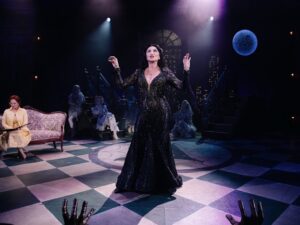 Sandra Allen’s Morticia Addams is a vision of dark glamour and commanding theatricality. Allen possesses a voice that is every bit as alluring as Morticia herself, and she uses it to glorious effect throughout the production. Her movement is equally impressive, particularly in “Tango de Amor,” where she brings the character’s sensuality and precision together in a number that practically sizzles. And then there’s that dress. Yes, that dress, cut down to Venezuela! It’s a jaw-dropping bit of costuming that would make even Morticia’s famously expressive eyebrows arch in approval. Allen understands that Morticia’s power lies in her composure, her wit, and her ability to command a room without appearing to exert the slightest effort. She is the very definition of dark elegance, with a vocal presence and physical confidence that make every entrance an occasion.
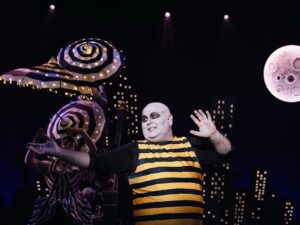 Jacob Waid’s Uncle Fester is an absolute delight, combining vocal strength, romantic exuberance, and an endearingly off-kilter sincerity that makes the character impossible not to love. Fester’s devotion to the moon is one of the musical’s most wonderfully ridiculous romantic conceits, and Waid embraces it with the enthusiasm of a man who has finally found his celestial soulmate. During “The Moon and Me,” he looks positively the bee’s knees in his swimsuit, an unexpected visual treat that only adds to the number’s goofy charm. But Waid’s performance is more than a collection of laughs and eccentricities. His commitment to Fester is evident in every detail, right down to the transformation required for the role. Usually quite hirsute, Waid has shaved his head AND his lumbersexual beard to become the bald, delightfully peculiar Fester. That’s dedication, folks! His performance once again backs up why he was named Best Stage Actor in Nashville Scene’s recently announced annual Best of issue. Between the vocals, the physical comedy, and the sheer joy he brings to the role, Waid makes a compelling case for the honor all over again.
Anna Jones, a recent Lipscomb University graduate making her Studio Tenn debut, has the unenviable task of making Wednesday Addams her own while following in the footsteps of one of the most recognizable characters in contemporary musical theatre. Consider that challenge conquered. Jones gives Wednesday a wonderfully deadpan exterior, but there’s just enough vulnerability beneath the black lipstick and killer stare to make her emotional journey believable. Her performance in the Act One fan favorite “Pulled” is a particular highlight, capturing Wednesday’s bewilderment as love begins to interfere with her carefully cultivated darkness. Jones delivers the number with an appealing blend of comic frustration and genuine feeling, making it easy to understand why Wednesday’s sudden brush with normal teenage romance feels so catastrophic to her. She doesn’t merely imitate the character audiences already know; she makes Wednesday her own. If director Cassidy knows what’s good—and I’m quite certain he does—this won’t be Jones’ last outing with Studio Tenn.
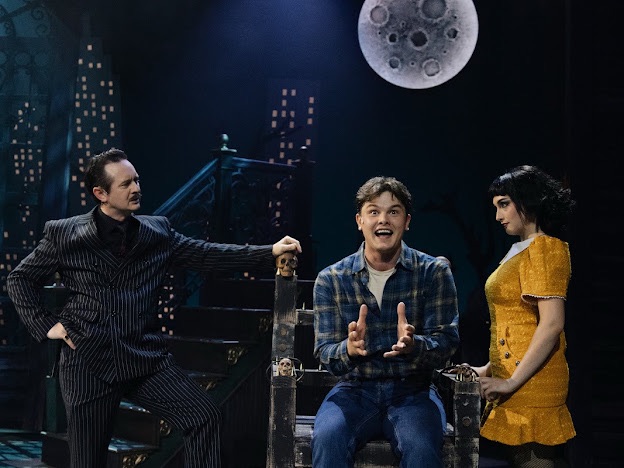
As Wednesday’s unsuspecting romantic interest, recent Belmont University graduate Dylan James makes for a charming Lucas Beineke. Last seen in Studio Tenn’s JERSEY BOYS ensemble, James steps into a featured role with an appealing combination of youthful sincerity and romantic determination. His Lucas is a teen dream, and that’s saying something, considering the nightmarish circumstances that meeting the creepy, kooky, ooky, spooky Addams Family might present to a young man expecting a relatively ordinary introduction to his girlfriend’s parents. James makes Lucas more than a straight-laced foil to Wednesday’s eccentricities. He brings enough personality and warmth to the role to establish why these two seemingly incompatible young people might actually be a perfect match. Their budding romance provides the emotional engine for the evening, and James is a winning partner for Jones.
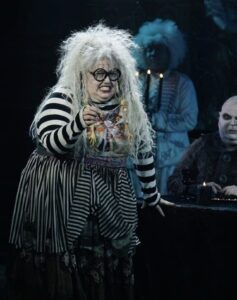
Rachel Agee’s Grandma Addams is one of the production’s many highlights. Almost completely unrecognizable beneath the wig, makeup, glasses, and that wickedly wonderful, intricately detailed costume, Agee disappears into the character with gleeful abandon. And yes, I’m fairly certain one layer of Grandma’s skirt features a zombie print, because apparently even the undead need a little fashion flair. Agee has a knack for making every moment count, whether she’s delivering a perfectly timed reaction or simply occupying a corner of the stage with the air of someone who has seen everything, done most of it twice, and probably poisoned the rest. If she’s onstage, she’s commanding the audience’s attention. Agee, as directed by Cassidy, is a deadly combination—in the very best way.
James Hodgin, the Pugsley I saw, is perfection as the bratty little brother who would rather torture his sister than see her fall in love and leave him behind. As a self-admitted bratty little brother myself, I feel uniquely qualified to recognize the authenticity of this particular sibling dynamic. Hodgin captures Pugsley’s gleeful mischief and underlying desperation with just the right balance, making his attempts to reclaim Wednesday’s attention both funny and oddly sympathetic. There’s something deliciously familiar about a younger sibling who considers torment a legitimate expression of affection, and Hodgin mines that relationship for every laugh. Lucas Goodfriend also shares the role of Pugsley at alternating performances. With these two young actors, rest assured that the Addams’ pint-sized agent of chaos remains a force to be reckoned with throughout the run.
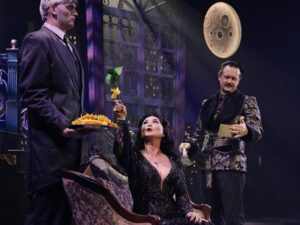 As Lurch, Scott Patrick Wilson breathes life—and a generous helping of heavy sighs—into the Addams family’s towering butler. Lurch is a character whose impact often depends on stillness, timing, and the occasional perfectly placed vocalization, and Wilson understands the assignment. His imposing presence and unhurried delivery provide a terrific counterpoint to the household’s more animated personalities. But don’t mistake his near-silent demeanor for a lack of theatrical contribution. Spoiler alert: Wilson is front and center in the show’s “Move Toward the Darkness” finale, proving that he’s not just a tall drink of Acrimonium. His contribution to the closing number is a particularly satisfying payoff for audiences who have watched this seemingly stoic servant hover in the background.
For the uninitiated, Acrimonium is the potion Pugsley swipes from Grandma to dose Wednesday in an attempt to return his suddenly besotted sister to her former tormenting self. Unfortunately, when Megan Murphy Chambers‘ Alice Beineke accidentally swigs the elixir, an otherwise hopefully uneventful family dinner erupts into a euphoric, laugh-riot awakening. Chambers is absolutely in her element as Alice, the buttoned-up suburban mother whose carefully maintained composure goes spectacularly off the rails. Watching her unleash a liberated, uninhibited version of Alice is one of the evening’s comic pleasures. Chambers knows how to turn a scene into an event, and her transformation gives the production one of its most memorable bursts of hilarity.
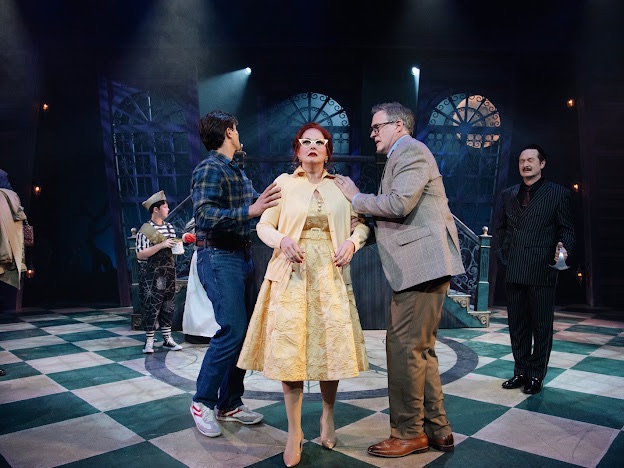
As Alice’s husband, Mal Beineke, Geoff Davin holds his own beautifully, proving that Alice’s straight man knows how to bend. Davin supplies the grounded reactions that make Chambers’ increasingly outrageous antics all the funnier, and the pair’s chemistry feels earned rather than manufactured. Both are beloved members of the Nashville-area theatre community, having shared the stage from time to time over the years, and their pairing here allows them to shine in roles that demand both comic precision and a convincing portrayal of a marriage under pressure. Their scenes are a reminder that the show’s central conflict isn’t simply about a supposedly normal family meeting a supposedly abnormal one. It’s about what happens when everyone’s carefully guarded secrets, insecurities, and expectations come spilling out at the same dinner table.
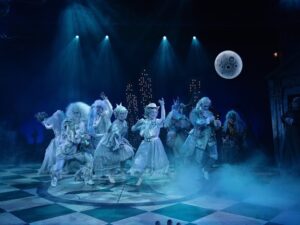 Rounding out the cast as the Addams Ancestors is a virtual who’s who of area up-and-comers and established favorites: Kelsey Brodeur, Maria Logan, Ryann Katherine Perkins, Meggan Utech, O’Neal Black, Alex Dee, Jonah M. Jackson, and Douglas Waterbury-Tieman. They provide the production with much of its visual richness and theatrical energy, helping establish the sense that the Addams family’s eccentricities stretch far beyond the living. The ancestors are more than atmospheric decoration; they contribute to the musical’s sense of tradition, history, and delightfully unconventional family values. Their collective presence gives the ensemble sequences added dimension and helps make the world of the show feel fully populated.
Of course, a musical of this scale succeeds only when the production values can match the performers’ energy, and Studio Tenn has assembled an impressive theatrical package. The costumes, designed by Devon Renee Spencer, are a particular triumph. The Addams family has an unmistakable visual identity, and these designs honor that legacy while giving each character a distinctive silhouette and personality. Homage without without exact duplication and it’s appreciated. Gomez’s tailored darkness, Morticia’s dramatic glamour, Wednesday’s severe monochrome aesthetic, Fester’s gloriously peculiar look, Grandma’s layered eccentricity, and Lurch’s imposing presence all contribute to the production’s cohesive visual language. The ancestors add another dimension of detail, with costumes that reward a closer look and reinforce the show’s macabre sensibility. Look and you’ll find a powdered-wigged dandy, a cowgirl, a flapper and more among the deliciously decked-out deceased. There’s a fine line between spooky and silly, and the wardrobe consistently lands on the right side of both. Makeup and wig design by Bailey Dorflinger-Slee is primarily spot-on, save a couple questionable wig choices—Wednesday’s Karen-ish flyaway nape fringe circa 2020, is…an interesting choice, but Grandma’s fright wig is chaotically crisp and frightfully right. The makeup, especially Fester’s sleepless hollowed eyes, Morticia’s ghoulish glam and the Ancestors’ ghostly glow, all add to the spooktacular look of the show.
The Broadwayesque scenic design by Andrew Cohen, perfectly mood-enhancing lighting design by Stephen Moss , choreo by Anna Claire Perry, music direction by Scott Brons and sound design by Danny Northup all come together brilliantly to further elevate the experience, creating a theatrical world that feels suitably grand without overwhelming the performers. The production’s visual atmosphere shifts to accommodate the show’s romantic, comic, and supernatural elements, while the lighting helps focus attention where it belongs, whether on an intimate exchange or a full-company musical number. The overall aesthetic is polished and purposeful, lending the evening the kind of professional finish that makes Studio Tenn’s larger-scale productions so satisfying. The design elements work in concert with Cassidy’s direction, allowing the performers to remain the focus while surrounding them with an appropriately extravagant Addams universe.
And then there are the voices. This is, after all, a musical, and the company delivers the vocal goods. Lippa’s score moves between big ensemble moments, character-driven comic numbers, and romantic passages, giving the cast ample opportunity to demonstrate its range. Jones’ “Pulled,” Allen’s commanding vocals, Waid’s spirited musicality, and the ensemble’s contributions make the score feel vibrant and alive. The music is never simply an interlude between jokes; it advances the story, deepens the characters, and gives the production its emotional momentum. The choreography and physical staging add further polish, with the company maintaining the precision necessary to make the larger numbers feel exciting rather than chaotic.
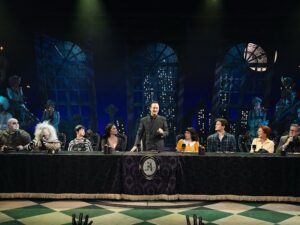 What impresses most about Studio Tenn’s THE ADDAMS FAMILY is the way it balances spectacle with character. The familiar black-and-white iconography, the dark humor, and the outrageous family dynamics are all present, but they’re supported by performances that understand the people beneath the eccentricities. Gomez and Morticia are devoted partners. Wednesday is a young woman discovering that love may be more complicated than she imagined. Lucas is a romantic caught between affection and bewilderment. Alice and Mal must confront the distance between the lives they present and the lives they actually lead. Even Pugsley’s desperate attempts to keep his sister close spring from a recognizably human fear of being left behind.
That emotional grounding gives the comedy room to land. The production never asks its audience to choose between laughing at the Addamses and caring about them. Instead, it recognizes that the family’s peculiarities are precisely what make them such enduring theatrical and pop-culture favorites. In this household, being normal would be the real horror.
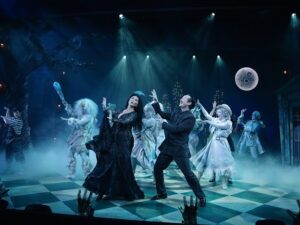 Studio Tenn’s THE ADDAMS FAMILY MUSICAL is a terrific showcase for a talented local company working at the top of its game. Cassidy’s assured direction, the cast’s spirited performances, the sumptuous costumes, the polished production values, and the score’s infectious theatricality combine to create an evening that feels every bit as ambitious and entertaining as the material deserves. From Allen’s show-stopping Morticia to Waid’s irresistible Fester, Jones’ winning Wednesday, and a supporting company that makes every corner of the Addams universe feel alive, this production delivers the goods.
The Addams family may have built its reputation on darkness, but Studio Tenn has found plenty of light in the shadows—and a whole lot of fun along the way. If you’re looking for a musical with Broadway-worthy polish, memorable performances, and enough kooky charm to make even the most buttoned-up Beineke loosen their collar, head to The Turner Theatre before the family packs up and returns to the crypt. Studio Tenn’s THE ADDAMS FAMILY MUSICAL is on stage now through Sunday, October 25, at The Turner Theatre inside The Factory at Franklin, 230 Franklin Road. CLICK HERE for tickets.
From Spooky Season to the most wonderful time of the year, following THE ADDAMS FAMILY MUSICAL, Studio Tenn rings in the holiday cheer with a return engagement of It’s a Wonderful Life: A Live Radio Play onstage at The Turner Theatre December 3-20. CLICK HERE for tickets or more information. Wanna keep up with the latest from Studio Tenn? Be sure to check out Studio Tenn online at StudioTenn.com or on social media at Facebook, Instagram and X.
Interested in coverage for your latest entertaining endeavor? Click the contact page and drop me a note. You can also follow JHP Entertainment on Instagram and Facebook. Until then, #GoSeeTheShow!
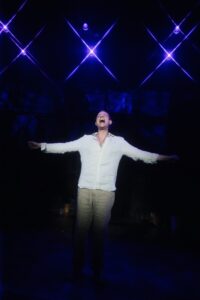
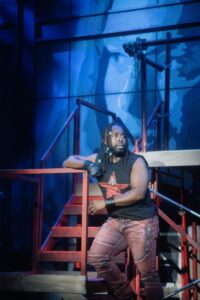 Opposite him, Grammy nominee Mykal Kilgore delivers a mesmerizing Judas. From the opening notes of “Heaven on Their Minds,” Kilgore refuses to portray Judas as a simple villain. Instead, his Judas feels conflicted, frightened, frustrated, and heartbreakingly human as he watches events spiral beyond anyone’s control. His powerhouse vocals soar effortlessly through the score, but it is the emotional vulnerability beneath the performance that lingers longest.
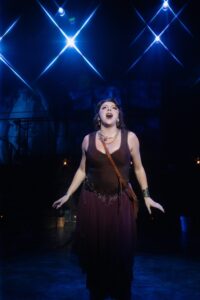 As Mary Magdalene, powerhouse vocalist Olivia Valli comes by her talents naturally. Granddaughter of The Four Season‘s founding member Fankie Valli, she’s a legacy entertainer. As Mary Magdalene, Valli brings warmth and aching sincerity to the role. Early on During “Everything’s Alright,” Valli’s calming presence provides a needed emotional balance amid the increasingly chaotic atmosphere surrounding Jesus. Soon after, her rendition of “I Don’t Know How to Love Him” avoids unnecessary theatrics in favor of emotional honesty, allowing the heartbreak within the song to quietly unfold. Under Cassidy’s direction, Valli explores the often-avoided attraction between Mary the woman and Jesus the man, once again offering yet another layer to the humanity of the piece.
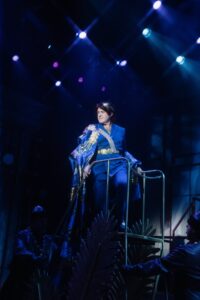 As Pontius Pilate, Geoffrey Davin offers one of the evening’s smartest tonal shifts . Presented as a gaudy, self-important joke of a man sporting an intentionally terrible hairpiece (kudos to the show’s wig designer Meredith Schieltz for just simply going for it), Davin leans fully into the absurdity of performative power. The portrayal initially earns plenty of laughs, but underneath the comedy lies another sharp reflection of the production’s larger themes—people desperate to appear more important than they truly are. His “Pilate’s Dream” balances nervous humor with growing dread, while sinisterly daunting presence during “Trial Before Pilate/39 Lashes” becomes genuinely unsettling.
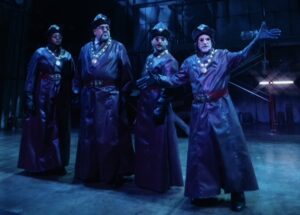 W. Scott Stewart’s thunderous bass vocals as Caiaphas roll in like a deep fog, brilliantly setting the stage for the dread and darkness to come. Robert Parker Jenkins‘ Annas perfectly snarky glances peering over those disturbingly small, dark glasses, brings an unspoken self-righteousness to his role as a high priest. As other members of Caiaphas’ doom squad, Garris Wimmer‘s sinister voice and Jennifer Whitcomb-Oliva‘s snide presence all come together perfectly to present a united and terrifying quartet who initiate the plot to end Jesus.
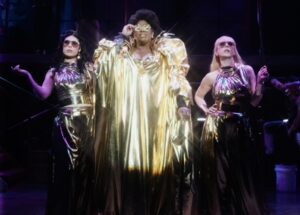 Then there’s the most intriguing of Whitcomb-Oliva’s multiple roles, her dazzlingly, gloriously commanding presence as King Herod. Landing somewhere firmly between Tina Turner’s Auntie Entity from Mad Max: Beyond the Thunderdome and Elton John’s Pinball Wizard from yet another rock opera, Tommy, Whitcomb-Oliva’s Herod is the true definition of the villainous character we know we’re not supposed to love, but we just can’t help ourselves. Combine the stage presence and spectacular wardrobe with Whitcomb-Oliva’s undeniable talents and you’ve got yourself a show-stopping performance and another of Studio Tenn‘s Jesus Christ Superstar‘s truly magical cast members. There is no role this mega-watt talented performer can’t handle and she proves it show after show after show.
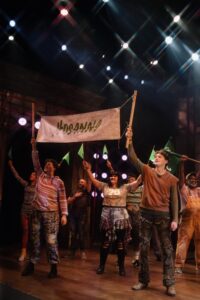 Other ensemble members like Bakari King, Garris Wimmer, Maya Antoinette Riley, Matthew Hayes Hunter, Savannah Stein, Lane Adam Williamson, Victoria Griffin, Emma Rose Williamson, Connor Adair, Nikki Berra, Christina Ledbetter and Patrick Jones each contribute to the overall energy, emotion and beauty of the piece. From the full ensemble Act 1 favorite, “What’s the Buzz’ to a shining, glittering all-in late-hour moment, the entire cast brings everything they’ve got, resulting in a feast for the eyes, the mind, the heart and soul.
 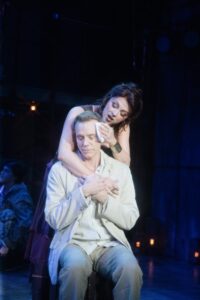 Likewise, Joi Ware’s choreography injects continuous movement and urgency into the production. There are moments where subtle Bob Fosse-inspired isolations seem to collide with flashes of Michael Jackson-inspired movement during larger ensemble sequences, creating choreography that feels simultaneously nostalgic and contemporary. Even those ensemble moments reinforce the power-in-numbers juxtaposed to the isolation of one theme found throughout the piece. Coupled with Cassidy’s direction, Ware’s choreography fills the stage with passionate movement, whether the entire company is on stage for a group number, or the action slows for a solitary moment from Pascal, Kilgore or Valli.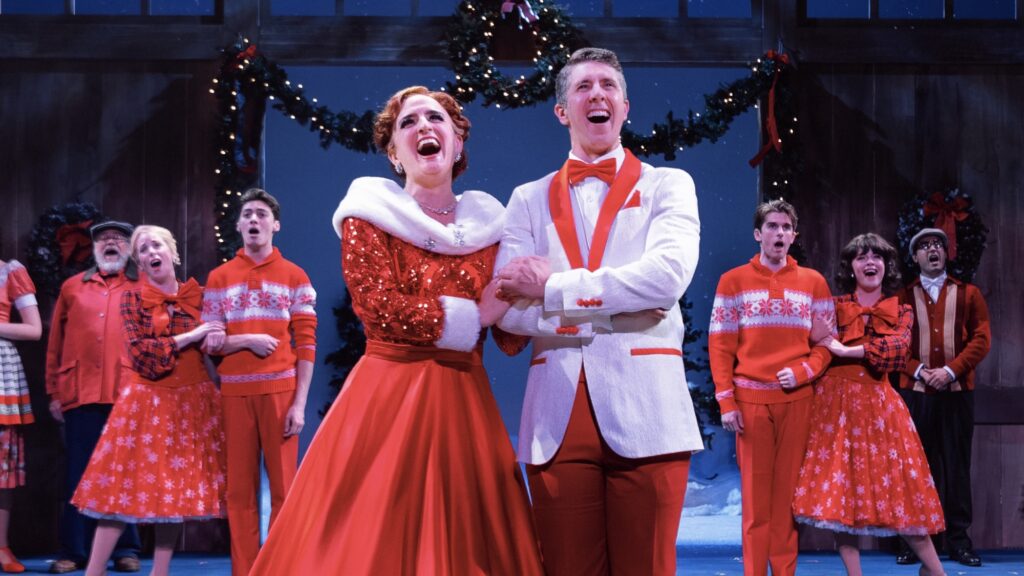
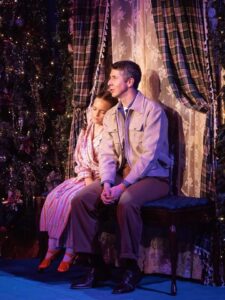 Ben Laxton, as the steady, dry-witted Bob Wallace, anchors the show with clean vocals and a grounded charm that never attempts to mimic Bing Crosby, but instead finds a sincerity and warmth all his own. His rendition of Count Your Blessings Instead of Sheep lands with a quiet power—simple, heartfelt, and beautifully sung.
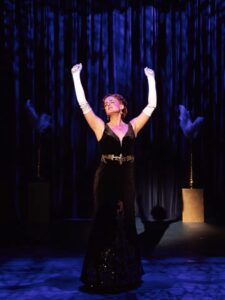 Laxton pairs especially well with Lisa Karlin’s Betty Haynes, whose rich, velvety alto brings a classic, old-Hollywood elegance to every number she touches. Her Love, You Didn’t Do Right By Me—a personal favorite moment of mine—was delivered with haunting restraint, channeling Rosemary Clooney without imitation and earning one of the night’s strongest responses.
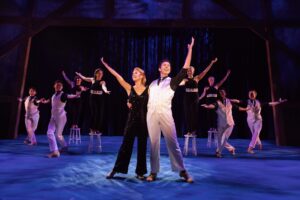 On the other side of the romantic coin, Jeremy Benton and Elizabeth McGuire ignite the stage as Phil Davis and Judy Haynes. Benton, not stranger to area theatre audiences, was last seen in Nashville as Bert in Nashville Rep‘s 2022 production of Mary Poppins, is also no stranger to the role, having performed in the National Tour of White Christmas and incredible 7 seasons. Speaking of previous connections to the show, Benton’s on-stage love interest McGuire, who’s making her Studio Tenn debut in the show, has previously appeared in two regional productions of White Christmas. Not only do they match the flirtatious comedic energy required of the roles, they also jointly co-choreographed the production—an ambitious undertaking given the show’s dance vocabulary is steeped in the iconic work of Randy Skinner. The result? Pure joy. Their The Best Things Happen While You’re Dancing is dreamlike and precise, but it’s the Act II taptastic extravaganza I Love a Piano that stops the show cold…or should I say Hot! Benton’s dancerly ease and McGuire’s crisp, buoyant tapping create the kind of musical-theatre electricity audiences hope for in December. They honor Skinner’s lineage while injecting fresh life into every step.
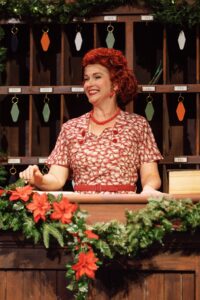 In comedic and heartwarming supporting turns, Megan Murphy Chambers (Martha) once again proves she can steal an act with one number. Her Let Me Sing and I’m Happy blends powerhouse vocals with effortless comedic bite—she lands every quip, every side-eye, and every belted high note with the precision of a seasoned pro. Belting lyrics like “if my song can start you laughin’/can start you cryin'”with humor and heart, rest assured MMC can and does! Chambers is a jewel in the crown of area theatre folk. She’s an entertainer’s entertainer. Equally at ease whether tasked with comedy or sincerity. Her scenes with Curtis Denham‘s General Waverly check all the marks perfectly hitting the highs of broad comedy and the more subtle genuine moments between two longtime friends. Speaking of, Curtis Denham brings a grounded gravitas to General Waverly, avoiding caricature and instead offering a touching
 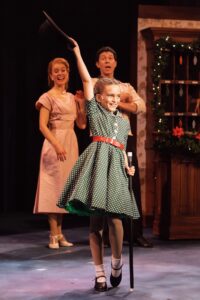 portrait of a leader rediscovering purpose. Rounding out the primary cast is young Frankie Lou Lauderdale, who simply charms instantly as Susan (Preslee Siebert also plays Susan at some performances). Lauderdale delivers the pint-sized earnestness gives the storyline its heart. I’ve always found it interesting that in the original film, Susan is General Waverly’s adult granddaughter, but for the stage adaptation, Susan is presented as a young girl. I does indeed add a more family-oriented dynamic and Lauderdale’s Susan provides the right amount of youthful sweetness combined with moxie, as proven in her cheer-inducing ambitious rendition of Let Me Sing and I’m Happy.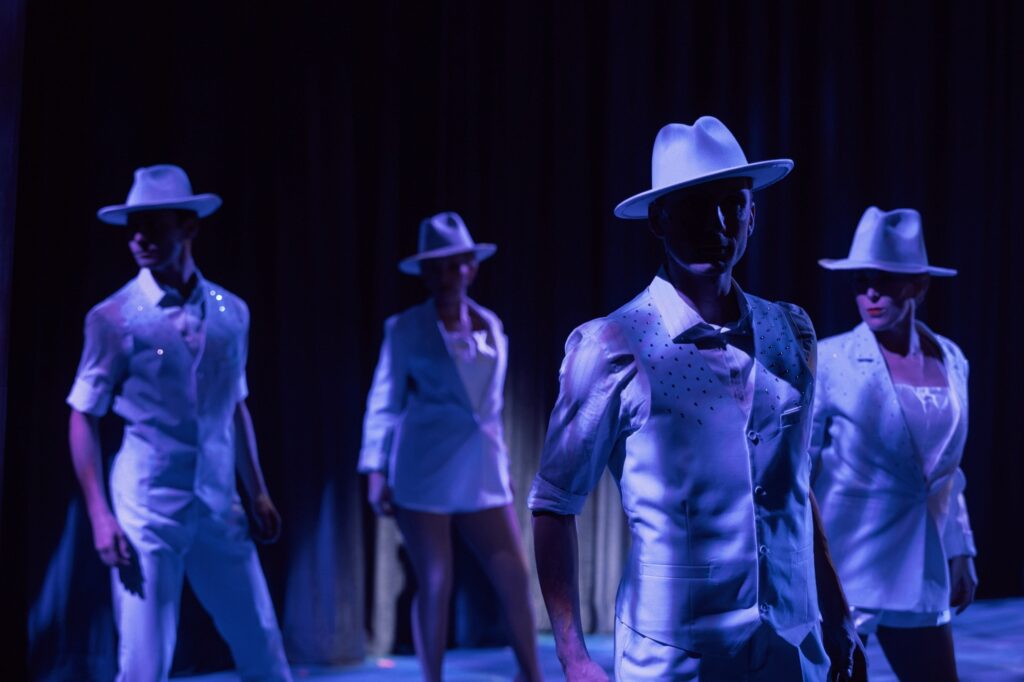
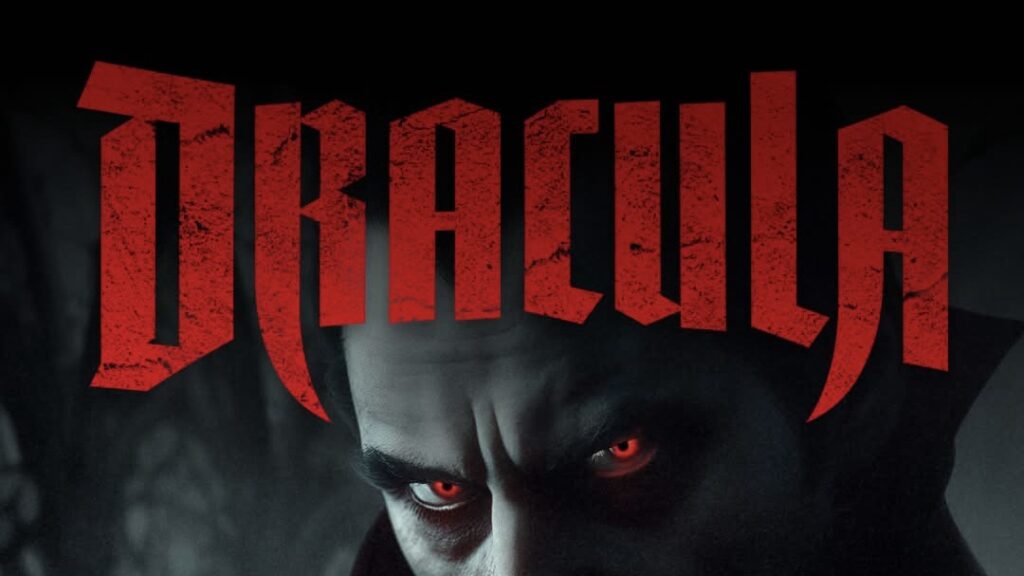
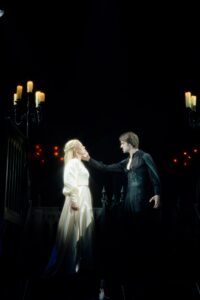 Jay Sullivan is chilling as Count Dracula. He doesn’t simply linger
 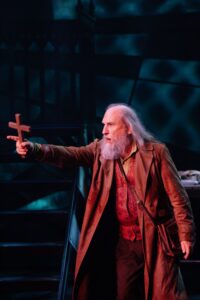 Opposite him, Sullivan’s performances is beautifully balanced by Brian Webb Russell who gives a gravely controlled performance as Abram Van Helsing, anchoring the heroic opposition with clarity of intent and moral weight. Russell’s Van Helsing offers the perfect amount of sharp intellect and righteous urgency. His verbal sparring with Sullivan’s Dracula are electric—two forces circling each other in a battle of will and belief.
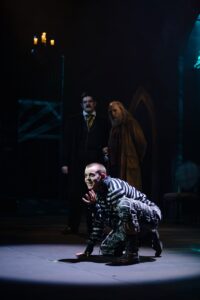 The trio of Lane Adam Williamson’s Renfield, DéYonté Jenkins’ Norbert Briggs and Catherine Gray’s Margaret Sullivan are tasked with carrying a bit of dark humor that helps temper the heavy suspense.
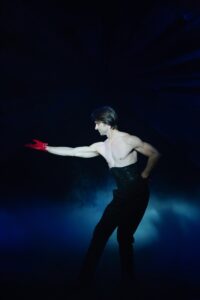 Then there’s Logan’s costumes. Every costume a work of art. The female cast members regal and radiant in finery fitting the period of the action. Van Helsing’s leather wardrobe, perfectly fitting for battle. Renfield’s asylum attire tattered and torn, but with a hit of glamour by way of some blinged-out blood spots. But it’s Dracula’s wardrobe that is truly glamorous and entrancing. From his first appearance bare-chested, but corseted in black to a black jacket accented with blood-red beaded erratic epaulets when he returns from a mysterious night right. (Gotta love that this particular look gets no mention within the context of the play, but is a jarring visual clue to the most astute audience member). The beauty of that costume not without merit, my personal favorite is yet another black jacket and pants combination. The jacket, from one side appears nothing special as the hem hits just below the actor’s waist, but from front view, its asymmetrical as the other side is more the length of a morning coat. Perhaps another visual clue of the duality of the wearer? Just when you think Logan’s used up his bag of costume tricks, in the final scene Dracula appears the most sparkly transfixing figure yet, but I’ll let you experience that on your own.
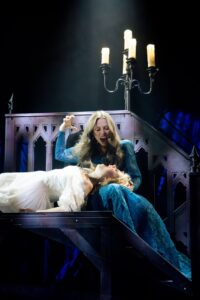 What impresses most about this DRACULA is how it leans into its horror while refusing sentimentality. McNulty’s choice to portray Dracula as predator (not tortured romantic) is honored here. That clarity gives other elements room to breathe: the trauma of Lucy’s affliction, Mina’s struggle with memory and agency, Van Helsing’s moral burden, Seward’s scientific disbelief challenged by the impossible.

 RAPID FIRE Q&A WITH IT’s A WONDERFUL LIFE’s GEOFF DAVIN
 RAPID FIRE Q&A WITH IT’s A WONDERFUL LIFE’s MARIAH PARRIS
 RAPID FIRE Q&A WITH IT’s A WONDERFUL LIFE’s CALEB SHORE
 RAPID FIRE Q&A WITH IT’s A WONDERFUL LIFE’s GEROLD OLIVER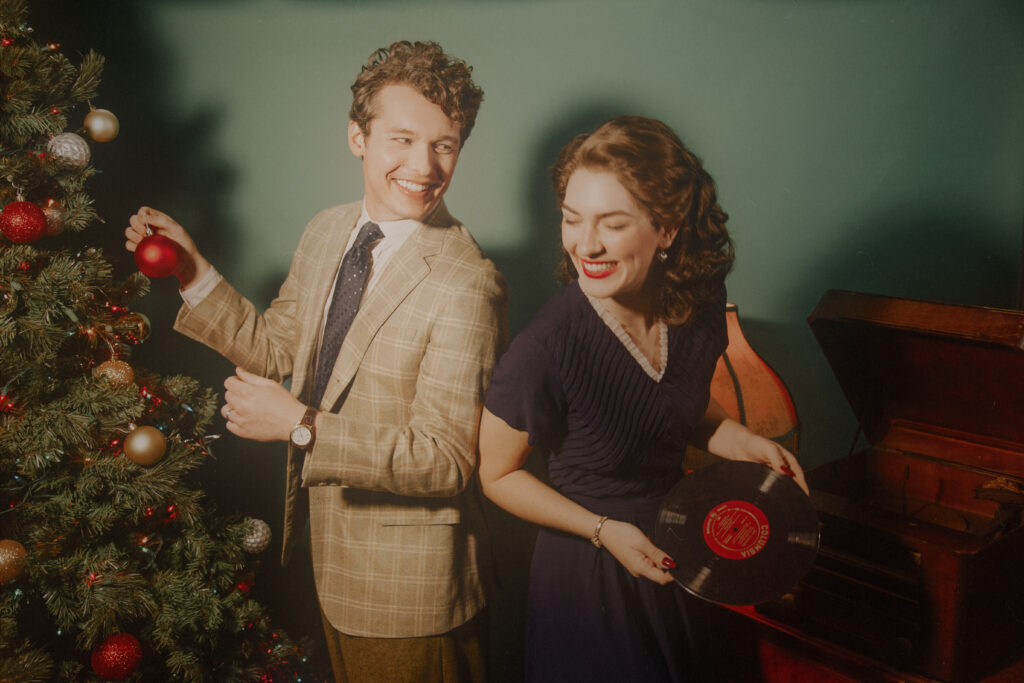
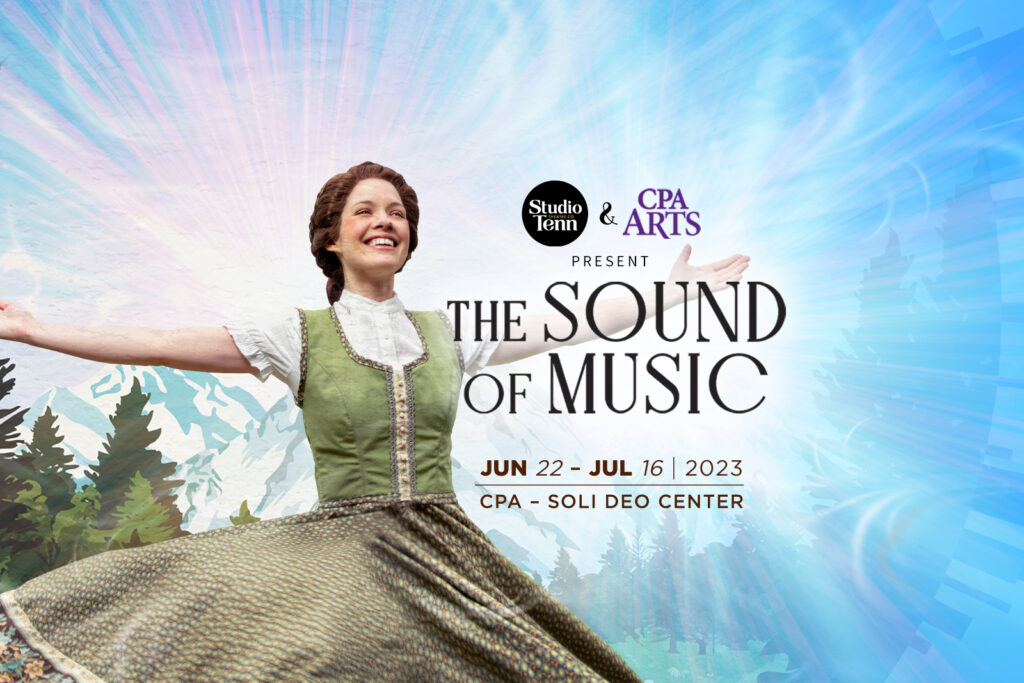
 RAPID FIRE Q&A WITH LAURIE VELDHEER, MARIA IN THE SOUND OF MUSIC
 RAPID FIRE Q&A WITH JOHN-MARK McGAHA, CAPTAIN von TRAPP IN THE SOUND OF MUSIC
 RAPID FIRE Q&A WITH JENNIFER WHITCOMB-OLIVA, SISTER BERTHE IN THE SOUND OF MUSIC
 RAPID FIRE Q&A WITH BRIAN CHARLES ROONEY, MAX DETWEILER IN THE SOUND OF MUSIC
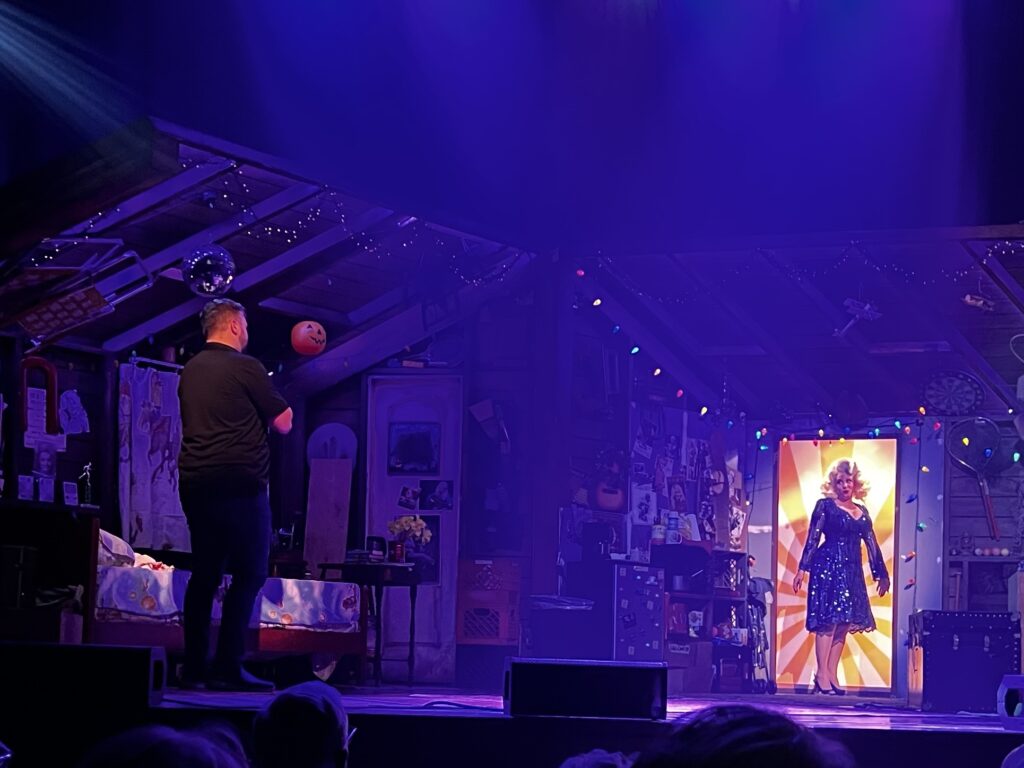
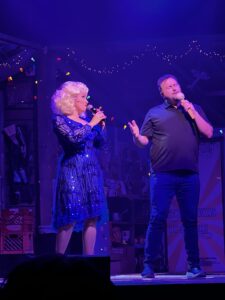 Further isolating Kevin, his parents are never seen in the play, and only his Mom’s voice is heard from off-stage from time to time. As the play begins, the audience gets their first glimpse at the show’s only set, the attic. Brilliantly created by Scenic Designer Anna Louizos with assistance from D. Craig M Napoliello, with lighting by Alessandra Docherty and assistant Isabella Gill-Gomez, the attic is easily recognized as both the family’s preferred storage area for seasonal decoration and Kevin’s former childhood playroom/teenage hangout. With pop culture relics from the far-distance 1980s, the attic set design is cleverly littered with things like a discarded GameBoy, an old Chineses Checkers boardgames and what appeared to be a single right Nike Air. But it’s the shrine to everyone’s favorite Country Music Songbird, Dolly Parton that’s most impressive…and I must admit relatable. I mean, switch all the Dolly posters, magazine pictures and photographs covering the walls for, say The Bionic Woman’s Lindsay Wagner, and you’d have my childhood bedroom.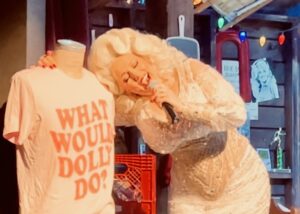
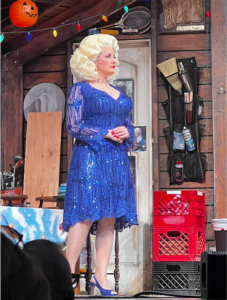 While most of the songs featured were written by Dolly, even the prolific singer/songwriter occasionally records tunes penned by others. Why’d You Come in Here Lookin Like That, Sing For the Common Man and the Dolly Parton/Kenny Rogers megahit, Islands in the Stream are all prefect placed and wonderfully sung. Interestingly, Islands, written by the Bee Gees, is followed by a funny, but very un-Dolly bit of snark courtesy Vilanch’s script.