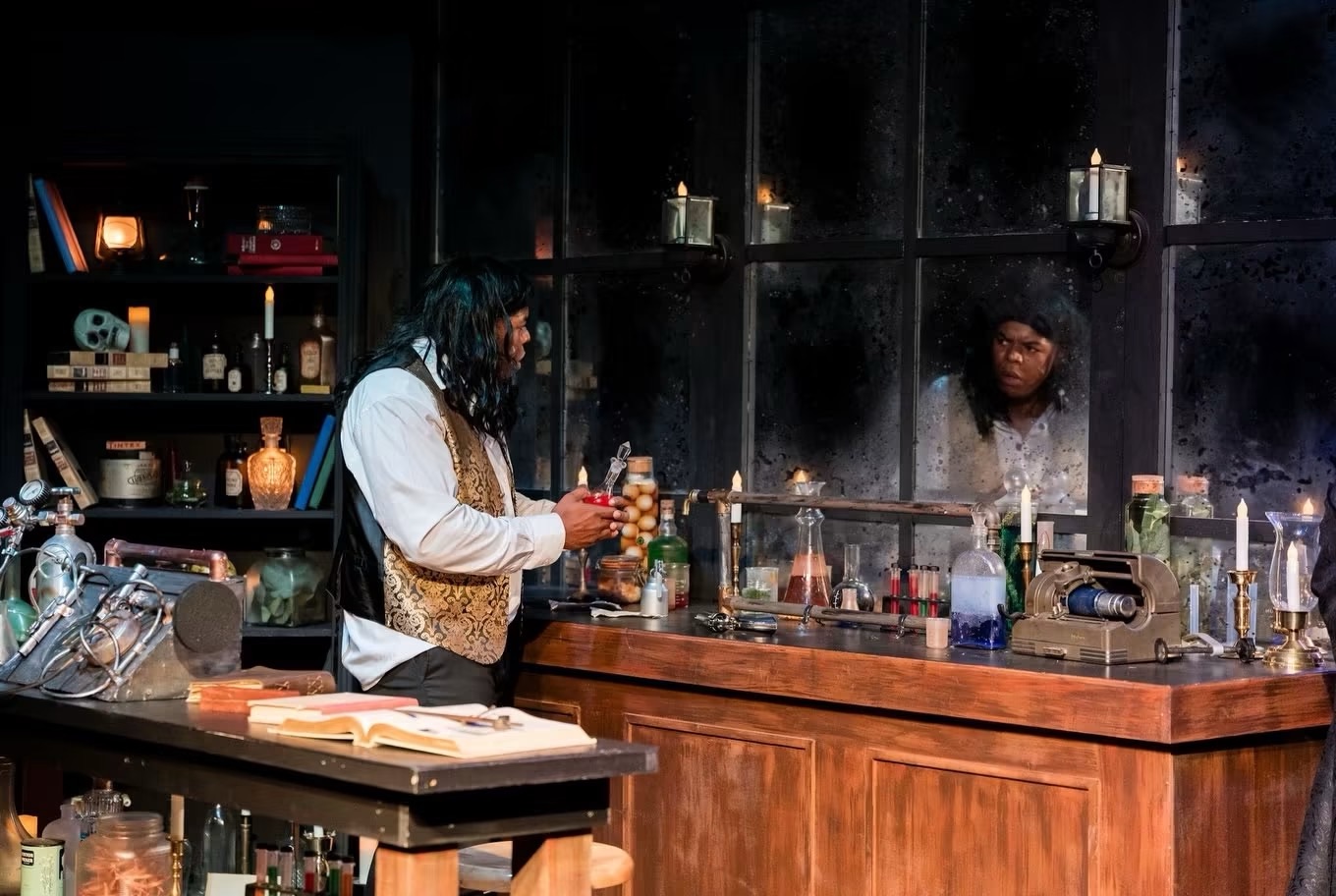
If you’ve never read Robert Lewis Stevenson’s gothic novella The Strange Case of Dr. Jekyll and Mr. Hyde, first published in 1886, upon which Steve Cuden and Frank Wildhorn conceived the musical Jekyll and Hyde (now onstage at Hendersonville Performing Arts Company through Sunday, October 4) with book and lyrics by Leslie Bricusse and music by Wildhorn—it’s the tale of a Victorian doctor so desperate to find answers about his father’s mental illness who creates a serum which isolates and presents one’s darker side as an almost separate being. Unable to find test subjects, the doctor takes the serum himself, but soon discovers he can’t control when his evil persona comes out of the darkness to wreck havoc on the streets of London—OR…in our current clickbait headline society, and through a slightly sarcastic lens, perhaps the plot of Jekyll and Hyde could easily be mistakenly interpreted as Bipolar Gothic Musical Fever Dream. Ok, so I’m joking, about that last part, but seriously, Jekyll and Hyde is one of a handful of musicals—most of them from the 80s and 90s—that I think I don’t like…until I see them again. HPAC’s current production definitely fits into that category. And, dang, was I wrong about not liking it. I loved it.
HPAC’s presentation helmed by director Marsalis Turner and music director Matthew Marcus marks my third time seeing this gothic musical, following the original pre-Broadway National Tour at TPAC in 1995, Circle Players’ 2010 production. After seeing Jekyll and Hyde three times over the course of more than 30 years, I walked into HPAC knowing the story, knowing the score and knowing exactly what happens to Henry Jekyll. While each production has had its own personality, what I didn’t know was that this production would leave me thinking I had just witnessed something extraordinary. HPAC’s Jekyll & Hyde doesn’t simply stand shoulder to shoulder with those previous productions—it just might be the best locally produced musical I’ve seen in my 20 years of covering theatre and my half century as an audience member. That is not a statement I make lightly.
Through Turner’s guidance, this production understands that Jekyll & Hyde requires more than strong voices and a familiar score. It needs atmosphere, danger, romance, desperation and just enough theatrical excess to make the gothic melodrama work. Turner delivers all of that while making remarkably effective use of HPAC’s performance space. And that space becomes part of the experience.
There is a wonderful sense of movement throughout the production, and I’m not just talking about the revolving circular cutout section of HPAC’s stage. Turner, alongside choreographer Allee Williams present a clear vision and keen eyes while staging the show and its two dozen plus ensemble with direction, placement and movement that makes the theatre feel considerably larger than the intimate space it occupies. Interestingly, when the plot calls for it—Jekyll’s transformation, a crowded street, the angry mod—the space also becomes uncomfortably crowded, but in the best way. Having been seated on the front row, there were scenes when Hyde’s snarling seemed frighteningly aimed directly at those of us in the audience within eyeshot. Conversely, there were moments when Lucy and the dancehall girls gave audience members a flirtatious glance. The result is a production that never feels confined by its surroundings, but invites its audience in. It’s a bit of unexpected immersive theatre.
One of the biggest surprises of the evening is just how ambitious this production looks. The set design by Dr. Andrew Armstrong and Britt Burkey is truly breathtaking, with Jekyll’s laboratory standing out as a particular triumph. Spookily illuminated and beautifully integrated into the action, the laboratory becomes more than scenery—it feels like an extension of Jekyll’s increasingly fractured mind. Spoiler Alert: When that turntable section of the stage rotates to reveal the laboratory (and if you didn’t read the word laboratory hearing a mad scientist’s voice in your head, what’s wrong with you?) there were approving audible gasps. It’s that gorgeous.
That atmosphere is heightened by Will Scoggins’ lighting design, which understands that Jekyll & Hyde is a story built in shadows. The lighting doesn’t simply illuminate the action; it helps create the world in which these characters are trapped. Gotta love a flooding of red light washing over the entire set when Hyde claims prey. A truly cinematic moment.
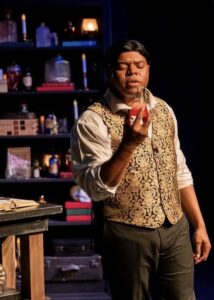 And then there are the three people at the center of that world. DéYonté Jenkins, as Henry Jekyll and Edward Hyde, takes on one of musical theatre’s great dual-role challenges and makes the transformation between the two personalities feel like an actual psychological unraveling rather than a theatrical gimmick. With the seemingly simple act of letting down his hair, increasing his audible breathing, snarling and yes, a bit of sweat and snotting, Jenkins transforms from Jekyll to Hyde in a scarily brilliant manner. Jekyll’s idealism, desperation and obsession gradually give way to Hyde’s darker liberation, and Jenkins makes that descent increasingly compelling. Again, the intimacy of this venue works with the show, not against it. Let’s not sleep on Jenkins’ vocals either. From Jekyll’s first musical number “Lost in the Darkness” to his final public transformation during “The Wedding”, whether as the meek and smooth as silk voiced Jekyll or the growling, guttural Hyde, Jenkins’ vocal control is enchanting. Those familiar with the musical can rest assured when Jenkins tackles “This is The Moment”, it’s not just a song title, it is the truth.
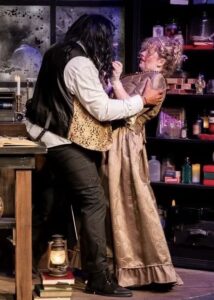 As Emma Carew, Dr. Henry Jekyll’s intended, Rebekah Joy brings an emotional strength to the production that keeps the character from becoming merely the devoted woman waiting for the troubled man she loves to come to his senses. There is genuine resilience beneath Emma’s affection, and Joy gives that emotional journey considerable weight. Vocally, Joy puts the opera in gothic opera. “Take Me As I Am”, Emma and Jekyll’s Act 1 duet showcases Joy’s control and power as a vocalist and as an actress. During this number you could have heard a pin drop in the sold out audience as Joy’s Emma hit that final note. Same goes for her Act 2 showstopper, “Once Upon a Dream”—goosebumps.
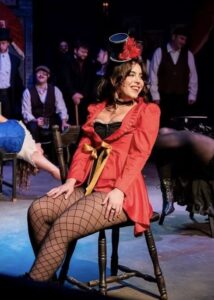 Then there is Francesca Noe as Lucy Harris, whose performance may be the production’s most heartbreaking. Noe gives Lucy vulnerability without ever making her fragile, allowing us to see a woman desperately searching for a way out of a world that has offered her precious few choices. Let’s face it, Lucy is the OG Pretty Woman, a hooker with a heart. Matching her co-stars note for note Noe’s vocal performance is gorgeous, but it is the emotional storytelling underneath those vocals that makes Lucy so affecting. From the rousing, rambunctious “Bring On the Men” to the Act 1 11 o’clock showstopper, “Someone Like You” Noe’s Lucy is stunningly captivating.
Together, Jenkins, Joy and Noe create something particularly effective: three people surrounded by others while carrying their own profound sense of isolation. It is that shared loneliness that gives the story much of its emotional power.
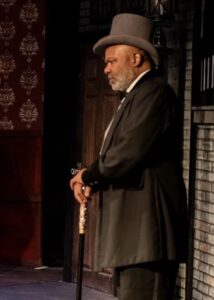 Skillfully aiding our lead as he navigates the uncertainty of his transformation is Elliott Robinson as Gabriel John Utterson, who initially serves up a bit of narrative exposition. Not gonna lie…knowing Robinson was among the cast was reason enough for me to check out this production. As he has done with any role he has taken on over the last two decades that he’s been a staple of area theatre, Robinson, simply by his presence, elevates the production. While this production doesn’t necessarily need any extra help in elevation, Robinson’s Utterson is the perfect unexpected ally to Jenkins’ troubled duality. Early on, Robinson’s Utterson joins the crowd for ‘Facade’ where he sings the telling line, “Each man you meet in the street isn’t one man, but two!” And how! It’s a simple phrase that could easily be lost if uttered by a lesser performer, but in Robinson’s capable hands, you’re like…Damn right.
The supporting cast features Lewis Walling, Alex Brazil, Jennifer Agatte, Tristan Graves, Noah Evitts, Ben Teal Davis, Adam Lang, Anthony Leverenz, Ezra High, Grace Montgomery, Brian Traughber, James Pevahouse and Kristen Pevahouse, Listen, thanks to their shared last name…
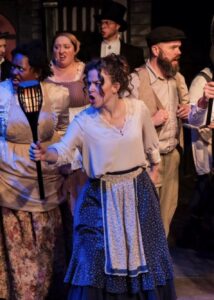
and their playbill bios…I now know that James and Kristen are married in real life, but even before I read that little tidbit, I noticed their playful chemistry as the brutish Spider and the spiritedly seductive Nellie.
The ensemble includes Francine Green-Thomas, Rachel Kell, Mary Mayhugh, Mack Overfelt, Jaime Riley, Savannah Villines, Genevieve Weaver and Sarah Fye (who also serves as assistant choreographer…wait! is that why she was the only dance hall girl wearing white lace-up ankle jacks when all the other Red Rat girls wear black?). Each and every member of the cast contributes to the production’s sense of place, helping create a world that feels populated beyond whatever scene is immediately unfolding.
Marsalis Turner, pulling double duty as director and Sound Designer, deserves particular praise, along with Markis Turner and Music Director Matthew Marcus, for the sound mixing. The score sounds full without swallowing the singers, allowing the vocal performances to remain front and center while still giving the orchestra the room it needs to create the musical’s dramatic sweep. Another subtle touch that deserves recognition: the use of reverb on several of the show’s key solo numbers. It gives those voices an almost ghostly quality, enhancing the haunting sense of aloneness that all three leads unknowingly share. It is a relatively small technical choice that adds considerable emotional depth to the production.
Marcus’ work as Music Director also helps keep the show’s demanding score moving with the dramatic urgency it requires, while the ensemble and supporting cast provide the Victorian world surrounding our central trio.
The production’s sound design makes that feeling even more pronounced. This is only my second show at Hendersonville Performing Arts Company, and while I thoroughly enjoyed HPAC’s previous production of Merrily We Roll Along, I recall the orchestra occasionally overpowering the vocals.
That problem has been remedied beautifully for Jekyll and Hyde. The 12-piece orchestra is located across the hall from the theatre space, allowing the sound team to control and blend the instrumentation with the vocals rather than having the orchestra compete with the performers. The difference is immediately noticeable.
There is also plenty happening behind the scenes to make the Jekyll and Hyde world work. Melissa Harris’ costume design helps establish the period and social distinctions of the characters without overwhelming the performers, while Melissa Kelly, as Assistant Costume Designer, contributes to that visual cohesion. If I could offer one tiny nitpicky note: steam those gorgeous gown fully. What can I say? I was distracted by a crease in one of Emma’s early outfits. Oh, and what was up with those mismatched argyles one of the male ensemble was sporting…YES, when a production is this great, you notice very minor imperfections).
While there was no one listed in the playbill credited for wigs/hair, it’s another element that lends authenticity and professionalism to this production. I was indeed impressed with, in particular, the ladies of the cast and their period authentic hairstyles. As for the good doctor, Jenkins opts for a, shall we say, smooth operator look in real life, so for Jekyll/Hyde he dons a wig. Yes, production could have sprung for a less-synthetic one—it did get kind of tangled during one key transformation scene and seemed to present a slightly lower hairline during Act 2, but again…when the rest of the show is so stellar, I’ve gotta mention the tiniest flaws, otherwise my own Jekyll/Hyde reputation as an honest reviewer might be tainted.
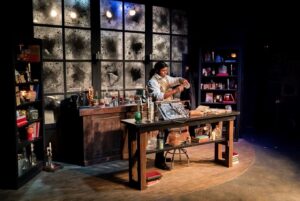 From the spooky frothing magic potion that turns Jekyll to Hyde to those candles that light the lab and books that become almost unnoticeably more disheveled and chaotic as the transformations become more frequent and uncontrolled…it’s those little touches by the set, scenic and props crew that bring you in this gothic world, and keep you there. Oh, and be sure and take notice of the handbills, notices and posters pasted to the wall just to the right of the main stage. My companion for the evening and I had fun during intermission figuring out what classic London lore each one represented. Nice touch! There’s also a fun, albeit completely out of place nod to our own skyline mixed in amongst the 1880s London skyline.
What makes all of this especially satisfying is discovering how much talent exists inside a company that could easily be overlooked by Nashville audiences. This incredibly ambitious theatre company is unassumingly tucked away in a newly revitalized strip mall just 15 miles outside Nashville in nearby Hendersonville. You could drive right past it. Don’t.
If Merrily We Roll Along was my introduction to what HPAC could do, Jekyll and Hyde is the production that has made me sit up and pay considerably closer attention. Because there is a difference between a community theatre production that successfully puts on a musical and a production that makes you momentarily forget where you are. HPAC achieves the latter.
There are moments during Jekyll and Hyde when the combination of Jenkins, Joy and Noe, the orchestra, the lighting, the sound design and that spectacular laboratory create an atmosphere that feels far bigger than the address on the marquee would suggest. And that’s ultimately what theatre is supposed to do.
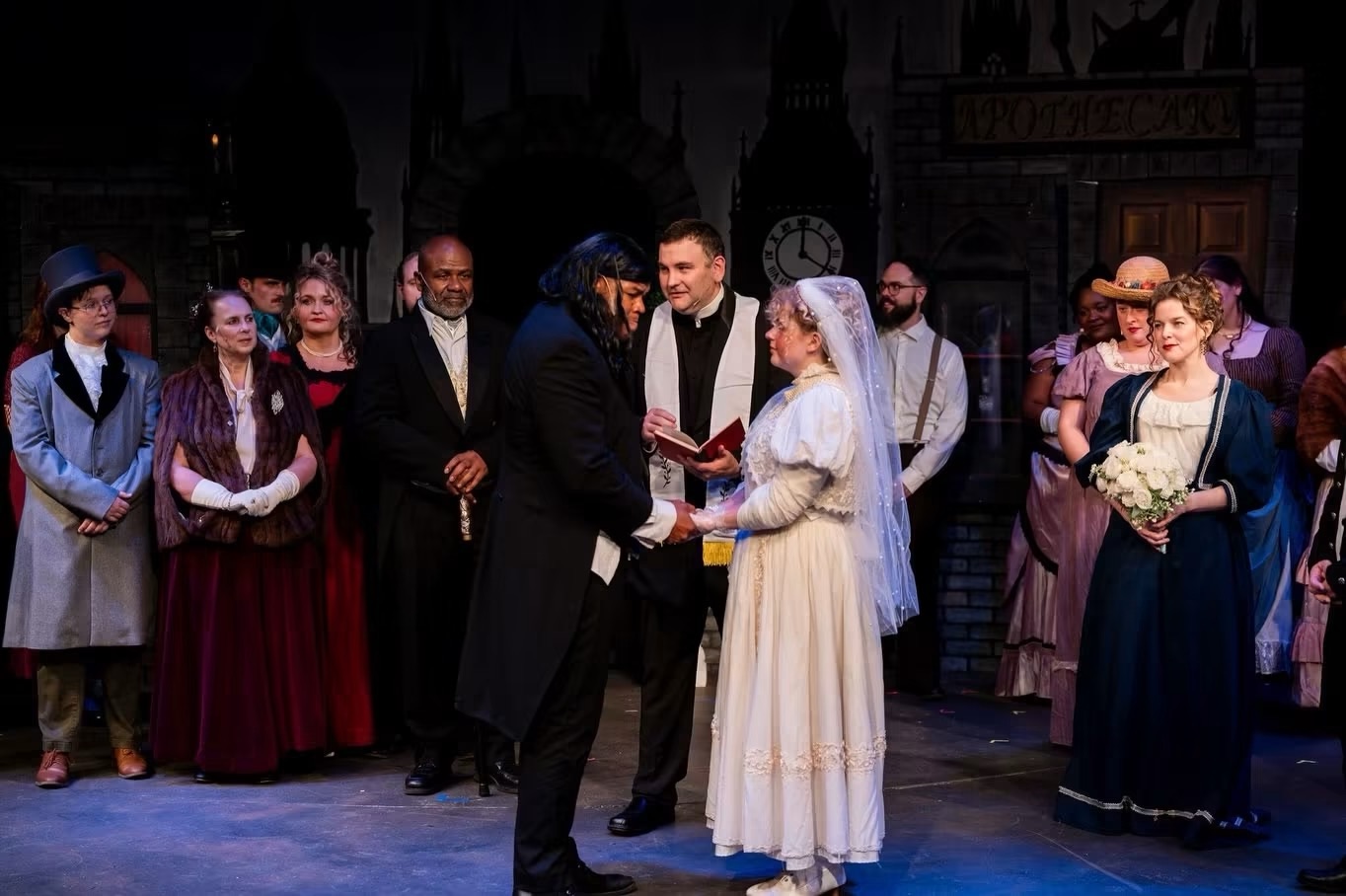
Marsalis Turner and his cast and creative team have created a production that is ambitious without being pretentious, atmospheric without becoming overdone, and emotional without losing the deliciously melodramatic spirit of the material. For a musical about a man attempting to separate the good and evil within himself, HPAC has found the perfect balance between the two. There is the spectacle. There is the darkness. There is the romance. There is the madness. And, at the center of it all, there are three remarkable performances and two dozen more supporting players that make us care about the people underneath the gothic theatrics. After 20 years of covering theatre and 50 years of sitting in the audience, I don’t throw around “best locally produced musical” casually. But this production makes a very convincing case for the distinction. HPAC’s Jekyll and Hyde isn’t simply a production worth discovering. It’s a production worth talking about. So don’t sleep on this company. Don’t let the unassuming address fool you. And don’t wait for Hyde to come looking for you. Go find him yourself.
Jekyll and Hyde: The Musical promises HPAC patrons a suitably sinister and thoroughly entertaining way to ease into the Halloween season. Jekyll and Hyde wraps its three week run at Hendersonville Performing Arts Company (260 West Main Street Suite 204, Hendersonville, TN 37075) with performances through Sunday, October 4. Performances are at 7:30pm Thursdays-Saturdays with 2pm matinees on Sundays. Tickets are $25/Adults and $22/Students and Seniors. All tickets are reserved seating. CLICK HERE to purchase tickets. For ADA accommodations, please call the box office at 615.826.6037. Please note: Jekyll and Hyde is rated PG-13 for violence, dark themes, sexual content and frightening scenes.