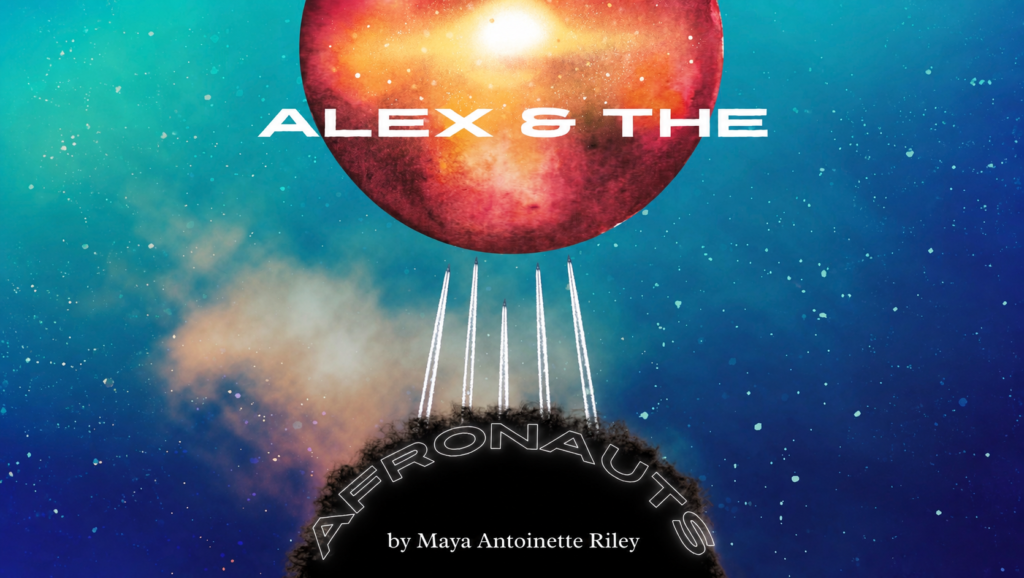
After two decades of covering theatre, one of the things I continue to enjoy most is getting the opportunity to discover and champion brand-new works—especially when they come from the creative mind of someone I’ve gotten to know over the years through Nashville’s theatre community. That makes Maya Riley’s Afrofuturist play, Alex and the Afronauts particularly exciting to follow. Having debuted an excerpt during last month’s 9th annual Kindling Arts Festival’s New Play Platter, it’s now time to hear the full story. At 7:30pm on Wednesday, September 2, playwright Maya Riley and director Jon Royal will present Alex and the Afronauts’s first-ever full staged reading at Darkhorse Theater as part of this year’s Shades of Black Theatre Festival. As the playwright, director and cast readied for the staged reading, JHPEntertainment had a chance to pose a few questions to Riley, Royal and actors Raven Buntyn and Andre Mason for our latest in our recurring interview feature, Rapid Fire 20Q.
RAPID FIRE 20Q WITH ALEX AND THE AFRONAUTS DIRECTOR, CAST MEMBERS & PLAYWRIGHT
 RAPID FIRE WITH ALEX AND THE AFRONAUTS DIRECTOR JON ROYAL
JHPENTERTAINMENT: You directed the excerpt of Alex and the Afronauts presented at Kindling Arts Festival. What was it about Maya’s writing and this particular story that made you want to climb aboard and help bring it to life by way of the full staged reading?
JON ROYAL: I told this to the cast, and I’ll tell anyone who’ll listen, if you catch me at any random moment during the day, I’m consistently daydreaming about Black people in space, particularly from a sci-fi lens. I’m down for any story like this like four flat tires.
JHPENTERTAINMENT: Having now worked with Maya on both the festival excerpt and this staged reading, what have you discovered about her as a playwright? What is particularly rewarding about collaborating with her at this early stage in the process?
JON ROYAL: I like vibing with Maya on the sci fi and audio aspects of inspiration for this world. Do you know how long I’ve been waiting for a process where I can geek out with collaborators about stories like The Expanse, Star Trek, Battlestar Galactica [and creatives like] Sun Ra and Octavia Butler. Elements of all of those things are here, and Maya an I enthusiastically discussed a wide range of space interpretations in art, during both processes.
JHPENTERTAINMENT: This story deals with some enormous ideas—race, class disparity, exploitation, power and the question of who gets to decide what happens to a community’s future. The script reveals that both Wallace and Harper face oppression, but their reaction to it and their attitudes of dealing with it and going forward differ greatly. How key to the overall story is this?
JON ROYAL: I think they’re all dealing with Blackness as a continuum, and oppression is only a part of that. If Blackness through time is a cosmic river, then everybody’s boat isn’t going to put in at the same place. As a Black audience member, I’m searching to find the moments when they actually link up, and that’s where the delicious tension comes from.
JHPENTERTAINMENT: Directing a staged reading presents a very different set of challenges from directing a fully realized production. Without the completed sets, costumes, props, blocking and visual world you would ultimately have at your disposal, how do you and the actors bring out enough theatricality for the audience to imagine the world of Alex and the Afronauts?
JON ROYAL: You work with what you have. The focus is on the words, with the expectation that this is only a part of this piece’s journey, as it will hopefully be produced in many more ways. This is an evolutionary step, and it will be fully rendered in the context of honoring these words before we have other elements.
JHPENTERTAINMENT: Since you’ve already had the experience of directing a portion of this piece at Kindling, what are you most excited about getting to do differently—or explore more deeply—now that you’re presenting the full work, and how might this reading help point the way toward a future production?
JON ROYAL: Without a doubt, it’s gotta be that this is the full arc of the story. This is a larger cast that’s adding their unique talents so that we can go deeper into the lives of the characters and this thrilling story!!
 RAPID FIRE WITH RAVEN BUNTYN, HARPER IN ALEX AND THE AFRONAUTS
JHPENTERTAINMENT: Harper is introduced in the middle of an escalating crisis, but it quickly becomes clear that her emotional baggage is every bit as significant as the technical problem facing the crew. What initially drew you to Harper, and what do you find most compelling about her?
RAVEN BUNTYN: I can relate to Harper in a lot of ways. I understand what it is like to be in the throes of grief and how the resulting anger and hurt can cloud your judgement. That’s why I feel so connected to her. She’s authentic, even if she’s wrong in a lot of ways. It’s real and raw and not pretty, but neither is true healing. And sometimes that clouded judgement can lead us to make harmful choices, but with patience and empathy, we always find our way back to ourselves.
JHPENTERTAINMENT: Harper carries the grief of losing her brother Kiante while also wrestling with his final message and the responsibility he seems to have left behind. How did you approach portraying someone whose grief is tangled up with anger, guilt, fear and the need to keep moving?
RAVEN BUNTYN: My approach to Harper is a deeply personal one. It’s not hard to tap into those emotions when I’ve had to sit in them myself. It’s a heavy task to allow yourself the space to have your feelings, without letting it paralyze you from moving forward. Even if that forward movement feels like trekking through quick sand. I’ve had to learn how not to allow my past to hold me back, just like Harper. It can be hard to learn how to move forward with what feels like a hole in your heart. But if we don’t, we stay stuck.
JHPENTERTAINMENT: Harper and Wallace have very different ideas about what survival means and whether returning to the people they left behind is actually an option. What do you think Harper sees that Wallace may not—and what do you think Wallace sees that Harper may be unwilling to confront?
RAVEN BUNTYN: I think Wallace and Harper both have valid points in their approach to the resistance. I think Harper understands the importance of letting the people have a say in what they’re getting themselves into. But Wallace, however, understands that there are always casualties in war, and those casualties don’t mean the war is over. And it would be dishonorable to those lost to give up on the mission. And I think because Harper is grieving her brother, it’s hard for her to see the bigger picture.
JHPENTERTAINMENT: This is a new character in a new play, so you’re essentially helping create Harper from the ground up. What has that process been like, and how much room has Maya given you to discover the character through rehearsal?
RAVEN BUNTYN: The process of discovering Harper has been beautiful and explorative. We often want to play characters who are very likable, and Harper does some things in the story that aren’t very likable. She can be selfish at times and let her fear get in the way of the bigger picture, and I find her so human for these reasons. It’s helped me accept myself and my humanity in deeper ways, which, in turn, makes my portrayal of Harper feel more authentic. Maya has opened the floor for us to really explore who these characters are and it’s such a cool, collaborative environment.
JHPENTERTAINMENT: When (and I’m saying WHEN, because it Will) Alex and the Afronauts eventually becomes a fully mounted production, would you jump at the opportunity to return and continue developing Harper?
RAVEN BUNTYN: Absolutely, I would love to continue developing Harper. I’m honored to even be a part of her journey now. And if it’s meant for me to continue her portrayal, I’ll always be available for it!
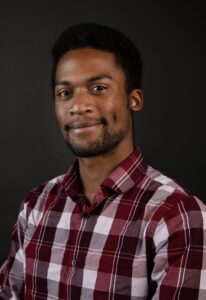
RAPID FIRE WITH ANDRE MASON, WALLACE IN ALEX AND THE AFRONAUTS
JHPENTERTAINMENT: Wallace is carrying the enormous responsibility of leading this group while simultaneously carrying the scars of everything that happened aboard the ship. What was your first reaction to Wallace, and what makes him such an interesting character to play?
ANDRE MASON: Initially, when I was reading for Wallace the first thing that came to mind was: “Man, this brother is a piece of work.” He wants to help his people; however, he has this “It’s my way or the highway” mindset. To be a leader, one has to not just be authoritative, but willing to listen to others, especially when found in the rather precarious position our intrepid afronauts find themselves in. To me, he is the phrase “The road to hell is paved with good intentions” personified. And I think that is partially why I enjoy being given the chance to portray him. Because sure, at times, he can come off as the other antagonist in this show, but at the end of the day, the brother is deeply unhealed, and had things gone his way, to his specific plan, well, the show would have had quite a different outcome. To me from a moral standpoint, when we first meet him, Wallace is neither black nor white, but rather a shade of gray. A shade of gray that got slightly darker with every injustice he encountered aboard that ship. And for me, morally gray characters are always fun to play as.
JHPENTERTAINMENT: Wallace’s anger comes from a very specific history of exploitation. He reminds Harper that they built the ship while others enjoyed the privileges of being aboard it, and that he—a licensed pilot—was reduced to working as a janitor. What do you think Wallace’s experience says about race, class, and who is considered valuable in this world?
ANDRE MASON: Sadly, this experience is all too common for people of color. It’s not a secret that in this country people of color have to work twice as hard to get half as far as non-POCs. Imagine: doing everything he did on Earth, helping not only to build but to maintain that ship, only to be regarded as the guy who empties the trash bins. It’s not exactly an ideal or just situation is it? What happens to him happens to far too many POCs, and of course it can take a toll on one’s view of self, as well as their view of the world around them.
JHPENTERTAINMENT: Wallace is absolutely determined not to turn back, even when Harper questions whether they are on a survival mission or a suicide mission. Do you see his determination as courage, stubbornness, leadership—or some complicated combination of all three?
ANDRE MASON: It’s definitely a sort of stew of the 3. On the one hand, I do not doubt that he truly believes that anywhere has to be better than being under the Armada. To him, death is stagnation, and allowing themselves to be subjugated is another form of death. In the face of what essentially appears to be a space army, Wallace helps to steal one of their ships in order to save the people who are regarded as lesser within the Armada’s main vessel. It takes some degree of courage/confidence in ones own actions to stage what is essentially a mutiny and steal a ship from a larger entity that can most definitely kill them all. On the other hand, he isn’t exactly the most diplomatic or democratic leader. He doesn’t consider his fellow crew mates’ insights, feeling as if he knows what is right for them all and should not be questioned on his strategies. I will also say I think there’s a little bit of ego in that stew I mentioned earlier, just off the interactions Wallace has with his crew mates, especially in his conversations with Harper.
JHPENTERTAINMENT: There can be something wonderfully freeing about a staged reading because you’re not dealing with costumes, elaborate sets, props or all the physical machinery of a full production. Does that more stripped-down environment allow you to concentrate differently on Wallace and the words Maya has written?
ANDRE MASON: Truthfully, this is a new experience for me with regards to a stage reading, but I will say it definitely feels like I can direct all my attention on developing the character within the parameters given by our playwright in this story. I can focus a little more on the story itself and how we can tell the story through our words and emotions in the moment.
JHPENTERTAINMENT: Finally, there’s something especially exciting about audiences getting only one opportunity to experience this particular version of Alex and the Afronauts. What does the exclusivity of a one-night-only staged reading mean to you, and what are you hoping audiences take away from this first full journey with Wallace and the Afronauts?
ANDRE MASON: For me, it’s bittersweet I can’t lie. Because on the one hand, a one-night-only reading makes this whole experience feel like something special. Like, we are about to perform what is basically the proto-version of this show, and I have loved every moment of the process thus far. On the other hand, I am a little bummed out that this is a one-night-only thing because I want as many people as possible to see this show because it is that good, in my opinion. I think the biggest thing I want the people to take away from this show, from my perspective, is trust. Its not likely that any of us will find ourselves in a situation where we are in space dealing with a space army on top of other issues that for the sake of spoilers I will not mention, however, we can find ourselves in a position where we are working with others in a precarious setting or scenario, and the only real way to come out of the scenario stronger is having trust in your fellow man/woman who is currently in the metaphorical trenches with you. Wallace can be so set in his ways, and I feel as if had he been a little more diplomatic, a lot of what happens in the show won’t have to come to pass… but then again, if he weren’t the stubborn semi-egotistical man that he is, well, we wouldn’t have a show would we? Or at least, it’d be a very different story that unfolds.
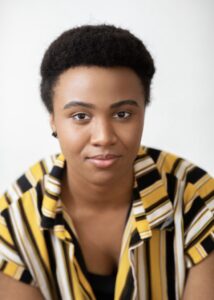 RAPID FIRE WITH MAYA ANTOINETTE RILEY, PLAYWRIGHT OF ALEX AND THE AFRONAUTS
JHPENTERTAINMENT: Take us back to the beginning. What was the original concept or spark for Alex and the Afronauts, and how has that initial idea evolved into the play we’re seeing today?
MAYA ANTOINETTE RILEY: Well, this play has taken quite a pivot over the course of 12 months. But this latest version was heavily inspired by a lot of Afrofuturist art. Music by Digable Planets and Sun Ra. Poetry by Douglas Kearney and Nikki Giovanni. Paintings and sculptures by Mikel Elam and Wangechi Mutu. So much of the Black experience is defined by the past. All the artists I mentioned are exploring the future. The alternatives to this current path we walk. I wanted to join in that exploration. This play, like many Afrofuturist works, is a daydream. A fantasy, embracing the unknown. Because change begins with dreaming a better life. And then you have to leap, step out on faith, to make the dream reality. That’s the golden nugget of this play.
JHPENTERTAINMENT: What has the writing process looked like from that first concept to this point? How long has Alex and the Afronauts been taking shape, and were there particular moments when you realized the piece had become something substantially different from where you started?
MAYA ANTOINETTE RILEY: It’s actually pretty wild. This play has taken so many different shapes over the course of this year. I started writing it in summer 2025, and it was a sci-fi take on a kitchen play. A story about two lovers trying to reconcile a failing relationship. But the world that I created around these two characters kept nagging at me. It brought up so many questions for me, so I decided to start answering those questions and ended up with an entirely different piece. The joy of writing…haha. But the two lovers who were originally at the center of the play have remained throughout every iteration.
JHPENTERTAINMENT: Audiences first encountered an excerpt of the work at last month’s Kindling Arts Festival as part of the New Play Platter. What was it like to hear and see a portion of this world in front of an audience for the first time, and what did that experience reveal to you about the piece?
MAYA ANTOINETTE RILEY: It’s always exhilarating to have an audience! I was revitalized by the experience. That was the first time any of my written work had been fully staged. A milestone for sure. Getting audience feedback is truly the final piece of any theatrical project/process. I needed to know what people loved, what they were confused about, what they talked about on the car ride home. I learned a lot. The characters and relationships were working, the mystery was working, but there were some world-building things I needed to flesh out. So I worked to tackle that. And I had to write Act II, because everyone was curious to see what happened next. A good place to be for sure.
JHPENTERTAINMENT: Moving from that excerpt to a complete staged reading is a significant next step for a new play. What have you discovered or changed between the Kindling presentation and this reading, and what are you hoping to glean from hearing the full piece in front of an audience?
MAYA ANTOINETTE RILEY: Well, I just wrote basically all of Act II in less than a month, so that was wild. I’m discovering things about the world of the play and the characters in it every single day. I go to bed thinking one thing about them, then wake up the next morning with new ideas. After the first read-thru last week, I gave the cast about 40 pages of rewrites. That’s the gig for new works, I suppose. I’m definitely not done tinkering. Having a full staged reading is just a pit stop on the journey to deepening this work. It’s just part of the process. I’ve looked at the script almost every day for the past 3 months. I can’t keep up with how many versions there have been. So seeing what lands with an audience will be incredibly beneficial. I’ve been zoomed into the piece for so long, I need their help to zoom back out and see it as a whole. I can’t wait to hear what people think!
JHPENTERTAINMENT: Alex and the Afronauts uses a futuristic space journey to examine very recognizable issues of race, class, inequality, exploitation, power and who gets access to resources. After this reading, what do you hope to learn about the play—and what do you hope the next chapter of its journey might be?
MAYA ANTOINETTE RILEY: I’m particularly interested in the paranormal aspect of the play. I won’t spoil it, but I think it’ll get people talking. It asks a very specific question of the audience, one that forces you to interrogate your ideas progress, legacy, and belief. It’s a very meaningful concept for me, and I wonder if others will feel similarly about it. I hope to someday mount a full production. It’s so rare to see Black Sci-fi get produced in any medium — film, television, theater, etc. I want to see Black people in space, having rich and compelling lives, searching for truth and new possibilities. So, I hope this journey can lead me there.
With Alex and the Afronauts, the journey is very much still in progress—and that may be the most exciting part. From a play that began as something entirely different, through months of rewrites, a first glimpse at Kindling Arts Festival and now a complete staged reading as part of Shades of Black Theatre Festival, Maya Antoinette Riley’s work continues to evolve with every step. And as Riley and her collaborators make clear, the audience isn’t simply there to watch that evolution—they’re part of it.
That makes Wednesday, September 2, at Darkhorse Theatre a particularly special opportunity. For one night only, Nashville audiences can experience the full Alex and the Afronauts while it is still in its developmental stage, hear where the story has traveled and help provide the feedback that could influence where it goes next. Because sometimes the most exciting theatre isn’t the show that’s already finished. It’s the one that’s just beginning to find its way.
The 2026 Shades of Black Theatre Festival officially kicks off with an Opening Mixer Monday August 31 thru Sunday, September 27 with nearly a dozen works presented throughout the month. The festival will include staged readings, full length plays, dance show, films, workshops, and other special events. CLICK HERE for a full list of the festival’s offerings. The Opening Mixer is free and open to the public. Alex and the Afronauts’ staged reading is free as well, but a suggested donation of $10 would be appreciated. Admission varies for the remaining festival events. All events of Shades of Black Theatre Festival will take place at Darkhorse Theater, 4610 Charlotte Avenue, Nashville, TN 37209, unless otherwise specified via the link above.
To keep up with Maya Riley and follow what’s next for her as well as for Alex and the Afronauts, CLICK HERE.
As always, if you wanna follow JHPEntertainment to find out who I’m chatting with for my next Rapid Fire Q&A, or for my take on the latest local and national theatre, music, arts and more, visit JHPENTERTAINMENT.com or find us on Facebook, Insta, Threads and X. Till then #GoSeeTheShow!