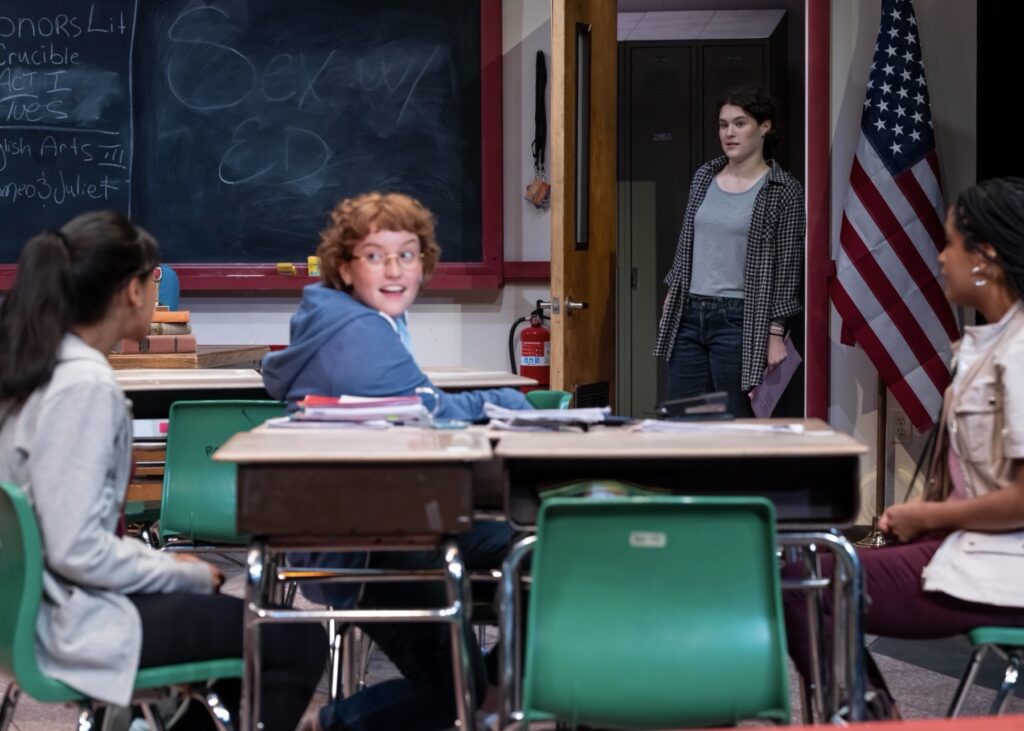
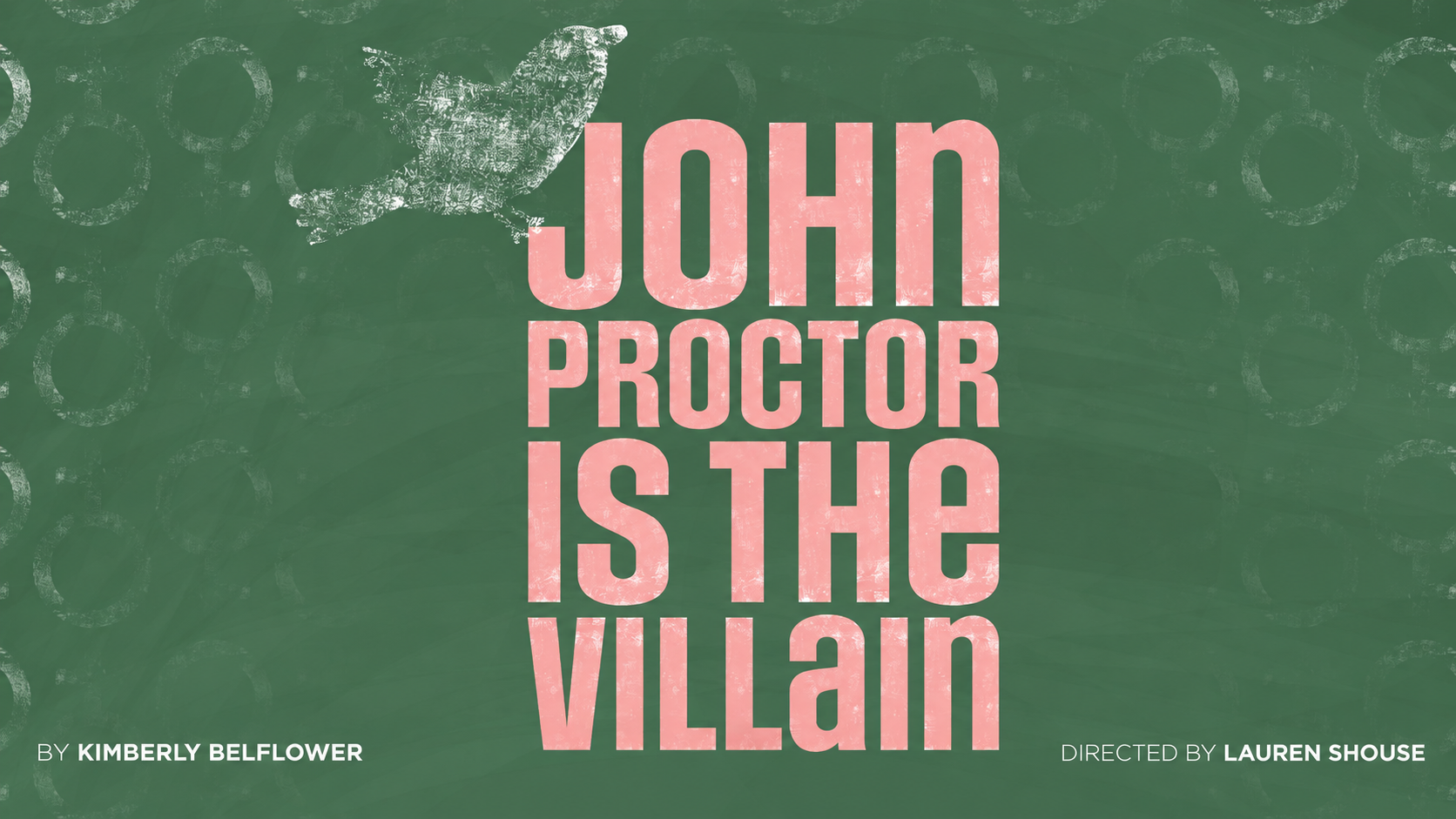
If you join us here on JHPEntertainment.com with any regularity, you likely know, after two decades of covering area theatre and a lifetime of loving it, I truly enjoy getting the opportunity to see something new. Having debuted on Broadway just last year, playwright Kimberly Belflower’s John Proctor is the Villain fits the bill. For its Tennessee premiere—on stage at TPAC’s Johnson Theatre thru October 18— Nashville Repertory Theatre wisely places Lauren Shouse at the helm. Shouse’s beautifully staged production of the acclaimed play proves that sometimes the most important thing young people can do is question the stories they’ve been told.
If the name in the title seems familiar, there’s good reason. He’s the perceived tragic hero of Arthur Miller’s The Crucible. There is something wonderfully audacious about taking one of the most frequently assigned American plays in the high-school curriculum and essentially telling an audience, Wait a minute…what if we’ve been looking at this all wrong? That is precisely what playwright Kimberly Belflower does with John Proctor Is the Villain, and Nashville Repertory Theatre’s new production embraces that challenge with intelligence, humor and a remarkable amount of heart.
Rather than attempting to retell Arthur Miller’s The Crucible, Belflower uses it as a jumping-off point for a much larger conversation about the stories we inherit, the people we label heroes and villains, and what happens when a younger generation starts asking questions that previous generations may have been too comfortable not asking. And in the hands of this terrific company, those questions become anything but academic.
Taking place in 2018 and set inside a rural Appalachian Georgia high-school classroom in a one-stoplight town (they’re getting another one), John Proctor Is the Villain follows a group of teenagers whose discussions of Miller’s classic begin to collide with their own increasingly complicated understanding of feminism, relationships, power, reputation, consent (yes, it takes place right smack in the middle of the #MeToo movement) and what it means to actually listen to someone else’s experience. It is indeed serious subject matter.
Fortunately, Belflower knows that teenagers don’t spend their lives speaking in serious declarations about serious subjects. They joke.They gossip. They interrupt each other. They misunderstand each other. They fall in and out of alliances. They say something hilariously inappropriate at exactly the wrong moment. And sometimes, almost accidentally, they say something extraordinarily profound. That balance between humor and emotional weight is one of the greatest strengths of Belflower’s writing—and Shouse’s production understands it beautifully. One can only assume Shouse’s “day job” as an Associate Professor of Theatre Directing at nearby MTSU might have aided her direction.
There is a natural rhythm to this staging that allows the comedy to land without ever diminishing the more difficult material. Just when you think you’re settling comfortably into a funny classroom exchange, the conversation shifts and suddenly you’re thinking about what you’ve just heard. Simply put, that is good theater. And John Proctor Is the Villain is very good theater. Shouse proves particularly adept at working with this predominantly young ensemble. There is no sense that she is directing young actors to act like teenagers. Instead, she gives them the freedom to create recognizable young people with individual personalities, insecurities, contradictions and senses of humor. The result is an ensemble that feels genuinely connected.
 Norah Younger’s Shelby Holcomb might not be in the opening scene, but once onstage, immediately commands attention. Younger gives Shelby an appealing intelligence and quickness, but wisely show restraint and uncertainty. There is something more complicated happening underneath Shelby’s rapid-fire observations, and Younger gradually reveals those layers with an impressive combination of confidence and vulnerability.
 Advika Ravishankar’s Raelynn Nix is equally compelling. Ravishankar finds the humanity in a character who has spent much of her young life navigating expectations—expectations about who she should be, how she should behave and what her relationships should look like. Watching those assumptions begin to crack is one of the production’s more affecting journeys, and Ravishankar handles that evolution with considerable sensitivity. One of my personal favorite Raelynn moments comes early on in the play when she fires off a rapid succession monologue of exposition to catch up Nell, the newest student, she ends the fast-paced info dump with “and that’s what you missed on Glee”—taking a cue from the intro phrase from the iconic teen-driven TV series that always started each episode.
Aubrey Bagley’s Beth Powell is perfection as the eager to please brainiac of the group who strives for acceptance. She’s the every-girl we all knew and were friends with in high school. Brityn Ramsey’s Nell Shaw, the newest addition to the classroom, having relocated from the more metropolitan Atlanta area, is the cool girl who isn’t afraid to follow whatever is said with an oh-so-biting retort or a not-so-subtle eye roll. Ella Saliba’s Ivy Watkins, who finds herself at the center of one of the many subplots offers up a quieter, unassuming version of the typical well-to-do school girl who could easily be stereotyped as a mean girl, but absolutely isn’t.
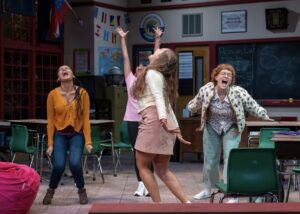
At no point do these actors seem like they’re standing around waiting for their next line. They are listening, reacting, judging, supporting, teasing and occasionally steamrolling over one another in ways that make the classroom feel genuinely inhabited. There is a terrific sense of rhythm to the dialogue as presented by the playwright and as brought to life among the performers.
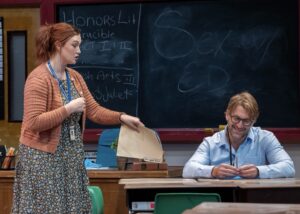 And then there are the adults of the piece Lucas Calhoun as Mr. Carter Smith and McKenna Steel as Ms Bailey. Lucas Calhoun’s Carter Smith, who finds just the right balance in the production’s adult male presence. As the English teacher and faculty advisor to the girls’ newly formed feminism club, Carter occupies an interesting position within the story. Calhoun doesn’t make him a conveniently enlightened adult who always knows exactly what to say. Instead, there is a humanity to his performance that allows Carter to listen, learn and occasionally realize that the most useful thing he can do is get out of the way. That makes Calhoun’s performance considerably more interesting—and considerably more believable. Calhoun’s Mr. Smith is the teacher we all remember from high school. Just a little older than the students, good looking, interested, but not hovering…again reference Glee, think Matthew Morrison as Mr. Will Schuester. McKenna Steel’s Ms Bailey Gallagher, the schools guidance counselor who many of the girls know from when she was a student herself, brings a welcome grounding presence. The girls relate to Steel’s Ms Bailey because she sees herself in them and they in her. When one of the girls unexpected blows up at Ms Bailey, it’s a tense moment that quickly quiets because of the familiarity of their shared experiences as women in a small rural community.
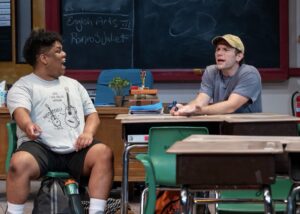 Rounding out the cast and reppin’ the boys, Lorenzo Rivera’s Mason Adams and Brent Bentley’s Lee Turner provide some of the production’s lighter moments without ever allowing their characters to become broad caricatures. In the hands of less skilled young actors, both roles could easily be stereotypes…Mason the jokester, Lee the cocksure jock, but as played by Rivera and Bentley, they reveal layers of uncertainty, self-doubt and eventual understanding, not only of themselves but of their female counterparts. Don’t get it twisted though, this play is about the young women. That said, it is an impressive company from top to bottom.
The chemistry among Younger, Ravishankar and their fellow cast members is one of the production’s greatest assets. There’s never a moment in the action that the audience has to be convinced that we’re not privy to a group of high school girls expanding upon the drama that is being a teenager in the modern era.
These characters have to feel like people who have known one another for years. They need to possess the casual shorthand of friendship—the glances, interruptions, private jokes and tiny frustrations that tell us there is a history between them even when the script isn’t explicitly telling us about it.
A lot of the success also comes from the physical world they’ve been given to inhabit. Scenic Designer Gary C. Hoff creates a classroom that feels immediately recognizable without becoming overly fussy or distracting. It is an environment that feels lived in, and because the entire play unfolds within this world, that authenticity becomes an important part of the storytelling. I frequently say I could live on one of Hoff’s sets and while I have no desire to return to the classroom, Hoff’s classroom is warm, inviting, and memory-unlocking. Minute details like an authentic intercom speaker box we all remember those morning announcement booming from, portraits of literary greats Wilde, Poe, Austen and the like lining the wall above the chalkboard all come together seamlessly to create a believable environment. Oh, and those fall leaves among the smooth rocks lining the path just outside the non-existent school wall nearest the front-facing audience. Nice touch!
The Johnson Theater’s intimacy works especially well here. Rather than placing the audience at a comfortable distance from the action, the space makes us feel almost like another group of observers inside the classroom. We’re close enough to catch the reactions, the shifts in body language and the moments when someone realizes that a conversation has suddenly become much more personal than expected. That closeness is invaluable.
Lighting Designer Amber Whatley complements the staging with a design that subtly tracks the emotional shifts without calling attention to itself. The lighting becomes increasingly expressive as the world of the characters begins to change, helping Shouse transition between the playful, familiar atmosphere of a classroom and the more emotionally charged territory the play eventually explores. Without giving too much away, that Lorde-enhancing pivotal “Green Light” sequence…cinematic indeed!
Melissa K. Durmon’s Costume, Hair & Makeup Design is equally effective. The characters look like contemporary teenagers rather than actors dressed to announce that they’re playing contemporary teenagers. Each individual has a distinct personality reflected in their appearance, while the ensemble still feels like a believable collection of students from the same community. From Mr. Carter’s teacheresque khaki pants to Mason’s plethora of sarcastically phrased t-shirts the wardrobe details do not go unnoticed.
That authenticity extends to the smallest details. And those details matter. From Lee’s fidget spinner to Beth’s stress stuffy. From the way Beth carefully places her books and binders in a mannerly fashion to Raelynn casually tossing her backpack on the floor. Each movement, carefully curated to reveal more about these characters.
 Because Belflower’s play is ultimately about authenticity. It’s about the difference between the story we’ve been handed and the story we experience ourselves. It’s about the danger of accepting a narrative simply because it has become familiar. It’s about the uncomfortable realization that the people we have been taught to admire may not always deserve our admiration—and that people we’ve been taught to dismiss may have considerably more to say than we ever bothered to hear.
That is a particularly potent idea to place in the hands of young characters. And Belflower never underestimates them. That’s perhaps what makes John Proctor Is the Villain so refreshing. The adults aren’t automatically right. The teenagers aren’t automatically right, either. Nobody gets to walk away with the moral high ground simply because they have the best argument in the room. Instead, the play asks everyone—including the audience—to listen.
 Belflower’s writing is smart enough to leave room for disagreement, while Shouse’s direction keeps that disagreement rooted in character rather than turning the production into a lecture. And that’s an important distinction. This isn’t a play telling an audience what to think. It’s a play encouraging an audience to think. By the time the production reaches its most emotionally resonant moments, the title John Proctor Is the Villain has become more than a provocative punchline. It has become a question about the very nature of heroes and villains—and about how easily those labels can be assigned when we only hear one version of a story. That is where Nashville Rep’s production really hits its stride. What begins as a clever reexamination of The Crucible gradually becomes something much more personal. Because eventually, the question isn’t really about John Proctor. It’s about us. What stories have we accepted without questioning? Whose version did we automatically believe? Who taught us what a hero was supposed to look like? And what happens when someone finally has the courage to say, Maybe that’s not the whole story.
Nashville Repertory Theatre has assembled a production that understands the power of those questions without becoming weighed down by them. Shouse keeps the pace energetic, the young cast keeps the world vibrant and Belflower’s script provides plenty of humor along the way. That combination makes John Proctor Is the Villain not only an important piece of contemporary theater, but an entertaining one. And perhaps that’s the biggest surprise. You come expecting a play about The Crucible. You leave thinking about the stories you’ve been carrying around your entire life. That’s the kind of theatrical alchemy Nashville Rep does exceptionally well.
With Lauren Shouse’s assured direction, Kimberly Belflower’s incisive script, Gary C. Hoff’s authentic scenic design, Amber Whatley’s evocative lighting, Melissa K. Durmon’s finely detailed costumes, hair and makeup, and an exceptionally committed ensemble led by Norah Younger, Advika Ravishankar and Lucas Calhoun, Nashville Repertory Theatre’s John Proctor Is the Villain is a production that earns both its laughs and its more difficult conversations. It doesn’t ask audiences to forget The Crucible. It asks us to look at it again. And perhaps more importantly, it reminds us that sometimes the most important lesson in the classroom is learning that you don’t have to accept the lesson exactly as it was given to you. Smart, funny, provocative and deeply human—Nashville Rep’s John Proctor Is the Villain is contemporary theater at its most engaging, giving a talented young ensemble a story that trusts them to question everything, including the stories we thought we already knew.
Nashville Repertory Theatre‘s John Proctor is the Villain continues at TPAC’s Johnson Theatre (505 Deaderick Street, Nashville, TN 37243) with performances weekends through Sunday, October 18. Thursday thru Saturday evening performances are at 7:30pm. Saturday and Sunday matinees begin at 2pm. Tickets range in price from $45.53-$89.23 (including fees). CLICK HERE to purchase tickets.
Following John Proctor is the Villain, Nash Rep presents Disney‘s Frozen starring Rachel Potter as Elsa and Aleia Eagleton as Anna, with Lane Adam Williamson as Hans, Colin Carswell as Kristoff, Reagan Allen as Olaf and Connor Adair as Sven. Frozen will be presented in TPAC’s Polk Theatre from December 4-20. CLICK HERE to purchase tickets or for more information. As always, check out Nashville Rep online and follow them on Facebook, X, YouTube and Instagram.
If you wanna follow JHPEntertainment to find out who I’m chatting with for my next Rapid Fire Q&A, or for my take on the latest local and national theatre, music and movie offerings, find us at JHPEntertainment on Facebook, JHPEntertainment onInstagram and JHPEntertainment on Twitter. Got an event or show we should know about, drop us a line at the Contact tab. Till then, #GoSeeTheShow!
 RAPID FIRE WITH JOHN PROCTOR IS THE VILLAIN‘s LUCAS CALHOUN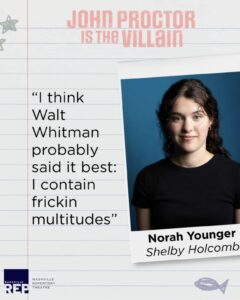
 RAPID FIRE WITH JOHN PROCTOR IS THE VILLAIN‘s
 RAPID FIRE WITH JOHN PROCTOR IS THE VILLAIN