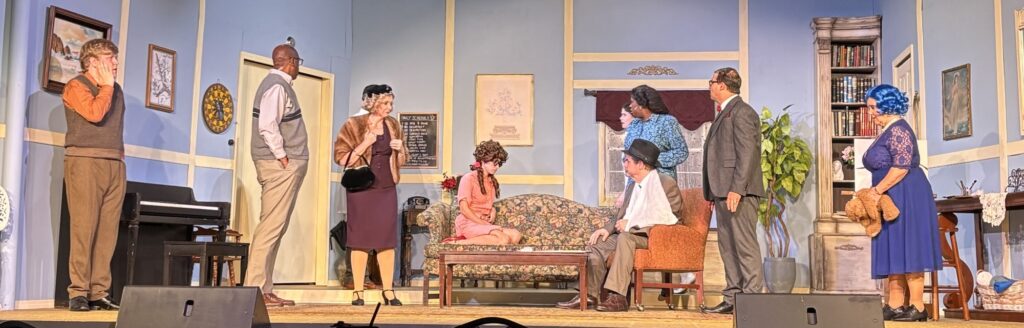
There’s something wonderfully reassuring about a play that suggests the people society considers crazy might actually have a better handle on life than those who insist they’re perfectly normal. John Patrick’s The Curious Savage delivers plenty of eccentric comedy, but beneath the laughs lies a pointed observation about money, family, compassion, and the absurdity of judging people by society’s standards. Currently onstage at The Keeton Theatre through October 25, director Michael Welch takes on this 1950 classic with a story that feels surprisingly relevant, reminding audiences that good manners don’t necessarily make good people, and a healthy bank account doesn’t guarantee a happy life.
The premise is deliciously simple. Wealthy widow Ethel Savage wants to use her late husband’s fortune to help people pursue their dreams rather than surrender it to her greedy stepchildren, Titus, Lily Belle, and Samuel. Their solution? Have Ethel committed to The Cloisters, where they expect to bring her to her senses. Instead, Ethel discovers a community of wonderfully unconventional individuals whose humanity puts her supposedly respectable family to shame.
Welch’s production understands that the comedy works best when the characters are treated as people rather than punchlines. The residents’ eccentricities provide the laughs, but their vulnerability and capacity for compassion give the play its heart. The result is a reminder that perhaps the most troubling behavior comes not from those who see the world differently, but from those convinced their own way is the only acceptable one.
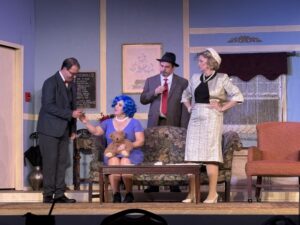 Ann Street-Kavanagh’s Ethel Savage is, to borrow a phrase, a performance of “tenacious mediocrity unhampered by taste.” I kid, I kid. (See the show and you’ll get the joke.) Seriously, this might be Street-Kavanagh’s shining moment in local theatre. She seems to have been born to play Ethel Savage, balancing the character’s whimsical nature with a quiet determination that makes her impossible to dismiss. She is the heart of the production, and watching her navigate Ethel’s determination to live life on her own terms is a genuine pleasure. The night I attended, Street-Kavanagh’s mic pack slipped from her dress mid-scene. Without missing a beat, she simply grabbed it, held it in her hand, and finished the scene like a pro. It was an impressively unfussy bit of theatrical problem-solving that demonstrated exactly the kind of composure you want from a seasoned performer.
As Titus Savage, Jason Rainwater delivers the haughty, self-important attitude that fits perfectly into the world of the societal Savages. Titus is a man accustomed to having his opinions respected and his expectations met, and Rainwater captures the character’s sense of entitlement without losing sight of the comedy. He represents the kind of respectable authority that playwright Patrick enjoys skewering, proving that a distinguished public image and a decent moral compass are two entirely different things. Yet another reason this 76-year-old play still feels oh so relevant.
Frederick ‘Rick’ Heiman Jr.’s Samuel Savage brings an authenticity to the character’s disdain for just about anything that inconveniences him. A judge whose own values are considerably less impressive than his professional title suggests, Samuel is driven by greed and an impressive capacity for irritation. Heiman makes that self-serving attitude part of the character’s comic appeal, giving Samuel the air of a man who considers everyone else’s existence a personal affront.
Katie Delaune’s Lily Belle Savage is an especially enjoyable balancing act. She understands Lily Belle’s concern with appearances and what other people think while also allowing a genuine concern for her stepmother to peek through. That little bit of humanity makes Lily Belle more interesting than a simple caricature of an avaricious socialite. Delaune also demonstrates terrific comedic prowess, particularly in one late-hour scene when Lily Belle drops behind the sofa and re-emerges a little worse for wear to riotous laughter. It’s a perfectly timed physical-comedy moment that earns every giggle.
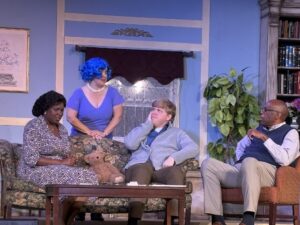 Among the residents of The Cloisters, Brittany Mask brings gentleness and humanity to Florence, the grieving mother who carries a doll she believes to be her young son, John, lost to illness five years previous. In researching to chat with some of the cast for my recent Rapid Fire 20Q, I discovered that some recent productions have chosen to portray the child as presence throughout the play, but The Keeton’s presentation follows the original 1950 production’s approach, allowing the doll to represent Florence’s son as she understands him. It’s a choice that keeps the focus squarely on Florence’s emotional reality, and Mask handles the character with tenderness rather than turning her grief into a cheap laugh. Her performance brings an affecting humanity not only to Florence but to the play itself, reminding us that the residents’ eccentricities often have deeply personal roots.
And speaking of John, young Logan Dowlen makes a brief appearance as Florence’s son during the dream sequence at the play’s end, earning the distinction of cutest co-star, ever. It’s a fleeting moment, but one that adds a sweet punctuation mark to Florence’s story.
As Hannibal, Damon Cathey brings a kind of Forrest Gump-ish simplicity to the role. His character’s conviction that he is a concert violinist is another example of the play’s fascination with the realities people create for themselves. Cathey leans into Hannibal’s guileless quality, adding another distinct personality to the ensemble without making the character’s eccentricity the whole point.
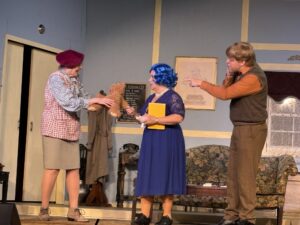 Riley Basner’s Jeffrey is notable for his perfectly presented shyness. An all-too-young war veteran carrying emotional scars, Jeffrey is a character whose reticence speaks volumes. Basner’s understated approach provides a welcome contrast to some of the production’s broader comic personalities, giving Jeffrey space to be vulnerable without pushing the sentiment too hard.
Kathy Crisp’s Ms. Paddy is captivating—and relatable. After all, my mantra is quite often “I hate everybody,” so a woman who only speaks to list the things she hates is my kind of woman. Crisp’s otherwise nonverbal Ms. Paddy is a silent scene-stealer, proving that a character doesn’t need a mountain of dialogue to leave a memorable impression. Her expressive presence and wonderfully sour outlook make her one of the production’s most entertaining eccentricities.
Christina Shandor’s Fairy May is the group’s resident optimist, comedically bespectacled and wigged in what can only be described as a cross between Little Orphan Annie and Pippi Longstocking. Her sunny disposition and colorful imagination provide plenty of comic opportunities, but there’s a more vulnerable character underneath all that cheerfulness. Fairy May’s insistence on seeing the good in everything is also a way of protecting herself from the harsher realities of the world. Shandor brings an infectious energy to the role, and you absolutely have to stay until the end to see not just how Fairy May sees herself, but how Mrs. Savage sees her and her fellow inhabitants. It’s a lovely final touch that gives the audience one more reason to reconsider the assumptions they’ve made about the people of The Cloisters.
The staff of The Cloisters provides another perspective on the institution and its residents. Tony Barrow’s textbook performance as Dr. Emmett works well within the sterile, mechanical atmosphere of a sanitarium. His recitative, unfluctuating delivery offers a contrast to the unpredictable personalities in his care, reinforcing the system-desired orderly framework surrounding the residents’ unconventional lives.
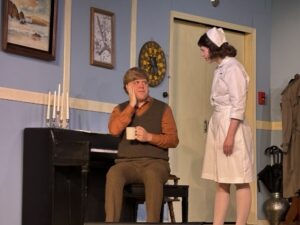
Kathleen McClanahan’s Miss Willie, meanwhile, mixes kindness with empathy and a little unexpected spirit. As the nurse who remains at The Cloisters to care for her husband, a war pilot who has lost his memory, Miss Willie embodies the complicated intersection of love and obligation. McClanahan gives the character warmth while allowing glimpses of the determination beneath her gentle exterior. I have always found it odd that the revelation about her relationship doesn’t happen sooner in the play, as it is almost lost when it finally comes to light. It’s an important piece of her story, and one that might carry greater emotional weight if the audience had more time to absorb its implications.
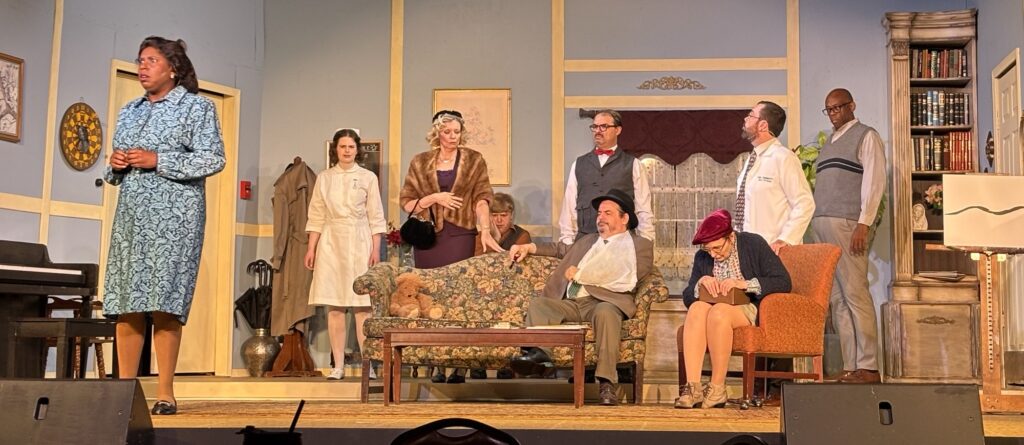
Behind the scenes, Welch is supported by stage manager Hailey Pelletier, and a team of skilled artisans. Technical director and set designer Kevin Driver brings authenticity to the play’s mid-century setting by peppering the stage with a console tube radio, the de rigueur framed print of Thomas Lawrence‘s portrait of Pinkie and other touches. Though I do question the publication date of a certain magazine located on the coffee table. (I’m sure The Keeton’s go-to graphic designer Danny Proctor, or even I could provide a vintage mag if asked, but I digress). Costumer Denese René Evans‘ work, most notably via wardrobe choices of Florence and Lily Belle again reinforce the vintage era. Mrs. Savage is decked out in finery–though that sparkle-accented jacket reads a bit too modern and those black character shoes are, well, out of character for a woman of her status. Sound designer Steve Love, and lighting designer Jesse Watts. work seamlessly in tandem to help establish the institutional, yet inviting world of The Cloisters, providing the setting for a story that moves between comic absurdity and genuine emotional reflection.
Ultimately, The Curious Savage is less interested in defining madness than in exposing the peculiar behavior of people who are convinced they have everything figured out. Ethel’s stepchildren may have money, status, and social standing, but the residents of The Cloisters offer something far more valuable: compassion, companionship, and the freedom to be themselves.
The Keeton Theatre’s production gives this classic comedy an opportunity to remind us that kindness matters more than appearances, that wealth cannot buy genuine affection, and that the people who make life worthwhile are often those who understand us without demanding that we change. After all, a little eccentricity may be the least of our problems. And if Ethel Savage has anything to teach us, it’s that a generous heart and an independent mind are worth considerably more than a fat bank account and a family tree full of people waiting to cash in.
The Keeton‘s The Curious Savage continues through Sunday, October 25. CLICK HERE for tickets. For Friday and Saturday performances, doors are at 5:45pm with dinner service until 6:45 and show beginning at 7pm. Thursdays are show only with doors at 6:30pm and show at 7pm. For Sunday matinees, doors open at 12:45pm with meal service until 1:45pm and showtime at 2pm.
Next up following The Curious Savage, The Keeton presents their holiday offering Scrooge in Love on stage December 3-20. So you don’t miss out on upcoming shows at The Keeton Dinner Theatre, follow them on Facebook, X and Instagram.
Interested in coverage for your latest entertaining endeavor? Click the contact page and drop me a note. You can also follow JHP Entertainment on Instagram and Facebook. In the meantime, #GoSeeTheShow!
In case you missed it, check out our recent Rapid Fire 20Q with The Curious Savage director and members of the cast.
Rapid Fire 20Q with Director and Cast of The Keeton’s ‘The Curious Savage’: Normalcy is Overrated