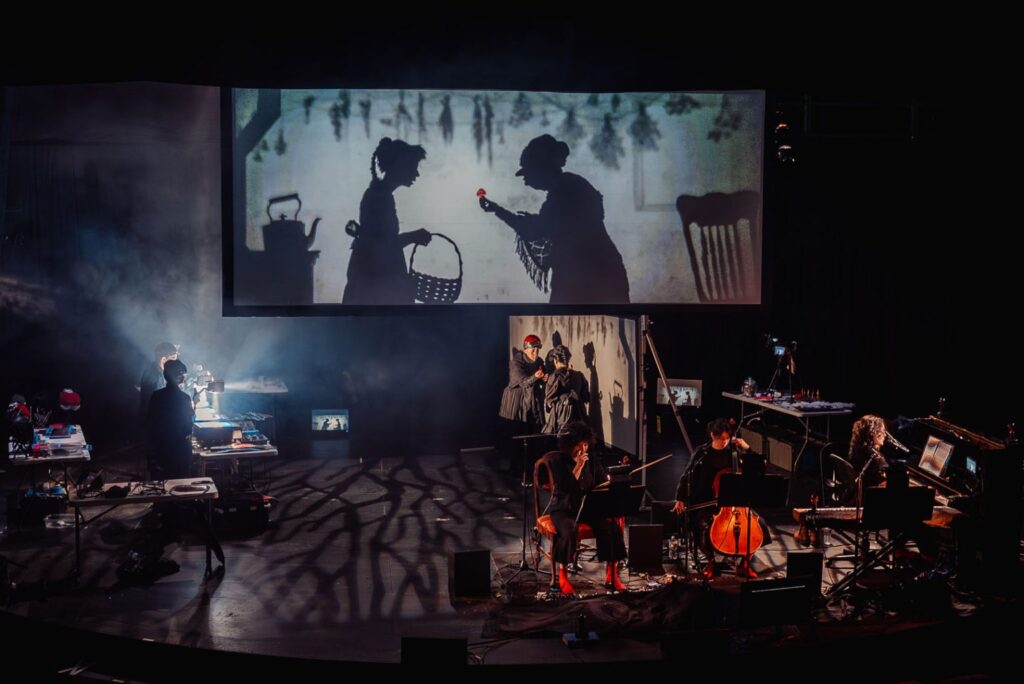
There are plenty of productions that ask audiences to suspend disbelief. Then there is Manual Cinema‘s The 4th Witch, which somehow makes you forget disbelief exists in the first place. Presented at OZ Arts Nashville through Saturday, the Emmy Award-winning collective’s latest work transforms Shakespeare‘s Macbeth into something wholly original—a visually stunning coming-of-age story told through shadow puppetry, live performance, music, filmmaking, and sheer theatrical ingenuity. What unfolds over the course of the evening feels less like watching a play and more like witnessing a movie being created before your eyes.
 Founded in 2010 by Drew Dir, Sarah Fornace, Julia Miller, Ben Kauffman, and Kyle Vegter–all five share co-artistic director credits–Manual Cinema has built an international reputation for pushing the boundaries of storytelling. The 4th Witch may be their most ambitious creation yet. Rather than simply retelling Macbeth from the perspective of kings, warriors, or even Shakespeare’s famous trio of witches, the production introduces audiences to a young girl whose life is forever altered by the violence occurring around her. What begins as a story unfolding in the shadows of Shakespeare’s tragedy gradually becomes a deeply human exploration of loss, survival, identity, and the choices we make when confronted with cycles of violence.
The plot itself is compelling, but it is the method of storytelling that leaves the strongest impression. Using vintage overhead projectors (you know the kind…those of us of a certain age surely recall teachers using them to project transparencies of mathematical equations and the like in high school classes), cameras, handcrafted puppets, live musicians, projected animation, and an astonishing amount of precision shadow-ography, the ensemble simultaneously performs the story while creating the cinematic images projected above them. One thrill of a Manual Cinema experience is that audience members can watch both the finished “film” and the intricate mechanics behind its creation at the same time. Somehow, knowing exactly how the illusion works only makes it more magical.
One of the evening’s most impressive achievements is the seamless collaboration between the performers, musicians, and designers responsible for bringing this world to life. Conceived and directed by Drew Dir and devised alongside Sarah Fornace and Julia Miller, The 4th Witch demonstrates the remarkable creative shorthand that has developed among Manual Cinema’s founding artists over the last fifteen years.
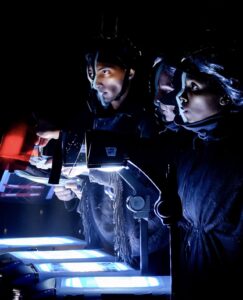
The production’s visual language is particularly striking. Dir’s storyboard and puppet design work provides the foundation for a series of hauntingly beautiful images, while Julia Miller’s silhouette mask designs help create a dreamlike aesthetic that feels simultaneously ancient and contemporary. Combined with David Goodman-Edberg‘s atmospheric lighting and Sully Ratke‘s costume and wig design, the result is a world that exists somewhere between folklore, nightmare, and fairy tale.
Yet for all of the technical wizardry on display, it is the performers who make the impossible seem effortless. The puppeteering ensemble works with the precision of a championship relay team. Lizi Breit, Leah Casey, Sarah Fornace, Julia Miller, and Jeffrey Paschal constantly shift responsibilities, characters, and storytelling functions, often within seconds. One moment they are manipulating puppets, the next they are operating cameras, creating visual effects, changing costumes, transitioning scenery and magically bringing the silhouetted shadow puppets to life. Watching them perform below the screen becomes almost as fascinating as the imagery being projected above it.
Particularly impressive is how seamlessly Fornace and Miller balance their roles as co-creators of the piece while simultaneously serving as performers within it. Miller’s commanding presence as the Lead Witch anchors much of the production’s visual storytelling, while Fornace’s work as the young Girl at the center of the narrative provides much of the show’s emotional heart. Jeffrey Paschal brings physicality and gravitas to multiple roles, including Macbeth himself, while Breit and Casey navigate a variety of characters that help populate the production’s ever-shifting world.
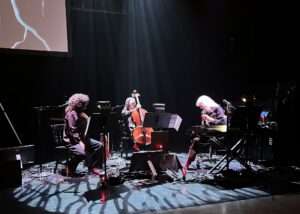 Equally deserving of recognition is the magical yet anything but witchy trio of musicians positioned in full view of the audience throughout the performance. Alicia Walter‘s vocals and keyboard work, joined by Lucy Little‘s violin and vocals and Erica Kremer‘s cello and vocals, create a lush, cinematic score that frequently serves as the emotional engine of the story. Their contributions elevate the production beyond a technical marvel into something genuinely moving, underscoring moments of wonder, danger, grief, and hope with remarkable sensitivity.
What makes The 4th Witch especially memorable is that none of these elements ever feel isolated from one another. The puppetry, music, projections, acting, sound design, and storytelling function as a single living organism, each piece dependent on the others. Kauffman and Vegter’s original score and sound design provide the connective tissue binding everything together, creating a production that feels less like a stage play and more like a handcrafted cinematic experience unfolding in real time.
Visually, The 4th Witch is breathtaking. Drawing inspiration from storybooks, silent cinema, and graphic novels, the imagery is often hauntingly beautiful. Interestingly, there’s no dialogue or narration, no intertitles like you’d see in a traditional silent movie. Moments of darkness and danger are balanced by scenes of wonder and imagination, creating a rich emotional landscape that feels both timeless and urgently contemporary. The story unfolds naturally and fully narratively cohesively through the skill and beauty of this truly groundbreaking cinematic medium.
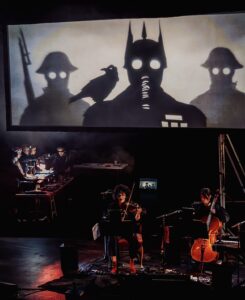
What ultimately makes The 4th Witch resonate, however, is its heart. Beneath the inventive staging and dazzling visuals lies a story about resilience, empathy, and finding one’s place in a complicated world. It is a reminder that even amid chaos and conflict, there remains the possibility of hope.
In an era where audiences have seemingly endless entertainment options available at the touch of a screen, Manual Cinema offers something increasingly rare: a theatrical experience that can only truly be appreciated in person. For Nashville theatergoers looking for something unlike anything else currently on stage, The 4th Witch is not merely recommended—it is essential viewing.
Manual Cinema’s The 4th Witch continues at OZ Arts Nashville (6172 Cockrill Bend Circle) with an 8pm performance Friday, June 5 and concludes Saturday, June 6 with both a 2pm matinee and a final 8pm evening performance. The venue opens an hour before each performance and offers a bar menu featuring a variety of alcoholic and nonalcoholic beverages for purchase. Youth and Artists/Creative tickets are $25, General Admission tickets are $35 and Generous tickets are $45. CLICK HERE to purchase tickets. As an extra bit of fun, following the June 5 performance, Oz Arts will host a post-show Friday Night Talkback featuring Sarah Fornace and Julia Miller moderated by Nashville Shakespeare Festival‘s Artistic Director Jason Spelbring. (this event is free to Friday night’s audience).
Whether you’re a Shakespeare enthusiast, a theatre lover, a film buff, or simply someone searching for an unforgettable artistic experience, this remarkable production proves that some of the most powerful magic still happens live and right before you eyes. Forget what The Wizard of Oz said…at this Oz Arts Nashville performance, go ahead and pay attention to the men and women behind the curtain!
Manual Cinema’s The 4th Witch marks the close of Oz Arts‘ current season, so be sure and CLICK HERE to stay in the know as Oz Arts reveals their coming 2026/2027 Season soon. To keep up with all things Oz Arts, follow them on Facebook, YouTube and Insta.
For more about Manual Cinema, and their current multi-city tour schedule, CLICK HERE or follow them on Facebook, Insta, Vimeo and Bandcamp.
As always, If you want to read our latest on Music, Movies, Performing or Visual Arts, please check out JHPEntertainment online or socials at Facebook, Insta, X and Threads.
In case you missed it, check out JHPEntertainment.com‘s Rapid Fire 20Q with Manual Cinema’s Julia Miller and Sarah Fornace, then…#GoSeeTheShow!