Playwright Kimberly Belflower’s John Proctor Is the Villain turns Arthur Miller’s The Crucible upside down, trading Salem’s witch trials for a Georgia high school classroom where feminism, friendship, consent and long-held assumptions are suddenly up for debate. As Nashville Repertory Theatre brings the acclaimed Broadway hit to Nashville for the first time, JHPEntertainment fires off 20 questions for director Lauren Shouse and cast members Lucas Calhoun, Norah Younger and Advika Ravishankar about reexamining a classic, finding the humanity beneath their characters and navigating the complicated—and sometimes hilarious—world of growing up. From a teacher caught in the middle to young women finding their voices, this Rapid Fire 20Q goes behind the scenes with the artists bringing Belflower’s provocative, funny and conversation-starting play to TPAC ‘s Johnston Theatre stage.
RAPID FIRE 20Q WITH CAST MEMBERS AND DIRECTOR OF NASHVILLE REP’s JOHN PROCTOR IS THE VILLAIN
 RAPID FIRE WITH JOHN PROCTOR IS THE VILLAIN‘s LUCAS CALHOUN
JHPENTERTAINMENT: Carter Smith is the English teacher who becomes the faculty advisor for the girls’ newly formed Feminism Club, which makes you one of the relatively few male voices in a play dominated by young women. What has been interesting about occupying that particular place in this world—and being the guy who has to know when to speak and when to simply listen?
LUCAS CALHOUN: I am an insatiably curious person. My experiences are wholly my own and in so limited in their breadth. To be surrounded by people whose journey through life has granted them unique and foreign experiences to me is a gift. If ever I have to consider when to listen or speak the answer is almost always listen. I’m not sure Carter would agree.
Carter’s pedagogy lies deeply in giving his students a voice. He creates a space where students are encouraged to question, challenge, fail, and fully express their viewpoints outside the restrictive conventions of their small religious town. To him this requires control. This ideology is called into question when Shelby returns and tests Carter’s control, belief in himself, and his skill as a teacher. That particular challenge is the interesting bit.
JHPENTERTAINMENT: Your own résumé includes graduating from The Second City Conservatory in Hollywood and eventually teaching in Second City’s youth program. Did that experience working with younger performers give you any particular insight into the rhythms, humor or occasionally gloriously unpredictable energy of the teenage world you’re surrounded by in this play?
LUCAS CALHOUN: Kimberly Bellflower masterfully captures the contradiction of the teenage experience. That sense of ‘knowing everything’ while in a constant state of insecurity over their understanding of the world. The Second City in addition to my training at Improv Olympic made me an active and attentive listener who searches for the new and unexpected. The beauty of working with teenage characters is their lives are rich with new and unexpected experiences. I just need to be willing to go along for the ride.
JHPENTERTAINMENT: Carter is teaching The Crucible while his students are essentially dismantling some of the assumptions behind it. As an actor playing the teacher, do you find yourself thinking about the difference between teaching young people what a story says and encouraging them to question why the story has been told that way?
LUCAS CALHOUN: I’m not sure there is any daylight between “what a story says” and “why the story has been told that way.” Both are essential when seeking meaning. This play challenges the fallacy of “evergreen art” by pitting a known historical allegory against a modern dialogue.
JHPENTERTAINMENT: You’re also a dad to a young daughter. While you have a few years before you’re faced with the inevitable task of helping her navigate some of the challenges young women face in today’s cultural climate, has working on this play planted any new seeds in your mind about how you hope to keep the lines of communication open with her?
LUCAS CALHOUN: One strength my wife and I share is the willingness to have difficult conversations. I admire my daughter’s bravery and self actualization at such an early age. She’ll inevitably face difficult challenges and uncertainty – I’m confident when those moments arise she’ll advocate for herself.
JHPENTERTAINMENT: Carter spends a lot of time in a room where the conversation is getting increasingly complicated, personal and uncomfortable. What’s the one thing about playing him that has surprised you most—and has there been a moment when you thought, “Okay, Carter, you really need to sit down and let the kids talk now”?
LUCAS CALHOUN: I imagine experiencing Carter from the audience and as the performer might be very different. To elaborate before we open would be doing both a disservice, but therein lies the surprise.
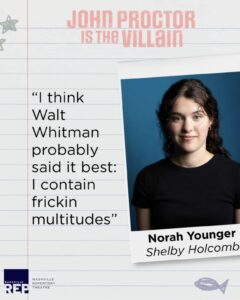
RAPID FIRE WITH JOHN PROCTOR IS THE VILLAIN‘s NORAH YOUNGER
JHPENTERTAINMENT: Shelby Holcomb is described as someone whose brain works faster than her mouth—and whose mouth works pretty darn fast—while also being someone people have consistently underestimated. What part of Shelby’s personality was the easiest for you to connect with, and what part required you to dig a little deeper?
NORAH YOUNGER: The part of Shelby’s personality that was the easiest to connect with was her rage. To be completely honest, as a woman experiencing the world outside the shelter of childhood, everything that is wrong and broken with the world makes me ragefully angry. Shelby’s frustration with her circumstances and with the troubles she must face was a very accesible connection for me. One aspect of Shelby that required me to dig a little deeper was the trauma she carries into this show. Without giving too much away, Shelby has been through some shit, and the majority of my character research was toward the short and long term psychological effects of some of those events.
JHPENTERTAINMENT: Shelby’s return to school after being away for a while changes the temperature in the room pretty quickly. Without giving away too much, what do you think she desperately wants the other girls—and perhaps the audience—to understand about her?
NORAH YOUNGER: Shelby’s desperation in this show comes from the need for her friends to listen to her. Shelby is constantly dismissed, interrupted, and never taken seriously by authority figures and her own best friends. So as a result she finds ways to make people listen.
JHPENTERTAINMENT: There’s a lot of very serious subject matter in John Proctor Is the Villain, but Belflower also gives these girls plenty of humor, pop-culture references and teenage attitude. I was struck at how perfectly the playwright captures the speech pattern and tone of 2018 youth. As someone who isn’t too far removed from their own teen years, has that aided you in finding Shelby’s voice?
NORAH YOUNGER: Somehow, Kimberly wrote Shelby’s speech pattern in a way that very much emulates my own, which has connected me to the character in such a beautiful way. Kimberly’s genius use of dialogue has given me so much insight into not only the character but her relationships with the others. So much of this show is dependent on the character relationships, and the text informs so much of those distinctions.
JHPENTERTAINMENT: With all the pop culture and music artist references present in the dialogue of the girls, while reading the script in anticipation of chatting with your director and cast mates, I couldn’t help but thing…this work could absolutely be a musical! Humor me…What tune, past or present could easily be Shelby’s ‘theme’?
NORAH YOUNGER: “Mad Woman” by Taylor Swift could easily be Shelby’s Theme. The song expresses how society scorns women who seem “crazy” and “angry” because women are never allowed the space to react proportionately to any terrible situation. Any time they speak up it seems like they are “breathing flames”.
JHPENTERTAINMENT: This play really depends on the feeling that these young women know each other—their friendships, frustrations, inside jokes and occasional explosions all have to feel lived-in. What has the fast-paced process of bonding with this cast been like?
NORAH YOUNGER: The bonding aspect of this play process has been one of the easiest parts for me. Not only is everyone in the cast just a lovely human, this play gives permission to be seen, to feel, to speak to not only the audience but also to us, as actors. I clicked with the other girls almost instantly on the surface level. But working on this play has brought the deepest, most vulnerable part of my soul to the surface; fragile and exposed, and my cast mates see this part of me every day and still accept me and love me through it all.
 RAPID FIRE WITH JOHN PROCTOR IS THE VILLAIN‘s ADVIKA RAVISHANKAR
JHPENTERTAINMENT: Raelynn Nix initially looks like she has the whole small-town high-school experience figured out—the cheerleader type who has spent much of her life living according to other people’s expectations. What did you discover underneath that exterior that changed the way you saw her?
ADVIKA RAVISHANKAR: Rae definitely looks like she has it all figured out, but honestly, almost none of it was ever up to her. Her dad is the town preacher, so everyone knows him, which means everyone knows her too. She isn’t just representing herself; she’s representing her dad and her whole family, so there’s an image she always has to maintain. What she actually wants doesn’t really matter, because everyone has already decided who the head cheerleader and preacher’s daughter is supposed to be. Once I understood what her life has been like, it completely changed how I wanted to tell her story. Her arc felt so much bigger, and her struggle felt so much more real.
JHPENTERTAINMENT: I love that Raelynn is dealing with some pretty complicated questions about identity, relationships and the expectations placed on her. Is there a particular aspect of her personality or her journey that feels surprisingly close to something you recognize in yourself?
ADVIKA RAVISHANKAR: Setting aside the fact that I was a high schooler in 2018 (funny enough, I read The Crucible that year too), there’s a lot I recognize in her. I’m definitely not from a one-stoplight town in Georgia, but there are real similarities between Raelynn’s community and the one I grew up in, especially with the unspoken expectations about who you’re supposed to be. Throughout the show, Raelynn tries to take up as little space as possible. Women are so often taught to be agreeable, never make mistakes, and have everything figured out, and I know what it’s like to be shamed for not fitting the mold people build for you. Whenever I speak my mind or let my personality show, I’m sometimes told I’m ‘too much’ or that I need to ‘calm down.’ So, like Rae, I find myself shrinking back to avoid ruffling any feathers. But also like her, I feel free to break away from those expectations when I’m leaning into the female friendships in my life. My friends from high school and the ones I found in college make me braver than I’ve ever been about just being myself, the same way Shelby and the feminist club do for Rae.
JHPENTERTAINMENT: One of the fascinating things about John Proctor Is the Villain is watching these characters discover that growing up sometimes means questioning things you previously accepted without thinking twice. What is the biggest question Raelynn finds herself wrestling with—and has exploring that question changed anything about how you view her?
ADVIKA RAVISHANKAR: I think the biggest thing Rae wrestles with is who to believe. When the show starts, Shelby’s been gone for a while, and no one really knows why, so the whole town has a theory. Rae and Shelby have a complicated history, and she’s stuck choosing between what people are saying and what she knows about the girl she grew up with. For someone who’s always gone along with the crowd, that’s huge. It might be the first time she’s ever had to make up her own mind and actually stick to it. It’s easy to see her as a follower, but watching her learn to trust herself showed me she’s had this quiet strength the whole time. Questioning something that people around you take as fact is scary, especially when you have as much to lose as she does. And really, the debate over whether John Proctor is a villain is just the tip of the iceberg. Once Rae starts asking whether the hero of The Crucible is actually a hero, she starts asking that about everything she grew up believing, like how girls are supposed to act and who always seems to get the blame.
JHPENTERTAINMENT: What has working with Lauren Shouse been like? With a young ensemble tackling material that can become emotionally intense, what does Lauren bring into the rehearsal room that helps everyone feel comfortable enough to take risks?
ADVIKA RAVISHANKAR: I cannot say enough good things about Lauren. She’s reminded me that the best work comes from a room where you’re allowed to be fully yourself, messy and vulnerable and all. I didn’t expect this show to hit so close to home, and it can be really hard to let your guard down enough to do these characters justice. Lauren is constantly checking in with us, and on the days when the material hits too hard, she always makes sure our mental and physical well-being comes first. She’s also created a space where we’re free to play with these characters and the world around them, and she’s encouraged us to make them our own and lean into the relationships we’ve built with each other. I think that’s a big part of why the friendships onstage feel so real: we’ve built real ones offstage too!
JHPENTERTAINMENT: Finally, this is a show about a group of teenagers who spend a lot of time talking, arguing, laughing, challenging one another. IF the characters in John Proctor had a group chat, who do you suspect would be the first person to get kicked out? AND who would quietly remove themselves from the chat?
ADVIKA RAVISHANKAR: For who’d get kicked out first, my gut says Mason, but not permanently. He’s hilarious and means well, but he’d absolutely send something out of pocket, and Nell (or even Beth) would clock him and put him on probation for a couple of hours while he “thinks about what he’s said.” Then he’d get added back just in time to send a notes app apology that Beth probably edited for him. Quietly leaving could go a couple of ways, but my first instinct is Rae. Lee would say something dumb, and she’d just leave without a word because she doesn’t want to deal with it.
 RAPID FIRE WITH JOHN PROCTOR IS THE VILLAIN DIRECTOR LAUREN SHOUSE
JHPENTERTAINMENT: You’re an Associate Professor of Theatre Directing at Middle Tennessee State University, where your teaching includes directing and script analysis. How much did the classroom side of your life—particularly teaching students how to break down a script and make directing choices—inform your approach to directing this predominantly younger cast?
LAUREN SHOUSE: I love working with young people and feel fortunate to have a front row seat to people in the critical stage of becoming who they are and finding their own unique voice. So for me, this process continues to teach me, not only all the cultural references that go over my head as they chat at lunch, but just what matters to them as individuals and as a generation. Also working with Governor’s School of the Arts for the last 5 years has given me the opportunity to see just how naturally Kimberly Belflower has crafted the language of this play for teenagers. The cast has said many times that they speak just like their character. It has been a gift to work with this exceptionally talented cast. Their energy has been infectious and the future is bright.
JHPENTERTAINMENT: John Proctor Is the Villain was just on Broadway last year, and now you’re the director introducing Kimberly Belflower’s very timely take on The Crucible to Nashville audiences for the first time. Is there an extra bit of excitement—or pressure—that comes with getting to be the person who brings a brand-new Broadway title home to Nashville?
LAUREN SHOUSE: I feel lucky and excited as this play has been on my list since I first read it in 2019. Also, the very first show I worked on with Nashville Rep was the 2007 production of The Crucible – I was the assistant stage manager. So, it has been fun to come full circle nearly 20 years later.
JHPENTERTAINMENT: The Johnson Theater at TPAC is considerably more intimate than a traditional proscenium setting. With a play that essentially puts us inside the world of a close-knit group of high schoolers—where conversations, alliances and secrets can change in a heartbeat—what does that intimacy give you as a director?
LAUREN SHOUSE: I love working in the Johnson with the thrust staging, especially for a fast-moving play like this. The dialogue is snappy and the tension builds throughout the play, so being close and especially if you are on the side audience banks, you feel like you are eavesdropping in the best way. I also feel like we just get to share the emotional moments of the play in a more impactful way, where the audience have the access to the actor and are collectively gasping or laughing with them.
JHPENTERTAINMENT: While researching your chat with you and members of your cast, I loved Mason’s line at about the midway point of the play when he says, “I feel like I’m reading a completely different play…I thought The Crucible was about witches.” One of the things I love about John Proctor Is the Villain is taking a canonical work like Arthur Miller’s The Crucible and essentially saying, “Okay, but what if we look at this story differently?” If you could give another classic play the John Proctor Is the Villain treatment and reexamine it through a modern lens, which one would you love to tackle—and why?
LAUREN SHOUSE: Oh man, what a question! I am sure I would have a deeper answer with more time, but my first thought is just to look at the genre of the Golden Age musical and how women were depicted in many of those “classic” musicals. I feel like in almost everyone one, the women give away their agency almost immediately and so I would love to explore what would it be like for a young woman today to play such a role and what does it say to our students? Those are the questions I would love to investigate in that genre.
JHPENTERTAINMENT: Without giving away the discoveries audiences will make along the way, what do you hope people walk out of the Johnson Theater thinking—or perhaps talking about—after experiencing John Proctor Is the Villain?
LAUREN SHOUSE: For me, this play is specifically about that moment in adolescence where we stop regurgitating the things our parents, teachers, church, government leaders said verbatim, and we shape our own individual truth. I hope the audience will ask what stories they have readily believed because someone in power told them it was true. John Proctor Is the Villainreminds us that the question is not simply whether we will tell the truth. It is whether we will have the courage to listen and act when someone else does.
With its mix of sharp humor, teenage candor and questions that refuse to stay neatly inside the classroom, John Proctor Is the Villain is sure to give audiences plenty to chew on long after the final curtain. We’ll leave the last word to Lauren, Lucas, Norah and Advika—because sometimes the most interesting part of rewriting the story is discovering what happens when someone finally asks, “But who gets to tell it?”
Nashville Repertory Theatre‘s John Proctor is the Villain opens at TPAC’s Johnson Theatre (505 Deaderick Street, Nashville, TN 37243) Friday, October 2 and runs weekends through Sunday, October 18. Thursday thru Saturday evening performances are at 7:30pm. Saturday and Sunday matinees begin at 2pm. Tickets range in price from $45.53-$89.23 (including fees). CLICK HERE to purchase tickets.
Following John Proctor is the Villain, Nash Rep presents Disney‘s Frozen starring Rachel Potter as Elsa and Aleia Eagleton as Anna, with Lane Adam Williamson as Hans, Colin Carswell as Kristoff, Reagan Allen as Olaf and Connor Adair as Sven. Frozen will be presented in TPAC’s Polk Theatre from December 4-20. CLICK HERE to purchase tickets or for more information. As always, check out Nashville Rep online and follow them on Facebook, X, YouTube and Instagram.
If you wanna follow JHPEntertainment to find out who I’m chatting with for my next Rapid Fire Q&A, or for my take on the latest local and national theatre, music and movie offerings, find us at JHPEntertainment on Facebook, JHPEntertainment onInstagram and JHPEntertainment on Twitter. Got an event or show we should know about, drop us a line at the Contact tab. Till then, #GoSeeTheShow!
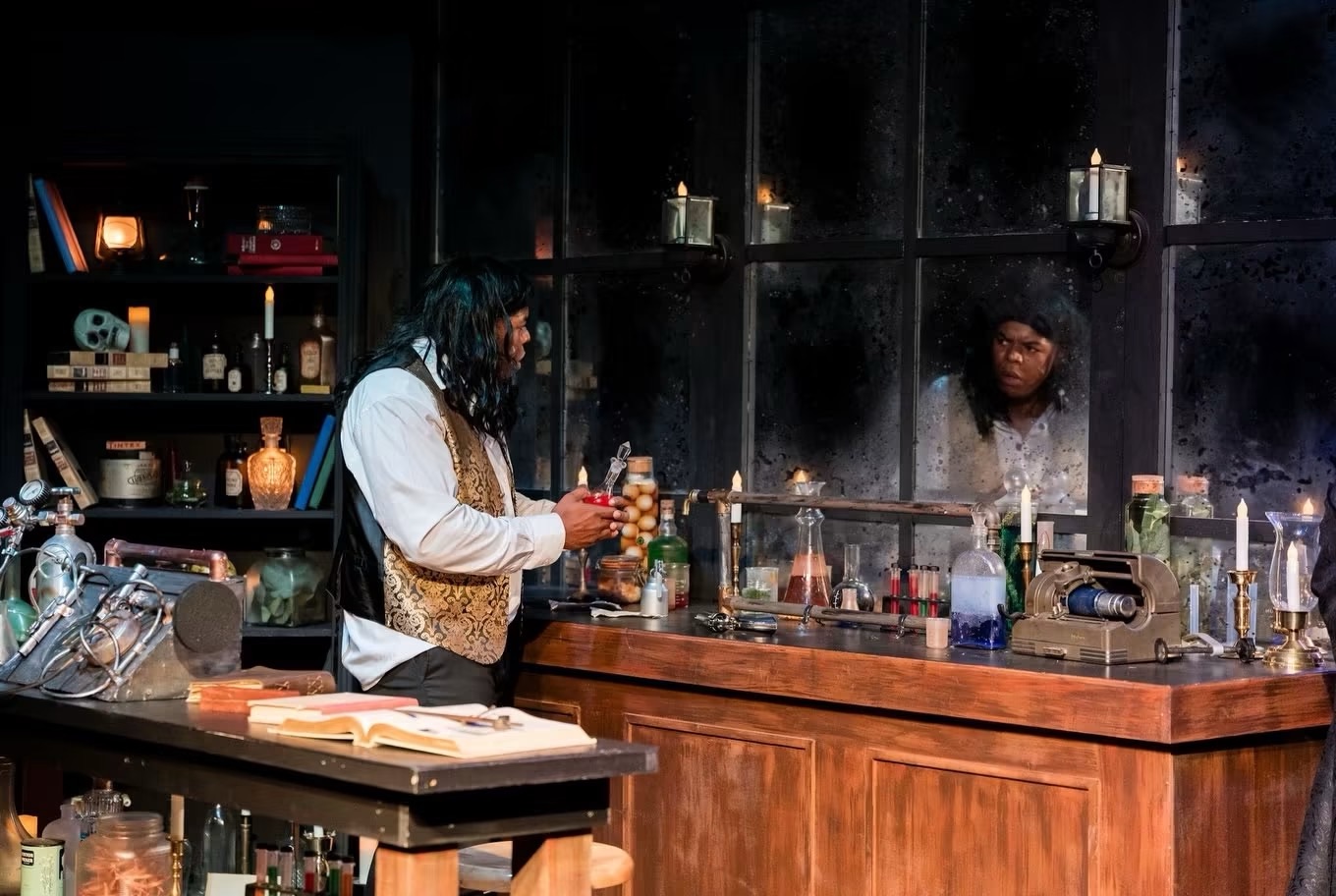
 And then there are the three people at the center of that world. DéYonté Jenkins, as Henry Jekyll and Edward Hyde, takes on one of musical theatre’s great dual-role challenges and makes the transformation between the two personalities feel like an actual psychological unraveling rather than a theatrical gimmick. With the seemingly simple act of letting down his hair, increasing his audible breathing, snarling and yes, a bit of sweat and snotting, Jenkins transforms from Jekyll to Hyde in a scarily brilliant manner. Jekyll’s idealism, desperation and obsession gradually give way to Hyde’s darker liberation, and Jenkins makes that descent increasingly compelling. Again, the intimacy of this venue works with the show, not against it. Let’s not sleep on Jenkins’ vocals either. From Jekyll’s first musical number “Lost in the Darkness” to his final public transformation during “The Wedding”, whether as the meek and smooth as silk voiced Jekyll or the growling, guttural Hyde, Jenkins’ vocal control is enchanting. Those familiar with the musical can rest assured when Jenkins tackles “This is The Moment”, it’s not just a song title, it is the truth.
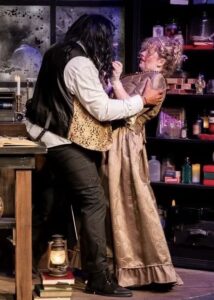 As Emma Carew, Dr. Henry Jekyll’s intended, Rebekah Joy brings an emotional strength to the production that keeps the character from becoming merely the devoted woman waiting for the troubled man she loves to come to his senses. There is genuine resilience beneath Emma’s affection, and Joy gives that emotional journey considerable weight. Vocally, Joy puts the opera in gothic opera. “Take Me As I Am”, Emma and Jekyll’s Act 1 duet showcases Joy’s control and power as a vocalist and as an actress. During this number you could have heard a pin drop in the sold out audience as Joy’s Emma hit that final note. Same goes for her Act 2 showstopper, “Once Upon a Dream”—goosebumps.
 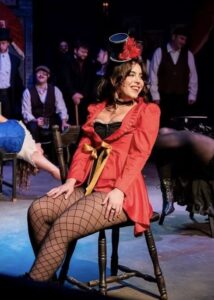 Then there is Francesca Noe as Lucy Harris, whose performance may be the production’s most heartbreaking. Noe gives Lucy vulnerability without ever making her fragile, allowing us to see a woman desperately searching for a way out of a world that has offered her precious few choices. Let’s face it, Lucy is the OG Pretty Woman, a hooker with a heart. Matching her co-stars note for note Noe’s vocal performance is gorgeous, but it is the emotional storytelling underneath those vocals that makes Lucy so affecting. From the rousing, rambunctious “Bring On the Men” to the Act 1 11 o’clock showstopper, “Someone Like You” Noe’s Lucy is stunningly captivating.
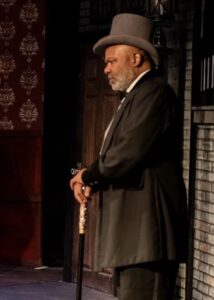 Skillfully aiding our lead as he navigates the uncertainty of his transformation is Elliott Robinson as Gabriel John Utterson, who initially serves up a bit of narrative exposition. Not gonna lie…knowing Robinson was among the cast was reason enough for me to check out this production. As he has done with any role he has taken on over the last two decades that he’s been a staple of area theatre, Robinson, simply by his presence, elevates the production. While this production doesn’t necessarily need any extra help in elevation, Robinson’s Utterson is the perfect unexpected ally to Jenkins’ troubled duality. Early on, Robinson’s Utterson joins the crowd for ‘Facade’ where he sings the telling line, “Each man you meet in the street isn’t one man, but two!” And how! It’s a simple phrase that could easily be lost if uttered by a lesser performer, but in Robinson’s capable hands, you’re like…Damn right.
 From the spooky frothing magic potion that turns Jekyll to Hyde to those candles that light the lab and books that become almost unnoticeably more disheveled and chaotic as the transformations become more frequent and uncontrolled…it’s those little touches by the set, scenic and props crew that bring you in this gothic world, and keep you there. Oh, and be sure and take notice of the handbills, notices and posters pasted to the wall just to the right of the main stage. My companion for the evening and I had fun during intermission figuring out what classic London lore each one represented. Nice touch! There’s also a fun, albeit completely out of place nod to our own skyline mixed in amongst the 1880s London skyline.