
KEDAGORO, a Japan-based contemporary dance company makes its highly anticipated Music City debut at OZ Arts Nashville on Saturday, November 14, at 8 p.m. and Sunday, November 15, at 5 p.m. These performances not only launch OZ Arts Nashville’s 14th season but also mark part of KEDAGORO’s first-ever U.S. performances, with the company’s three-city American tour traveling from New York to Greenville, South Carolina, before concluding in Nashville.
Founded by Reisa Shimojima, KEDAGORO has developed a reputation for fearless, thought-provoking work that explores the complexities of human behavior, historical memory, cultural identity and the often uncomfortable questions that shape our understanding of the world. As we discovered during our recent conversation with Shimojma for our latest Rapid Fire 10Q, KEDAGORO’s latest work, The Age is Yours, My Liege! (A Tale of Proto-Japan), ventures into the surreal territory of ancient Japanese culture, imperial mythology, power and national identity.
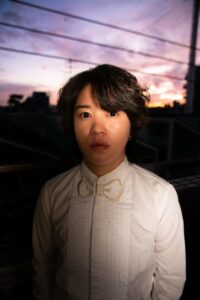 RAPID FIRE 10Q WITH KEDAGORO’s REISA SHIMOJIMA
JHPENTERTAINMENT: You were born in Kagoshima, Japan, and began dancing at just seven years old, studying everything from jazz to traditional Yosakoi. What first sparked your passion for dance, and did you always envision it becoming your life’s work?
REISA SHIMOJIMA: When I was seven years old, a friend from elementary school invited me to join her at a jazz dance class. At the time, I had absolutely no interest in dance. To be honest, I really didn’t want to take lessons at all. Ever since I was little, I had been fascinated by history. At home, I loved playing games like pretending to be prehistoric humans or acting out wars. However, Kagoshima, where I grew up, is a rural part of Japan with very small, close-knit communities. If you turned down an invitation from a friend, you could suddenly become a target for bullying or even be ostracized by the community. So, reluctantly, I started attending the jazz dance classes.
Then, one day, something rather unexpected happened. My jazz dance teacher started having an affair with the chairman of the Kagoshima Chamber of Commerce and Industry. Around that time, the chairman wanted to make Kagoshima a more vibrant place and came up with the idea of bringing YOSAKOI, a Japanese festival dance tradition that wasn’t particularly popular in Kagoshima at the time, to the region. And my dance teacher, wanting to win the chairman’s heart, decided to turn the entire jazz dance school into a YOSAKOI dance school! From then on, we spent almost every weekend traveling to YOSAKOI festivals in different parts of Japan, performing to promote Kagoshima. YOSAKOI festivals bring together all kinds of teams from across the country. But what I found fascinating wasn’t just the dancing. There were middle-aged men and women dancing while enjoying alcohol and cigarettes, complicated romantic affairs between members of different teams, and all sorts of messy, very human dramas. It was a world full of raw human behavior, desires, and tangled relationships. I became fascinated by all of it.
And eventually, I started to enjoy dancing. But to be precise, it wasn’t really dancing itself that I fell in love with. I loved using dance as an excuse to observe human behavior and the way people live their lives. Somehow, almost 30 years have passed, and I’ve kept dancing all this time. I never imagined that dance would actually become my profession. Even now, I don’t think dancing itself is my ultimate goal. I suppose I’m still enjoying the many aspects of human life and behavior through dance, using it as my excuse.
JHPENTERTAINMENT: You attended J. F. Oberlin University, where you studied theater and contemporary dance under acclaimed choreographer Kuniko Kisanuki. Your early university work included choreography, composition and directing. While you utilize all three aspects in your creativity, do you primarily consider yourself a choreographer and does your theatrical background influence the way you approach dance today?
REISA SHIMOJIMA: To be honest, I have never really thought of myself as a “choreographer.” What I mean is that I don’t consider myself a choreographer in the conventional sense of the word. My role as a choreographer is not to create choreography, but rather to bring out the errors that already exist within bodies that have been choreographed. What I mean by this is that I believe human beings are naturally choreographed throughout their lives by various environments and cultures. Through this process, our understanding of the body and the ways we use it are gradually shaped. I believe my role is to create various triggers that expose the history embedded in each person’s body, bringing it out into the open and making it visible on stage. I imagine this way of thinking has been influenced by my background in YOSAKOI and theater. But I have also learned a great deal from my dance mentor, Kuniko Kisanuki. She taught me not only about dance, but also about fundamental questions such as what it means to be human and how we should live as human beings.
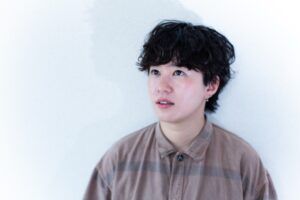 JHPENTERTAINMENT: Originally founded in 2013, KEDAGORO’s official website currently lists six core company members. Tell us a little about the company dynamic. How many performers are traveling with you on this American tour, and what makes this particular group of collaborators click?
REISA SHIMOJIMA: For this American tour, there are four KEDAGORO members, including myself. The other eight dancers were selected through auditions. When I was at university, before founding KEDAGORO, I had formed a dance group with some incredibly skilled dancers. However, relationships between dancers can be extremely complicated. I found myself caught in a dilemma: the higher our ambitions became, the harder it was to keep the group together. Eventually, the group fell apart.
At a time when I was completely at a loss about what to do next, I met the people who are now the core members of KEDAGORO at my university. They were students who didn’t really know what they wanted to do with their lives after graduation. They weren’t particularly enthusiastic about studying performing arts either. They were almost like ghosts, just drifting through university life. So, almost as a last resort, I asked them, “Why don’t we try forming a group and putting on just one performance together?” And somehow, before we knew it, we had been together for 13 years.
We’re a group of people with completely different personalities and interests, but somehow, being together feels very natural. Under the pretext of making work together, we can spend endless hours drinking and talking about all sorts of silly things. That’s the kind of team we are. Of course, that dynamic alone doesn’t always provide the balance we need, and that’s where the dancers selected through auditions come in. They support the group in ways that our core members cannot always provide.
I think dance companies can easily become trapped by certain preconceptions. There’s often an idea that working hard and performing well are the ultimate virtues. But I believe this is one of the most dangerous traps in dance. We also need to embrace the possibility of making mistakes and allow those errors to become fertile ground for creativity. I think the relationship between KEDAGORO’s core members and the audition-selected dancers creates a very delicate and interesting balance. It’s not that one group represents one particular way of thinking and the other represents something completely different. Rather, everyone constantly shifts their positions, changing the direction of the sails as we move forward together.
I also think of it this way: even if we’re all on the same boat, if everyone is looking in the same direction, we won’t notice what’s approaching from behind us. But in this group, although we’re all on the same boat, everyone is looking in a different direction — some looking forward, others backward, and others to the sides. I think that’s what makes KEDAGORO such an interesting team. We move forward together, but we don’t all look at the world from the same perspective.
JHPENTERTAINMENT: A quick Internet search reveals that KEDAGORO is a rather colorful name, reportedly translating to something along the lines of animal droppings on the ground in the Kagoshima dialect. That’s certainly one way to make a memorable first impression! What’s the story behind choosing the name, and have you ever had second thoughts about introducing your company to the world with it?
REISA SHIMOJIMA: As I mentioned earlier, KEDAGORO was originally formed for a one-time performance. So, to be honest, we weren’t particularly attached to the idea of having a company name. We simply wanted something unusual, a name that wouldn’t be used by many other people and would come up at the very top of the search results when someone looked it up online. That’s how we came up with “KEDAGORO.” Well, I suppose it was also a fitting name for a group of people who had been rolling around university like dog shit. We never imagined that we would still be using this name 13 years later. These days, we’ve adopted a slogan that goes something like this: “Even something as dirty and ugly as dog shit can be an essential source of nourishment for flies and other creatures. We want to become something like that for humanity, too.” I’ve never once regretted choosing this company name. If anything, I feel as though the people we were 13 years ago are still encouraging us from behind, saying: “Keep creating work that makes this name something to be proud of. Keep doing things that will never make you regret choosing it!”
JHPENTERTAINMENT: Your work doesn’t exactly shy away from controversial subject matter, tackling everything from the United Red Army incident and the Aum Shinrikyo cult to the Sewol ferry disaster and questions surrounding Japanese national identity. As an artist and choreographer, what excites you most about confronting difficult subjects through dance, and do you see provoking discussion as an essential part of your creative responsibility?
REISA SHIMOJIMA: Because I often deal with social and political themes in my work, people tend to describe my work as journalistic. But actually, I don’t really see it that way myself. I see historical events as important clues that can help us understand human beings. Rather than looking at these events through the information we receive from the media, I want to observe them on a much more cosmic scale through physical expression. I believe that memories dating back hundreds of millions, or even trillions, of years are engraved in our bodies. These memories go far beyond the limits of human thought and emotion. So, in my work, there is no question of taking sides, either for or against something. What exists is simply evidence of the fact that we are human beings.
When I use historical events as the subject of a work, audiences naturally try to find something in it. Depending on their age, gender, and personal life experiences, each person has a different relationship with the event. As a result, a wide range of opinions and reactions emerge. Contemporary dance often deals with abstract themes, but I believe that using specific events that are part of humanity’s collective memory can open up new possibilities for the audience’s imagination. And I myself sometimes discover entirely new interpretations of my own work through the opinions and reactions of the audience. What matters most to me is that the audience creates a world within the work that even the choreographer could never have imagined. I am fully prepared to accept every response from the audience, whether they love my work or absolutely hate it.
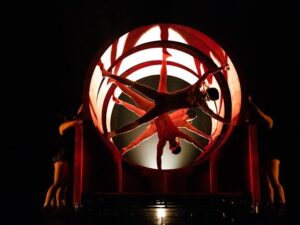
 JHPENTERTAINMENT: Let’s talk about The Age is Yours, My Liege! (A Tale of Proto-Japan). The production takes audiences into a surreal world of ancient Japanese culture, imperial mythology, power and national identity, complete with some rather unexpected theatrical imagery. In a few words, what can audiences expect when they enter this world, and what was the initial spark that inspired you to create this particular piece?
REISA SHIMOJIMA: I’m very curious to know what kind of experience each audience member will have when they see our work. After all, I imagine that Japanese and American audiences may find very different things in the same piece. In fact, even during our performances in New York, there were moments when the audience reacted in ways I hadn’t expected. For me, this is one of the great joys of performing in another country. It’s fascinating to discover how people from different cultural backgrounds respond to our work. I think there are many things about Japan that we become blind to simply because we live in Japan. Actually, what inspired me to create this piece was my experience over the past few years of creating work in various Asian countries. During that time, I encountered many traces and remnants of the period when Japan colonized other Asian countries. As I came across these histories, I found myself wondering: “What exactly is Japan?” That question became the starting point for this work. I would really love to hear your honest thoughts about what you, as American audiences, experience and feel when you watch it. My hope is that when people leave the theater after seeing our work, they feel that something has shifted, even just a little, in the way they see the world and other human beings.
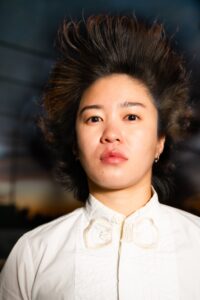 JHPENTERTAINMENT: I understand this production marks Kedagoro’s North American debut, with a three-city American tour taking you from New York to Greenville, South Carolina, and ultimately to Music City at OZ Arts Nashville. What’s most exciting about bringing your creative vision to American audiences for the very first time, and is there anything in particular you’re curious to discover about how audiences here will respond?
REISA SHIMOJIMA: Japan and the United States have had deep historical ties, and that relationship continues to this day. How does this work look from the perspective of a country that decided to keep the Emperor on the throne after World War II? And how do Americans see the Japanese people? More than anything, I am looking forward to hearing your honest opinions. They don’t have to be positive ones.
My aim is to interpret the world through my work. I hope to hear discussions and discover perspectives that I could never have imagined myself. That, to me, is what makes a work come alive. It’s what gives it blood flowing through its veins. I hope that American audiences will breathe new life into this work and give it a new existence through their own perspectives and responses.
 JHPENTERTAINMENT: You’ve remarked that KEDAGORO was built around your belief that “dance is a method for interpreting the world.” Now here you are presenting your latest piece to U.S. audiences. Any hopes of discovering future collaborators while here in the states?
REISA SHIMOJIMA: Yes! So far, I’ve had many opportunities to collaborate with artists from across Asia and Europe, and I would really love to meet potential collaborators here in the United States as well. I don’t necessarily want to focus directly on political issues between Japan and the United States. What I would really like to explore is the kind of chaos that might emerge when bodies from these two countries come into collision with one another. As long as I’m alive, I want to keep exploring the world. So, to everyone here in the United States, I sincerely hope we can connect and create something together. I look forward to meeting you!
JHPENTERTAINMENT: While researching our conversation, I came across a quote from you that I absolutely love: “After I decided to do dance seriously, I ‘bared my fangs’ and adopted an attitude that I would kick my heels up and do things no one expected!” I love that rebellious spirit! For the next generation of dancers and choreographers who might be afraid to take creative risks or march to the beat of their own drum, what advice would you offer?
REISA SHIMOJIMA: Of course, having your own passion and beliefs is important. But if you want to stay true to what you believe in and keep following your own path, you need people by your side. I want you to find people who believe in you and support you, people who will help protect your passion and your convictions. I think the reason I was able to make the decision to pursue dance seriously was because I had people around me. Taking artistic risks is never easy. There will inevitably be times when you get hurt, when you lose faith in yourself, and when you start to doubt everything. So, rather than focusing on creating good or interesting work, I want you to focus on finding your comrades — people who share your vision and are willing to walk alongside you. And work hard to put yourself out there and meet those people. I believe that truly interesting work begins there. The world is vast. There are absolutely people out there who will become your allies. Dancers and choreographers should believe that first and foremost. Don’t worry so much about your own artistic talent.
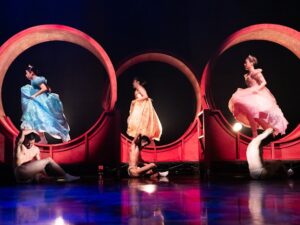 JHPENTERTAINMENT: And finally, after audiences experience The Age is Yours, My Liege! (A Tale of Proto-Japan), what do you hope the production sparks in their minds? What questions, conversations or perhaps even a little controversy would you like them to take with them when they leave the theater?
REISA SHIMOJIMA: I want you to feel both the foolishness of humanity and how deeply lovable we are. This may sound harsh, but I believe that as long as human beings remain human, war will never come to an end. However, I believe that if we can release some of our deepest, hidden human desires within the fictional world of performing arts, we may be able to reduce conflict, even if only a little, in the real world. That is precisely why I believe theaters and works of performing art exist: to bear the weight of the world’s distortions. In other words, I invite you, the audience, to become accomplices in this shared time and space. As accomplices, you have every right to question, challenge, criticize, or debate anything about this work. I sincerely hope you will share your thoughts and reactions with me. A work does not end when it is presented to an audience. In fact, that is where it begins. I look forward to beginning this journey with all of you, together with this work!
Shimojima’s answers offer a fascinating glimpse into an artist who sees dance as far more than movement, technique or choreography. Whether she’s recounting an unconventional introduction to the art form, explaining the rather memorable origins of her company’s name, or inviting audiences to become accomplices in an exploration of humanity’s contradictions, one thing is abundantly clear: KEDAGORO isn’t particularly interested in playing it safe. And perhaps that’s precisely the point. As Shimojima reminds us, a performance doesn’t end when the curtain comes down. That’s where the conversation begins.
Nashville audiences will have their opportunity to join that conversation when KEDAGORO presents The Age is Yours, My Liege! (A Tale of Proto-Japan) at OZ Arts Nashville on Saturday, November 14, at 8 p.m. and Sunday, November 15, at 5 p.m. The performances open OZ Arts Nashville’s 14th season and are part of the dance company’s historic first U.S. tour. Come with an open mind, bring your curiosity and don’t be afraid to have an opinion. Reisa Shimojima and KEDAGORO are ready to hear it.
Ticket options include:
- Artist & Creative Community (discounted, no code required) $25
- General Admission $35
- Generous Admission (I love this one!) $45
CLICK HERE for tickets.
Next up at OZ Arts Nashville as Season 14 continues its New York-based hip hop spoken word artist Dahlak Brathwaite‘s Try/Step/Trip Friday and Saturday, December 4 & 5 at 8pm. CLICK HERE for more info or to purchase tickets. To keep up with all things OZ Arts, find them HERE or follow them on Facebook, X, YouTube and Insta.
For all things KEDAGORO, CLICK HEREor follow them on Insta, Facebook, X and YouTube.
As always, If you want to read our latest on Music, Movies, Performing or Visual Arts, please check out JHPEntertainment online or socials at Facebook, Insta, X and Threads. Till then…. #GoSeeTheShow!

 RAPID FIRE WITH MANUAL CINEMA CO ARTISTIC DIRECTOR JULIA MILLER
 RAPID FIRE WITH MANUAL CINEMA CO ARTISTIC DIRECTOR JULIA MILLER

 Blending choreography, sound design, lighting, and digital projection into a single, seamless vision, Umeda doesn’t just create dance—he builds entire worlds. A true one-man creative powerhouse.
 In a note from Oz’s Artistic Director, Murphy recalls first presenting Umeda in Los Angeles in 2013, where the work left a lasting impression—earning praise from the Los Angeles Times for “a defining artistic vision for our time.” Now, that same boundary-pushing artistry returns to Nashville with a program locals haven’t witnessed before. I’m certain that my readers know: every now and then, a performance comes along that genuinely shifts your expectations. This is one of those moments.