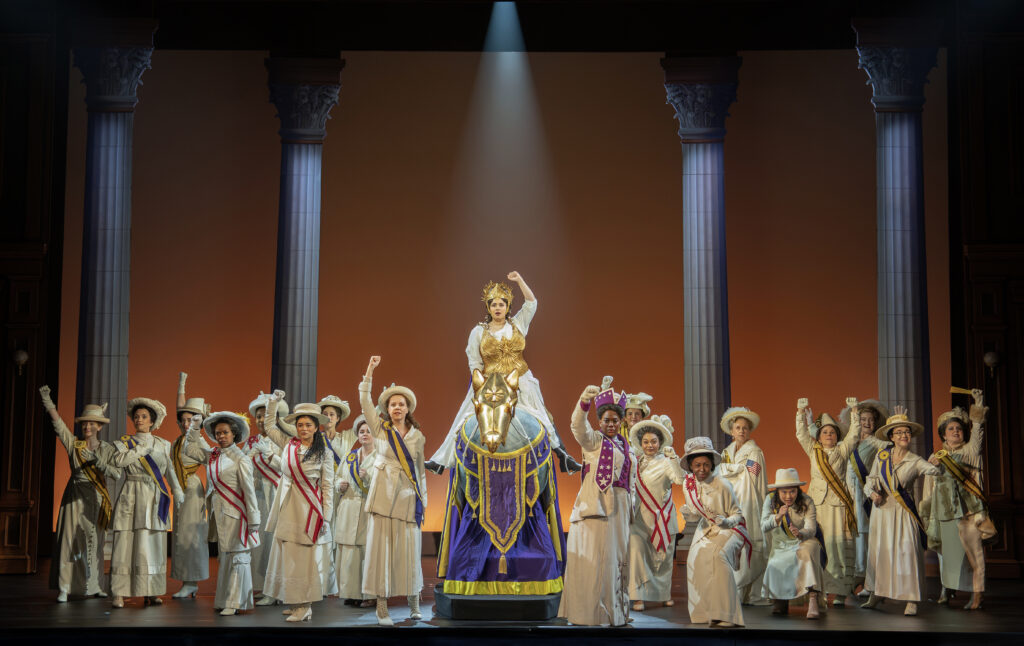
There are opening nights… and then there are opening nights that feel cosmically aligned with history. On March 3, 2026, the national tour of Suffs unfurled its banners at TPAC’s Jackson Hall in Nashville—and not just on any date. Music City’s first performance landed on the 113th anniversary of the 1913 Women’s March organized by young activist Alice Paul, when more than 5,000 women paraded down Pennsylvania Avenue demanding the right to vote, led by the indomitable Inez Milholland astride a white horse. History echoed loudly inside Jackson Hall that night.
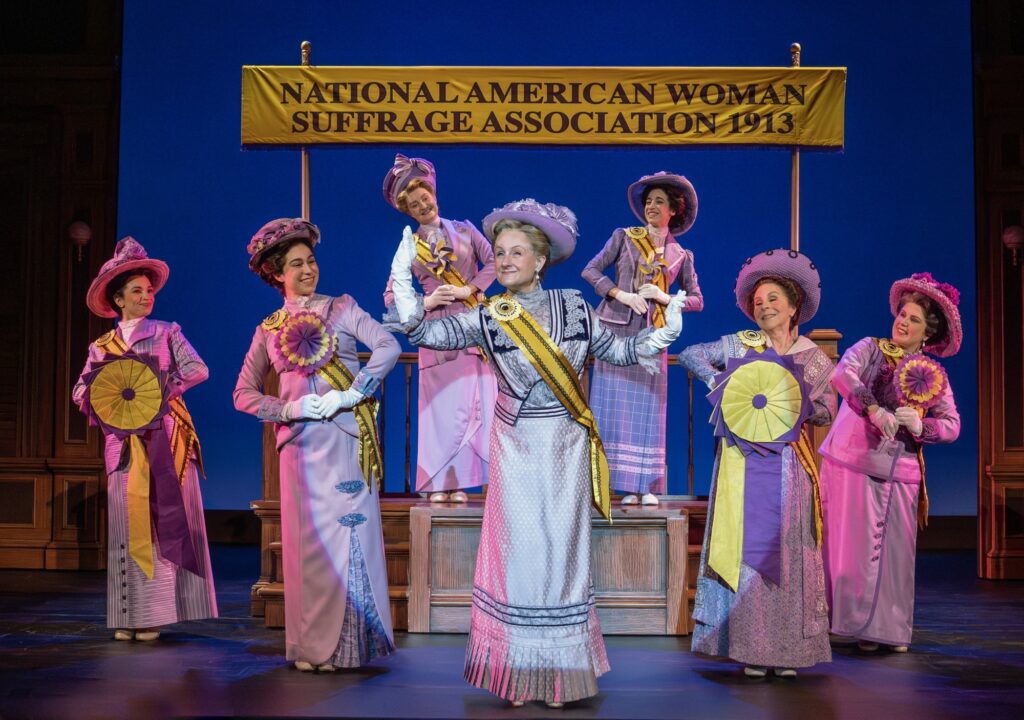
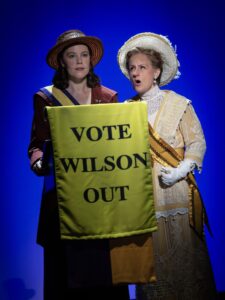 From the opening strains of the period-perfect ragtime-syncopated “Let Mother Vote,” maternally led by Mary Grandy‘s Carrie Chapman Catt and backed by a vocally powerful ensemble, Suffs makes it clear: this isn’t a museum piece. It’s a movement. The storytelling feels urgent, strong, and emotionally immediate—never preachy, always human.
At the center stands Maya Keleher as Alice Paul—focused, flinty, and fiercely principled. Her “Finish the Fight” functions as both rallying cry and mission statement, delivered with unwavering conviction. Later, in “Insane,” Keleher reveals the psychological toll of imprisonment with a performance that is raw without losing control. Opposite her, Grandy’s Carrie Chapman Catt brings seasoned authority and strategic patience to the aforementioned “Let Mother Vote.” Their Act II duet, “She and I,” beautifully captures the tension—and eventual respect—between two women fighting for the same goal through different methods. Grandy’s “This Girl” adds reflective depth, grounding the generational divide in lived experience.
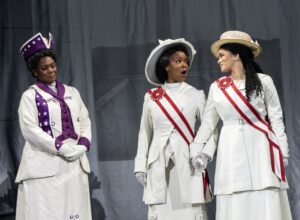 As Ida B. Wells, Danyel Fulton commands attention with moral clarity, emotional precision and powerhouse vocals to rival a certain recent Broadway Gypsy. “Wait My Turn” simmers with justified frustration, and when she returns in “I Was Here,” alongside Mary Church Terrell (Trisha Jeffrey) and Phyllis Terrell (Victoria Pekel), the moment lands as a declaration of presence that resonates well beyond the period setting. Speaking of Fulton’s co-stars, Jeffrey brings elegance and resolve to Mary Church Terrell, particularly in “Hold It Together,” serving as an emotional anchor amid political fractures. Meanwhile, Pekel’s Phyllis as well as a later turn as Robin, reinforce the vitality of youthful exuberance necessary for any movement to continue into the next generation. Whenever any of these three talented performers are on stage, the audience is mesmerized and treated to stunning vocals.
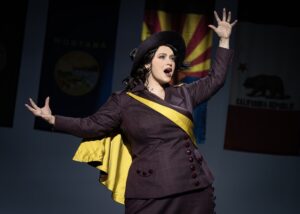 Monica Tulia Ramirez’s Inez Milholland radiates charisma in “The March (We Demand Equality),” which she leads alongside Fulton’s Ida and the ensemble in one of the production’s most visually arresting sequences. Act I’s “Show Them Who You Are” showcases Ramirez’s sass while Act II’s reprise flips the script to haunting results. Milholland’s personal life and sacrifices poignantly reveal the true dedication these powerful, but often unsung heroes of the moment possessed.
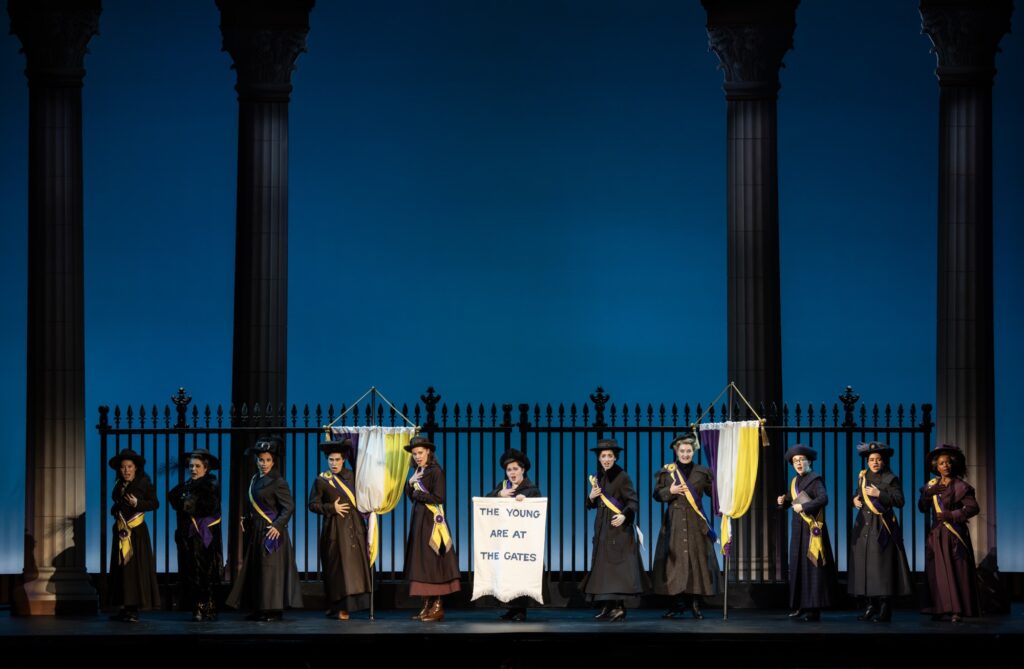
As Lucy Burns, Gwynne Wood delivers a blazing “Lucy’s Song,” electrifying the audience with defiance, while Livvy Marcus injects Doris Stevens with sharp wit, youthful urgency and to borrow a descriptive of Mary Tyler Moore’s Mary Richards…spunk, particularly in “The Young Are at the Gates,” which propels Act II forward with fire.
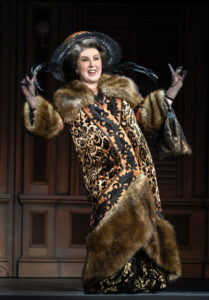 Laura Stracko‘s Alva Belmont is boisterously brilliant. Gotta love a socialist socialite. Act I’s “Alva Belmont” introduces the character in a big way. With another period-nod, “Alva Belmont” is presented as a toe-tappin’ Tin Pan Alley-style ditty complete with playful, yet pointed lyrics: “I divorced my husband for philandering. Now I’ve got his millions for philanthropy.” Flawlessly introducing the character. Interestingly, while not really relevant to the plot, I discovered while researching to interview some of the cast that the real Alva Belmont, a native of Alabama, has ties-by-association to Tennessee. Her maternal grandfather, Robert Desha was a U.S. House of Representatives for the state of Tennessee. In the years before her political activism, she was first married to William Kissam Vanderbilt, the grandson of Commodore Cornelius Vanderbilt (for whom Nashville’s Vanderbilt University was named).
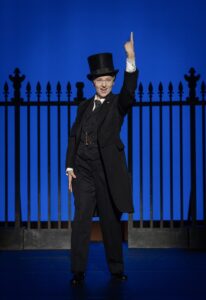 As President Woodrow Wilson, Jenny Ashman offers a sharply drawn portrayal. “Ladies” drips with calculated condescension (and sadly echoes a little too closely our current administration’s views on the arguably stronger sex, but I digress). Later in the show, Ashman’s Wilson attemps to placate with “Let Mother Vote (reprise)”, which lands with pointed irony. On Opening Night in Nashville, Ariana Burks stepped into the role of President Wilson’s Third Assistant Secretary of State Dudley Malone, a role usually played by Brandi Portert. Covering the role, Burks shines in “Respectfully Yours, Dudley Malone,” blending romantic sincerity with political awakening. Her chemistry with Marcus’ Doris in “If We Were Married” and its reprise adds warmth and texture to the broader narrative. Just one of a handful of relationships, while not at the center of the narrative, a wonderful aside. Other notable personal relationships alluded to within Suffs include sorority sisters Ida B. Wells and Mary Church Terrell, friends Alice Paul and Lucy Burns and longtime partners Carrie Chapman Catt and Mollie Hay.
The ensemble numbers—“Find a Way,” “The Convention Part 1 & 2,” “The Campaign,” and “August 26th, 1920”—surge with collective momentum, creating stage pictures that feel both intimate and epic. Act I builds to the layered and emotionally charged “How Long?,” leaving the audience suspended in uncertainty before intermission. Act II escalates quickly with the explosive “Fire & Tea,” a collision of ideology and impatience that crackles with tension. Side Note: I love that during my Rapid Fire 20Q, Marya Grandy noted that the effigy to Woodrow Wilson seen in “Fire & Tea” is made of kitchen utensils! Giving me a little insider info that I’m happy to pass along to my readers.
Across the board, the vocals are exceptional. Touring companies frequently fall victim to the occasional technical issue inherent in the logistics of setting up in a new venue each week—but not Suffs thanks to Jason Crystal‘s sound design and the impeccable vocals skills of the entire cast. From the first notes of “Let Mother Vote” to the powerful final bars of “Keep Marching,” the vocals—both individual and united—were crisp, clear, and strong. Harmonies were tight. Lyrics were fully intelligible. Not a single mic felt unbalanced, and the orchestra never overpowered the storytelling. The sound mixing and design were remarkably polished for an opening night in a new city, allowing the emotional weight of each lyric to land cleanly and confidently. Considering even though I was there to review the show, yet relegated to the back of the theatre in seats Ida B. Wells herself would reject, the sound throughout the show was simply perfect. Every lyric, every note delivered and received with precision and clarity.
Visually, the touring production is both strong and fluid. Based on Riccardo Hernandez‘ Broadway scenic designs, Christine Peters has adapted ever-moving walls and platforms, unfurling drapes and banners suggesting both protest staging and democracy under construction, while seamless transitions allow rallies, jail cells, convention halls, and the Tennessee State House to materialize with cinematic efficiency. Hair and wig design by Charles G. LaPointe and Paul Tazwell‘s period-authentic costuming clearly delineates factions, with the crisp whites of the National Woman’s Party glowing under strategic lighting in “The March (We Demand Equality).” Lap Chi Chu‘s lighting design proves especially effective in “Insane,” where stark isolation heightens emotional impact. Add to that choreographer Mayte Natalio‘s movement choices from the opening number and throughout the show…what I’ve dubbed marchography. It’s succinct and effective without being too rigid, further conveying the forward-momentum and motivation of the cause. On the lighter side, there’s a segment about halfway through the show that takes place at a bar when Natalio’s genius draws the eye to a couple patrons in the background who raise their beers and clink their drinks in rhythm to the song being performed that caused me to make a mental note: drinkography. The absolute attention to everything from period references in wardrobe and music styles to sets, lighting and movement throughout Suffs, a multitude of reasons this show is so enjoyable.
Earlier, I made reference to Tennessee’s connection to the subject matter. While “Down at the State House” sets the stage, it’s “A Letter From Harry’s Mother”, featuring Laura Stracko, Jenna Lee Rosen and Maya Keheler, that transforms the evening into something deeply local for those of us from The Volunteer State. As mentioned in my recent Rapid Fire 20Q with members of the cast, this moment recounts Tennessee’s pivotal role in ratifying the 19th Amendment, when, in August 1920, Tennessee became the 36th and final state needed for ratification.
When Stracko’s Phoebe, Rosen’s Harry, and Keheler’s Alice bring that story to life onstage, it hits differently in Tennessee. The reaction inside Jackson Hall was immediate and thunderous—very possibly the most sustained applause the company has received on tour during that particular sequence. It wasn’t simply appreciation. It was pride. It was recognition. It was a state seeing itself in the story of progress. Something, sadly we as a state are lacking these days. (An aside: Dubbed in the press of the day as “War of the Roses,” saw pro-suffrage lawmakers wearing yellow roses while opponents donned red. So naturally, yours truly donned a yellow lapel flower while attending Music City’s Opening Night.)
By the time “Keep Marching” swelled in the finale, led by Alice and the full ensemble, it no longer felt like the end of a performance. It felt like a charge forward. After all, as Suffs reiterates time and time again, progress is not inevitable. It is organized. On opening night at TPAC, Nashville didn’t just witness history. It gratefully recognized its role in it.
———-
Created by Shaina Taub, this thrilling and emotionally charged musical shines a spotlight on the brilliant, passionate, and often divided women who fought tirelessly for the right to vote. Beyond the accolades lies a story that feels especially resonant here in Tennessee — the final battleground that secured ratification of the 19th Amendment. More than a century after Tennessee cast the deciding vote, Suffs reminds us that history is not just something we inherit — it’s something we shape. And sometimes, it only takes one voice to tip the balance.
The national tour plays TPAC’s Jackson Hall March 3–8 with the following performances: Tuesday, March 3 – Friday, March 6 with 7:30pm curtain, Saturday, March 7 – 2:00pm & 7:30pm, Sunday, March 8 – 1:00pm* & 6:30pm.
*Sunday’s 1pm performance includes ASL interpretation, Open Captioning, Audio Description, and Large Print and Braille programs.
To purchase tickets to Suffs at TPAC, CLICK HERE. Following Suffs, Broadway at TPAC‘s 2025-2026 Season continues with another Music City debut as Back to the Future takes to the stage March 17-22. CLICK HERE for tickets or more info. Follow TPAC on Facebook, Instagram, YouTube & TikTok.
Not in Nashville? Catch Suffs in a city near you as the National Tour continues with stops in Charlotte, Boston, Dayton, Minneapolis, Detriot and more through summer of 2026. CLICK HERE for upcoming tour stops. Keep up with all things Suffs via the show’s socials on Facebook, Insta, X , TikTok and YouTube.
In case you missed it, CLICK HERE to read my Rapid Fire 20Q with members of the Suffs cast. As always, if you wanna follow JHPEntertainment to find out who I’m chatting with for my next Rapid Fire Q&A, or for my take on the latest local and national theatre, music and movie offerings, visit JHPENTERTAINMENT.com or find us on Facebook, Insta and Twitter. In the meantime… #GoSeeTheShow!
 RAPID FIRE WITH SUFFS‘ Carrie Chapman Catt, ACTRESS MARYA GRANDY
 RAPID FIRE WITH SUFFS‘ Mary Church Terrell, ACTRESS
 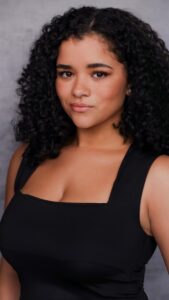 RAPID FIRE WITH SUFFS‘ Phyllis Terrell and Robin, ACTRESS VICTORIA PEKEL
 RAPID FIRE WITH SUFFS‘ Mollie Hay, ACTRESS TAMI DAHBURA