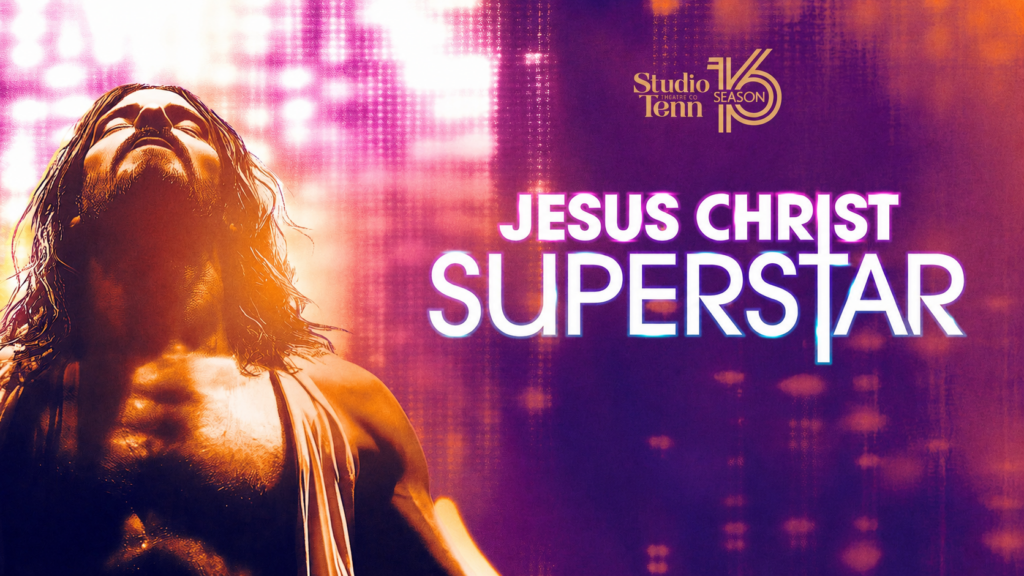
Since its groundbreaking 1971 Broadway debut, Jesus Christ Superstar has remained one of musical theatre’s most provocative works. Andrew Lloyd Webber and Tim Rice’s legendary rock opera has never been content presenting a straightforward biblical retelling. Instead, the piece examines faith, fame, politics, and humanity through the eyes of the people surrounding Jesus during the final days leading to the crucifixion. More than fifty years later, the material still feels startlingly relevant.
Studio Tenn Artistic Director Patrick Cassidy, who’s at the helm of this production as the show’s director, clearly understands why. Rather than reinventing the show through gimmick or spectacle, Cassidy’s emotionally charged new production smartly leans into the themes already embedded within the material: celebrity worship, performative devotion, mob mentality, and the emotional cost of turning human beings into symbols.
As Cassidy notes in his director’s statement, this production asks audiences to consider what happens when a person becomes “more than human in the eyes of the world.” It is a concept that permeates nearly every aspect of this imaginative interpretation.
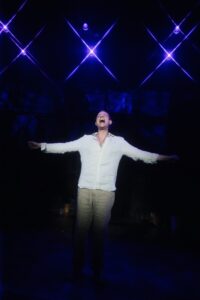
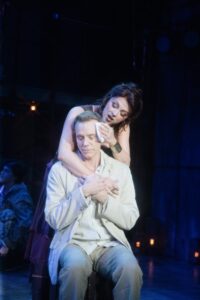
Leading the cast is Broadway icon, Tony-nominated Adam Pascal as Jesus Christ, and despite the production being filled with powerhouse performances, Pascal remains its emotional center. Rather than portraying Jesus as some untouchable religious figure, Pascal presents him as a weary modern everyman crushed beneath the expectations of those around him. Costume designer Devon Renee Spencer wisely avoids the traditional flowing robes often associated with the role, instead dressing Pascal in loose linen shirt and neutral-toned pants that ground the character in recognizable humanity.
Vocally, Pascal delivers exactly the kind of performance longtime fans hoped for while still finding fresh emotional textures within the score. One moment, his voice slips into soft, heartfelt vulnerability during quieter emotional exchanges. The next, he unleashes the kind of raw, anger-struck rock wailing that made him a Broadway icon in the first place. His “Gethsemane” becomes one of this production’s many emotional peak—not merely sung, but emotionally exorcised from somewhere deep within him. Pascal allows Jesus’ fear, frustration, exhaustion…and yes, rage…to boil violently to the surface.
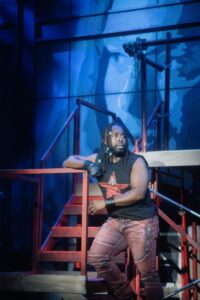 Opposite him, Grammy nominee Mykal Kilgore delivers a mesmerizing Judas. From the opening notes of “Heaven on Their Minds,” Kilgore refuses to portray Judas as a simple villain. Instead, his Judas feels conflicted, frightened, frustrated, and heartbreakingly human as he watches events spiral beyond anyone’s control. His powerhouse vocals soar effortlessly through the score, but it is the emotional vulnerability beneath the performance that lingers longest.
The chemistry between Pascal and Kilgore fuels many of the production’s strongest moments, particularly during “What’s the Buzz?” and “The Last Supper,” where simmering resentment and emotional exhaustion visibly fracture the relationship between the two men.
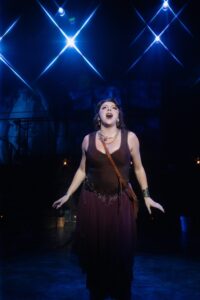 As Mary Magdalene, powerhouse vocalist Olivia Valli comes by her talents naturally. Granddaughter of The Four Season‘s founding member Fankie Valli, she’s a legacy entertainer. As Mary Magdalene, Valli brings warmth and aching sincerity to the role. Early on During “Everything’s Alright,” Valli’s calming presence provides a needed emotional balance amid the increasingly chaotic atmosphere surrounding Jesus. Soon after, her rendition of “I Don’t Know How to Love Him” avoids unnecessary theatrics in favor of emotional honesty, allowing the heartbreak within the song to quietly unfold. Under Cassidy’s direction, Valli explores the often-avoided attraction between Mary the woman and Jesus the man, once again offering yet another layer to the humanity of the piece.
And while Pascal, Kilgore, and Valli anchor the production through their notoriety and talents, Cassidy’s supporting cast of beloved local performers repeatedly threatens to steal the evening out from under them—in the best possible way.
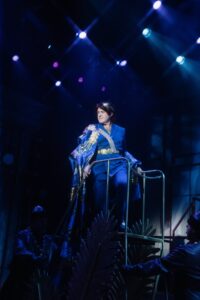 As Pontius Pilate, Geoffrey Davin offers one of the evening’s smartest tonal shifts . Presented as a gaudy, self-important joke of a man sporting an intentionally terrible hairpiece (kudos to the show’s wig designer Meredith Schieltz for just simply going for it), Davin leans fully into the absurdity of performative power. The portrayal initially earns plenty of laughs, but underneath the comedy lies another sharp reflection of the production’s larger themes—people desperate to appear more important than they truly are. His “Pilate’s Dream” balances nervous humor with growing dread, while sinisterly daunting presence during “Trial Before Pilate/39 Lashes” becomes genuinely unsettling.
Another noteworthy performance comes via Connor Barr. Barr also delivers emotionally effective work as Peter, particularly during “Peter’s Denial,” where fear and shame visibly consume him in real time. Knowing the Bible story like the good southern christian my Mama raised me to be, I found myself counting 1…2…3…as Barr fulfilled the prediction of denial in this small but surprisingly emotional moment within this production.
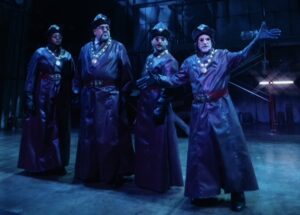 W. Scott Stewart’s thunderous bass vocals as Caiaphas roll in like a deep fog, brilliantly setting the stage for the dread and darkness to come. Robert Parker Jenkins‘ Annas perfectly snarky glances peering over those disturbingly small, dark glasses, brings an unspoken self-righteousness to his role as a high priest. As other members of Caiaphas’ doom squad, Garris Wimmer‘s sinister voice and Jennifer Whitcomb-Oliva‘s snide presence all come together perfectly to present a united and terrifying quartet who initiate the plot to end Jesus.
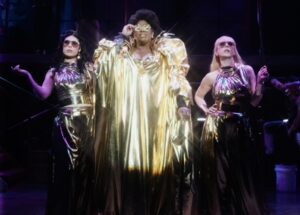 Then there’s the most intriguing of Whitcomb-Oliva’s multiple roles, her dazzlingly, gloriously commanding presence as King Herod. Landing somewhere firmly between Tina Turner’s Auntie Entity from Mad Max: Beyond the Thunderdome and Elton John’s Pinball Wizard from yet another rock opera, Tommy, Whitcomb-Oliva’s Herod is the true definition of the villainous character we know we’re not supposed to love, but we just can’t help ourselves. Combine the stage presence and spectacular wardrobe with Whitcomb-Oliva’s undeniable talents and you’ve got yourself a show-stopping performance and another of Studio Tenn‘s Jesus Christ Superstar‘s truly magical cast members. There is no role this mega-watt talented performer can’t handle and she proves it show after show after show.
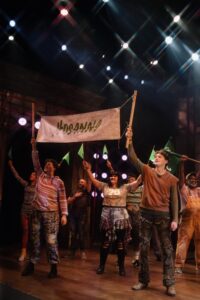 Other ensemble members like Bakari King, Garris Wimmer, Maya Antoinette Riley, Matthew Hayes Hunter, Savannah Stein, Lane Adam Williamson, Victoria Griffin, Emma Rose Williamson, Connor Adair, Nikki Berra, Christina Ledbetter and Patrick Jones each contribute to the overall energy, emotion and beauty of the piece. From the full ensemble Act 1 favorite, “What’s the Buzz’ to a shining, glittering all-in late-hour moment, the entire cast brings everything they’ve got, resulting in a feast for the eyes, the mind, the heart and soul.
Cassidy’s contemporary framing of the musical proves equally effective visually. Scenic designer Andrew Cohen’s stripped-down, two-tiered industrial scaffolding set serves the material beautifully. After all, Jesus Christ Superstar has never truly been about lavish scenery—it has always been about the music, emotion, and collision of faith, celebrity, and mob mentality.
Dominating the stage is a massive painted mural of Jesus that vacillates between sacred tribute and selfie-ready photo backdrop, serving as a sharp visual commentary on true belief versus performative optics.
Devon Renee Spencer’s costume work deserves particular praise throughout. With what feels like a subtle nod to Pascal’s Tony-nominated turn in Rent, much of the ensemble appears in elevated retro-grunge aesthetics layered with plaid flannels, distressed textures, and muted earth tones.
But Spencer’s most effective storytelling device is color. The militaristic blood-red dusters worn by Caiaphas and his followers immediately establish danger and authoritarian control. Meanwhile, Judas’ wardrobe slowly evolves alongside his emotional deterioration. Kilgore first appears in a sleeveless black shirt emblazoned with a bright red star. By the time betrayal arrives, the star has vanished, replaced instead with a spiderweb design—a haunting visual metaphor for the trap Judas both creates and becomes trapped within.
Darren Levin’s lighting design further deepens the production’s emotional power. Much of his work is so seamlessly integrated audiences may not consciously notice its impact until a startling–even though we know it’s coming–Act 2 moment when the stage suddenly floods in violent crimson. Combined with Danny Northrup’s immersive sound design and Randy Craft’s music direction (featuring Craft and Ming Aldrich-Gan on keys, Brad Williamson on drums, bassist Thomas Altman, Sam Merrill on trumpet, Jennifer Kummer on French horn, Gus Arnold on reeds, and guitarists Cameron Cleland & Miles Aubrey), the behind the scenes crew turns out to be just as stacked as the players on-stage.
 Likewise, Joi Ware’s choreography injects continuous movement and urgency into the production. There are moments where subtle Bob Fosse-inspired isolations seem to collide with flashes of Michael Jackson-inspired movement during larger ensemble sequences, creating choreography that feels simultaneously nostalgic and contemporary. Even those ensemble moments reinforce the power-in-numbers juxtaposed to the isolation of one theme found throughout the piece. Coupled with Cassidy’s direction, Ware’s choreography fills the stage with passionate movement, whether the entire company is on stage for a group number, or the action slows for a solitary moment from Pascal, Kilgore or Valli.
The production’s final moments ultimately land with devastating restraint. Rather than over-staging the Crucifixion, Cassidy allows Pascal’s increasingly broken physicality and exhausted vocals to carry the emotional weight of the scene. The result is haunting. By the time the orchestra transitions into “John 19:41,” the audience sits in near-total silence…followed immediately by thunderous applause.
Studio Tenn’s Jesus Christ Superstar succeeds not because it attempts to reinvent the material, but because it trusts the emotional complexity already living inside it. The result is a hauntingly modern interpretation of a decades-old rock opera that somehow feels more relevant than ever. Even before the show opened it was announced that it would extend its initial run through May 31. Performances of Studio Tenn‘s Jesus Christ Superstar on stage at Turner Theatre inside The Factory at Franklin (230 Franklin Road, Franklin, TN 37064) are Wednesdays thru Sundays with 7pm performances Wednesdays-Saturdays, Saturday matinees at 2pm and Sunday matinees at 1pm. CLICK HERE to purchase tickets or for more information.
To keep up with the latest from Studio Tenn be sure to check out Studio Tenn online at StudioTenn.com or on social media at Facebook, Instagram and X.
Interested in coverage for your latest entertaining endeavor? Click the contact page and drop me a note. You can also follow JHP Entertainment on Instagram and Facebook. Until then, #GoSeeTheShow!