There are holiday shows that entertain, and then there are holiday shows that wrap you up—the kind that feel like stepping inside a snow globe of music, memory, and pure theatrical joy. Studio Tenn’s production of Irving Berlin’s White Christmas, now dazzling audiences at Turner Theater at The Factory at Franklin, is very much the latter. Under the direction of Patrick Cassidy, with a warm nod to the story’s cinematic origin, and powered by a starry, tap-happy cast, this beloved classic arrives with all the shimmer and heart audiences expect, plus a few luminous surprises. With opening night snow, showstopping choreography, and voices that echo the golden age of movie musicals, this White Christmas may well be Studio Tenn’s most enchanting holiday offering yet.
Cassidy’s interpretation of the fan favorite feels like exactly what a holiday musical should be—a big-hearted confection wrapped in nostalgia, polished to a glossy Broadway shine, and delivered by a cast who understand that style, sincerity, and spectacular dance numbers are the holy trinity of this beloved classic.
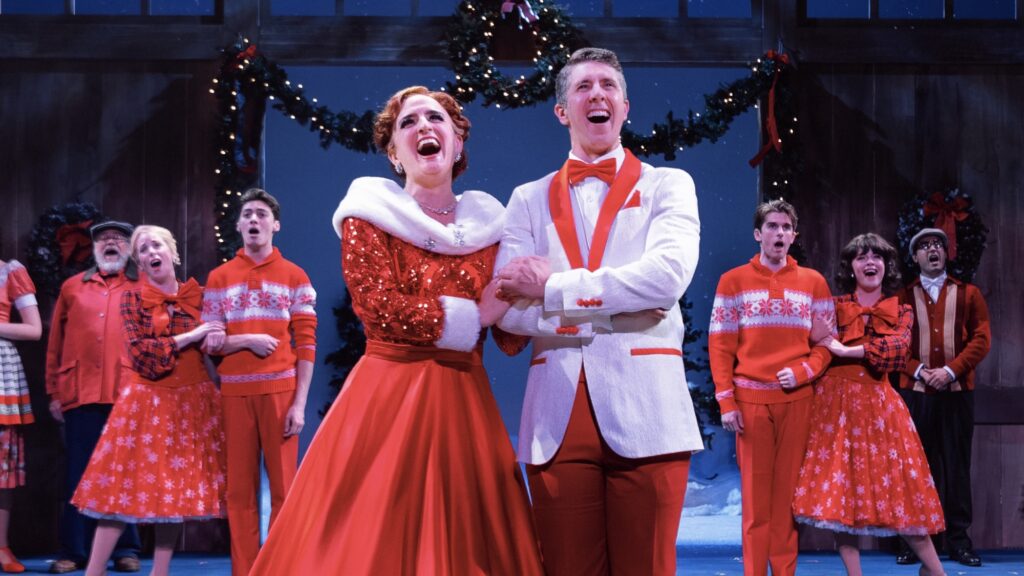
While White Christmas traditionally seems best suited for a larger venue, Andrew Cohen’s picture postcard scenic design works perfectly with Turner Theatre’s more intimate space. By presenting the inn and other key sets with a more minimalist approach, ie smaller set pieces on casters, while focusing the heft of his set design on the barn, which serves as backdrop to most of the larger all-in cast numbers, Cohen adds to the action, rather than drawing too much attention from it. Devon Renee Spencer’s sumptuous costumes, from those pink and green holiday costumes early in Act 1 and her take on Betty’s solo gown to the iconic finale garb are a wardrobe wonderland themselves. Darren Levin’s painterly lighting brilliantly coveys mood scene by scene. These craftspeople combined with Scott Brons’ lush musical direction, and the production glows from first tableau to that highly-anticipated, but much-loved final snowfall.
But the secret to White Christmas has always been its quartet at the center: two entertainers, two sisters, four hearts that collide, resist, and inevitably soften under falling snowflakes and Irving Berlin’s irresistible melodies. Studio Tenn’s leads deliver beautifully.
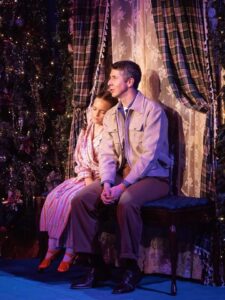 Ben Laxton, as the steady, dry-witted Bob Wallace, anchors the show with clean vocals and a grounded charm that never attempts to mimic Bing Crosby, but instead finds a sincerity and warmth all his own. His rendition of Count Your Blessings Instead of Sheep lands with a quiet power—simple, heartfelt, and beautifully sung.
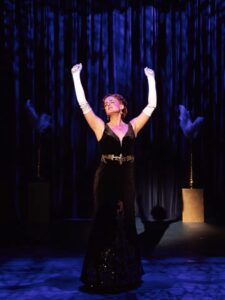 Laxton pairs especially well with Lisa Karlin’s Betty Haynes, whose rich, velvety alto brings a classic, old-Hollywood elegance to every number she touches. Her Love, You Didn’t Do Right By Me—a personal favorite moment of mine—was delivered with haunting restraint, channeling Rosemary Clooney without imitation and earning one of the night’s strongest responses.
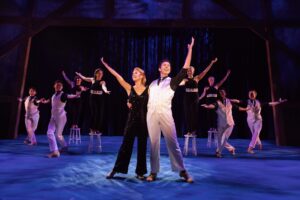 On the other side of the romantic coin, Jeremy Benton and Elizabeth McGuire ignite the stage as Phil Davis and Judy Haynes. Benton, not stranger to area theatre audiences, was last seen in Nashville as Bert in Nashville Rep‘s 2022 production of Mary Poppins, is also no stranger to the role, having performed in the National Tour of White Christmas and incredible 7 seasons. Speaking of previous connections to the show, Benton’s on-stage love interest McGuire, who’s making her Studio Tenn debut in the show, has previously appeared in two regional productions of White Christmas. Not only do they match the flirtatious comedic energy required of the roles, they also jointly co-choreographed the production—an ambitious undertaking given the show’s dance vocabulary is steeped in the iconic work of Randy Skinner. The result? Pure joy. Their The Best Things Happen While You’re Dancing is dreamlike and precise, but it’s the Act II taptastic extravaganza I Love a Piano that stops the show cold…or should I say Hot! Benton’s dancerly ease and McGuire’s crisp, buoyant tapping create the kind of musical-theatre electricity audiences hope for in December. They honor Skinner’s lineage while injecting fresh life into every step.
And speaking of ensemble numbers, Snow—another of my personal from the film—receives a full-throated, all-in treatment here. The boxcar becomes a bustling world of anticipation and winter wonder, and the cast–in particular Richard Daniel as The Snoring Man–leans into every comedic beat and harmonic swell. It’s impossible not to smile.
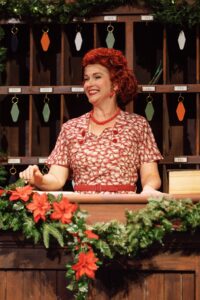 In comedic and heartwarming supporting turns, Megan Murphy Chambers (Martha) once again proves she can steal an act with one number. Her Let Me Sing and I’m Happy blends powerhouse vocals with effortless comedic bite—she lands every quip, every side-eye, and every belted high note with the precision of a seasoned pro. Belting lyrics like “if my song can start you laughin’/can start you cryin'”with humor and heart, rest assured MMC can and does! Chambers is a jewel in the crown of area theatre folk. She’s an entertainer’s entertainer. Equally at ease whether tasked with comedy or sincerity. Her scenes with Curtis Denham‘s General Waverly check all the marks perfectly hitting the highs of broad comedy and the more subtle genuine moments between two longtime friends. Speaking of, Curtis Denham brings a grounded gravitas to General Waverly, avoiding caricature and instead offering a touching
 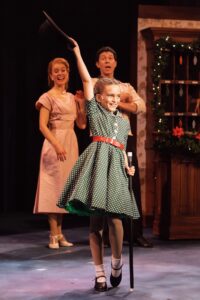 portrait of a leader rediscovering purpose. Rounding out the primary cast is young Frankie Lou Lauderdale, who simply charms instantly as Susan (Preslee Siebert also plays Susan at some performances). Lauderdale delivers the pint-sized earnestness gives the storyline its heart. I’ve always found it interesting that in the original film, Susan is General Waverly’s adult granddaughter, but for the stage adaptation, Susan is presented as a young girl. I does indeed add a more family-oriented dynamic and Lauderdale’s Susan provides the right amount of youthful sweetness combined with moxie, as proven in her cheer-inducing ambitious rendition of Let Me Sing and I’m Happy.
As for the rest of the cast, the bench is equally deep: the aforementioned Richard Daniel’s more prominent role, Ezekiel will surely cause audience members to mimic his “AyYup” response throughout the holiday season. Douglas Waterbury-Tieman doubling as Mike McNulty and Ralph Sheldrake showcase his ease with frenzy and calm, respectively. Rita and Rhoda, the zesty pair of chorus girls continually vying for attention from Benton’s Phil, are played to the coquettish hilt courtesy of Anna Claire Perry and Maria Logan–charmed, I’m sure, INDEED!
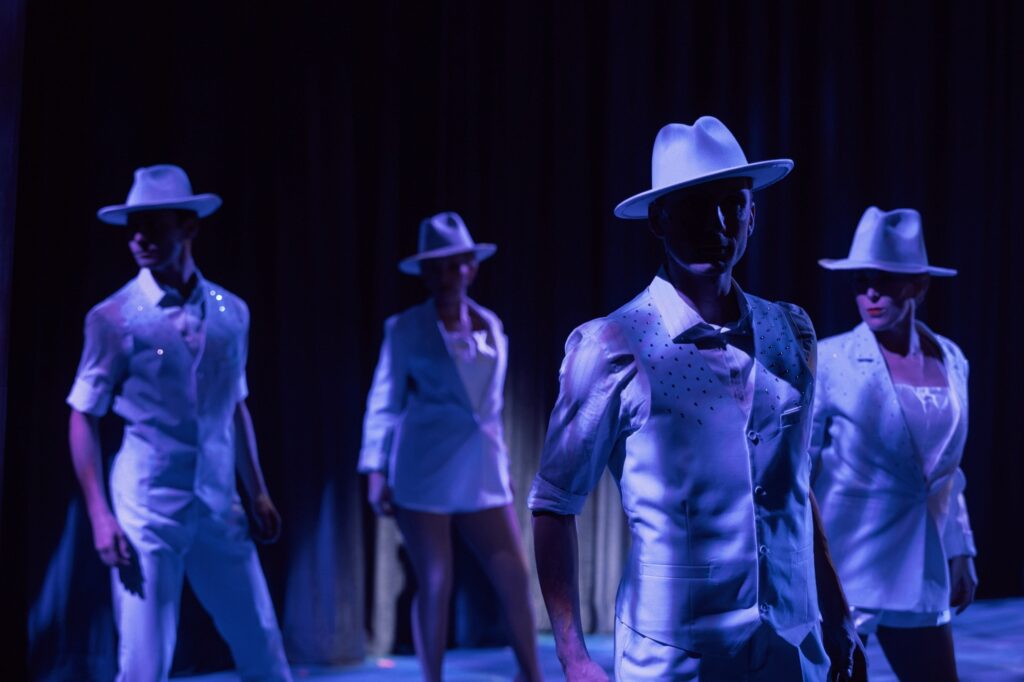
The ensemble—Kelsey Brodeur, Allison Little, Christine Toole, Alex Dee, Jordan Long, Isaiah Mayhew, and David Benjamin Perry—executes Benton’s and McGuire’s choreography with dazzling precision, tapping, swirling, and harmonizing through the show’s most technicolor moments.
Of the 2018 national tour, which featured Benton, in my review I once wrote of the show’s “glistening, gleaming, smiling, singing, happy, tapping, merry-making” energy, Studio Tenn’s White Christmas delivers all of that and more—scaled for intimacy but performed with unabashed Broadway ambition. Director Cassidy tips his hat to the timeless film, but never becomes trapped by reverence; this is a production that understands nostalgia is most magical when it feels freshly lived, not simply recreated.
By the final chorus of White Christmas, as snow drifts across Turner Theater and voices swell in perfect harmony, Studio Tenn captures the exact blend of warmth and spectacle that has made this musical a December tradition for generations.
A radiant, tap-happy holiday spectacular anchored by four outstanding leads, scene-stealing supporting turns, and choreography that honors the classic while blazing its own bright trail. As the final notes fade and the snow gently settles across the stage, Studio Tenn’s White Christmas leaves its audience warmed, smiling, and perhaps even humming an Irving Berlin tune on the walk back to the parking lot. It’s the rare production that satisfies longtime devotees of the film while welcoming newcomers into its cozy embrace—proof that nostalgia, when handled with artistry and heart, can still feel brand new. With exceptional performances, lovingly rendered design, and choreography that taps straight into holiday magic, this production is more than a seasonal outing—it’s a gift. And like all the best gifts, it lingers long after the curtain falls. As Laxton and Karlin‘s Bob and Betty suggest by song in Act 1, Count Your Blessings, and this year those blessings certainly include Studio Tenn‘s White Christmas.
Wanna keep up with the latest from Studio Tenn? Be sure to check out Studio Tenn online at StudioTenn.com or on social media at Facebook, Instagram and X.
Interested in coverage for your latest entertaining endeavor? Click the contact page and drop me a note. You can also follow JHP Entertainment on Instagram and Facebook. Until then, #GoSeeTheShow!

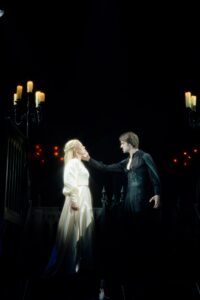 Jay Sullivan is chilling as Count Dracula. He doesn’t simply linger
 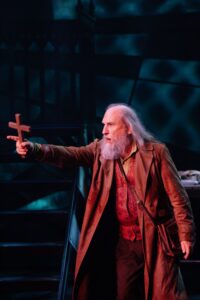 Opposite him, Sullivan’s performances is beautifully balanced by Brian Webb Russell who gives a gravely controlled performance as Abram Van Helsing, anchoring the heroic opposition with clarity of intent and moral weight. Russell’s Van Helsing offers the perfect amount of sharp intellect and righteous urgency. His verbal sparring with Sullivan’s Dracula are electric—two forces circling each other in a battle of will and belief.
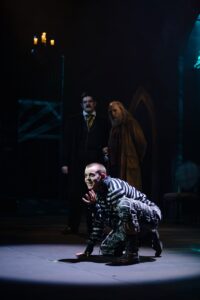 The trio of Lane Adam Williamson’s Renfield, DéYonté Jenkins’ Norbert Briggs and Catherine Gray’s Margaret Sullivan are tasked with carrying a bit of dark humor that helps temper the heavy suspense.
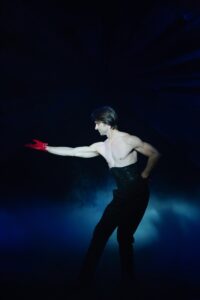 Then there’s Logan’s costumes. Every costume a work of art. The female cast members regal and radiant in finery fitting the period of the action. Van Helsing’s leather wardrobe, perfectly fitting for battle. Renfield’s asylum attire tattered and torn, but with a hit of glamour by way of some blinged-out blood spots. But it’s Dracula’s wardrobe that is truly glamorous and entrancing. From his first appearance bare-chested, but corseted in black to a black jacket accented with blood-red beaded erratic epaulets when he returns from a mysterious night right. (Gotta love that this particular look gets no mention within the context of the play, but is a jarring visual clue to the most astute audience member). The beauty of that costume not without merit, my personal favorite is yet another black jacket and pants combination. The jacket, from one side appears nothing special as the hem hits just below the actor’s waist, but from front view, its asymmetrical as the other side is more the length of a morning coat. Perhaps another visual clue of the duality of the wearer? Just when you think Logan’s used up his bag of costume tricks, in the final scene Dracula appears the most sparkly transfixing figure yet, but I’ll let you experience that on your own.
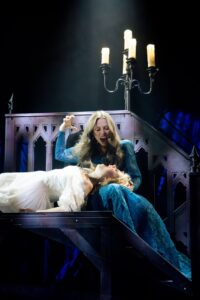 What impresses most about this DRACULA is how it leans into its horror while refusing sentimentality. McNulty’s choice to portray Dracula as predator (not tortured romantic) is honored here. That clarity gives other elements room to breathe: the trauma of Lucy’s affliction, Mina’s struggle with memory and agency, Van Helsing’s moral burden, Seward’s scientific disbelief challenged by the impossible.





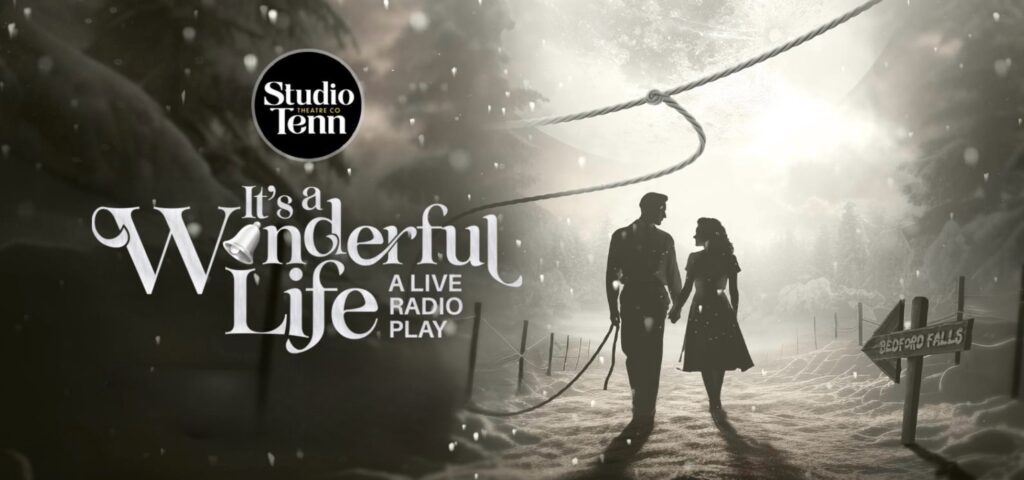
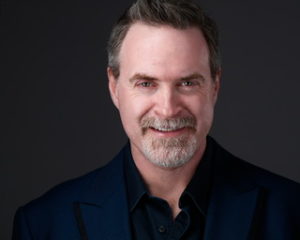 RAPID FIRE Q&A WITH IT’s A WONDERFUL LIFE’s GEOFF DAVIN
 RAPID FIRE Q&A WITH IT’s A WONDERFUL LIFE’s MARIAH PARRIS
 RAPID FIRE Q&A WITH IT’s A WONDERFUL LIFE’s CALEB SHORE
 RAPID FIRE Q&A WITH IT’s A WONDERFUL LIFE’s GEROLD OLIVER
 RAPID FIRE Q&A WITH LAURIE VELDHEER, MARIA IN THE SOUND OF MUSIC
 RAPID FIRE Q&A WITH JOHN-MARK McGAHA, CAPTAIN von TRAPP IN THE SOUND OF MUSIC
 RAPID FIRE Q&A WITH JENNIFER WHITCOMB-OLIVA, SISTER BERTHE IN THE SOUND OF MUSIC
 RAPID FIRE Q&A WITH BRIAN CHARLES ROONEY, MAX DETWEILER IN THE SOUND OF MUSIC
 Further isolating Kevin, his parents are never seen in the play, and only his Mom’s voice is heard from off-stage from time to time. As the play begins, the audience gets their first glimpse at the show’s only set, the attic. Brilliantly created by Scenic Designer Anna Louizos with assistance from D. Craig M Napoliello, with lighting by Alessandra Docherty and assistant Isabella Gill-Gomez, the attic is easily recognized as both the family’s preferred storage area for seasonal decoration and Kevin’s former childhood playroom/teenage hangout. With pop culture relics from the far-distance 1980s, the attic set design is cleverly littered with things like a discarded GameBoy, an old Chineses Checkers boardgames and what appeared to be a single right Nike Air. But it’s the shrine to everyone’s favorite Country Music Songbird, Dolly Parton that’s most impressive…and I must admit relatable. I mean, switch all the Dolly posters, magazine pictures and photographs covering the walls for, say The Bionic Woman’s Lindsay Wagner, and you’d have my childhood bedroom.
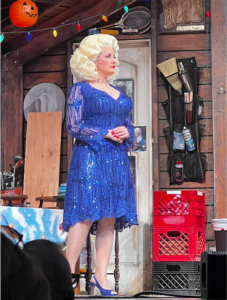 While most of the songs featured were written by Dolly, even the prolific singer/songwriter occasionally records tunes penned by others. Why’d You Come in Here Lookin Like That, Sing For the Common Man and the Dolly Parton/Kenny Rogers megahit, Islands in the Stream are all prefect placed and wonderfully sung. Interestingly, Islands, written by the Bee Gees, is followed by a funny, but very un-Dolly bit of snark courtesy Vilanch’s script.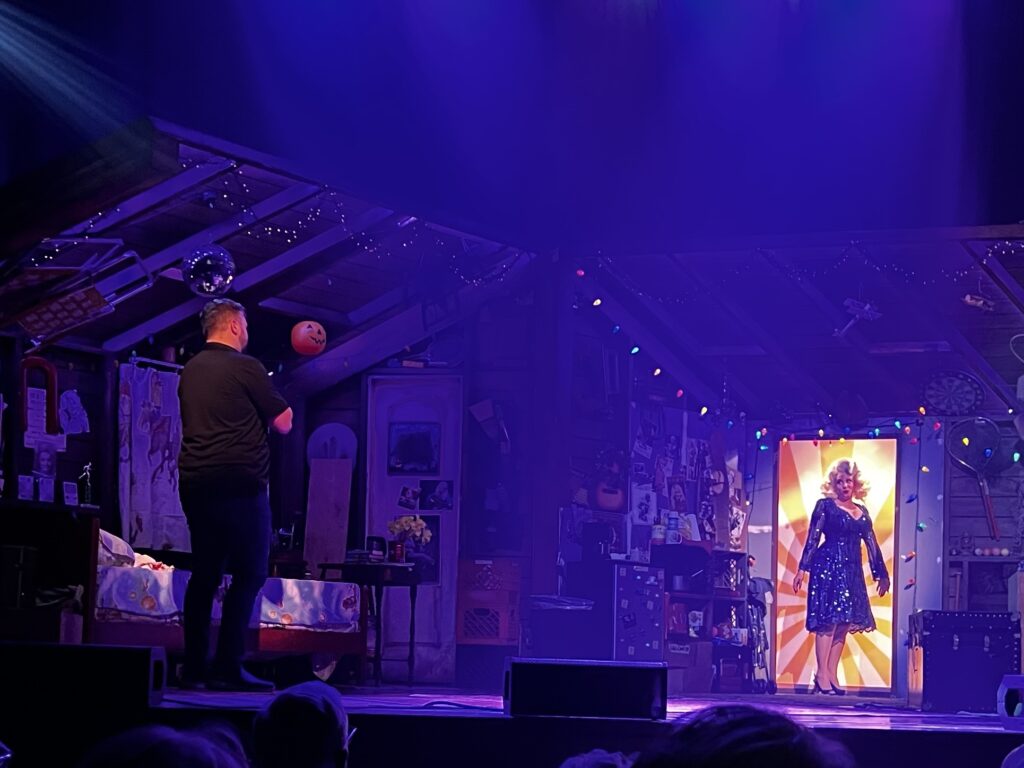

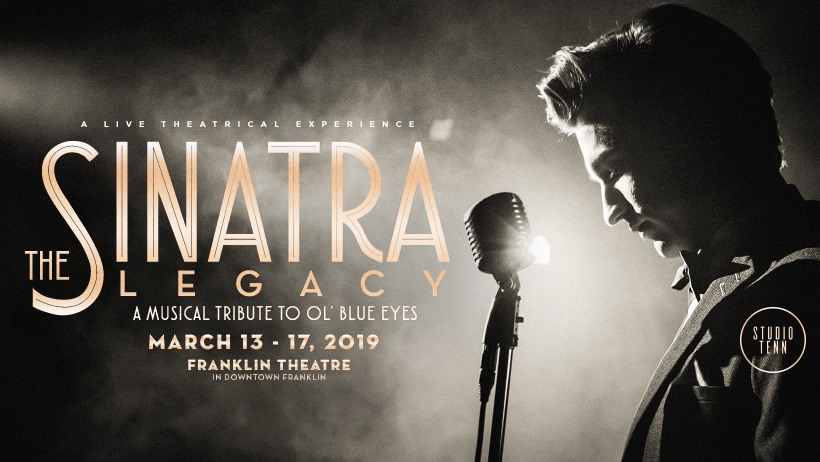
 RAPID FIRE WITH THE SINATRA LEGACY’S MATT GIRAUD
 RAPID FIRE WITH THE SINATRA LEGACY’S MAGGIE RICHARDSON
 RAPID FIRE WITH THE SINATRA LEGACY’S JAIMEE PAUL
 RAPID FIRE WITH THE SINATRA LEGACY’S WILLIAM HALL
 While many in the Nashville area (myself among them) associate the iconic singer and the nearly-equally beloved musical with local mega-talent Mandy Barnett, who’s many performances in the role are as near to seeing Cline herself as anyone can get, director Benji Kern and star Chambers make wise choices in the way Chambers presents Cline. While Barnett mystifyingly embodies the icon, so much so, you might begin to believe in reincarnation, Chambers makes her turn as Cline her own, and in doing so, putting the emphasis on both jukebox and musical, offering audiences something between a tribute show and a modern take on the esteemed theatrical piece and the woman for whom the show is named.