• Skip to primary navigation
  • Skip to main content
  • Home
  • About
  • Features
  • Contact

JHP Entertainment

Entertainment News, Reviews and Interviews

  • Home
  • About
  • Features
  • Contact

Big Fish

Theater Review: Keeton Dinner Theatre Hooks Delightful Tall Tale with ‘Big Fish’; on Stage Through February 22

February 13, 2026 by Jonathan


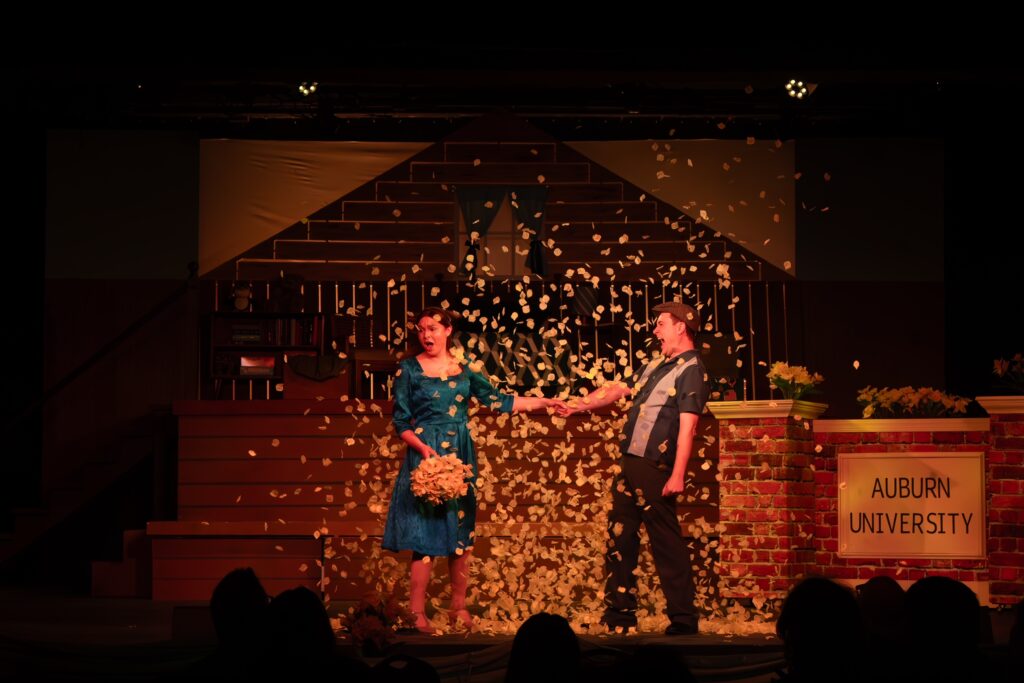
From the first triumphant notes of the all-in opening number Be the Hero, The Keeton’s production of “Big Fish” announces itself with confidence, color, and heart. Andrew Lippa and John August’s Drama Desk–nominated musical has always walked a delicate line between spectacle and sincerity, and under the direction of Aaron Gray, this staging embraces both.

Gray keeps the father–son relationship firmly at the center. Even as witches appear, giants roam, and daffodils bloom by the hundreds, the emotional throughline never wavers: this is a story about legacy, about listening, and about what we choose to believe.

As Edward Bloom, Micheal Walley bursts onto the stage with charisma and conviction. From his first entrance, his speech pattern and delivery lands near Mark Twain’s distinctive Southern storytelling drawl — deliberate, charming, measured — and for some reason put me in mind of French Stewart’s Harry Solomon from “Third Rock from the Sun”, quick with an unexpected sarcastic bite. The blend gives Edward both homespun authenticity and razor-edged comedic timing, a balance that keeps the character from drifting into caricature. The subtle but effective vocal change between younger Edward to his more frail self in later years is quite interesting to take in.
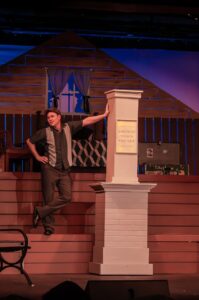
Be the Hero sets the tone — brassy, buoyant, unapologetically theatrical — and Walley meets the marathon demands of Lippa’s eclectic score with stamina and emotional nuance. As Walley revealed in my recent Rapid Fire 20Q with the show’s director, Walley and two of his fellow cast members, he’s a self-proclaimed “actor who sings”. That said, his Edward isn’t simply performing for applause; he’s inviting us into possibility.

Edward’s early adventures unfold with theatrical flourish. Miya Nicole Burt delivers a bewitching — and yes, pun entirely intended — turn as The Witch. Her presence is equal parts playful and ominous, her vocals slicing cleanly through Lippa’s driving rhythms while maintaining an alluring mystique. In particular, during her early solo during The Witch, hers is a performance that anchors one of the show’s most pivotal revelations.

Then there is Karl. Portrayed by Gray Miller, the gentle giant is, quite literally, larger than life. Miller commands the stage both physically and emotionally, bringing warmth and childlike innocence to the towering role. Remarkably, he had never walked on stilts before rehearsals began — a fact that makes his comfort and control in performance all the more impressive. What could have been a novelty becomes a fully realized character, and one the audience revels in seeing.

Musically, the production is in confident hands. Under the direction of Ian Mannino, the orchestra navigates Lippa’s stylistic range — from Broadway brass to tender balladry to gospel-infused exuberance — with clarity and cohesion. Mannino ensures the score supports the storytelling rather than overpowering it.
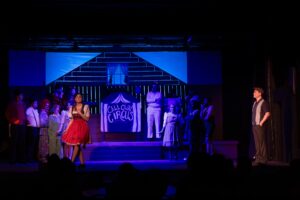
Choreographer Andrea Campbell, working in clear collaboration with director Aaron Gray, makes masterful use of The Keeton’s intimate stage. With a cast of twenty, filling the space without overwhelming it is no small feat, yet the production never once feels crowded. Instead, it feels alive. From kick lines to tap and everything in between, the variety of choreography reflects the musical’s tonal shifts while showcasing the ensemble’s versatility. One can only imagine the rigor of rehearsals required to master such range within spatial constraints, and the ensemble rises to the challenge with precision and enthusiasm. Director Gray deserves equal praise for staging that maximizes every inch of the performance area, creating dynamic stage pictures that feel expansive, an appropriate nod to the story’s 2003 cinematic retelling courtesy Tim Burton‘s film adaptation, despite the venue’s modest footprint.

Equally essential to that visual storytelling is Kevin Driver‘s set design. From the opening scene in which the backdrop of the Bloom family house and picket fence appear in mostly in silhouette, there’s an immediate storybook feel to the actors’ surroundings. Balancing storybook whimsy with practical fluidity, the stage elements allow scenes to transition seamlessly from small-town Alabama to mythic landscapes without interrupting the show’s pacing or emotional rhythm. The stage area’s aquatic element…quite effective and fanciful.

If Walley’s Edward provides the fireworks, Claire Yancy as Edward’s lifelong love, Sandra provides the stillness — and the soaring vocals. Yancey’s vocal prowess is undeniable. Her tone is rich, controlled, and emotionally open, particularly in Time Stops, where the courtship unfolds in suspended romantic glow. As Sandra matures into the family’s emotional anchor, Yancey deepens the portrayal beautifully. Her performance of I Don’t Need a Roof becomes one of the evening’s most affecting moments — restrained, resolute, and vocally luminous.
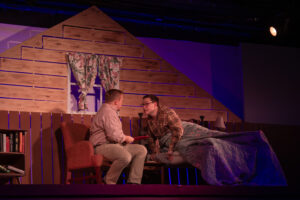
Jacob Hinnen as Edward’s adult son, delivers a fully believable, emotionally grounded portrayal of Will Bloom. Hinnen never pushes for sympathy; instead, he allows Will’s frustration and skepticism to emerge organically. The result is authenticity. As Will prepares to become a father himself, the shift in perspective is subtle yet powerful. You believe him — every step of the way.

With an ensemble of twenty actors, it would be nearly impossible to single out every strong performance, but several deserve special mention. Audrey Bagley, as Josephine, perfectly portrays her devotion to Will while balancing a genuine fascination with her seemingly eccentric future father-in-law. Her warmth and quiet curiosity add texture to the generational dynamic at the heart of the story.

Ryman Stanton, portraying Young Will, delivers a heartfelt performance that marks his third production with the company, further securing his place as a full-fledged member of The Keeton family. His enthusiastic appreciation of his father’s tall tales strengthens and perfectly exemplifies the emotional bridge between past and present.

In the supporting but pivotal role of Jenny Hill, Jessica Fonville makes an impressive Keeton debut, convincingly aging nearly forty years over the course of the production. Her transformation, while only slightly visually different, is emotional and understated, grounding one of the show’s most poignant and surprising storylines to life.

There are also delightful scene-stealers throughout the ensemble. Among them, Wanderson Rezende, who has the rare ability to catch the audience’s eye with a subtle facial flex or an intentionally flamboyant gesture, commanding attention in both restraint and exuberance. Meanwhile, Tommy Anglim, another Keeton favorite, repeatedly makes audiences double-take with the quickness of his rapid costume changes,  shifting characters — including Dr. Bennett — with ease and in record time.

As the story moves toward its conclusion, fantasy and reality stop competing and begin coexisting. The final sequences land with earned emotional resonance. YES, my eyes began to sweat! Walley softens into fragility without losing Edward’s spark. Hinnen allows Will’s understanding to shift naturally. Bagley’s support, a needed comfort. Yancey’s quiet strength anchors it all.

What makes The Keeton’s “Big Fish” succeed is not simply its theatrical flourish, inventive choreography, cohesive musical direction, or imaginative scenic design — though all are present in abundance. It is the belief at its center, and the message at its core: Heroes are not defined by perfection. They are defined by the stories that outlive them. In this heartfelt, thoughtfully crafted production, those stories will certainly swim long after the curtain falls.
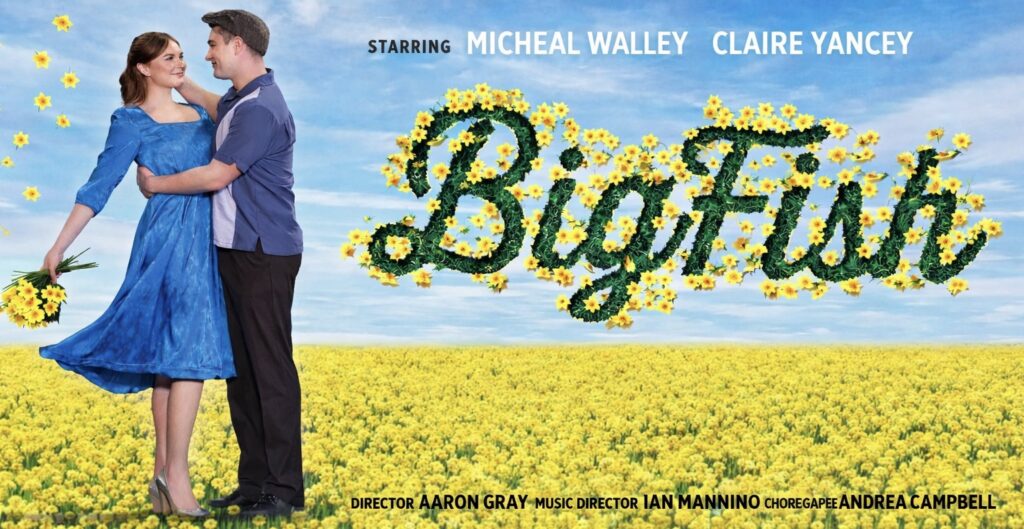
BIG FISH continues at The Keeton through Sunday, February 22. Thursday performances are show only with Doors at 6:30pm and Show at 7pm. Friday & Saturday Doors at 5:45pm/Dinner at 6pm and Show at 7pm. Sunday matinee Doors at 12:45pm/Meal at 1pm and Show at 2pm. Show Only Tickets: $30.00 (Thursday performances), Adult Dinner and Show: $40.00, Child Dinner and Show: $35.00. CLICK HERE for tickets.

Following BIG FISH, The Keeton will present “The Play That Goes Wrong” with performances April 10-26. So you don’t miss out on upcoming shows at The Keeton Dinner Theatre, follow them on Facebook, X and Instagram.

Interested in coverage for your latest entertaining endeavor? Click the contact page and drop me a note. You can also follow JHP Entertainment on Instagram and Facebook. In the meantime, #GoSeeTheShow!

Filed Under: Entertainment, Theatre Review Tagged With: 2026, Big Fish, The Keeton, The Larry Keeton Dinner Theatre, Theatre Review

Rapid Fire 20Q with the Storytellers of ‘Big Fish’; on stage at The Keeton February 6-22

February 5, 2026 by Jonathan

Few musicals capture the space between truth and imagination quite like BIG FISH, the 2014 Drama Desk–nominated musical by Andrew Lippa with a book by John August. Based on Daniel Wallace’s novel Big Fish: A Novel of Mythic Proportions and the 2003 film written by John August and directed by Tim Burton, the story explores the myths we create, the legacies we leave behind, and the love that binds families together.

Now swimming onto the stage at The Keeton beginning Friday, February 6, Big Fish blends soaring music, theatrical spectacle, and deeply human storytelling as it follows Edward Bloom — a man whose life is told through towering tales — and his son Will, who must learn how to listen beyond facts to understand the heart of his father’s stories. JHPENTERTAINMENT sat down with the artists bringing this mythic journey to life for a Rapid Fire 20Q conversation about imagination, family, and the power of storytelling.

RAPID FIRE 20Q WITH CAST AND DIRECTOR OF THE KEETON’s BIG FISH

RAPID FIRE WITH MICHAEL WALLEY, EDWARD BLOOM IN BIG FISH

JHPENTERTAINMENT: Edward Bloom is a man of myth, magic, and tall tales—what excited you most about stepping into his larger-than-life shoes?

MICHEAL WALLEY: The music of BIG FISH is absolutely gorgeous. This past fall, I was driving when Fight the Dragons came on the SiriusXM Broadway channel, and it completely stopped me in my tracks. I already knew BIG FISH was in The Keeton’s season, and I made plans to audition immediately. I’d describe myself as more of an “actor who sings” than a traditional vocalist, and Edward’s music stretches across haunting ballads, twangy pop, and everything in between. Bringing his character to life through that musical range has been both thrilling and demanding. Truthfully, I feel like I’ve been training for a marathon. My hope is that through every note, Edward’s larger-than-life heart and spirit come through loud and clear.

JHPENTERTAINMENT: A quick perusal of your theatre credits reveals your previous Keeton roles as Singin’ in the Rain’s Cosmo Brown and White Christmas’ Phil Davis share the common thread of being the comic foil to those show’s leading men—what sets Edward apart from roles you’ve played before?

MICHEAL WALLEY: At the end of our run of Singin’ in the Rain, my good friend Matthew Roberts, who played Don Lockwood, said something like, “I think you need the chance to play a leading man with some substance.” While I absolutely loved playing comic sidekicks like Phil and Cosmo (and I’d happily play either role again! Hint hint to any theatre company who needs a comic-dancer-goofball), Edward’s journey is overflowing with depth and meaning. I still get the chance to make ’em laugh, but this time I also get to take The Keeton audience on a much deeper emotional journey. Truly, I’ve never played a character anything like Edward.

JHPENTERTAINMENT: Edward’s stories often say more about love than facts. What do you think Edward is really trying to pass on?

MICHEAL WALLEY: Without giving too much away, a character near the end of the show realizes that Edward’s tall tales were always meant to inspire. I grew up in a small town in Mississippi, much like Edward’s Alabama hometown, and I always had this sense that there was something bigger out there. I wasn’t satisfied unless I was chasing it, and even now, in my 30s, that feeling hasn’t gone away. Edward is the same because he’s always chasing the next big dream, and his stories become a way to invite others into that sense of possibility. Facts may fade (and we live in 2026, does anyone really care about facts?), but inspiration is what lasts.

JHPENTERTAINMENT: As a writer, puppeteer, and voiceover artist, how have your many creative hats informed your approach to this role?

MICHEAL WALLEY: This role has flexed creative muscles I didn’t even know I had. I get to play Edward at multiple stages of his life, moving from wide-eyed teenage heartthrob to cranky old man. Jumping between different voices, physicality, and energy levels is something all my creative side-quests have really prepared me for. It also helped me better understand what John August was trying to convey. Edward evolves throughout his life, but his spirit stays consistent even as his body and circumstances change.

JHPENTERTAINMENT: If Edward Bloom were telling your life story, what detail would he absolutely exaggerate?

MICHEAL WALLEY: First of all, I’m 100% positive Edward would describe me as six-foot tall, wildly muscular, rich enough to buy a tall-and-skinny in 12 South, and effortlessly hitting every high note in Andrew Lippa’s score. But for real, I like to think he’d tell the story of a small-town Mississippi boy who loved theatre, set it aside during college and early adulthood to focus on what mattered, and then realized in his late 20s that his dreams and passions really mattered too. He’d talk about Micheal jumping into the Nashville theatre scene, making meaningful art, building lasting relationships, and getting to tell stories that truly matter, like Edward Bloom’s.

RAPID FIRE WITH CLAIRE YANCEY, SANDRA BLOOM IN BIG FISH
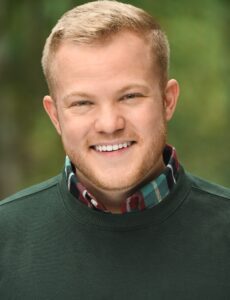
JHPENTERTAINMENT: This marks your Keeton debut—what made Big Fish the perfect first dive into this community?

CLAIRE YANCEY: The Keeton has been such a positive space from day one. Even at auditions, I felt immediately welcomed and comfortable, and it was clear how much heart and dedication everyone brings to make this not only a great production but a great experience for everyone involved. I feel deeply connected to this cast and genuinely look forward to coming to the Keeton for every rehearsal. This community has welcomed me with open arms, and I could not have asked for a better first show at this theatre.

JHPENTERTAINMENT: With a background in classical piano and voice, how does Lippa’s score speak to you as a musician?

CLAIRE YANCEY: As a musician, learning Lippa’s score has been one of my favorite parts of this process. There is something really special about working through the more intricate and challenging moments of the music together as a cast and watching it all click. Hearing songs you have listened to countless times come to life in the room with the people around you is incredibly satisfying. I love the rich harmonies and the wide range of musical styles throughout the show, which makes the score both exciting and deeply rewarding to perform.

JHPENTERTAINMENT: What’s one moment in the show where you feel Sandra’s heart most clearly?

CLAIRE YANCEY: This may feel like an obvious answer, but it is definitely during I Don’t Need a Roof. This is the moment where Sandra is seen most clearly and vulnerably. Throughout the show, she works hard to be strong for Edward and their family, often hiding how deeply his illness is affecting her.

JHPENTERTAINMENT: Sandra’s love story spans a lifetime—what do you find most beautiful about her journey?

CLAIRE YANCEY: From the very first moment they see each other, there is something magical about the way Sandra and Edward recognize something special in one another. Throughout the show, you can see that their relationship never loses its youthful spirit, even as the magic and adventure settle into the reality of growing old together. They remain deeply in love, still carrying that sense of playfulness and joy with each other.

JHPENTERTAINMENT: Sandra is the emotional anchor of Edward’s wild imagination. How do you ground her while still letting the magic exist?

CLAIRE YANCEY: I think Sandra is grounded because she is fully present and deeply attentive to the people she loves. She allows Edward, with his wild imagination, and Will, who is more grounded, to be fully themselves. Sandra has a beautiful ability to meet people exactly where they are and offer them steady love and support. While she still carries that same sense of wonder and adventure that connects her to Edward, she is also able to see the world clearly and hold space for both perspectives.

RAPID FIRE WITH JACOB HINNEN, WILL BLOOM IN BIG FISH

JHPENTERTAINMENT: Will Bloom is caught between frustration and wonder—what’s been the biggest challenge in telling his story?

JACOB HINNEN: The biggest challenge has been living in the tension between frustration and hope, especially as Will wrestles with what it means to be a father himself. He’s demanding truth from Edward, but underneath that is a deep need to understand the man behind the stories before he becomes a father himself. That tension drives every interaction. Hope is always present, but it’s tested, stretched, and reshaped as Will tries to reconcile who his father is with who he needs to be.

JHPENTERTAINMENT: You’ve played romantic leads and comedic roles—how does Will stretch you differently as a performer?

JACOB HINNEN: Playing Will stretches me differently because his confidence is paired with constant questioning. Unlike roles where the character’s path is clear or emotions are outwardly expressed, Will is always wrestling with what it means to be a son and a future father. I’ve had to channel that drive, balancing certainty with curiosity, so the audience can feel both his boldness and the weight of his internal journey.

JHPENTERTAINMENT: The father–son relationship is the emotional spine of BIG FISH. What has portraying Will taught you about listening?

JACOB HINNEN: Will has taught me that listening isn’t just about extracting answers and simply responding; it’s about recognizing intention. Edward is telling the truth in his own way, and Will has to learn that fatherhood isn’t always taught through facts, but through meaning. Playing this role has reminded me that listening sometimes means setting aside your expectations long enough to hear what someone is really trying to convey.

JHPENTERTAINMENT: This performance is dedicated to your dad. How does that personal connection shape the way you step onstage each night?

JACOB HINNEN: My dad always believed in me, even when we didn’t fully understand each other. I carry his presence with me onstage, feeling the push and pull of tension, hope, and love in every moment. It’s shaped how I tell this story: a story of love conquering death, of listening to understand rather than listening to simply respond, and of never giving up hope. Every night, stepping into Will’s shoes feels like honoring him while exploring what it truly means to be a son and eventually, a father.

JHPENTERTAINMENT: If Will could rewrite one of Edward’s stories, which moment would he finally see differently?

JACOB HINNEN: Will wouldn’t change the events themselves; he’d change the way he sees them. He’d recognize that Edward’s stories weren’t just embellishments, but expressions of love, courage, adventure and guidance. They were a father’s way of teaching him how to live fully, love boldly, and carry hope even in uncertainty. 

RAPID FIRE WITH AARON GRAY, DIRECTOR OF BIG FISH

JHPENTERTAINMENT: What was the very first image or moment from BIG FISH that made you say, “I have to direct this show”?

AARON GRAY: The first time I saw BIG FISH, there were several moments that brought me to that realization, but they all came back to the father–son relationship at the heart of the show. As a father of a six year old son, that dynamic hit me in a very immediate way, especially the moment when Will realizes he’s about to become a father himself, and suddenly his relationship with his own dad begins to change. That felt incredibly honest and personal to me.
 
I was also deeply moved by the love story. The way Edward loves Sandra, with imagination, devotion, and unwavering certainty, is something I think every romantic partnership should strive for. It’s romantic, but it’s also rooted in commitment and choice.
What ultimately made me say I had to direct this show is that it truly has everything! Romance, comedy, drama, and moments of theatrical magic, but at its core, it’s just a beautifully told story about family, love, and how we come to understand one another.
 
JHPENTERTAINMENT: BIG FISH lives in the space between reality and imagination—how did you approach balancing spectacle with emotional truth onstage?
 
AARON GRAY: The magic in BIG FISH only works if it’s grounded in emotional truth. We always let the relationships lead, and allowed the spectacle to grow out of what the characters are feeling, rather than the other way around.
 
JHPENTERTAINMENT: What can you tell me about your creative discussions with Ian Mannino, this production’s musical director, in regard to bringing Andrew Lippa’s whimsical score to life?
 
AARON GRAY: John August includes a note to the director in the script that points to a video Andrew Lippa created, where he dives deeply into the score,  showing how the songs function dramatically and emotionally. Having that level of insight directly from the composer was an incredible resource, and it became a foundational tool in my conversations with Ian. 
 
From there, our discussions were really grounded in respect for Andrew Lippa’s writing. Our shared goal was to keep the music true and honest to what he wrote. The score already contains so much whimsy, warmth, and emotional clarity that we never felt the need to overcomplicate it. Instead, Ian focused on letting the music breathe and supporting the storytelling, while I concentrated on how the songs live inside the characters and the moment.
 
What emerged from that collaboration is a score that feels both playful and deeply sincere. When the music is treated with that kind of care, its beauty really speaks for itself, and it becomes a powerful emotional guide for the audience throughout the show.
 
JHPENTERTAINMENT: In your show bio you describe this as a dream project. What part of your own storytelling sensibility feels most at home in BIG FISH?
 
AARON GRAY: At its heart, BIG FISH asks two questions that feel very personal to me: “What makes a good father?” and “How do heroes live on?” As a father, I connect deeply to the first question. The show shows us that being a good father isn’t about perfection, it’s about listening, showing up, and creating a space where your children can grow into themselves. Watching Will navigate his relationship with Edward while stepping into fatherhood himself felt incredibly real to me, and it’s a story I wanted to bring to life onstage.
 
The second theme, how heroes live on, is really about memory and storytelling. Edward becomes a hero not because he’s flawless, but because of the way his stories shape Will’s understanding of him and, in turn, the person Will becomes. That idea, that our loved ones live on through the stories we carry, is central to the show, and it resonates deeply with my own sense of storytelling. I’ve always been drawn to stories that exist somewhere between reality and imagination, where emotion comes first and spectacle serves the heart of the story.
 
For me, BIG FISH perfectly blends those elements: family, love, myth, and imagination. It allows wonder and sincerity to coexist, and that balance is exactly why it feels like a dream project, it’s a story that is both fantastical and deeply human, and it’s a story I truly love. 
 
JHPENTERTAINMENT: What do you hope audiences carry with them long after they leave The Keeton and the curtain comes down on BIG FISH?
 
AARON GRAY: I hope audiences leave remembering the power of storytelling and the people they love. Big Fish reminds us that family and connection aren’t perfect, but they’re profound, and that our stories keep those we care about alive. I want them to feel the magic, the wonder, and the joy in seeing life, and love, through a lens of imagination, and to carry that feeling with them long after they leave the theatre. 

BIG FISH opens at The Keeton on Friday, February 6 and continues through Sunday, February 22. Thursday performances are show only with Doors at 6:30pm and Show at 7pm. Friday & Saturday Doors at 5:45pm/Dinner at 6pm and Show at 7pm. Sunday matinee Doors at 12:45pm/Meal at 1pm and Show at 2pm. Show Only Tickets: $30.00 (Thursday performances), Adult Dinner and Show: $40.00, Child Dinner and Show: $35.00. CLICK HERE for tickets. 

Following BIG FISH, The Keeton will present The Play That Goes Wrong with performances April 10-26. So you don’t miss out on upcoming shows at The Keeton Dinner Theatre, follow them on Facebook, X and Instagram.

Interested in coverage for your latest entertaining endeavor? Click the contact page and drop me a note. You can also follow JHP Entertainment on Instagram and Facebook. In the meantime, #GoSeeTheShow!


Filed Under: Entertainment, Rapid Fire 20 Q, Theare Tagged With: Big Fish, Interview, Live Performance, live theatre, Music CIty, Musical, Musical Theatre, Nashville, Nashville Theatre, Rapid Fire, Rapid Fire 20 Q, The Keeton, The Larry Keeton Dinner Theatre

Copyright © 2026 · News Pro on Genesis Framework · WordPress · Log in