• Skip to primary navigation
  • Skip to main content
  • Home
  • About
  • Features
  • Contact

JHP Entertainment

Entertainment News, Reviews and Interviews

  • Home
  • About
  • Features
  • Contact

The Larry Keeton Dinner Theatre

Theatre Review: The Keeton’s ‘The Play That Goes Wrong’ Nails the Art of Disaster as Everything Falls Apart (Right on Cue); Final performances this weekend through Sunday, April 26

April 24, 2026 by Jonathan

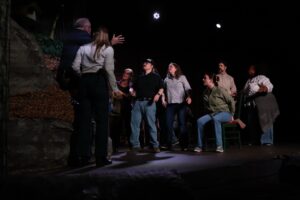
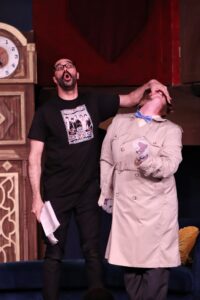
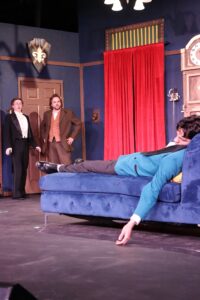
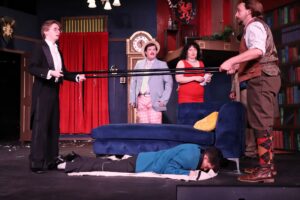
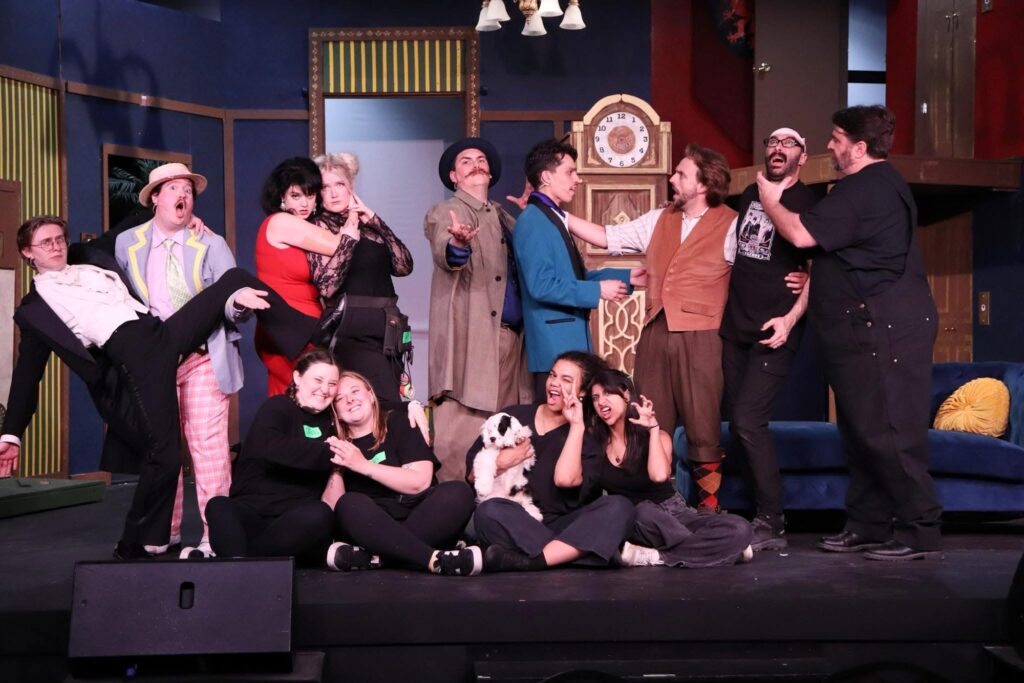
The cast of ‘The Play That Goes Wrong’ (all photos by Alixandria Brown/courtesy The Keeton)

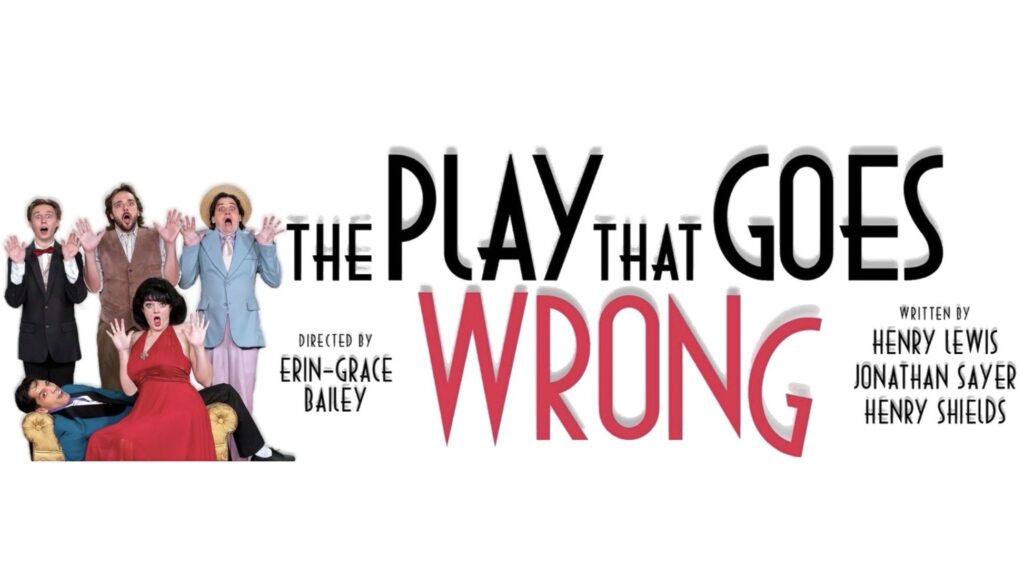
Imagine if British comedy icons French and Saunders or The Mighty Boosh decided to mount an Agatha Christie Hercule Poirot mystery…There, now you’ve got the basic vibe of The Keeton’s latest offering. The Play That Goes Wrong, a madcap mishap of a show-within-a-show similar in theme to Noises Off–in that the audience witness the backstage antics of a fictitious theatre troupe while simultaneously trying to follow the storyline of their attempt to put on a classic murder mystery–The Keeton‘s production of The Play That Goes Wrong is wrapping it’s three week run with shows through Sunday, April 26. As directed by Erin-Grace Bailey, The Play that Goes Wrong is the kind of gleefully unhinged farce that practically dares its audience not to laugh—and then steamrolls them anyway. This production leans hard (sometimes a little too hard) into the chaos but ultimately comes out the other side with a win…even if everything onstage most certainly does not.

The premise is simple: the Cornley Polytechnic Drama Society is attempting to present a very serious murder mystery, The Murder at Haversham Manor. The reality? Nothing works. Props go missing, lines are butchered, actors drop like flies (sometimes literally), and the set itself seems to have taken out a personal vendetta against the cast. And yet, somehow, it all clicks with clockwork precision.

From the moment you step into the theatre, it’s clear this isn’t your standard night of community theatre. Pre-show antics spill into the house, there’s mention of a missing dog, a raffle that no one seems to know anything about, “tech issues” are already in full swing, and the fourth wall is less of a wall and more of a polite suggestion. It’s immersive…whether you asked for that or not.

Now, I’ll be honest, having seen the National Tour back in 2018, and two more recent regional productions including last year’s Clarence Brown Theatre mounting, I am a huge fan of this work—so, when I first heard The Keeton was tackling The Play That Goes Wrong, I raised a somewhat doubting eyebrow. This is a show that, by design, demands a lot from a technical standpoint. It’s big, it’s intricate, and it requires a set that doesn’t just exist, but actively participates in the chaos. In a more intimate space like The Keeton, it’s fair to wonder if that kind of controlled destruction might be a bit…ambitious. And yet, credit where it’s due: this team doesn’t just meet the challenge—they lean into it with gusto. The result is a production that feels just as delightfully unstable as it should, without ever actually losing control.

Leading this beautifully doomed endeavor is Joshua Mertz as Chris, the director/star/producer/everything-else of the show-within-the-show. Mertz plays Chris with just the right mix of puffed-up authority and slow-burn panic. As The Inspector within the mystery, watching him try to maintain control as things unravel faster than a cheap sweater is half the fun—and when he finally snaps, it’s worth the wait. Mertz, in his sixth show at The Keeton is proving himself to be a valuable asset the the company.

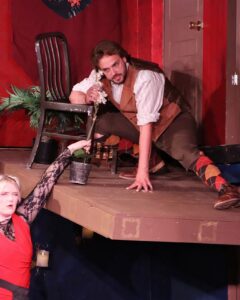
Aaron Gray’s Robert is the kind of community theatre actor who clearly believes he’s performing in Masterpiece Theatre, even as the world collapses around him. The fact that Gray is in or involved with nearly every Keeton production somehow added a if you know you know aspect to his role as Robert. As Thomas Collymoore, his dead-serious commitment in the face of utter nonsense makes every moment land harder, especially as the physical comedy ramps up and refuses to let him off easy. Kudos to his library scene. While the Keeton stage area does limit the intensity of the prospect of the second floor of the set completely collapsing, Gray’s physicality while keeping himself and all the props around his from falling away as the floor beneath him gives way, is gasping, belly-laughing joy to behold.

Hazen Lawson’s Dennis Tyde meanwhile, is a walking (and frequently stumbling) disaster in the best possible way as the newbie of the theatre troupe within the show tasked with playing the typically forgettable role of Perkins the butler within the mystery. With lines written on his forearm and a completely naturally nervous nature, Lawson delivers line flubs and verbal gymnastics with such earnest confusion you almost feel bad for laughing…almost. His constant mispronunciation of such words as cyanide, ominous and morose quickly becomes a running gag.

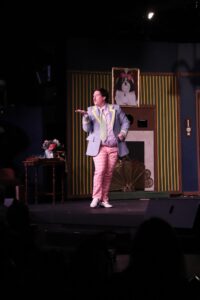
Keeton newcomer, Connor Boggs is tasked with the key role of Max. Initially cast in another role, Boggs stepped into the role of Max after the original actor had to drop out of the show. As Max and his mystery counterpart, Cecil, he figures out very early on that subtlety is overrated. Within the supposed seriousness of the murder mystery, for Cecil, once he gets a taste of audience laughter, it’s game over. He milks every moment for all it’s worth, turning even the smallest slip into a full-blown bit. That said, dressed in wardrobe that can only be described as a technicolor travesty—yes, the character is typically a bit of a dandy, but not quite so…flamboyant. Usually played as an overly confident community theatre actor with at least an initial modicum of subtlety, Bogg’s Cecil starts at 100mph and never slows down doing everything short of cartwheels from his stage entrance right on through to the final curtain. Under the direction of Bailey, Bogg’s Cecil is amped up and definitely played for laughs so much so that it runs the risk on a SNL skit that just doesn’t know when to  stop. But still, within the craziness of this show, it somehow works.

Also making her Keeton debut, Leslie King’s Sandra Wilkinson brings a diva energy that feels both earned and hilariously misplaced given the circumstances. Her Florence Colleymoore is equal parts glamour and growing frustration, and King handles the show’s increasingly demanding physical comedy without ever dropping character. In one scene in particular, she’s pulled and flopped around by her cast mates as if her joins are made of bendy straws. Her physicality is slapstick at its best.

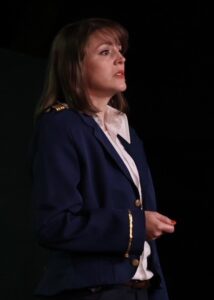
Bree Presson—yet another new face to Keeton audiences— as Annie, is an MVP for anyone who’s ever worked backstage and thought, “Well…this is fine,” while everything burned down around them. Presson’s journey from frazzled stage manager to unwilling leading lady—when the above-mentioned King’s Florence becomes incapacitated—is a comedic slow burn that pays off big in true Goes Wrong style the payoff somehow gets even bigger when she’s forced into the spotlight opposite King in two-divas, one role scene that quickly devolves into chaos squared.

Wanderson Rezende’s Trevor Watson, stationed at the tech booth, proves that sometimes less is more. His distracted, couldn’t-care-less approach to running the show results in some of the night’s most perfectly timed “mistakes,” and when he’s finally dragged into the action, it’s awkward brilliance. And yes, Denese Rene’ Evans (the show’s costumer) I did indeed appreciate that Trevor is sporting a Duran Duran t-shirt!

And then there’s David Fonville as Jonathan (nice character name, by the way), tasked with playing a corpse who…isn’t exactly great at the whole “lying still” thing. Fonville’s physical comedy—mistimed reactions, missed cues, and all—adds an extra layer of delightful absurdity to a role that could just be…well, dead.

Adding to the mayhem is the Tech Chorus—Hannah Blough, MaryGrace Brittain, Hazely Merkle-Sanderson, Rich Moses, Advika Ravishankar, and  the above-mentioned Wanderson Rezende—all blur the line between backstage and onstage with impeccable timing. The mantle falls early on…no biggie, a stagehand dressed in black will just stand there with arms extended holding whatever props were supposed to rest on the mantle. Problem solved. Their presence reinforces the idea that in this production, literally no one is safe and the old adage that the show must go on is of utmost importance.

From a technical standpoint, this show is a masterclass in controlled chaos. Kevin Driver’s set design is essentially a ticking time bomb of comedic payoff, collapsing, malfunctioning, and misbehaving on cue. Was I a little let down that the telephone gag seems to have dropped the call, yes, but when an entire wall collapses around an actor, I was like “Damn, they did it!” Every sight gag is there, the patriarch portrait, the house intercom, the fainting grandfather clock—and all somehow carried off with precision and resulting uproarious laughter from the audience. In a space where something like this does feel a bit scaled down, Driver still finds ways to make every gag land with impact. Brooke Sanders’ lighting and Steve Love’s sound design are in on the joke at every turn.

Director Erin-Grace Bailey deserves serious credit for orchestrating what looks like total anarchy but is anything but. With Assistant Director Fiona Barrett and Stage Manager Alison Gaddy keeping the wheels (barely) on, the production hits its marks—even when it looks like it’s missing all of them.

Bottom line, if you like your theatre polished, pristine, and predictable…this ain’t it. But if you’re in the mood to laugh until your face hurts while watching a cast absolutely commit to the bit—even as the set tries to take them out—The Play That Goes Wrong at The Keeton is exactly the kind of beautifully disastrous night out you’re looking for. Just don’t expect anything to go right, because…Where’s the fun in that?

The Keeton’s The Play That Goes Wrong wraps it’s three-week run with shows continuing now thru Sunday, April 26. The Keeton Theatre is located at 108 Donelson Pike, Nashville, TN 37214. Friday & Saturday Doors at 5:45pm/Dinner at 6pm and Show at 7pm. Sunday matinee Doors at 12:45pm/Meal at 1pm and Show at 2pm. Show Only Tickets: $32.00 (Thursday performances), Adult Dinner and Show: $42.00, Child Dinner and Show: $37.00. For a slight upcharge, Salmon can be chosen as the dinner entree. Group tickets receive a discount. Please call the Box Office at 615.883.8375 or CLICK HERE for tickets. In case you missed it, CLICK HERE to read my recent Rapid Fire 20Q with the show’s director and cast members. 

Following The Play That Goes Wrong, on Tuesday, May 2 at 7pm, it’s time for The Keeton’s Annual Gala directed by The Keeton‘s own Donna Driver with musical direction by Jane Kelley. This year’s annual fundraiser for the theatre is themed: Role Reversal. Tickets to the gala are $60. Gala tickets include dinner, a chance to win some great prizes donated by supporters of the theatre and the opportunity to be among the first to purchase Season Tickets for The Keeton’s upcoming 2026-2027 Season. CLICK HERE to purchase gala tickets. So you don’t miss out on upcoming shows at The Keeton Dinner Theatre, follow them on Facebook, X and Instagram.

Interested in coverage for your latest entertaining endeavor? Click the contact page and drop me a note. You can also follow JHP Entertainment on Instagram and Facebook. In the meantime, #GoSeeTheShow!
Filed Under: Entertainment, Theare, Theatre Review Tagged With: 2026, Dinner Theatre, Live Performance, live theatre, Nashville Theatre, The Keeton, The Larry Keeton Dinner Theatre, Theatre Review

An Accidental (On Purpose) Rapid Fire 20Q with The Keeton’s ‘The Play That Goes Wrong’

April 7, 2026 by Jonathan

Frequently described as Sherlock Holmes meets Monty Python, The Play That Goes Wrong began as a spirited production created by the UK-based Mischief Theatre Company. What started as a fringe production quickly snowballed into a West End hit and Broadway favorite, delighting audiences with its perfectly timed mishaps, collapsing sets, and characters determined to press on no matter how disastrous things become. 

Now, that same brand of orchestrated mayhem takes center stage at The Keeton Theatre from April 10–26, bringing Nashville audiences a whirlwind of laughter where every missed cue, falling prop, and “accidental” blunder must be carefully executed in order to keep the illusion of screw-up believable.

As the cast and crew prepared for their opening night, we caught up with cast members Josh Mertz (Chris), Leslie King (Sandra), Hazen Lawson (Dennis), and director Erin-Grace Bailey to talk about the art of controlled chaos, the technical precision behind the comedy, and exactly what it takes to make everything go so hilariously wrong.

—–

RAPID FIRE 20Q WITH THE KEETON’s THE PLAY THAT GOES WRONG

RAPID FIRE WITH THE PLAY THAT GOES WRONG’s JOSH MERTZ

JHPENTERTAINMENT:As a Nashville native and frequent Keeton performer, what makes coming back for this show feel special?

JOSH MERTZ: The Keeton is my theatre home. I absolutely love performing here! Kevin and Donna Driver are amazing, and they run this space with such care- which is one of the many reasons I keep coming back. The reason I auditioned for this particular show in the first place is the absolute dream production team of Erin-Grace Bailey, Allison Gaddy, and Fiona Barrett. I love getting to work with them so much!  I think they bring fun energy and passion for this craft into the rehearsal space. I appreciate the production team’s ability to create nuanced performances and challenge us to be the best actors we can be. Allison is an unsung hero as our stage manager because without her calm presence backstage running the show, there simply wouldn’t be one. Fun fact – during the audition, I told the team I would play “Tree number 1” just to work with them again, and the trust they had in me to play Chris is just an added bonus, as it is a dream role for me to portray.

JHPENTERTAINMENT: Chris takes himself very seriously—how fun is it to play someone completely unaware of how wrong things are going?

JOSH MERTZ: Chris has been such a fun character to build. In my interpretation of Chris, he is your typical over the top, overbearing director with a “the show must go on” mentality. I do believe he’s more oblivious to how wrong things are going earlier on in the show but … Chris certainly has a breaking point! This show is fun as an actor because while we know all the things that will “go wrong,” our characters do not always see what’s coming. And hopefully, neither does the audience!

JHPENTERTAINMENT: You’ve done everything from Ragtime to Footloose—how does comedy like this challenge you differently?

JOSH MERTZ: I consider myself as primarily a character actor, so this show was right in my wheelhouse. I think what challenges me the most as a performer is how fast-paced and high energy the show is. This has been the most challenging show I’ve ever done in my life. Between the running, jumping and falling, by the end 0f the night Chris is so exhausted. The play goes by so fast, and I hope the audience is ready to buckle up for this rollercoaster of a show.

JHPENTERTAINMENT: What’s the most difficult accidental moment you have to execute on purpose each night?

JOSH MERTZ: The most difficult moment for me personally is having to fall off of a high platform. Erin-Grace prioritizes actor safety in all of the choreographed chaos of this show, so it has been incredible to know that I would never be asked to do anything that was going to put me at risk of injury. I won’t give away the stage magic, but it was definitely something I had to mentally ease my way into. 

JHPENTERTAINMENT: What’s your personal favorite moment of chaos in the show? 

JOSH MERTZ: My favorite moment of utter chaos is the ending of Act 2. The entire cast is on stage, and it is so fun to all be there together for the culmination of the show. I cannot give too much away, so you will just have to get your tickets to see how it ALL falls apart.

RAPID FIRE WITH THE PLAY THAT GOES WRONG’s LESLIE KING

JHPENTERTAINMENT: Sandra has to juggle performance and disaster at the same time—what’s the trick to balancing both?

LESLIE KING: I’ve found that being able to trust my fellow cast mates is super important. All of our disasters are carefully constructed and executed and if I’m focusing on what everyone else is doing it doesn’t leave much bandwidth to focus on myself and my character. Because I trust my cast mates to be where they’re supposed to be and do what they need to do, it makes it easy to balance both. 

JHPENTERTAINMENT: Sandra’s claim to fame is that her aunt is Dame Diana Rigg. In your real life, who’s your favorite name drop?

LESLIE KING: I have a connection to Gabe Gibbs (played Elder Price in The Book of Mormon on Broadway 2015-2017) and his family. He probably wouldn’t have any idea who I am but his parents would. We went to church with them for about a decade, and I went to high school with his brother. 

JHPENTERTAINMENT: You’ve previously appeared in area productions as varied as Cabaret and Puffs. Where does a physical comedy like The Play That Goes Wrong fall in the mix?

LESLIE KING: It has been so much fun to work on. While I’ve done comedies before, the physicality of this show is unlike anything I’ve done before. It adds an extra element of challenge, but I’ve absolutely loved it. 

JHPENTERTAINMENT: What’s the hardest moment to keep a straight face when everything is going wrong? AND Who among your fellow cast mates breaks easiest? 

LESLIE KING:  I’d have to say watching David Fonville inch his way off stage after the gurney fails is high on the list of moments I struggle to keep a straight face. Either that, or the ring around the rosey scene at the end of act one where they get stuck going in circles on the same scene. Luckily I’m offstage for that so I can laugh as much as I like. 

Honestly we’ve all worked pretty hard to stay composed but occasionally I’ll still get Josh Mertz to break. 

JHPENTERTAINMENT: The Keeton’s resident scenic designer Kevin Driver has his work cut out for him with this show. What’s your favorite set element that Goes Wrong?

LESLIE KING: I think the walls or the platform are both great elements. They’re both completely unexpected if you haven’t seen the show before and I love the moment we really catch people off guard with elements like those. 

RAPID FIRE WITH THE PLAY THAT GOES WRONG’s HAZEN LAWSON

JHPENTERTAINMENT: Even though he is a bit of a novice on the stage, Dennis quickly realizes even his flubs get a memorable reaction from the audience. How much fun are you having leaning into that aspect of the character?

HAZEN LAWSON: It’s been a lot of fun digging into how Dennis sees himself on and off the stage. His biggest dream is to be in “the big leagues” with actors like Robert, Chris, and Sandra, and I think he just can’t even believe he gets to be on stage with these talented actors. Dennis strives so hard to do everything right, but every time he messes up – to fanfare from the audience – it’s another reminder that he’s not as polished as his fellow actors. Playing off the juxtaposition of Max has also been a lot of fun; where Max pushes for attention from the audience, Dennis is absolutely mortified by it. 

 JHPENTERTAINMENT: This show is very physical—what’s the most demanding part for you?

HAZEN LAWSON: The ending scene of Act I is a bit of a gauntlet for me when Dennis can’t quite seem to get his lines right. It’s a full-on mental circus act keeping track of the script and blocking while everything loops over and over again to make sure that everything runs exactly as it should every time. And then by the end of the scene, I’ve been thrown on the floor, drenched with several glasses of scotch, and Dennis is having a full-blown panic attack. It’s a big push, but it’s absolutely worth it for the utter catharsis those ending lines bring. 

JHPENTERTAINMENT: Your show bio reveals a love of reading, knitting, and hiking—all seemingly tranquil—How do you mentally shift into the fast-paced chaos of The Play That Goes Wrong?

HAZEN LAWSON: Funnily enough, I think my love for my grandma activities as I call them has been crucial to helping me keep up with the show. Every single joke, line, and practical effect has been knit into this intricate story that will start to unravel the second a thread gets dropped. Tranquility, and especially attention to detail, is the name of the game when you need to keep a level head and stay in complete control while the show seemingly falls apart around you. To the audience it should look like total chaos, but for those of us up on stage it should be running like clockwork.

JHPENTERTAINMENT: What’s one moment where timing is absolutely everything for the joke to land?

HAZEN LAWSON: Is saying the entire show an option?? If I had to choose just one moment, it would probably be at the beginning of Act II where Dennis’ lines are cut off by Trevor having fun with some sound cues. It’s a moment where I really have to be in sync with Wanderson Rezende – who’s playing Trevor up in the fake sound booth – and with Steve Love – our actual sound designer/operator in the real sound booth – to make sure everything lines up.

JHPENTERTAINMENT: Have you had any almost mishaps that felt a little too real?

HAZEN LAWSON: During one of our rehearsals, the set may have fallen apart just a little too early. Thankfully everyone was where they needed to be and no one was in any danger – but I will say I have a newfound perspective on Dennis’ reaction to almost being crushed by a flat.

RAPID FIRE WITH THE PLAY THAT GOES WRONG’s DIRECTOR, ERIN-GRACE BAILEY 

JHPENTERTAINMENT: You’ve directed a wide range of work, from the Bell Witch Fall Festival‘s Smoke and Women In Theatre‘s Tiny Beautiful Things to The Keeton‘s 2024 production of William Inge‘s Bus Stop—what drew you to The Play That Goes Wrong?

ERIN-GRACE BAILEY: This was kind of a dream show for me. I’m a big fan of a lot of British work and grew up on a lot of that classic slapstick comedy. I was that weird teenager that would rather re-watchI Love Lucy and Downton Abbey than keep up with the latest fad. That interest grew in high school when I discovered Oscar Wilde and then even more in college when I started studying Noel Coward. I got to see the National Tour of The Play That Goes Wrong my sophomore year for free after a friend gave up some tickets. I had no idea what I was walking into but immediately fell in love with it. I felt like it combined all of my favorite things. I’ve been an avid follower of Mischief Theatre Company who created the play ever since. The work they’re doing is not only incredibly creative and entertaining but extremely impressive. It’s an honor to bring a little piece of that to middle Tennessee.

JHPENTERTAINMENT: You had me at I Love Lucy, but I digress…How do you begin to direct something that’s supposed to look completely chaotic?

ERIN-GRACE BAILEY: Well, Step One is to swallow your anxiety and pray, haha. Step Two is a lot of research. We spent a lot of time on YouTube looking at other production, reading and then re-reading the script, and talking to people we knew who had done the show before. 

A lot goes into this show. Our technical director Kevin Driver has outdone himself. The set for this show is no easy feat, and we’ve had it for a while for the actors to practice on. Everyone in this show has spent a lot of time learning stage combat and stunts, memorizing their lines early on, and fine tuning little things so they’re shocking to the audience but predictable for the people they’re on stage with. 

Above all, I want to recognize that while every show takes a village, this one especially does. Everyone apart of this has put in a lot of work, contributed ideas, and collaborated to bring out the best in one another. Nothing about this show is possible without an amazing team. 

JHPENTERTAINMENT: What’s the biggest challenge in balancing technical precision with comedic freedom?

ERIN-GRACE BAILEY: Time. We could have probably rehearsed this show for the rest of the year and continued to have made discoveries, but in a rehearsal period, there has to be sort of a cut off for new things. I still encourage the actors to play so it’s fresh every night, but there are some pieces of the show that have to happen the exact same way every time so all of the elements can work together. It’s a fine line, but this cast and crew has mastered it with professionalism.

JHPENTERTAINMENT: You touched on it a bit earlier, but let’s delve into it a tad more…What has this show’s technical team done particularly well in bringing your vision of “controlled chaos” to life?

ERIN-GRACE BAILEY: Their dedication and communication has been nothing short of phenomenal. There’s a lot of bouncing ideas off one another. I think Kevin and I have had a phone call almost daily for the past two weeks talking about magnets and measurements. Ironically, for something to look so chaotic, it all has to be extremely precise. We’ve used the script as a formula, and then I think just about every designer has added little things of their own, too. It’s also a lot of fun to be directing a show where the designers get to bring out their comedic side as well. They’re so creative and lovely. I can’t thank them enough for the hours they’ve put in on this show.

JHPENTERTAINMENT: What do you hope audiences leave with after seeing The Keeton‘s production of The Play That Goes Wrong?

ERIN-GRACE BAILEY: As Dolly Parton says, “If you see someone without a smile, give them yours!” We’re living in some dark times. Even the day-to-day struggles just feel a little bit extra heavy lately. I hope folks get to come in to the theatre, have a nice meal, and just leave those struggles at the door for a little while. I hope they’re entertained, that they laugh, and they get to have an evening of no internet – just a bunch of strangers in a crowded room enjoying some weird, hilarious, impressive art.

—–

 The Play That Goes Wrong runs April 10–26 at The Keeton Theatre, located at 108 Donelson Pike, Nashville, TN 37214. Friday & Saturday Doors at 5:45pm/Dinner at 6pm and Show at 7pm. Sunday matinee Doors at 12:45pm/Meal at 1pm and Show at 2pm. Please note that the two Thursday evening performances during the run are show-only with Doors at 6:30pm and Show at 7pm. Show Only Tickets: $32.00 (Thursday performances), Adult Dinner and Show: $42.00, Child Dinner and Show: $37.00. For a slight upcharge, Salmon can be chosen as the dinner entree. Group tickets receive a discount. Please call the Box Office at 615.883.8375 or CLICK HERE for tickets.

During the run of The Play That Goes Wrong, The Keeton will present The Keeton Community Wind Ensemble’s Spring Concert An Evening at the Theatre, directed by Dillon Wright and featuring a selection of music from the movies. Door open for this one-night-only event at 6:30pm with the performances beginning at 7pm on Tuesday, April 14. Tickets are $15. CLICK HERE to purchase.  Following The Play That Goes Wrong, on Tuesday, May 2 at 7pm, it’s time for The Keeton’s Annual Gala directed by The Keeton‘s own Donna Driver with musical direction by Jane Kelley. This year’s annual fundraiser for the theatre is themed: Role Reversal. Tickets to the gala are $60. Gala tickets include dinner, a chance to win some great prizes donated by supporters of the theatre and the opportunity to be among the first to purchase Season Tickets for The Keeton’s upcoming 2026-2027 Season. CLICK HERE to purchase gala tickets. So you don’t miss out on upcoming shows at The Keeton Dinner Theatre, follow them on Facebook, X and Instagram.

Interested in coverage for your latest entertaining endeavor? Click the contact page and drop me a note. You can also follow JHP Entertainment on Instagram and Facebook. In the meantime, #GoSeeTheShow!

Filed Under: 2026, The Play That Goes Wrong Tagged With: 2026, Interview, Nashville Theatre, Rapid Fire 20 Q, Rapid Fire Q&A, The Keeton, The Larry Keeton Dinner Theatre

Theater Review: Keeton Dinner Theatre Hooks Delightful Tall Tale with ‘Big Fish’; on Stage Through February 22

February 13, 2026 by Jonathan


From the first triumphant notes of the all-in opening number Be the Hero, The Keeton’s production of “Big Fish” announces itself with confidence, color, and heart. Andrew Lippa and John August’s Drama Desk–nominated musical has always walked a delicate line between spectacle and sincerity, and under the direction of Aaron Gray, this staging embraces both.

Gray keeps the father–son relationship firmly at the center. Even as witches appear, giants roam, and daffodils bloom by the hundreds, the emotional throughline never wavers: this is a story about legacy, about listening, and about what we choose to believe.

As Edward Bloom, Micheal Walley bursts onto the stage with charisma and conviction. From his first entrance, his speech pattern and delivery lands near Mark Twain’s distinctive Southern storytelling drawl — deliberate, charming, measured — and for some reason put me in mind of French Stewart’s Harry Solomon from “Third Rock from the Sun”, quick with an unexpected sarcastic bite. The blend gives Edward both homespun authenticity and razor-edged comedic timing, a balance that keeps the character from drifting into caricature. The subtle but effective vocal change between younger Edward to his more frail self in later years is quite interesting to take in.
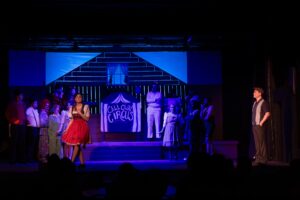
Be the Hero sets the tone — brassy, buoyant, unapologetically theatrical — and Walley meets the marathon demands of Lippa’s eclectic score with stamina and emotional nuance. As Walley revealed in my recent Rapid Fire 20Q with the show’s director, Walley and two of his fellow cast members, he’s a self-proclaimed “actor who sings”. That said, his Edward isn’t simply performing for applause; he’s inviting us into possibility.

Edward’s early adventures unfold with theatrical flourish. Miya Nicole Burt delivers a bewitching — and yes, pun entirely intended — turn as The Witch. Her presence is equal parts playful and ominous, her vocals slicing cleanly through Lippa’s driving rhythms while maintaining an alluring mystique. In particular, during her early solo during The Witch, hers is a performance that anchors one of the show’s most pivotal revelations.

Then there is Karl. Portrayed by Gray Miller, the gentle giant is, quite literally, larger than life. Miller commands the stage both physically and emotionally, bringing warmth and childlike innocence to the towering role. Remarkably, he had never walked on stilts before rehearsals began — a fact that makes his comfort and control in performance all the more impressive. What could have been a novelty becomes a fully realized character, and one the audience revels in seeing.

Musically, the production is in confident hands. Under the direction of Ian Mannino, the orchestra navigates Lippa’s stylistic range — from Broadway brass to tender balladry to gospel-infused exuberance — with clarity and cohesion. Mannino ensures the score supports the storytelling rather than overpowering it.

Choreographer Andrea Campbell, working in clear collaboration with director Aaron Gray, makes masterful use of The Keeton’s intimate stage. With a cast of twenty, filling the space without overwhelming it is no small feat, yet the production never once feels crowded. Instead, it feels alive. From kick lines to tap and everything in between, the variety of choreography reflects the musical’s tonal shifts while showcasing the ensemble’s versatility. One can only imagine the rigor of rehearsals required to master such range within spatial constraints, and the ensemble rises to the challenge with precision and enthusiasm. Director Gray deserves equal praise for staging that maximizes every inch of the performance area, creating dynamic stage pictures that feel expansive, an appropriate nod to the story’s 2003 cinematic retelling courtesy Tim Burton‘s film adaptation, despite the venue’s modest footprint.
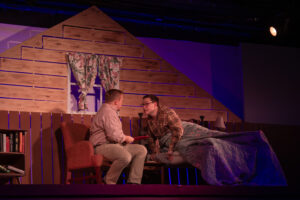
Equally essential to that visual storytelling is Kevin Driver‘s set design. From the opening scene in which the backdrop of the Bloom family house and picket fence appear in mostly in silhouette, there’s an immediate storybook feel to the actors’ surroundings. Balancing storybook whimsy with practical fluidity, the stage elements allow scenes to transition seamlessly from small-town Alabama to mythic landscapes without interrupting the show’s pacing or emotional rhythm. The stage area’s aquatic element…quite effective and fanciful.

If Walley’s Edward provides the fireworks, Claire Yancy as Edward’s lifelong love, Sandra provides the stillness — and the soaring vocals. Yancey’s vocal prowess is undeniable. Her tone is rich, controlled, and emotionally open, particularly in Time Stops, where the courtship unfolds in suspended romantic glow. As Sandra matures into the family’s emotional anchor, Yancey deepens the portrayal beautifully. Her performance of I Don’t Need a Roof becomes one of the evening’s most affecting moments — restrained, resolute, and vocally luminous.

Jacob Hinnen as Edward’s adult son, delivers a fully believable, emotionally grounded portrayal of Will Bloom. Hinnen never pushes for sympathy; instead, he allows Will’s frustration and skepticism to emerge organically. The result is authenticity. As Will prepares to become a father himself, the shift in perspective is subtle yet powerful. You believe him — every step of the way.

With an ensemble of twenty actors, it would be nearly impossible to single out every strong performance, but several deserve special mention. Audrey Bagley, as Josephine, perfectly portrays her devotion to Will while balancing a genuine fascination with her seemingly eccentric future father-in-law. Her warmth and quiet curiosity add texture to the generational dynamic at the heart of the story.

Ryman Stanton, portraying Young Will, delivers a heartfelt performance that marks his third production with the company, further securing his place as a full-fledged member of The Keeton family. His enthusiastic appreciation of his father’s tall tales strengthens and perfectly exemplifies the emotional bridge between past and present.

In the supporting but pivotal role of Jenny Hill, Jessica Fonville makes an impressive Keeton debut, convincingly aging nearly forty years over the course of the production. Her transformation, while only slightly visually different, is emotional and understated, grounding one of the show’s most poignant and surprising storylines to life.

There are also delightful scene-stealers throughout the ensemble. Among them, Wanderson Rezende, who has the rare ability to catch the audience’s eye with a subtle facial flex or an intentionally flamboyant gesture, commanding attention in both restraint and exuberance. Meanwhile, Tommy Anglim, another Keeton favorite, repeatedly makes audiences double-take with the quickness of his rapid costume changes,  shifting characters — including Dr. Bennett — with ease and in record time.

As the story moves toward its conclusion, fantasy and reality stop competing and begin coexisting. The final sequences land with earned emotional resonance. YES, my eyes began to sweat! Walley softens into fragility without losing Edward’s spark. Hinnen allows Will’s understanding to shift naturally. Bagley’s support, a needed comfort. Yancey’s quiet strength anchors it all.

What makes The Keeton’s “Big Fish” succeed is not simply its theatrical flourish, inventive choreography, cohesive musical direction, or imaginative scenic design — though all are present in abundance. It is the belief at its center, and the message at its core: Heroes are not defined by perfection. They are defined by the stories that outlive them. In this heartfelt, thoughtfully crafted production, those stories will certainly swim long after the curtain falls.

BIG FISH continues at The Keeton through Sunday, February 22. Thursday performances are show only with Doors at 6:30pm and Show at 7pm. Friday & Saturday Doors at 5:45pm/Dinner at 6pm and Show at 7pm. Sunday matinee Doors at 12:45pm/Meal at 1pm and Show at 2pm. Show Only Tickets: $30.00 (Thursday performances), Adult Dinner and Show: $40.00, Child Dinner and Show: $35.00. CLICK HERE for tickets.

Following BIG FISH, The Keeton will present “The Play That Goes Wrong” with performances April 10-26. So you don’t miss out on upcoming shows at The Keeton Dinner Theatre, follow them on Facebook, X and Instagram.

Interested in coverage for your latest entertaining endeavor? Click the contact page and drop me a note. You can also follow JHP Entertainment on Instagram and Facebook. In the meantime, #GoSeeTheShow!

Filed Under: Entertainment, Theatre Review Tagged With: 2026, Big Fish, The Keeton, The Larry Keeton Dinner Theatre, Theatre Review

Rapid Fire 20Q with the Storytellers of ‘Big Fish’; on stage at The Keeton February 6-22

February 5, 2026 by Jonathan

Few musicals capture the space between truth and imagination quite like BIG FISH, the 2014 Drama Desk–nominated musical by Andrew Lippa with a book by John August. Based on Daniel Wallace’s novel Big Fish: A Novel of Mythic Proportions and the 2003 film written by John August and directed by Tim Burton, the story explores the myths we create, the legacies we leave behind, and the love that binds families together.

Now swimming onto the stage at The Keeton beginning Friday, February 6, Big Fish blends soaring music, theatrical spectacle, and deeply human storytelling as it follows Edward Bloom — a man whose life is told through towering tales — and his son Will, who must learn how to listen beyond facts to understand the heart of his father’s stories. JHPENTERTAINMENT sat down with the artists bringing this mythic journey to life for a Rapid Fire 20Q conversation about imagination, family, and the power of storytelling.

RAPID FIRE 20Q WITH CAST AND DIRECTOR OF THE KEETON’s BIG FISH

RAPID FIRE WITH MICHAEL WALLEY, EDWARD BLOOM IN BIG FISH

JHPENTERTAINMENT: Edward Bloom is a man of myth, magic, and tall tales—what excited you most about stepping into his larger-than-life shoes?

MICHEAL WALLEY: The music of BIG FISH is absolutely gorgeous. This past fall, I was driving when Fight the Dragons came on the SiriusXM Broadway channel, and it completely stopped me in my tracks. I already knew BIG FISH was in The Keeton’s season, and I made plans to audition immediately. I’d describe myself as more of an “actor who sings” than a traditional vocalist, and Edward’s music stretches across haunting ballads, twangy pop, and everything in between. Bringing his character to life through that musical range has been both thrilling and demanding. Truthfully, I feel like I’ve been training for a marathon. My hope is that through every note, Edward’s larger-than-life heart and spirit come through loud and clear.

JHPENTERTAINMENT: A quick perusal of your theatre credits reveals your previous Keeton roles as Singin’ in the Rain’s Cosmo Brown and White Christmas’ Phil Davis share the common thread of being the comic foil to those show’s leading men—what sets Edward apart from roles you’ve played before?

MICHEAL WALLEY: At the end of our run of Singin’ in the Rain, my good friend Matthew Roberts, who played Don Lockwood, said something like, “I think you need the chance to play a leading man with some substance.” While I absolutely loved playing comic sidekicks like Phil and Cosmo (and I’d happily play either role again! Hint hint to any theatre company who needs a comic-dancer-goofball), Edward’s journey is overflowing with depth and meaning. I still get the chance to make ’em laugh, but this time I also get to take The Keeton audience on a much deeper emotional journey. Truly, I’ve never played a character anything like Edward.

JHPENTERTAINMENT: Edward’s stories often say more about love than facts. What do you think Edward is really trying to pass on?

MICHEAL WALLEY: Without giving too much away, a character near the end of the show realizes that Edward’s tall tales were always meant to inspire. I grew up in a small town in Mississippi, much like Edward’s Alabama hometown, and I always had this sense that there was something bigger out there. I wasn’t satisfied unless I was chasing it, and even now, in my 30s, that feeling hasn’t gone away. Edward is the same because he’s always chasing the next big dream, and his stories become a way to invite others into that sense of possibility. Facts may fade (and we live in 2026, does anyone really care about facts?), but inspiration is what lasts.

JHPENTERTAINMENT: As a writer, puppeteer, and voiceover artist, how have your many creative hats informed your approach to this role?

MICHEAL WALLEY: This role has flexed creative muscles I didn’t even know I had. I get to play Edward at multiple stages of his life, moving from wide-eyed teenage heartthrob to cranky old man. Jumping between different voices, physicality, and energy levels is something all my creative side-quests have really prepared me for. It also helped me better understand what John August was trying to convey. Edward evolves throughout his life, but his spirit stays consistent even as his body and circumstances change.

JHPENTERTAINMENT: If Edward Bloom were telling your life story, what detail would he absolutely exaggerate?

MICHEAL WALLEY: First of all, I’m 100% positive Edward would describe me as six-foot tall, wildly muscular, rich enough to buy a tall-and-skinny in 12 South, and effortlessly hitting every high note in Andrew Lippa’s score. But for real, I like to think he’d tell the story of a small-town Mississippi boy who loved theatre, set it aside during college and early adulthood to focus on what mattered, and then realized in his late 20s that his dreams and passions really mattered too. He’d talk about Micheal jumping into the Nashville theatre scene, making meaningful art, building lasting relationships, and getting to tell stories that truly matter, like Edward Bloom’s.

RAPID FIRE WITH CLAIRE YANCEY, SANDRA BLOOM IN BIG FISH

JHPENTERTAINMENT: This marks your Keeton debut—what made Big Fish the perfect first dive into this community?

CLAIRE YANCEY: The Keeton has been such a positive space from day one. Even at auditions, I felt immediately welcomed and comfortable, and it was clear how much heart and dedication everyone brings to make this not only a great production but a great experience for everyone involved. I feel deeply connected to this cast and genuinely look forward to coming to the Keeton for every rehearsal. This community has welcomed me with open arms, and I could not have asked for a better first show at this theatre.

JHPENTERTAINMENT: With a background in classical piano and voice, how does Lippa’s score speak to you as a musician?

CLAIRE YANCEY: As a musician, learning Lippa’s score has been one of my favorite parts of this process. There is something really special about working through the more intricate and challenging moments of the music together as a cast and watching it all click. Hearing songs you have listened to countless times come to life in the room with the people around you is incredibly satisfying. I love the rich harmonies and the wide range of musical styles throughout the show, which makes the score both exciting and deeply rewarding to perform.

JHPENTERTAINMENT: What’s one moment in the show where you feel Sandra’s heart most clearly?

CLAIRE YANCEY: This may feel like an obvious answer, but it is definitely during I Don’t Need a Roof. This is the moment where Sandra is seen most clearly and vulnerably. Throughout the show, she works hard to be strong for Edward and their family, often hiding how deeply his illness is affecting her.

JHPENTERTAINMENT: Sandra’s love story spans a lifetime—what do you find most beautiful about her journey?

CLAIRE YANCEY: From the very first moment they see each other, there is something magical about the way Sandra and Edward recognize something special in one another. Throughout the show, you can see that their relationship never loses its youthful spirit, even as the magic and adventure settle into the reality of growing old together. They remain deeply in love, still carrying that sense of playfulness and joy with each other.

JHPENTERTAINMENT: Sandra is the emotional anchor of Edward’s wild imagination. How do you ground her while still letting the magic exist?

CLAIRE YANCEY: I think Sandra is grounded because she is fully present and deeply attentive to the people she loves. She allows Edward, with his wild imagination, and Will, who is more grounded, to be fully themselves. Sandra has a beautiful ability to meet people exactly where they are and offer them steady love and support. While she still carries that same sense of wonder and adventure that connects her to Edward, she is also able to see the world clearly and hold space for both perspectives.

RAPID FIRE WITH JACOB HINNEN, WILL BLOOM IN BIG FISH

JHPENTERTAINMENT: Will Bloom is caught between frustration and wonder—what’s been the biggest challenge in telling his story?

JACOB HINNEN: The biggest challenge has been living in the tension between frustration and hope, especially as Will wrestles with what it means to be a father himself. He’s demanding truth from Edward, but underneath that is a deep need to understand the man behind the stories before he becomes a father himself. That tension drives every interaction. Hope is always present, but it’s tested, stretched, and reshaped as Will tries to reconcile who his father is with who he needs to be.

JHPENTERTAINMENT: You’ve played romantic leads and comedic roles—how does Will stretch you differently as a performer?

JACOB HINNEN: Playing Will stretches me differently because his confidence is paired with constant questioning. Unlike roles where the character’s path is clear or emotions are outwardly expressed, Will is always wrestling with what it means to be a son and a future father. I’ve had to channel that drive, balancing certainty with curiosity, so the audience can feel both his boldness and the weight of his internal journey.

JHPENTERTAINMENT: The father–son relationship is the emotional spine of BIG FISH. What has portraying Will taught you about listening?

JACOB HINNEN: Will has taught me that listening isn’t just about extracting answers and simply responding; it’s about recognizing intention. Edward is telling the truth in his own way, and Will has to learn that fatherhood isn’t always taught through facts, but through meaning. Playing this role has reminded me that listening sometimes means setting aside your expectations long enough to hear what someone is really trying to convey.

JHPENTERTAINMENT: This performance is dedicated to your dad. How does that personal connection shape the way you step onstage each night?

JACOB HINNEN: My dad always believed in me, even when we didn’t fully understand each other. I carry his presence with me onstage, feeling the push and pull of tension, hope, and love in every moment. It’s shaped how I tell this story: a story of love conquering death, of listening to understand rather than listening to simply respond, and of never giving up hope. Every night, stepping into Will’s shoes feels like honoring him while exploring what it truly means to be a son and eventually, a father.

JHPENTERTAINMENT: If Will could rewrite one of Edward’s stories, which moment would he finally see differently?

JACOB HINNEN: Will wouldn’t change the events themselves; he’d change the way he sees them. He’d recognize that Edward’s stories weren’t just embellishments, but expressions of love, courage, adventure and guidance. They were a father’s way of teaching him how to live fully, love boldly, and carry hope even in uncertainty. 

RAPID FIRE WITH AARON GRAY, DIRECTOR OF BIG FISH

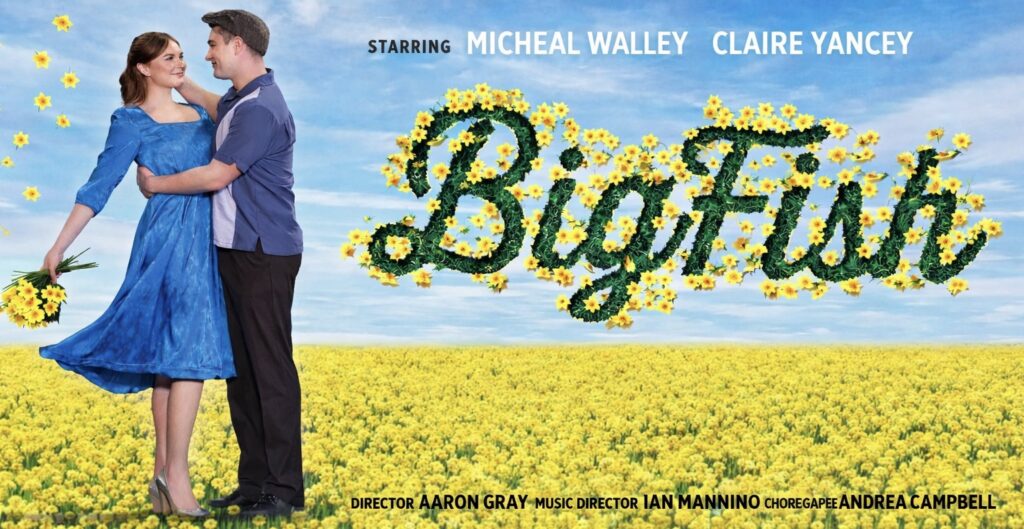
JHPENTERTAINMENT: What was the very first image or moment from BIG FISH that made you say, “I have to direct this show”?

AARON GRAY: The first time I saw BIG FISH, there were several moments that brought me to that realization, but they all came back to the father–son relationship at the heart of the show. As a father of a six year old son, that dynamic hit me in a very immediate way, especially the moment when Will realizes he’s about to become a father himself, and suddenly his relationship with his own dad begins to change. That felt incredibly honest and personal to me.
 
I was also deeply moved by the love story. The way Edward loves Sandra, with imagination, devotion, and unwavering certainty, is something I think every romantic partnership should strive for. It’s romantic, but it’s also rooted in commitment and choice.
What ultimately made me say I had to direct this show is that it truly has everything! Romance, comedy, drama, and moments of theatrical magic, but at its core, it’s just a beautifully told story about family, love, and how we come to understand one another.
 
JHPENTERTAINMENT: BIG FISH lives in the space between reality and imagination—how did you approach balancing spectacle with emotional truth onstage?
 
AARON GRAY: The magic in BIG FISH only works if it’s grounded in emotional truth. We always let the relationships lead, and allowed the spectacle to grow out of what the characters are feeling, rather than the other way around.
 
JHPENTERTAINMENT: What can you tell me about your creative discussions with Ian Mannino, this production’s musical director, in regard to bringing Andrew Lippa’s whimsical score to life?
 
AARON GRAY: John August includes a note to the director in the script that points to a video Andrew Lippa created, where he dives deeply into the score,  showing how the songs function dramatically and emotionally. Having that level of insight directly from the composer was an incredible resource, and it became a foundational tool in my conversations with Ian. 
 
From there, our discussions were really grounded in respect for Andrew Lippa’s writing. Our shared goal was to keep the music true and honest to what he wrote. The score already contains so much whimsy, warmth, and emotional clarity that we never felt the need to overcomplicate it. Instead, Ian focused on letting the music breathe and supporting the storytelling, while I concentrated on how the songs live inside the characters and the moment.
 
What emerged from that collaboration is a score that feels both playful and deeply sincere. When the music is treated with that kind of care, its beauty really speaks for itself, and it becomes a powerful emotional guide for the audience throughout the show.
 
JHPENTERTAINMENT: In your show bio you describe this as a dream project. What part of your own storytelling sensibility feels most at home in BIG FISH?
 
AARON GRAY: At its heart, BIG FISH asks two questions that feel very personal to me: “What makes a good father?” and “How do heroes live on?” As a father, I connect deeply to the first question. The show shows us that being a good father isn’t about perfection, it’s about listening, showing up, and creating a space where your children can grow into themselves. Watching Will navigate his relationship with Edward while stepping into fatherhood himself felt incredibly real to me, and it’s a story I wanted to bring to life onstage.
 
The second theme, how heroes live on, is really about memory and storytelling. Edward becomes a hero not because he’s flawless, but because of the way his stories shape Will’s understanding of him and, in turn, the person Will becomes. That idea, that our loved ones live on through the stories we carry, is central to the show, and it resonates deeply with my own sense of storytelling. I’ve always been drawn to stories that exist somewhere between reality and imagination, where emotion comes first and spectacle serves the heart of the story.
 
For me, BIG FISH perfectly blends those elements: family, love, myth, and imagination. It allows wonder and sincerity to coexist, and that balance is exactly why it feels like a dream project, it’s a story that is both fantastical and deeply human, and it’s a story I truly love. 
 
JHPENTERTAINMENT: What do you hope audiences carry with them long after they leave The Keeton and the curtain comes down on BIG FISH?
 
AARON GRAY: I hope audiences leave remembering the power of storytelling and the people they love. Big Fish reminds us that family and connection aren’t perfect, but they’re profound, and that our stories keep those we care about alive. I want them to feel the magic, the wonder, and the joy in seeing life, and love, through a lens of imagination, and to carry that feeling with them long after they leave the theatre. 

BIG FISH opens at The Keeton on Friday, February 6 and continues through Sunday, February 22. Thursday performances are show only with Doors at 6:30pm and Show at 7pm. Friday & Saturday Doors at 5:45pm/Dinner at 6pm and Show at 7pm. Sunday matinee Doors at 12:45pm/Meal at 1pm and Show at 2pm. Show Only Tickets: $30.00 (Thursday performances), Adult Dinner and Show: $40.00, Child Dinner and Show: $35.00. CLICK HERE for tickets. 

Following BIG FISH, The Keeton will present The Play That Goes Wrong with performances April 10-26. So you don’t miss out on upcoming shows at The Keeton Dinner Theatre, follow them on Facebook, X and Instagram.

Interested in coverage for your latest entertaining endeavor? Click the contact page and drop me a note. You can also follow JHP Entertainment on Instagram and Facebook. In the meantime, #GoSeeTheShow!


Filed Under: Entertainment, Rapid Fire 20 Q, Theare Tagged With: Big Fish, Interview, Live Performance, live theatre, Music CIty, Musical, Musical Theatre, Nashville, Nashville Theatre, Rapid Fire, Rapid Fire 20 Q, The Keeton, The Larry Keeton Dinner Theatre

Theatre Review: The Keeton’s ‘She Loves Me’; a Love Letter for the Holiday Season

December 8, 2025 by Jonathan

Romance, wit, and a dash of musical magic have drifted into Donelson as She Loves Me opened at The Keeton Dinner Theatre this past Thursday evening with the show continuing with Thursday thru Sunday shows until December 21. With its intimate space, casual dinner-theatre setting, and a cast obviously invested in the show’s nearly century-long legacy, The Keeton proves an ideal home for this sweet classic midcentury musical.

Based on Miklós László’s 1937 play Parfumerie—the source material for later films, The Shop Around the Corner, In the Good Old Summertime, and, spiritually, You’ve Got Mail—She Loves Me remains one of musical theatre’s most charming “quiet classics.” Its central “enemies-to-lovers through anonymous letters” premise still sparkles, especially when placed in the hands of performers who understand just how human, funny, and tender these characters truly are.

While Jimmy Stewart’s Alfred from 1940’s The Shop Around the Corner presented the male counterpart of the story as a bit of a prickly nay-sayer, the musical adaptation’s male lead Georg Now, played in The Keeton’s She Loves Me by Jayden Murphy,  who was last seen on The Keeton stage as Coalhouse in Ragtime, once again brings a youthful warm and layered and hopeful presence beneath the character’s famously cantankerous exterior. When we chatted with Murphy for our recent Rapid Fire 20Q, he admitted to being a bit of a “hopeless romantic” much like Georg. On stage Murphy channels that vulnerability to sweet success in the bittersweet Tonight at Eight and especially in the show’s title tune, She Loves Me. His smoothly rich voice—flexible, grounded, and carefully guided under Music Director Roger Hutson—honors the show’s more classical, operetta-leaning score while still feeling contemporary and honest. Murphy’s understanding of the show’s history is in full view throughout: this is a Georg who feels fully lived-in, not mimicked from past productions.
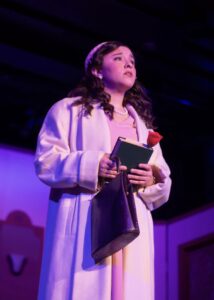
As Amalia Balash, Jiana Kevilus is radiant—sharp-tongued in the workplace to comedic delight when pitted again Georg one moment and achingly vulnerable when speaking (or singing) of her unidentified letter-writing love the next. Her interpretation honors Amalia’s insecurities, especially those revealed in Will He Like Me?, while infusing her with modern emotional clarity. As anticipated, Kevilus’ Vanilla Ice Cream—approached as a pivotal moment where Amalia subconsciously begins to realize Georg’s true identity—bubbles with joy, confusion, and discovery. It is one of the highlights of the evening: vocally agile and acted with specificity. In an admirable way, Kevilus’ performance of the song put me in mind of Olivia Newton-John’s Hopelessly Devoted Grease moment.

The chemistry between Murphy and Kevilus is strong and believable. Their banter often borders on playful chaos.That ease pays off—this Amalia and Georg disagree ferociously, but they always feel tethered by something deeper, and the much-anticipated revelation of their true identities and mutual feelings all the more sweet because of it.

Kimberly Wolff, who seems to have become a full-fledge member of the Keeton company of frequently seen actors, is a standout as Ilona Ritter. Wolff gives the role the perfect blend of glamour, vulnerability, no-nonsense practicality and emotional intelligence. Her work in the number I Resolve is especially effective—Ilona’s attempt at independence is tinged with hope, frustration, and surprising strength.
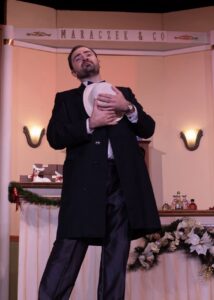
Her scenes with Tommy Anglim’s Kodaly are super-charged with electrically playful tension. Anglim’s Kodaly is smooth, sly, and charming in all the most infuriating ways. During their shared musical numbers—particularly Ilona, Anglim’s Kodaly delivers a somewhat bawdy, yet perfectly comedically timed riotous performance. Anglim’s delightfully narcissistic Kodaly and Wolff’s tough-but-tender Ilona feel like they walked straight out of a Golden Age film.
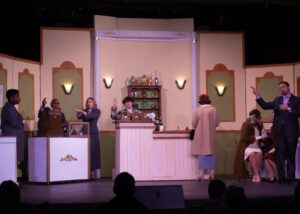
Director Morgan Robertson, making her directorial debut, does so with charm and an obvious admiration for the musical, having music directed a previous production across town. There are a few instances when blocking seems a bit awkward and clunky (sorry, but why are we seeing the backs of actors in scenes throughout?). The overall look and feel of the show is a success and the actors each seem to have been directed to make the characters their own in the most enjoyable way possible.

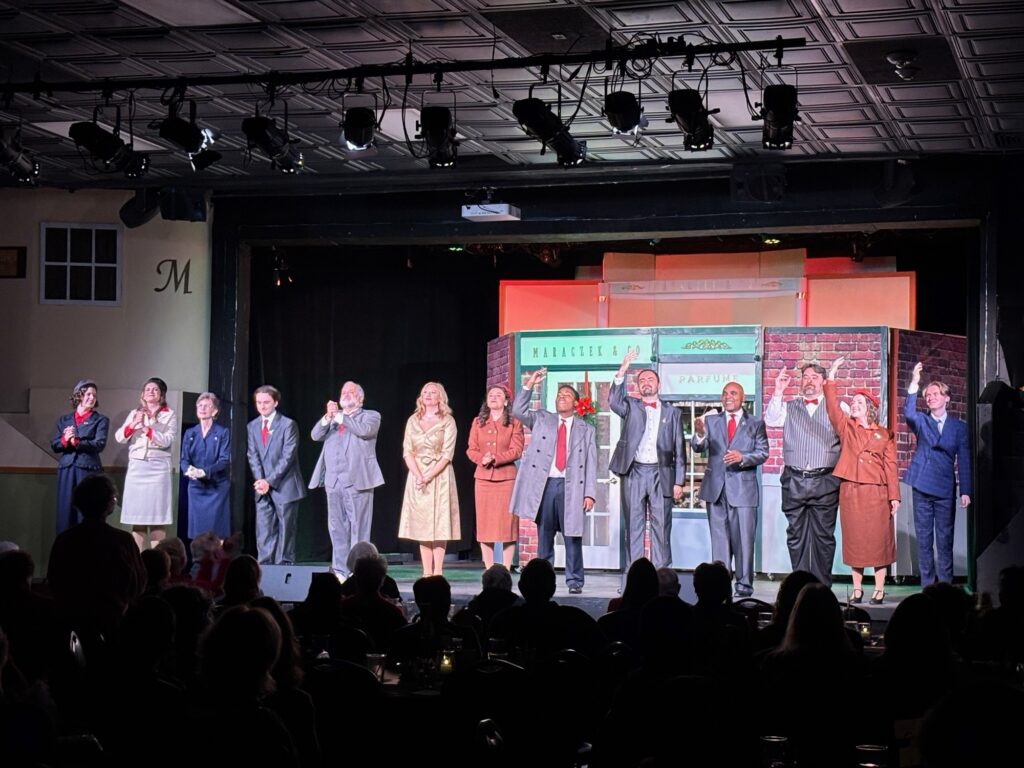
Once again, The Keeton’s in-house scenic designer, Kevin Driver delivers a triumph and his She Loves Me set should be one of the most-talked-about elements of the production. Inspired by the 2016 Tony-winning Broadway revival’s transformative shop design, Driver creates an only slightly scaled-down Maraczek’s Parfumerie that feels timeless, elegant, and tactile. The mobile units shift the space effortlessly, inviting the audience directly into the warmth of the 1930s Budapest shop.

Denese René Evans’ costumes reinforce that old-world charm—smart, flattering silhouettes and texture-rich fabrics that reflect class, profession, and personality without ever feeling like caricature. Loved the small detail of all the shop employees wearing an “M” initial lapel pin. If a couple suggestions could be offered…invest in a steamer to relieve a bit of static cling on those silk pjs and suspenders should take care of a few of the male performers’ pant legs dragging the floor.

Sound designer Steve Love and lighting designer Brooke Sanders work together to create seamless transitions between bustling shop scenes, intimate revelations, and the cozy glow of the story’s romantic scenes. Especially of note, following a particularly jarring event, flooding the interior of the shop with crimson light might have been my favorite lighting effect.

The supporting roles are filled with memorable performances. Brian Best, last seen as William Frawley in The Keeton’s Lucy Loves Desi, lends Mr. Maraczek gravitas and returns Best to the typical bravado roles for which he’s come to be known. His solo of Act 1’s Days Gone By and its Act 2 reprise are unexpectedly hauntingly touching. Sipos, a role often played as gentle and understated, in the hands of Victor Davis, creates a charmer with soulful presence and hilarious comedic timing. Making his Keeton debut, Samuel Boggs brings youthful earnestness to Arpad, his Try Me full of plucky determination. Boggs’ performances should be remembered as he’s definitely poised to be one to watch with a sure-fire future in Nashville’s theatre community. 


As for the rest of the cast, Brenda Brannon (always a personal favorite) is snooty perfection as the sever in the upscale restaurant where our two fated lovers attempt their first face-to-face, Rich Moses, and the ensemble—Chloe Beehm, Hazen Lawson, Kathleen McClanahan, and Amanda Noss—bring humor, color, and a bit of extra fun to each moment they touch. Again, particularly enjoyable is the restaurant scene, from the physical comedy to flirtation abounding.
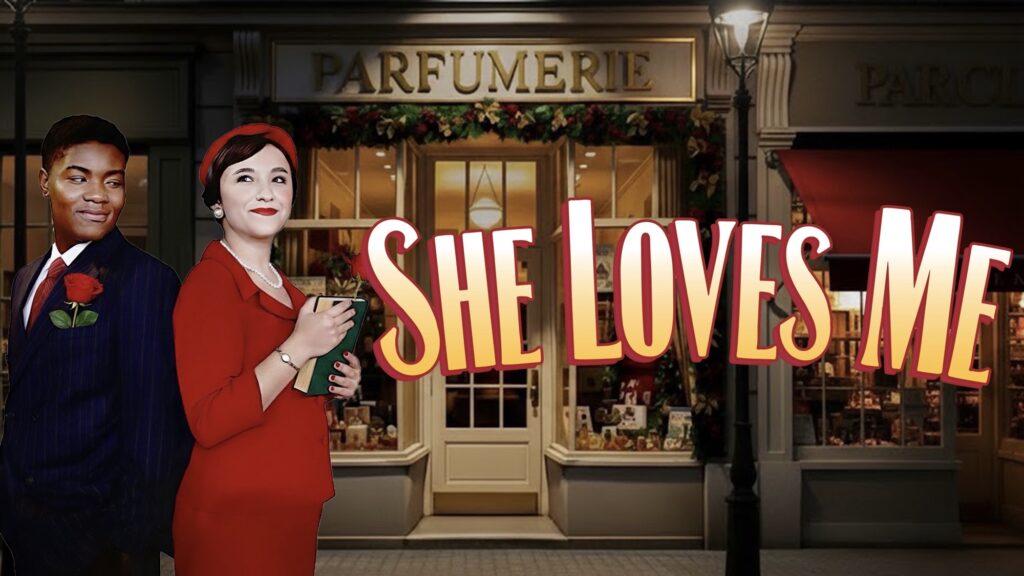

All in all, She Loves Me is “cozy theatre.” It looks to present heart, honesty, and fun rather than spectacle—and The Keeton delivers all three. Robertson’s production is grounded in affection for the material, executed by a cast that understands the charm and underlying fragility of the story they’re telling. The result is a She Loves Me that feels warm, human, and full of light—exactly the kind of theatre Nashville audiences crave during the holiday season.

Ready to take a trip to Maraczek’s shop around the corner and check out the goods yourself? Dear Friend, you’re in for a treat as She Loves Me continues its run at The Keeton (108 Donelson Pike, Nashville, TN 37214) thru December 21 with evening diner and show performances Thursdays, Fridays and Saturdays and additional matinees Saturdays and Sundays. Tickets range from $35–$47. CLICK HERE to purchase before the run sells out, and visit thekeeton.org for more information.

In case you missed it, CLICK HERE to read my recent Rapid Fire 20Q with the director and four principal actors. So you don’t miss out on upcoming shows at The Keeton Dinner Theatre, follow them on Facebook, X and Instagram.

Interested in coverage for your latest entertaining endeavor? Click the contact page and drop me a note. You can also follow JHP Entertainment on Instagram and Facebook. In the meantime, #GoSeeTheShow!

Filed Under: Entertainment, Theare, Theatre Review Tagged With: 2025, Christmas, Interview, Q&A, Rapid Fire, Rapid Fire 20 Q, She Loves Me, The Larry Keeton Dinner Theatre, Theatre, Theatre Review

Rapid Fire 20Q with Director and Cast of ‘She Loves Me’; The Keeton’s classic musical holiday gift runs December 4 thru 21

December 3, 2025 by Jonathan

Romance, wit, and a dash of musical magic are heading to the Donelson stage as SHE LOVES ME opens at The Keeton Dinner Theatre, running December 4–21, 2025. With show-only Thursday evenings and full dinner-and-a-show experiences on Fridays, Saturdays, and Sundays, audiences can step into Maraczek’s Parfumerie for an evening of charm wrapped in melody. We caught up with the cast and creative team for a Rapid Fire 20Q—diving into character work, classic film adaptations, backstage dynamics, and what makes this production sparkle. Consider this your first peek behind the counter before the curtain rises.

_____

RAPID FIRE 20Q WITH CAST AND DIRECTOR OF THE KEETON’s SHE LOVES ME

RAPID FIRE WITH JAYDEN MURPHY, GEORG IN SHE LOVES ME

JHPENTERTAINMENT: Georg is the original “grumpy romantic.” What part of his personality do you most relate to in your everyday life?

JAYDEN MURPHY: Oh my gosh, where do I even start? I’m kidding, but honestly, even at my age, dating is rough. We have all this technology now and it still feels confusing and disappointing most of the time. I’m not saying I’m trying to settle down and start a family right now, but I definitely relate to Georg on that level. What I connect with the most is that his grumpy romantic side really comes from him being a hopeless romantic. He wants to fall in love so badly, and when things don’t go the way he hopes, that disappointment shows up as frustration. I understand that. I’m a hopeless romantic myself, and that helps me tap into who he is. His grumpiness isn’t about being cold. It is because he genuinely cares and he wants that storybook ending with someone. And we will see if he finds it.

JHPENTERTAINMENT: SHE LOVES ME has such a beloved lineage — from the original play Parfumerie to this musical adaptation to the classic film The Shop Around the Corner to the more modern You’ve Got Mail. I know you’re much younger than the character you’re portraying. Heck, you were born more than a decade after the Tom Hanks film version came out, so…were you familiar at all with the history of the show prior to your audition?

JAYDEN MURPHY: I spent a lot of time researching the full history of SHE LOVES ME. I’m the kind of actor who prides himself on being well-prepared before an audition or before my name goes into a Playbill. In college, I actually worked on all of Georg’s songs, which gave me an early understanding of who he is. My college director also directed a national tour of SHE LOVES ME and has close ties to the original writers, so being around him helped me learn even more about the show. I also looked back at the original play, the musical itself, and the film versions. One of my favorite parts of musical theatre is becoming a character, so even though I’m younger than Georg, I wanted to fully understand his world and the legacy of the role before stepping onstage. All that research helped me connect with him in a real and honest way.

JHPENTERTAINMENT: The original run of SHE LOVES ME debuted on Broadway in 1963. Since then it has enjoyed Broadway revivals in 1993 and 2016. One aspect it has maintained since its debut is that many of the tunes feature a more operatic vocal style, as opposed the the more common showtimes flair of many modern musicals. Having seen you wow the crowd as Coalhouse in The Keeton’s Ragtime, I’m curious to know if this second pairing with Roger Hutson as your Music Director has helped you lock in on your approach to Georg vocally?

JAYDEN MURPHY: Yes, absolutely. I really pride myself on being a versatile vocalist. My vocal coach and everyone I work with knows that I don’t like to put labels on what I am or what I can be. I’m only 19, and my voice is still developing, so I try to stay as agile and flexible as possible in what I do. Working with Roger again has been amazing. He really lets me explore who I believe Georg is, both onstage and through the songs. At the same time, he holds me accountable and pushes me in all the right ways. We work really well together, and I definitely feel like he’s helped me find a strong vocal approach to this role. I think people will be surprised by how I portray Georg and how he sounds, because Roger has helped me tap into a version of the character that feels natural and honest to me while still honoring the more classical style of the show.

JHPENTERTAINMENT: If Georg were working at Maraczek’s Parfumerie today, what modern-day app or platform do you think he’d be using? AND…How would the opening line of his profile bio read?

JAYDEN MURPHY: That is a hilarious question. I definitely think Georg would be on Hinge. He just gives me “Hinge guy” energy. His opening line would probably sound very proper, like “Good day, madam, may I help you?” lol But honestly, I think he’d lie a little on his profile at first. He’d probably say he was some kind of businessman or shop owner, something that makes him sound more impressive. But I also think once he actually met the girl, he’d come clean. Georg is charming, and he means well, so he’d eventually tell the truth. But yeah… he’s absolutely a Hinge guy.

RAPID FIRE WITH JIANA KEVILUS, AMALIA IN SHE LOVES ME

JHPENTERTAINMENT: Amalia is smart, stubborn, and deeply hopeful. What’s your favorite contrast between how she sees herself vs. how others see her?

JIANA KEVILUS:  I think the contrast in Amalia’s self-image versus how others see her is one of the most compelling things about her as a character. In one of her songs, we learn that she worries that “Dear Friend” will be disappointed to find that she is “shy” and “quiet.” This is a stark contrast to the confident and witty personality we see from her when interacting with Georg and the other clerks and customers at the shop. I think this offers a very human and relatable side to Amalia, because while she may be secretly insecure, the people around her are more focused on her charm. 

JHPENTERTAINMENT: The 1940 film The Shop Around the Corner gave Amalia a slightly different flavor. In researching the role, did you check out either film adaptation? Or, did you simply find your own Amalia through the rehearsal process?

JIANA KEVILUS: This show has been a favorite of mine for a long time. Because of this, I was already somewhat familiar with different productions and adaptations. When preparing for the role however, I’ve tried to avoid spending too much time watching other people’s interpretations of Amalia as I tried to learn what my own organic take on the character should be. I think there is happy medium between golden age damsel and independent and headstrong young woman that I’ve found in my interpretation of her. 

JHPENTERTAINMENT: Vanilla Ice Cream is a beast of a number. Did your Director, Morgan Roberts or the show’s Musical Director, Roger Hutson offer any specific advice that changed how you approach this number? 

JIANA KEVILUS: Morgan and Roger have both had such wonderful visions for this production! With their guidance, I’ve been lucky enough to have been given a lot of artistic freedom in this number. When discussing with Morgan what Amalia’s motivation is in this song, we found that it is much more compelling if this is the beginning of her slowly starting to realize the true identity of “Dear Friend.” Whether she fully understands it yet or not, this is a turning point for her character and altogether such a fun number to sing!

JHPENTERTAINMENT: As Amalia and Georg, you and Jayden have to walk the tightrope between enemies, coworkers, and secret lovers. What has helped you unlocked that balance?

JIANA KEVILUS: Jayden is a delight to work with and he puts on such a charming performance. While our characters certainly take some hard digs at each other, so much of the dialogue is so humorous that we find it hard not to laugh when rehearsing many of the scenes. We just have so much fun with these characters that I think it translates well to the different dynamics between them. 

RAPID FIRE WITH TOMMY ANGLIM, KODALY IN SHE LOVES ME

JHPENTERTAINMENT: If Kodaly were to follow in Georg’s example and begin corresponding to an unknown potential love interest, how would the opening line of his introductory letter read? 

TOMMY ANGLIM: Kodaly would NEVER pick up a woman without knowing what she looks like! However, his go to pick up line for strangers on the street (or in the shop) is likely along the lines of “Cherie, I have never seen a face like yours. You are absolutely as glamorous as Garbo.” And somehow… that line would work every time.

JHPENTERTAINMENT: The banter between the characters in SHE LOVES ME is iconic. What’s one line in the show—whether yours or that of a co-star—that makes you laugh even after dozens of runs?

TOMMY ANGLIM: I feel like two specific moments come to mind. The scene leading up to the song Ilona is one of my favorite ones to do with Kim Wolff. She and I have found a rhythm to those lines that are quick jabs at each other and it’s a joy every time (even though we seem quite angry in the moment!). For my second answer, I have to give a shoutout to Sam Boggs who plays Arpad. He brings such an innocent humor to that role that makes me laugh at lines I’ve never even thought were meant to be funny!

JHPENTERTAINMENT: If Kodaly were giving modern-day dating advice, what’s the first rule he’d insist everyone follow?

TOMMY ANGLIM: Always have a backup plan in case you need to replace your date!

JHPENTERTAINMENT: This show is quite the conundrum. It’s beloved by those who know it, but by-and-large, it’s rarely done by local theatre companies. How excited are you to potentially be introducing audiences members to this show?

TOMMY ANGLIM: I think it’s a very exciting opportunity! The show is a pretty trope-heavy, low stakes, enemies-to-lovers story that also has a cozy, Christmas ending, so it’s generally easy for audience members to find something about it to enjoy. I think what really sets the bar high in this production is the set that Kevin Driver has designed. He has really outdone himself providing mobile set pieces to really bring this story to life, and bring the audience into the shop with all of us.

RAPID FIRE WITH KIMBERLY WOLFF, ILONA IN SHE LOVES ME

JHPENTERTAINMENT: Ilona’s glamour and vulnerabilities are such a fun combination. What part of her surprised you most once you started digging in?

KIMBERLY WOLFF: Ilona, although may not be the smartest, she is still a catch. She is caring, loving, and very loyal. She’s just looking for someone to treat her right so that she can do the exact same for someone else. One the surface she may come across one way, but when you really dig in and see who she is, she offers so much more. 

JHPENTERTAINMENT: Every adaptation handles Ilona a little differently. In preparing for the role, did you check out any of the previous incarnations, whether stage adaptations or film versions?  — or did you purposely avoid them?

KIMBERLY WOLFF: Before I even audition, I will generally skim through other productions so that I have a good grasp on what the show is about and who these characters are. After that, I never go back, as I don’t want to be too influenced by other performances. Once I have the script in hand, and start acting it out with the other actors cast, I can bring her to life how I see her. That is half the fun of it. Bringing to life this character that I have spent weeks getting to know. 

JHPENTERTAINMENT: With a background in choreography yourself, how has it been having Heidi Buyck as choreographer for the show? AND…Which number makes you feel the most like you’re living your full Ilona fantasy?

KIMBERLY WOLFF: I’m very excited to finally get to work with Heidi. I have seen other shows she has choreographed, and she has seen other shows I have been a part of. We have both mentioned we hope we get to work together one day. Now, here we are. Performing the song, Ilona, that Tommy, aka Kodaly, sings has been a blast. Tommy and I have had a lot of fun bringing that one to life. Ilona is once again seduced by Kodaly’s charm, and against her better judgement gives him, yet again, another chance. 

JHPENTERTAINMENT: Ilona and Kodaly have… a complicated relationship. What’s one thing your Kodaly, Tommy Anglim brings to the dynamic that made your scenes instantly click?

KIMBERLY WOLFF: Tommy is a great scene partner. He has certainly brought all of his Kodaly energy for this role. His ability to transform into this character is effortless. We were both very excited when we found out we would get to play these characters together. We already have hilarious banter off stage so we couldn’t wait to be in this dynamic on stage. 

RAPID FIRE WITH SHE LOVES ME DIRECTOR, MORGAN ROBERTSON
JHPENTERTAINMENT: While you’ve performed as an actor, music director, teaching artist and choreographer, I understand The Keeton’s SHE LOVES ME marks your directorial debut. The show is famously delicate — grounded, funny, and deeply human. What was your North Star when shaping the tone of this production?

MORGAN ROBERTSON: As you say – this show is deeply human.   We’ve been interacting with various iterations of this narrative for years, (enemies to lovers is one of the most successful themes in pop culture!) With that being said, my two objectives as a first time director were 1) cast it well and 2) empower the team. This show (as a musical and a play before that) has been around for nearly 100 years. That means the bones are good! All I needed to do was find the people that could respect and highlight the central themes of the show and make sure they feel fully supported to embody the human experience. I consider this show to be a loving call for self reflection. I wanted our rehearsal process to feel the same way and I think this cast has been fully engaged with that idea. 

JHPENTERTAINMENT: Having music directed a 2023 production of SHE LOVES ME elsewhere about town, is there an aspect of the show’s score, as music directed by The Keeton’s Roger Hutson that you absolutely love?

MORGAN ROBERTSON: Yes! I fell in love with this show as music director for Trevecca University back in 2023, under the direction of Jeff Frame. Roger has always made me feel that my experience as MD is as valuable as my process as Director. I love the way he gets excited about the music! He’s a true music lover and he’s working with a huge range of musical styles in this show. Not only that, but he knows this cast (having worked with most of them on multiple productions) and so his attention to the needs of each song and each actor have really allowed me to take an outside view of just how unique this score is and how it serves each of the scenes with such specificity. 

JHPENTERTAINMENT: When SHE LOVES ME enjoyed its latest Broadway revival in 2016, the exterior of the Parfumerie moved to reveal the charming little shop and in doing so, the show’s scenic design won the Tony, beating out, among others, a little show called Hamilton. For The Keeton’s production, What’s your personal favorite aspect of the set?

MORGAN ROBERTSON: Well I don’t want to spoil anything … but I will say – my favorite aspect of the set is the set designer – Kevin Driver. Kevin has been extremely collaborative and often thinks my thoughts before I need to voice them. We discussed what wealth looks like in a glamorized society as well as what it looks like for a place like Maraczek’s parfumerie which exists in 1930’s Hungary. We’re dealing with old world ideas like buildings should be built well, with good material, meant to last. So we explored heightened natural elements. What does it look to make something marvelous and timeless? And I think we have found a really grounded balance. 

JHPENTERTAINMENT: What do you hope audiences take with them long after seeing The Keeton’s SHE LOVES ME?

MORGAN ROBERTSON: Remember that it was worth it to get out and see live theater! Especially as the Keeton does it! The Keeton is uniquely situated in that they’ve been offering heightened, intimate theatrical experiences for years now.  The talent is incredible, every bit what you would see at any pro venue in town.  They’re brining in people who are ready to try new things with theatre in Nashville and that means all of their productions are filled with heart.  We’ve been brave with this show – we’ve opened the doors on every level for new ideas.  I’m a new director, though not new to the Nashville theater community.  I’ve developed my artistic voice in these communities and it feels incredible to be trusted with this experience.  I hope they remember how amazing it felt to watch people who love what they do and are incredibly good at it. Remember that we love what we do and we love sharing it with you.

_____

Ready to unwrap the enchantment of SHE LOVES ME for yourself? Performances run at The Keeton (108 Donelson Pike, Nashville, TN 37214) December 4–21, 2025, with show-only Thursday evenings and full dinner-and-a-show experiences on Fridays, Saturdays, and Sundays, a. Tickets range from $35–$47. CLICK HERE to purchase tickets before the entire run sells out. More information can be found at thekeeton.org. “Dear Friend,” you’re in for a treat, so #GoSeeTheShow!

Filed Under: Entertainment, Rapid Fire 20 Q, Theare Tagged With: 2025, Christmas, Musical, Musical Theatre, Q&A, Rapid Fire, Rapid Fire 20 Q, She Loves Me, The Keeton, The Larry Keeton Dinner Theatre

THEATRE REVIEW: ‘LUCY LOVES DESI: A Funny Thing Happened on the Way to the Sitcom’ at The Keeton thru October 26

October 13, 2025 by Jonathan

Before LUCY LOVES DESI: A Funny Thing Happened on the Way to the Sitcom ever graced The Keeton stage for its Tennessee Premiere (onstage now thru October 26), it had already began its own fascinating chapter in the story of I Love Lucy. Based largely on Laughs, Luck… and Lucy: How I Came to Create the Most Popular Sitcom of All Time—a memoir by I Love Lucy creator Jess Oppenheimer, completed by his son Gregg Oppenheimer in 1996—the play traces the real-life creation of television’s most enduring comedy.

Originally premiering at UCLA’s James Bridges Theatre in 2018 as I Love Lucy: A Funny Thing Happened on the Way to the Sitcom in an L.A. Theatre Works production, the World Premiere featured Sarah Drew (Grey’s Anatomy) as Lucille Ball and Oscar Nuñez (The Office) as Desi Arnaz, and was recorded live for public radio. The piece was later reborn under its current title, LUCY LOVES DESI, for a 2020 BBC Radio 4 broadcast starring Anne Heche and Wilmer Valderrama. Most recently, the play completed a successful 21-city national tour with L.A. Theatre Works in 2023, bringing audiences across the U.S. an intimate, funny, and touching tribute to the groundbreaking sitcom.

Now, it’s Nashville’s turn as The Keeton’s audiences have the chance to experience this love letter to television history, thanks to The Keeton’s delightful and impeccably cast production. Directed by Donna Driver, the show invites audiences behind the curtain (or, more accurately, behind the microphone) to witness how Lucille Ball and Desi Arnaz fought to bring their vision to life in a skeptical, male-dominated industry—and how their persistence changed entertainment forever.

During Driver’s welcome remarks on Opening Night, she very kindly made mention that it was yours truly who had suggested the play be part of their current season, so you know I loved that. She also informed the audience that the playwright had been very accessible via numerous phone calls and emails during preparation and rehearsal for The Keeton’s production, even writing new scenes and adding in vignettes featuring classic musical moments from I Love Lucy to allow The Keeton’s production of the show to expand from its original one-act length to a full two-act show. In doing so, The Keeton’s production captures both the warmth and wit that defined I Love Lucy while reminding us that innovation often begins with risk.

The Keeton’s scenic designer, Kevin Driver’s clever set—the backdrop transformed into a vintage 21” wooden cabinet tv, upscaled to about 10’x10’, complete with old-school antenna—allowed the audience visuals for scene changes by way of stills projected onto the large tv screen of locations like CBS & Desilu Studios and The Arnaz’s Palm Springs home. Completing the set, simple chairs for the actors to sit while not featured, and the side stage riser all come together to evoke the golden age of live radio, complete with period microphones, a glowing “On Air” sign, and a prominently featured Foley table manned with precision and playfulness by Beverly Grant, whose sound effects artistry earns laughs all its own. You’ll likely find ourself looking up at the Foley table more to catch Grant’s antics from time to time.

I always correct folks when they introduce me as a theatre critic, preferring the term reviewer, but I have to be truthful, being a huge Lucille Ball fan and longtime memorabilia collector of both her I Love Lucy years and her film career before (and yes, even her years after), I came into the evening with reservations, with my critic hat fully in place. I also have to admit that I was, overall, pleasantly and thankfully surprised at just how sweetly, lovingly and honorably the cast of The Keeton presented the backstory of how my favorite comedy actress and her Cuban bandleader husband made television history.

The way this performance is structured, Jason Rainwater’s Desi Arnaz steps in and out of the action of the play to talk directly to the audience. As Desi Arnaz, Rainwater delivers a winning performance full of charisma and authenticity. As he mentioned during our recent Rapid Fire 20Q when I questioned him on the authenticity of his Desi voice, his vocal work is uncanny—so richly textured and musically accurate that it often truly sounds like Arnaz himself. The chemistry between Rainwater and Grace Gaddy as Lucy is the stuff of which stage pairings are made; together they bring the Ball–Arnaz partnership to life with warmth, wit, and a rhythm that feels instinctual. Just as one would imagine him, Rainwater’s Desi is a charmer, a showman, a proud immigrant and a great example of a mid-century business man and entertainer who redefined what it is to live the American dream.

While none of the cast truly look like their real-life counterparts, it’s not an impersonator show in Las Vegas, after all, Grace Gaddy’s Lucille Ball is, when all is said and done, a loving tribute to the iconic comedian. From her expressive eyes and impeccable comic timing to the way she embodies Lucy’s signature blend of glamour and goofiness, Gaddy gives a performance that’s joyously alive. Her physicality and facial expressions elicit hearty laughter while paying true homage to one of television’s greatest icons. My only hesitation in a giving Gaddy’s Lucilly Ball a full five star review rests on the fact that Gaddy’s choice of voice isn’t quite there. Yes, Lucille Ball’s real-life voice was quite different from her quicker, higher-pitched Lucy Ricardo voice, but Gaddy, try as she may, never quite hits the mark vocally. Of course the average Keeton audience member will easily overlook this because of Gaddy’s otherwise full-force embodiment of the iconic comedic actress. It should be noted that Gaddy’s Lucy is at her best not only when recreating a few classic I Love Lucy moments–her lip-smacking, face-pulling expressions during a quick look at Vitameatavegamin is indeed near-perfection–but also during scenes that show the rarer more vulnerable moment of the woman behind the legendary laughs.
Even though he plays the man upon whose book this play is based, Michael Welch has the benefit of playing someone most people have never seen and whose physical appearance isn’t as easily recognized as the four stars of the groundbreaking sitcom. That anonymity works to Welch’s advantage as he simply shines as Jess Oppenheimer, serving as the grounding force amid the behind-the-scenes chaos. His balance of humor and sincerity keeps the story engaging and human. His scenes between Gaddy’s Lucy and Rainwater’s Desi truly exemplify Oppenheimer’s role as both close friend and trusted collaborator in the creating of one of the world’s most beloved sitcoms.
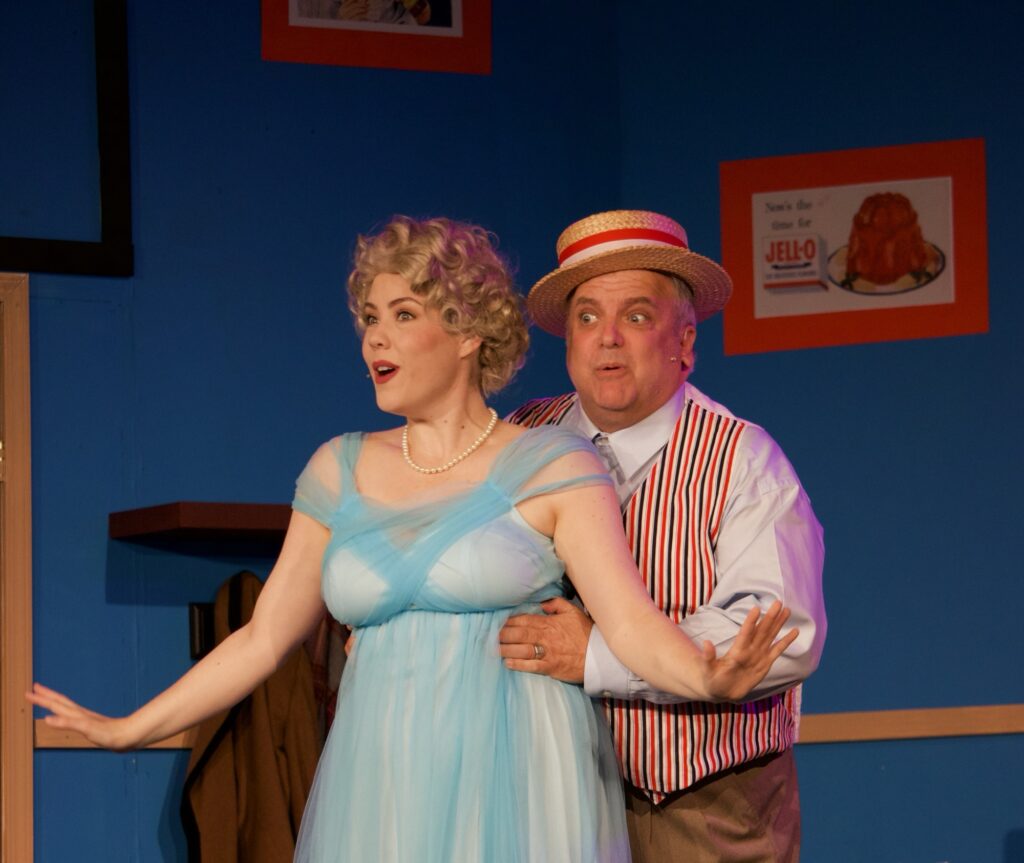
Cassidy Davis is delightful as Betty Garrett, a close pal of Lucille Ball’s who happens by the radio studio in a brief scene early on. Again, pop culture nerd that I am, I feel compelled to remind you that Garrett, a radio and film star like Ball in their early days, also gained fame on television—for roles on All in the Family and Laverne & Shirley (Garret played the girls’ landlord and Laverne’s eventual step-mom). I do wish there’d been time for a wig change as Garrett was more often a brunette. But yes, I’m just being picky. However, it’s Davis’ Vivian Vance that’s key to the story. Davis plays Vance a little sweeter, a little lighter than the real actress and again, there seems to be no concern for sounding like the original. Nonetheless, Davis nails each of her many roles—from Betty Garrett and various secretaries throughout to Vivian Vance and even a male executive at one point—with comedic grace and sharp timing. Again, does she really look or even sound like Vance? No, but does she deliver the goods? Yes.

Living up to his last name, Brian Best as William Frawley, is indeed, the best at fully embodying the role. Best turns in a masterclass of voice acting. His portrayal of William Frawley is eerily accurate, perfectly capturing Frawley’s gravelly timbre and gruff charm, while also handling multiple other characters—including network head William Paley—and with more than a bit of a smokers cough, Best’s Parker McComas, President of I Love Lucy sponsor Philip Morris, is a scene stealer. Rounding out the ensemble, Eric Crawford, Chris Hill, and Tony Bernui each contribute energetic and distinctive performances that heighten the show’s humor. Crawford’s facial reactions, Hill’s authoritarian vibe and Bernaui’s ability to switch from portraying Lucille’s early radio husband, the dashing Richard Denning, to I Love Lucy season one director and friend of Vivian Vance, the theatrically flamboyant Marc Daniels, all add to the fun of the piece.

Musically, this expanded version of the show delights with nostalgic selections that evoke memories of classic I Love Lucy episodes, including I’ll See You in C-U-B-A, Friendship, California Here I Come, and the beloved I Love Lucy theme song, complete with a bit of a did you know who wrote it spoiler and Rainwater and Gaddy singing the rarely heard lyrics. Enhancing the musical score throughout, frequent Keeton musical director Roger Hutson’s piano recordings add a lighthearted, era-appropriate touch, while Steve Love’s sound design, Brooke Sanders’ lighting, wig design by Alison Gaddy (loosen up those wigs so they look more natural and like the real-life ladies they’re styled after) and Denese René Evans’ costumes work in harmony to transport the audience straight to midcentury Hollywood. Evans’ costumes throughout are quite fun and seemingly period authentic, I do wish that Lucille’s Emmy dress was accurate, through…again, I’m just being an overzealous Lucy fan.
In spite of my above-reference initial hesitations and a strangely tepid Opening Night audience (Note: it’s ok to laugh out loud and to applaud after a particularly entertaining scene) and what could probably be chalked up to first night jitters from the cast resulting in the majority of Act 1’s delivery being a tad flat with several lines coming across as monotone with not real inflection and somewhat memorized, rather than convincingly felt and delivered with punch, those initial hesitations faded once the cast found their groove.
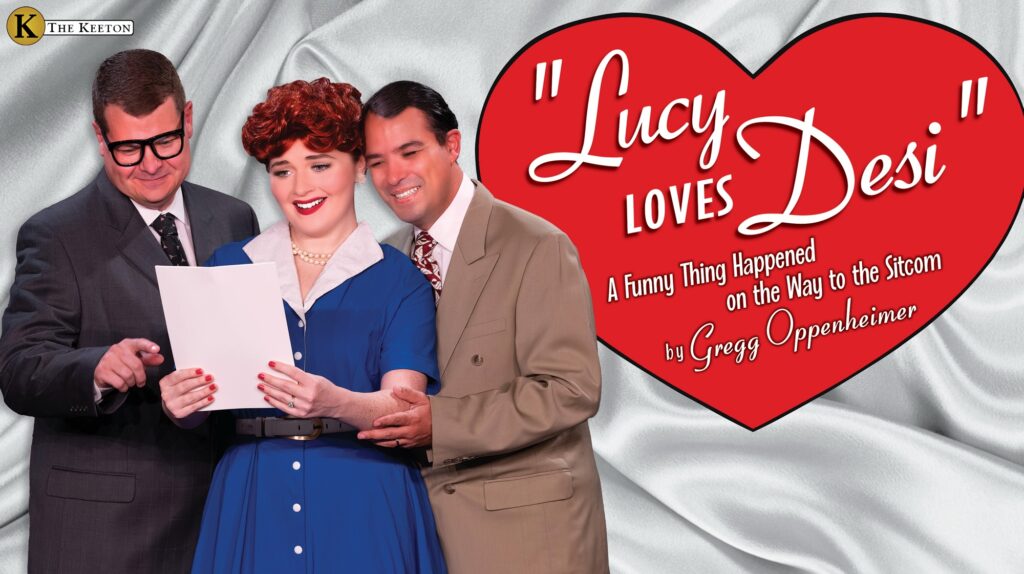
Bottom line, The Keeton’s LUCY LOVES DESI is a sentimental, heartfelt tribute to two of television’s most influential pioneers and the creative force behind them that believed America just might take to heart the story of a zany redhead and her latin love. Equal parts history lesson, love story, and nostalgic romp, it captures the magic that made I Love Lucy timeless—and proves that behind every great laugh is a story worth telling.

LUCY LOVES DESI: A Funny Thing Happened on the Way to the Sitcom runs through October 26 at The Keeton Dinner Theatre, oh and speaking of dinner, just like Lucy enjoyed at The Brown Derby, in the February 7, 1955 Season 4 episode of I Love Lucy titled L.A. at Last, The Keeton is serving up Spaghetti and Meatballs with a side salad and croissant and dessert for the pre-show dinner.  CLICK HERE for tickets and showtimes. 

If you happened to miss my recent Rapid Fire 20Q with the cast, CLICK HERE to check it out.

Following LUCY LOVES DESI: A FUNNY THING HAPPENED ON THE WAY TO THE SITCOM, The Keeton’s current season continues with SHE LOVES ME, onstage December 4-21, BIG FISH, running February 6-22, THE PLAY THAT GOES WRONG April 10-26, with STATE FAIR closing the season June 13-29! CLICK HERE for tickets and more details. 

So you don’t miss out on upcoming shows at The Keeton Dinner Theatre, follow them on Facebook, X and Instagram.

Interested in coverage for your latest entertaining endeavor? Click the contact page and drop me a note. You can also follow JHP Entertainment on Instagram and Facebook. In the meantime, #GoSeeTheShow!

Filed Under: Entertainment, Theare, Theatre Review Tagged With: 2025, I Love Lucy, Live Performance, live theatre, Lucy Loves Desi, Musical Theatre, Nashville, The Keeton, The Larry Keeton Dinner Theatre, Theatre, Theatre Review

Rapid Fire 20Q with cast of ‘Lucy Loves Desi: A Funny Thing Happened on the Way to the Sitcom’; at Keeton Dinner Theatre Beginning October 10

October 8, 2025 by Jonathan

For their new production, The Keeton will present LUCY LOVES DESI: A Funny Thing Happened on the Way to the Sitcom by Gregg Oppenheimer, on stage October 10 through 26. Directed by the company’s managing administrator, Donna Driver, the show features Grace Gaddy as Lucille Ball, Jason Rainwater as Desi Arnaz, Michael Welch as Jess Oppenheimer, Cassidy Davis as Vivian Vance and Brian Best as William Frawley. If you know me, you know I’ve been a fan of I Love Lucy, and more to the point, it’s star Lucille Ball since writing a school paper on her during my freshman year of college. A few months ago Driver posted on Facebook asking for suggestion for their upcoming theatrical season. So I quickly commented that they should check into presenting the live radio play the junior Gregg had written, based on his father’s memoir. Thrilled when I learned the show had indeed been added to their season, I just had to chat with the cast for my latest Rapid Fire 20Q. So get ready to step back into the golden age of television and behind-the-scenes of LUCY LOVES DESI: A Funny Thing Happened on the Way to the Sitcom by Gregg Oppenheimer as I chat with the cast just days before the live radio play makes its Tennessee Premiere revealing just how of one of the most enduring televison series of all time came to be.

————-

RAPID FIRE 20Q WITH CAST OF LUCY LOVES DESI: A Funny Thing Happened on the Way to the Sitcom

RAPID FIRE WITH GRACE GADDY, LUCILLE BALL IN LUCY LOVES DESI 

JHPENTERTAINMENT: You’re portraying Lucille Ball in The Keeton’s production of LUCY LOVES DESI: A Funny Thing Happened on the Way to the Sitcom. With the audience’s idea of Lucille and her iconic Lucy Ricardo character such a presence in pop culture, was there any discussion with your director, Donna Driver on just how much of a characterization of Lucille Ball she wanted you to delve into as you make the character your own? 

GRACE GADDY: There were definitely discussions about how to portray Lucille in this production since there are so many versions of her you see over the span of her life and career. This play is very much dedicated to the legacy of the playwright’s father, Jess Oppenheimer, so it shines a light on all of their greatest moments. My portrayal of Lucille may give subtle hints at her strong willed, determination, but overall is a light and joyful reenactment of her journey to stardom alongside her love, Desi.

JHPENTERTAINMENT: How have Denese Rene’ Evans’ costumes for the show aided in your Lucille transformation? 

GRACE GADDY: Denese is a genius and crafted a spot-on lineup of costumes for this production. Each outfit has allowed me to truly feel in tune with Lucille and Lucy alike. There are some outfits that look like they were picked right out of an episode of I Love Lucy which has made each scene even more fulfilling. 

JHPENTERTAINMENT: In addition to sharing the stage with Jason Rainwater as Desi, you also have scenes with Tony Bernui as Richard Denning. Denning having played George Cugat opposite Lucille’s Liz Cugat in the pre-I Love Lucy radio show My Favorite Husband (Side Note: I love that the playwright included a scene from the radio show within this play). How much fun are you having sharing the stage with your two leading men?

GRACE GADDY: It has been absolutely delightful to work with each of them throughout the rehearsal process. Both Jason and Tony are class acts and their dedication to each scene has inspired and motivated me in my own role. Tony skillfully plays many characters in this show, but we have the most fun during our My Favorite Husband scenes, although his character, Richard Denning, may look a bit distressed at Liz’s antics. Jason’s portrayal of Desi is truly awe inspiring. Every choice he makes brings his character even more to life and has encouraged me in my characterization as well.

JHPENTERTAINMENT: In LUCY LOVES DESI, as the powers that be are wheeling and dealing to get the sitcom green-lit there’s a lot of phone conversations the audience is privy to. Taking a queue from that, if you could have a phone conversation with Lucille Ball, what would you ask her?, AND What would you say to her?

GRACE GADDY: I would have to ask her what they put in that Vitameatavegamin bottle that had her chewing so much. But in all seriousness, I would ask her how it truly felt to be such a trailblazer in a time when women weren’t very autonomous. She got what she wanted and made history doing so. I would also like to tell her just how inspired I am by the woman she was on and off stage. She was such a beautiful, smart, hilarious, and determined woman who loved fiercely and made an iconic career out of being a goofball. Her legacy has always inspired me and my theatrical endeavors, because at the end of the day, all I want to do is make someone laugh. 

RAPID FIRE WITH JASON RAINWATER, DESI ARNAZ IN LUCY LOVES DESI 

JHPENTERTAINMENT: As Desi Arnaz, you’re on stage most of the time during Lucy Loves Desi: A Funny Thing Happened on the Way to the Sitcom. What’s your secret to keeping your energy up and to making the dialogue sound fresh when you’ve rarely got a second off-stage?

JASON RAINWATER: A great thing about the narration that Desi provides in the play is that he’s talking to the audience as if they came to visit him in his living room and they asked him to tell a story. And does he ever have a story to tell! The secret? I want the audience just as excited to hear the story as I am to tell it to them. I owe it to them for the entirety of the play to let them know we’re sharing the journey together and I use that as motivation throughout the performance. In my mind, the audience for this show is the play that Desi is going to see and he wants to be just as glued to the story as I hope they will be. 

JHPENTERTAINMENT: Rainwater…I could be wrong, but that doesn’t exactly sound of Cuban origin, so, how are you approaching Desi’s distinct accent without it coming across as parody or too much of a stereotype? 

JASON RAINWATER: You got me there. My lineage is not Cuban. My family is a mixture of Native American and Mexican descent. Desi had a TV voice, but then he had his home voice. I did my best to study both and use the accents that I grew up listening to since I was a little boy and merge them the best I can. I think I have been successful and the praise from my fellow cast members regarding my accent has been very touching. Desi Arnaz in my family was idolized. So that pressure to not make my performance a caricature of the man is not just motivation for me as an actor, but for my family and heritage in my small way.

JHPENTERTAINMENT: Your bio mentions you’re a Star Trek fan. Please tell me you already knew the Star Trek/Desi & Lucy connection by way of their production company, Desilu, before taking on the role of Desi? 

JASON RAINWATER: Desi and Lucy are the Godparents of Star Trek. They are also that for Mission Impossible, Our Miss Brooks and countless other creations that nearly every other production company turned away. That is what is great about Desi and Lucy. They created their brand, but they opened their arms to help create others. Growing up, my family only had one channel. Channel 6, and you knew you would get three things: The local news, Star Trek: The Next Generation, and I Love Lucy. So to say that both shows helped shape the person I am today, is an understatement.

JHPENTERTAINMENT: Gregg Oppenheimer’s script does a fantastic job of capturing the essence of not only Lucille and Desi, but also offers audiences a bit of a peek at their I Love Lucy dynamic. Is there a particular scene or line that stands out to you as a personal favorite?

JASON RAINWATER: There are so many good scenes and while the finale is special, my favorite scene is a scene I share with Grace Gaddy who plays Lucy. All that is happening is that Desi is reading a letter. But, the letter shows just how cunning and ambitious Desi was, but without even saying it, it also shows the love Desi has for Lucy. To share that moment with Grace has been the biggest blessing of this whole experience. I adore her as a performer as much as Desi did Lucy.

RAPID FIRE WITH CASSIDY DAVIS, VIVIAN VANCE IN LUCY LOVES DESI 

JHPENTERTAINMENT: Before taking on the role of Vivian Vance, did you already know she came to join one of television’s most enduring comedies, or have you discovered her in a whole new way through this show? 

CASSIDY DAVIS: I’ve absolutely discovered Vivian in new ways! She was a fascinating gal – the consummate professional, persevering in a really tough business. She was wildly talented and had a huge range of character capability. Something a lot of people don’t consider is how difficult it is to be a good “sidekick”. Ethel’s function was to help Lucy shine while still holding her own. Can you imagine trying to do that next to Lucille Ball?! 

JHPENTERTAINMENT: You mention in your show bio that you grew up watching reruns of I Love Lucy with your mom. With that in mind, what’s one episode that still makes you laugh every time?

CASSIDY DAVIS: To this day, my mom and I get in laughing fits watching The Ballet. My mom owned a dance studio when I was little, and I spent my formative years in ballet classes. So, to watch Lucille Ball swinging on a ballet barre in a tutu because her leg is stuck? Please. We have no chance of keeping our mascara intact. Laughing that hard with my mom is my favorite thing. 

JHPENTERTAINMENT: Has that personal memory of growing up enjoying the reruns with your Mom made the experience of being part of a show that celebrates I Love Lucy’s creation more meaningful to you?

CASSIDY DAVIS: Very much so. Like other Lucy fanatics, I’ve continued to find ways to include the show in my life. My I Love Lucy Barbies are in mint condition, my ringtone has been the theme song for about 10 years, and I still use the lampshades my mom and I collaged with black and white episode stills before I left for university. To be cast in a show written by Gregg Oppenheimer that allows me to embody people who’ve added so much joy to my life and those around me is beyond priceless.

JHPENTERTAINMENT: While the zany adventures of Lucy and Ethel that play out in I Love Lucy are obviously exaggerated for comedic effect, I think we all see ourselves in the friendships between Lucy & Ethel and Ricky & Fred. In your own life, are you more often the Lucy or the Ethel?

CASSIDY DAVIS: That’s a tough one!  I think it depends on which life phase and which friends. As an oldest daughter, I’m usually the Ethel – cautious, a good listener, and adaptable. But I’ve certainly been my fair share of Lucy. Shoutout to childhood friends who got roped into doorbell ditching the neighbors during summer sleepovers.

RAPID FIRE WITH BRIAN BEST, WILLIAM FRAWLEY IN LUCY LOVES DESI

JHPENTERTAINMENT: I find it interesting that William Frawley is only in one scene, but thanks to Gregg Oppenheimer’s script, it’s a memorable one. Did you go back and study Frawley’s Fred Mertz to capture the actor’s mannerisms & gruff persona, or are you leaning more on your own high-waisted gut instincts?

BRIAN BEST: One of my favorite TV shows to watch growing up (reruns, of course) was I Love Lucy. Lucy’s hysterical physical comedy and the sharp sarcastic wit of Fred were part of my “school” for acting. Fred reminds me of a cuddly Grandpa…even if he is a little cranky. The memories from that show seem to live on in my mind…so I didn’t really need to study Fred. However, I did pull up a YouTube video to make sure I had his voice mimicked correctly right before the audition.

JHPENTERTAINMENT: In addition to playing William Frawley, you’re also juggling the roles of CBS executive Bill Paley, and more in LUCY LOVES DESI—Which character has been the biggest stretch for you, and which one feels most natural? 

BRIAN BEST: That is a difficult question. Characters and voices come very naturally to me. The voice that is most like mine is Paley. And honestly, the character that is most like me is Fred…although I’m NOT as cranky as he is. Paley may be the biggest stretch because his personality is much pushier than mine. My cast mates just reminded me that Parker McComas may be my biggest challenge because he coughs throughout his scene…and it sometimes becomes too real. The biggest challenge with these characters is remembering which voice goes with which character.

JHPENTERTAINMENT: Frawley’s fondness for the occasional drink is mentioned in the script. In light of that, if you could belly-up to the bar with him, what would you order and what might you ask him? 

BRIAN BEST: I feel like Fred/Frawley would have been fun to hang out with anywhere. I am not a big drinker and usually make one drink last the entire night. Typically, it’s a fruity drink. I would ask him for advice…what to do and what NOT to do. His career may have been hurt by his attitude towards others that stemmed from his drinking. I would try to learn from him and see how it could help my own stage career.

JHPENTERTAINMENT: Because LUCY LOVES DESI is presented as a radio play, sound effects are being performed onstage. If William Frawley had a sound effect, what would it be? AND…same question for you…If Brian Best had a sound effect, what would it sound like? 

BRIAN BEST: Sound effects…interesting question. I feel like Fred would be a low bass drum…or maybe a tuba…reminiscent of a marching band. Sounds that make people happy but are still a little rough…bossy…cranky. I feel like my sound effect would be the giggle that The Pillsbury Doughboy makes when his tummy is poked. Or a nice “awwww”…like when people see a good friend they haven’t seen in a while…or a little puppy dog. Or a trombone slide…because that’s fun. I think that, like Fred, I am a fun, lovable guy that makes people happy…just hopefully not as cranky!

RAPID FIRE WITH MICHAEL WELCH, JESS OPPENHEIMER IN LUCY LOVES DESI 
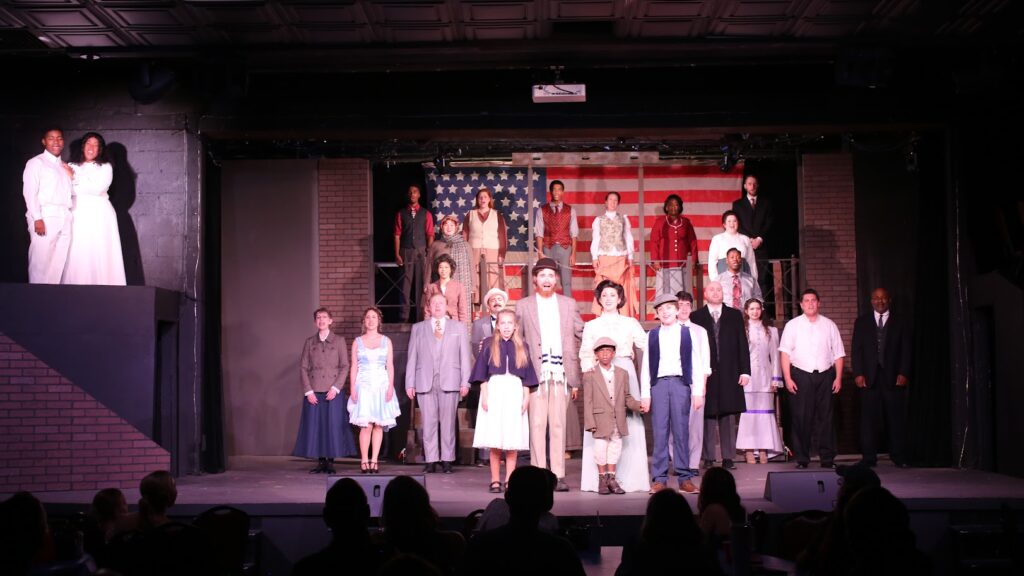
JHPENTERTAINMENT: In LUCY LOVES DESI, you play Jess Oppenheimer, I Love Lucy’s producer and head writer. It was Jess’ posthumously-released memoir Laughs, Luck…and Lucy: How I Came to Create the Most Popular Sitcom of All Time co-authored by his son, Gregg, upon which the younger Oppenheimer based this play. Did you know much about Jess before auditioning for this role?

MICHAEL WELCH: I didn’t know much about him at all. I had only completed my usual pre-audition research. Listening to the audiobook version of the story by L.A. Theatre Works was quite helpful. The author, Gregg, was interviewed at the end of the show, so I was able to hear some tidbits directly from him. 

JHPENTERTAINMENT: Being a huge Lucille Ball fan and collector, myself, I was already familiar with the basics of how the classic sitcom came to be, but, speaking of research, in preparation of chatting with you and your cast mates, I read the script, and loved it. As you began preparing for the show, what surprised you about the script? 

MICHAEL WELCH: I was surprised by the warmth and tenderness of the characters. We have all heard how “show business” is a ruthless affair. However as presented in this show, Desi, Lucy and Jess seem to have a real friendship. I believe that will be translated to the audience. It is the romance between Lucy and Desi that was the real draw of the script for me. I might have shed a small tear when reading the last line of the script. 

JHPENTERTAINMENT: I understand the playwright won’t be able to be in attendance for the Nashville and Tennessee premiere production, but he’s asked that a video of the production be sent to him. What does knowing the playwright will not only see you perform, but also see you take on the role of his father mean to you as an actor? 

MICHAEL WELCH: Actually, I didn’t know that until now. My version of Jess is not an imitation. Jess was described as the “field general” and “the brains” of the outfit.  He just got things done. I hope that the playwright sees what I do as a reflection of what his father meant to I Love Lucy and to him. Hopefully, Gregg will be pleased with my effort.   

JHPENTERTAINMENT: I like to finish these interviews by asking…what do you hope audiences take with them after attending a performance of LUCY LOVES DESI: A Funny Thing Happened on the Way to the Sitcom?

MICHAEL WELCH: Honestly, I hope that it encourages them to watch the reruns of I Love Lucy. Now that they will know a little bit more about the people behind the characters, the iconic situation comedy will, hopefully, have a broader meaning and appeal. Can anyone watch the “candy on the conveyor belt scene” without cracking up? We all need a surefire laugh now and then.  

————-

Much like Lucy and Ethel’s best-laid plans, this Rapid Fire 20Q proved to be equal parts laughter and heart. After chatting with the cast, I’m confident The Keeton’s LUCY LOVES DESI: A Funny Thing Happened on the Way to the Sitcom promises to deliver both in spades—with nostalgia, behind-the-scenes hilarity and a cast that truly loves Lucy.

Catch LUCY LOVES DESI: A Funny Thing Happened on the Way to the Sitcom at The Keeton Dinner Theatre October 10-26. CLICK HERE for tickets and showtimes.

Following LUCY LOVES DESI: A FUNNY THING HAPPENED ON THE WAY TO THE SITCOM, The Keeton’s current season continues with SHE LOVES ME, onstage December 4-21, BIG FISH, running February 6-22, THE PLAY THAT GOES WRONG April 10-26, with STATE FAIR closing the season June 13-29! CLICK HERE for tickets and more details.

So you don’t miss out on upcoming shows at The Keeton Dinner Theatre, follow them on Facebook, X and Instagram.

Interested in coverage for your latest entertaining endeavor? Click the contact page and drop me a note. You can also follow JHP Entertainment on Instagram and Facebook. In the meantime, #GoSeeTheShow!

Filed Under: Entertainment, Rapid Fire 20 Q, Rapid Fire Q&A, Theare Tagged With: 2025, Interview, Lucy Loves Desi, Rapid Fire 20 Q, The Keeton, The Larry Keeton Dinner Theatre

Theatre Review: ‘Ragtime: The Musical’; at The Keeton through Sunday, August 31

August 20, 2025 by Jonathan

There’s a certain something about heading into The Keeton-this area’s oldest continuing dinner theatre-on a summer night. You’re greeted with good food, friendly faces, and a buzz of anticipation. This certainly held true as I attended opening night of RAGTIME, their current production helmed by director Mitchell Vantrease. Under Vantrease’s sure-handed direction, with Roger Hutson conducting a lush, heart-pounding score, this powerful  production doesn’t just entertain—it moves you.

Before I delve into my thoughts on this production, let me just get one thing out of the way—Jayden Murphy is a revelation. At only 18, this recent Jimmy Awards semi-finalist steps into the role of Coalhouse Walker, Jr. with the kind of intensity and nuance you usually see from actors twice his age. His booming vocals, his emotional honesty, his laser-focused presence—Murphy’s Coalhouse is equal parts inspiring and heartbreaking. If you read his segment of my recent Rapid Fire 20Q, you already know he understands the depth and power of this role. On stage? He proves it. His voice, rich and smooth, possesses the perfect combination of strength, heartache and comfort. Act I’s Justice…just fabulous.

Matching him note for note is Miya Nichole Burt as Sarah. From her tender take on Your Daddy’s Son to each of her gut-wrenching ballads, Burt makes Sarah’s journey deeply personal. The chemistry between Burt and Murphy shines through, making Sarah’s fate hit all the harder.

Then there’s Holli Trisler as Mother. She’s the heart of this production—warm, grounded, and quietly commanding. Her Back to Before brought the house to much deserved applause, and judging from the audience around me, more than a few tears.

Nicholas Branson brings grit and grace as Tateh. His Gliding was staged with such simple beauty that it practically shimmered. You believe him when he sings of the American Dream, because he sings it like he’s living it. A gorgeous reminder that we’re ALL hoping to live it.

Meanwhile, Matthew Marcus gives us a restless, fiery Mother’s Younger Brother. His energy in every scene makes you sit up straighter, as if you’re being pulled into the whirlwind of his convictions. Like many of the cast, RAGTIME marks Marcus’ Keeton debut, but something tells me we’ll be seeing a lot more of this scene-snagging actor.

On the subject of noteworthy ensemble performances, The Keeton’s RAGTIME is brimming with them, chocked-full with moments you likely won’t be able to stop talking about on the drive home. For me? LaToya Gardner—one of my longtime “theatre crush”—absolutely slayed the Act I closer Till We Reach That Day. Her voice soared, her presence commanded the stage, and suddenly the entire room was with her, united in that raw cry for justice.

If Act I’s wow moment belonged to Gardner, Act II belonged to another of my longtime “theatre crushes”, Elliott Robinson as his Booker T. Washington pleads with Murphy’s Coalhouse Walker, Jr to Look What You’ve Done. Commanding yet full of quiet dignity, this monologue/song is the kind of performance that makes you lean in and take note.

Let’s not forget yet another veteran scene-stealer Danny Proctor as Grandfather. Only Proctor could toss out a couple perfectly timed quip that had the audience roaring, and then turn around and remind us why Grandfather’s cantankerous spirit has always been a fan-favorite.

Others whose performances added to this production include Joshua Mertz as Houdini, Brenda Brannon as Emma Goldman Brian Best as Willie Conklin and young actors Ryman Stanton and Ayla Carlock, who play Little Boy and Little Girl. Oh, and perhaps the biggest little scene-stealer of them all, Lawson Dowlen, who, with one eleventh hour walk-on, serves as another beautiful reminder that with each new generation, there’s hope for the future of us all.

Kudos also to the technical crew, including: Denese Rene Evans, for her work on some pleasing period-perfect wardrobe choices, choreographer McKenna Driver, who keeps the cast literally moving (though there was a bit of a modern take included in a few of the Harlem Ensemble scenes). Tech director Kevin Driver’s stripped-down set, basically a catwalk, two rolling stairs and a 45-star flag, seemed initially a tad lackluster, but when you realize the music, the voices and the talent are the focus, the industrial set design makes perfect sense. Then, when Murphy’s Coalhouse Walker, Jr. rolls up in stage-created Model T, complete with working headlamps, it’s evident that Driver was indeed in the driver’s seat as far as set design was concerned.

Lastly, I’m not sure if it was director Vantrease’s suggestion, or that of the costumer, or someone else, but I can’t tell you how much I appreciated the small, but noticeable detail of the hairstyles. The majority of the female cast elegantly sported either high pompadours or figure 8s while the majority of the male cast were sleek and sophisticated with deep side parts and a little hair grease.

With vocals rich and commanding to emotional performances from Murphy, Burt, Trisler, Branson, and Marcus, alongside unforgettable turns by Gardner, Robinson, & Proctor and all-‘round, this RAGTIME doesn’t just tell a story—it demands you listen to it. Mitchell Vantrease and his team have crafted a production that honors the show’s sweeping history while keeping it intimate and immediate.  It’s safe to say RAGTIME at the Keeton Dinner Theatre is one of the must-see productions of the summer.

What makes this RAGTIME so impactful isn’t just the talent on stage, but the truth of its themes. More than 25 years after its Broadway debut—and over a century after the events it dramatizes—the struggles against racism, class divides, and injustice are, heartbreakingly, still with us. Yet, in the midst of that sobering reality, RAGTIME reminds us that unity, compassion, and resilience can light the way forward.

It’s that blend of hard truth and enduring hope that makes this production so necessary—and so moving—right now. At the Keeton Dinner Theatre, RAGTIME isn’t just a night of great music and performance. It’s a call to remember where we’ve been, reflect on where we are, and hopefully, to believe in where we can still go.

But don’t just take my word for it. CLICK HERE to reserve your seats now and head to Donelson to experience RAGTIME for yourself. The show runs through August 31, and if the energy on opening weekend was any indication, you’ll want to snag tickets before they’re gone.

To keep up with the latest from The Keeton Dinner Theatre, follow them on Facebook, Twitter and Instagram.

Interested in coverage for your latest entertaining endeavor? Click the contact page and drop me a note. You can also follow JHP Entertainment on Instagram and Facebook. In the meantime, #GoSeeTheShow!

Filed Under: Entertainment, Theare, Theatre Review Tagged With: 2025, Dinner Theatre, Ragtime, Ragtime: The Musical, Summer, The Keeton, The Larry Keeton Dinner Theatre, Theatre Review

Rapid Fire 20Q With Director and Cast of ‘Ragtime’; on stage at The Keeton beginning Friday, August 15

August 15, 2025 by Jonathan

Earlier this week, as cast and crew of The Keeton Dinner Theatre’s RAGTIME: THE MUSICAL prepared for their Friday, August 15 opening night, I had the chance to chat with Mitchell Vantrease, the show’s director, as well as cast members Miya Nicole Burt, Nicholas Branson, Holli Trisler and Jayden Murphy for the latest installment of my recurring interview feature, Rapid Fire 20Q. What follows are those conversations.

—————

RAPID FIRE 20Q WITH THE KEETON’s RAGTIME DIRECTOR AND CAST

RAPID FIRE 20Q WITH RAGTIME DIRECTOR, MITCHELL VANTREASE

JHPENTERTAINMENT: RAGTIME is a sweeping, emotionally charged musical—what drew you to this particular show as your next directing project at The Keeton?

MITCHELL VANTREASE: I’m very familiar with this musical—it’s one of my all-time favorites. I’ve had the honor of performing in it three times in Arizona, and each time deepened my understanding of its powerful themes. Set in 1906, this story still resonates today because we are still having the same conversations—about racial prejudice, police brutality, immigration, and privilege.

With my background as an actor in this piece, I felt called to bring my perspective to the director’s chair. This is my opportunity to help tell the story through a new lens, with truth, heart, and urgency.

JHPENTERTAINMENT: You’ve directed everything from FENCES to A CHRISTMAS STORY: THE MUSICAL. How does your approach shift when taking on a historical epic like RAGTIME with its layered themes?

MITCHELL VANTREASE: One thing that was especially important to me with this production was telling the truth—my truth—through the lens of a Black American man. There are moments in the script that I didn’t want to soften or gloss over. I wanted them to land, plain and clear. Audiences will feel that.

For example, our set has an industrial look, anchored by a worn, tattered American flag as the backdrop—a visual reminder of how far we’ve come, and how far we still have to go as a nation.

JHPENTERTAINMENT: As a theater educator and recent recipient of the Spotlight Award for Outstanding Direction, how does your work with students influence your process when working with a professional or community cast?

MITCHELL VANTREASE: I’ve been directing community and youth theater for years—even before becoming a high school teacher. Educational theater is a different experience, though. It’s not just about entertainment; it’s about learning, growing, and helping students discover their potential.

Community and professional theater may share similarities, especially in the caliber of performance, but the difference is often the cast—usually made up of adults with a great deal of experience. That’s what makes this summer’s production of Ragtime so unique. We have six high school, middle and elementary school students in the cast—three of whom are part of my program at Mt. Juliet High School.

It’s a big responsibility for a student to step into a production like this, surrounded by seasoned actors and professionals. That could easily be intimidating. But these students are rising to the occasion. They’re showing maturity, drive, and a real passion for the craft.

During the school year, I get to work with student performers almost 200 days out of the year, and I love it. But there’s something refreshing about collaborating with talented adults in the summer. This entire cast of 32 is phenomenal, and I’m so proud of the work we’re doing together.

JHPENTERTAINMENT: From creating the original work, THE SOUL OF BROADWAY to helming over 40 productions, what’s one core value or message you always strive to instill in any cast you direct?

MITCHELL VANTREASE: I’ve always told my cast—whether they’re adults or kids—that as artists, it’s our responsibility to entertain and tell the truth. That applies whether we’re sharing a lighthearted comedy or a powerful piece like RAGTIME: THE MUSICAL. We’re all working together to tell a story that could impact someone’s life—whether it stays with them for just a couple of hours or for a lifetime.

RAPID FIRE 20Q WITH RAGTIME’s SARAH, MIYA NICOLE BURT

JHPENTERTAINMENT: This is your Keeton Theatre debut—what has the experience of joining this production of RAGTIME meant to you personally and artistically?

MIYA NICOLE BURT:  Making my debut at the Keeton Theatre with RAGTIME has honestly been such an incredible and rewarding experience!  Personally, it’s a milestone that reminds me how much growth is possible when you step into new spaces and challenges. Artistically, RAGTIME offers such a rich tapestry of history, emotion, and humanity that it has pushed me to explore new depths in my craft. Being part of this production has allowed me to connect with a story that is both powerful and incredibly timely in our country today, and I’m extremely grateful to contribute to its message within our community. 

JHPENTERTAINMENT: Sarah is such a complex and demanding role. How have you connected with her story, and what do you hope audiences take away from your performance?

MIYA NICOLE BURT: Sarah’s journey resonates with me on so many different levels. Her strength, vulnerability, and determination to protect her family amidst societal change as a Black woman in America really hits home for me. I’ve connected with her by embracing the contradictions within her: her struggle to maintain control while facing uncertainty and her courage to evolve. I hope audiences walk away with a deeper empathy for the everyday heroes in history whose quiet battles helped shape the world. Ultimately, I want Sarah’s story to remind people of the power of resilience and compassion. 

JHPENTERTAINMENT: You’ve played everything from the lead in AIDA to Gary Coleman in AVENUE Q—what do you love most about tackling such a wide range of characters?

MIYA NICOLE BURT: Honestly, I love how every role is a new adventure! Having the opportunity to constantly reinvent myself and explore different facets of humanity is what attracted me to theatre in the first place. Each character, whether dramatic or comedic, gives me a fresh perspective and challenges me to adapt my voice, body, and emotions in unique ways. Playing such diverse roles keeps my work exciting, and it reminds me that storytelling is limitless! There’s always a new story to tell and a new truth to uncover within a character. 

JHPENTERTAINMENT: When not performing onstage, you work as a vocal coach. How does that work influence your performances on stage—and vice versa?

MIYA NICOLE BURT: Working as a vocal coach has given me a deeper understanding of breath control, vocal health, and emotional expression, which naturally enhances my stage performances. It’s rewarding to apply technical skills to bring authenticity and clarity to my singing and acting. Conversely, being onstage keeps me connected to the emotional and physical demands performers face, allowing me to empathize and tailor my teaching to support my students and their artistic journeys fully. The two roles enrich each other and fuel my passion for the craft. 

RAPID FIRE WITH RAGTIME’s TATEH, NICHOLAS BRANSON

JHPENTERTAINMENT: From Gilbert & Sullivan to Sondheim, you’ve performed on stages around the world—what was it about the role of Tateh in RAGTIME that spoke to you?

NICHOLAS BRANSON: I think what most drew me most to the role and the show is how important the story is to tell. In our current moment, I think it benefits us all to take a look back. Many of the issues we face today have historical antecedents that remain etched in our collective consciousness. I think a lot of us felt secure in believing these problems (anti-black racism, anti-immigrant sentiment, misogyny) were in the past. But so many of the story beats in this show set 120 years ago could easily be headlines from tomorrow. Progress is fought for and won, not given, and we must never forget that or become complacent. Tateh’s story is the story of so many of us; of our friends, coworkers, parents, and grandparents. It’s a story of hope. Naive hope, desperate hope, ecstatic hope. A hope for a new and better tomorrow for you and your family, and a willingness to defy odds to make it happen.

JHPENTERTAINMENT: You’ve studied classical voice and sung opera in cities like Prague and Salzburg—how do you approach storytelling differently when shifting into a character-driven musical like RAGTIME?

NICHOLAS BRANSON: I think the process is distinct in a couple ways. In the era before amplification, the need for vocal projection and clarity brought these fantastical, larger than life, often melodramatic, opera roles to the stage that played to the back of the room. Amplification gave musical theatre the freedom to explore so many more nuances of the human voice and the emotions it can express. A character like Tateh gets to explore trepidation, hope, the sting of failure, deep despair, and steely resolve all within the span of a single song! Where a lot of opera characters are really effective at imparting big, deep, cutting emotions; Tateh brings shades of real life to the stage. There’s also much more opportunity in musical theatre to try new things and collaborate. Many characters in the standard operatic repertoire have decades if not centuries of paratextual expectations and standard practice. A character like Tateh affords the actor so much more freedom to interpret and express.

JHPENTERTAINMENT: What’s been the most surprising or rewarding part of working with the cast and creative team at The Keeton for this production?

NICHOLAS BRANSON: I have been so overwhelmed by the genuine kindness of the cast and crew at the Keeton. Everyone has been so friendly and welcoming. This is my first show here and I can honestly say that everyone has been amazing to work with.The caliber of the performers as well as the artistry of the set designer, costume designer, director, music director, choreographer, stage managers and lighting and tech crew have made this production a joy to rehearse. 

JHPENTERTAINMENT: Tateh can sometimes be portrayed as a one-dimensional immigrant stereotype—how have you worked to bring authenticity and depth to his journey in RAGTIME while honoring the character’s cultural context?

NICHOLAS BRANSON: I definitely focused on finding a unique voice for Tateh as part of the learning process. I studied Polish, Russian, and Yiddish dialect coaching manuals to avoid creating an accent that was too unipolar. He’s an artist from war torn Latvia, leaving behind his homeland and people with nothing but his daughter, and I wanted to give Tateh the depth and nuance his character deserves. I definitely didn’t want to shy away from the immigrant narrative though. Immigrating to America is such a vital piece of Tateh’s story; he experiences poverty, hardship, discrimination and violence that all impact his character and shape his outlook on the world. His initial, simplistic view of the American dream is quickly shattered, but his love for his family allows him to carry on and forge a new life. I think that’s really the focus of his character: the love he has for his daughter and his willingness to do anything to improve her life for the better. 

RAPID FIRE WITH RAGTIME’s MOTHER, HOLLI TRISLER

JHPENTERTAINMENT: After performing across Disney Parks around the world, what drew you to take on the role of Mother in RAGTIME—and at The Keeton, no less?

HOLLI TRISLER: Performing for over a decade with the Walt Disney Company gave me extensive experience in the art of storytelling – something that Disney does best. It taught me how to bring different characters to life in an authentic and well rounded way, with an emphasis on drawing people in to each character’s story as if they were a part of it. The role of Mother drew me in because of the storytelling journey she gets to be part of in the show. She is such a rich, layered character, and I knew it would be a beautiful challenge for me not only as an actor and singer, but as a storyteller. Not only does this show have incredible, moving music from beginning to end, but the story is one that is timeless – it has and continues to be one that needs to be told, and I am honored to play a part in telling this story. The Keeton has a reputation for not only putting on great shows, but having an incredible production team behind the curtain, pouring their hearts into each show with care and passion. It is an honor to join the Keeton family in this production.

JHPENTERTAINMENT: Mother’s arc in RAGTIME is one of quiet strength and awakening—how have you approached portraying her evolution throughout the show?

HOLLI TRISLER: Mother’s character journey has been so challenging yet thrilling to dive into during our rehearsal process. To me, the purpose of her role is to demonstrate the evolution of a person becoming aware of the lives and hardships of those outside her social circle, developing empathy for those situations, and deciding to break from tradition to stand up for what she realizes is good and right – even at the sacrifice of her own reputation, resources, or relationships. In preparation for the role, I spent a lot of time studying her throughout the script – finding those moments where things start to shift for her in her mind and her subsequent actions. In each scene, she becomes more and more aware, more and more empathetic, and more and more bold in her choices to stand up for what she believes in. She’s a delicate balance of quiet strength and bold risks, and I’ve thoroughly enjoyed diving in to discover that balance.

JHPENTERTAINMENT: Your resume includes everything from Belle to Eponine—how does Mother compare to the iconic characters you’ve played in the past?

HOLLI TRISLER: I believe each character I’ve played has shaped me as an actor and storyteller and have in their own way prepared me for the role of Mother. If you think of those iconic characters, each goes on their own journey of discovery of the world around them being different than they hoped, thought, or expected, and have to consequently shift their points of view and grow in wisdom and strength. Belle finds a world outside her small, provincial town and learns that things aren’t always what they seem. Eponine gains her strength from enduring through hardship and unrequited love. Mother’s journey is of transformation within – she starts in a place of privilege and certainty, and ultimately has a complete shift in her worldview which draws out a strength in her that she never knew she had.

JHPENTERTAINMENT: When you’re not on stage, you’re running an Etsy shop and doing taxes—how do the creative and analytical sides of your life come together to fuel your work as a performer?

HOLLI TRISLER: It’s true, I have a lot of very seemingly unrelated interests and passions! However, I think this helps me to be more well rounded as an actor and storyteller. My creative side inspires my desire to tell stories and play roles in a unique way – to imagine and experiment with different character choices, line delivery, and reactions to the scene around me. My analytical side not only helps me with learning music and memorizing lines, but it also makes me more attentive to detail. It allows me to be able to see the nuances in the script and music and consequently use those details to create a fuller, more developed character. Performing is certainly a challenging balance of both those sides for me – to allow my analytical side to give way to creativity and experimentation and vice versa. This is one of the many ways that theatre is so beautiful – everyone brings a bit of themselves to each role, so no two casts will ever present a show in the same way. That means this production of RAGTIME will be unlike any you’ve ever seen or will see again. Thanks for joining us for this beautiful, unique moment in time at the Keeton Theatre!

RAPID FIRE WITH RAGTIME’S COALHOUSE WALKER, JR, JAYDEN MURPHY

JHPENTERTAINMENT: At just 18, you’re taking on one of musical theatre’s most demanding roles—what was your first reaction when you were cast as Coalhouse?

JAYDEN MURPHY: My reaction to getting cast as Coalhouse…I was just grateful. As you said, you rarely see someone my age get a role that is this taxing and demanding. The trust that the cast and crew has given me is so fulfilling and it keeps me pushing through those hardships and tough times. 

JHPENTERTAINMENT: You’ve played everything from Henry in NEXT TO NORMAL to Evan in 13: THE MUSICAL—how does stepping into RAGTIME compare to your previous experiences?

JAYDEN MURPHY: It’s definitely a full 360, but it’s been a fun process. I personally love character work and learning about the things my character went through. I studied the novel of this show to see all the things that didn’t even make it to the Broadway script and added that into my character. 

JHPENTERTAINMENT: As a Jimmy Awards Semi-Finalist and Spotlight Award Winner, how have those opportunities helped shape your growth as a performer?

JAYDEN MURPHY: It’s shown me a lot about myself. How I deal with high pressure situations and the opportunities and connections that I made during those two award shows will follow me through the rest of my career 

JHPENTERTAINMENT: RAGTIME is a show with deep emotional impact—what do you hope audiences leave thinking or feeling after seeing this production?

JAYDEN MURPHY: I personally hope the audience is aware that not really anything has changed and goes into life with a better mindset after it.

—————

That wraps up this round of Rapid Fire 20Q with the talented cast of RAGTIME: THE MUSICAL at the Keeton Dinner Theatre! This powerful, sweeping story with unforgettable music and a rich narrative of America at the turn of the 20th century is brought to life on stage August 15–31 at the Keeton Dinner Theatre, 108 Donelson Pike, Nashville, TN. So CLICK HERE to reserve your seats now for an evening of theatre paired with the Keeton’s signature dinner experience and see for yourself why RAGTIME..is timeless.

To keep up with the latest from The Keeton Dinner Theatre, follow them on Facebook, Twitter and Instagram.

Interested in coverage for your latest entertaining endeavor? Click the contact page and drop me a note. You can also follow JHP Entertainment on Instagram and Facebook. In the meantime, #GoSeeTheShow!

Filed Under: Entertainment, Rapid Fire 20 Q, Theare Tagged With: 2025, Dinner Theatre, Interview, Live Performance, live theatre, Musical, Musical Theatre, Nashville, Q&A, Ragtime, Rapid Fire, Rapid Fire 20 Q, Rapid Fire Q&A, The Keeton, The Larry Keeton Dinner Theatre

  • Page 1
  • Page 2
  • Page 3
  • Go to Next Page »

Copyright © 2026 · News Pro on Genesis Framework · WordPress · Log in