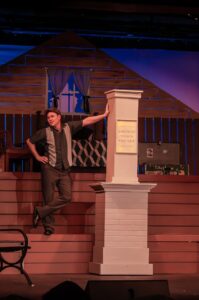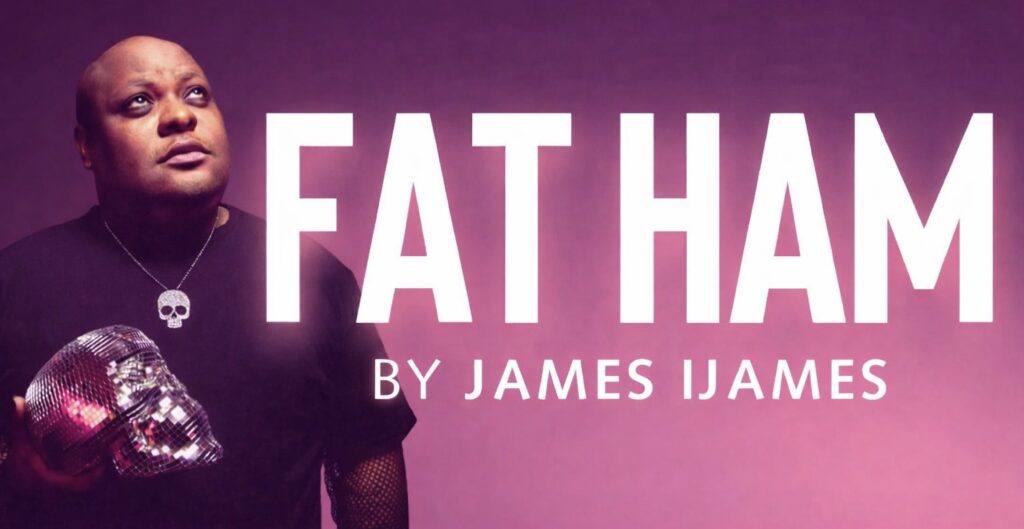
• Skip to primary navigation
  • Skip to main content
  • Home
  • About
  • Features
  • Contact

JHP Entertainment

Entertainment News, Reviews and Interviews

  • Home
  • About
  • Features
  • Contact

Archives for February 2026

Theatre Review: Nashville Rep’s Collab with Nashville Shakes Serves Up ‘Fat Ham’ with Sauce and Soul and We’re All Invited to the Cookout; On Stage at TPAC’s Johnson Theatre thru February 22

February 18, 2026 by Jonathan

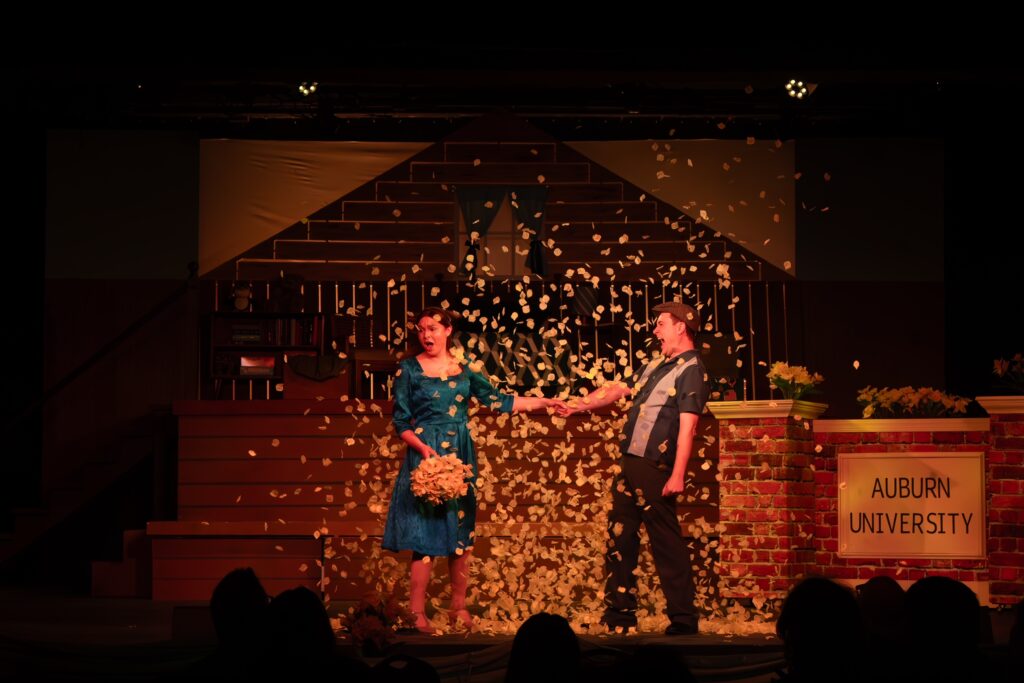
Okay, okay, I’ll admit it. When I was assigned to read Shakespeare‘s Hamlet in high school and again in college, I read the Cliff’s Notes instead of diving in to the full text. Even if I had read the play, nothing could have prepared me for just how relatable and uniquely enjoyable playwright James Ijames‘ take, Fat Ham is, especially in the hands of Nashville Rep‘s current production directed by Mikael Burke, featuring a truly stellar cast and co-presented by Nashville Shakespeare Festival; on stage at TPAC‘s Johnson Theatre thru Sunday, February 22.

Yes, I know the basic themes: familial strife, loyalty, deceit, treachery and death, but my Hamlet knowledge lies more in that episode of Gilligan’s Island in which the castaways turn The Bard’s classic into an unintentionally comedic musical than in the original text. Here’s the cool thing though…you don’t have to be a literary elitist to understand or fully revel in this Pulitzer Prize-winning adaptation.

Over the past 400 years or so, Hamlet has been presented in settings from war zones to psychiatric wards. IJames’ Fat Ham, not only modernizes it, but takes some brilliant liberties . Flipping the script by peppering the dialogue with quick comebacks, modern references and hot topics while also including clever nods to familiar soliloquies. Nashville Repertory Theatre’s co-production with Nashville Shakespeare Festival brings the story to vibrant life for the regional premiere.

The Bard’s Elsinore Castle now replaced by the everyman kingdom of a backyard cookout in the American South. There’s a grill smoking, table and chairs set for an impromptu wedding celebration, and the low hum of family history hanging in the air. At the center is Juicy—a young, Black man haunted not only by the ghost of his recently deceased father, but also a few internal battles ranging from his own sexuality and what his future holds to protective feelings towards his mother and disdain of his uncle. Early on, The ghost insists he was murdered by Juicy’s uncle, who is now celebrating his engagement to Juicy’s mother. The parallels to Hamlet are unmistakable—but the lens is entirely new.

While I myself as probably considered as white as Wonder Bread, so many of Ijames’ themes, ideals and plot devices resonate with me in the best, most unexpected ways. Through that unmistakable Southern family bond, the familiar rhythms of a backyard gathering, Ijames reframes the story not as a tragedy of indecision, but as a meditation on inherited trauma and the radical act of choosing something different, all with a darkly comedic twist.

The production leans into that communal spirit. The humor lands with knowing precision, the shade draws audible reactions, and the audience feels invited into the rhythm of the gathering.
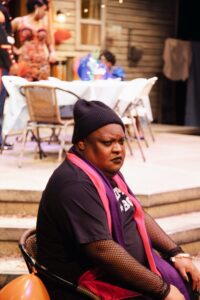
As Juicy, this retelling’s Hamlet, Julian “Joolz” Stroop delivers a performance that is instantly mesmerizing. Dressed in black, but with flare that lets us know they’re their own person deep down, Stroop’s Juicy is a stark contrast to the bright, bustling energy around them, Stroop embodies what it means to feel different within your own family. Their Juicy is wickedly sarcastic, deeply unsure of themself, yet painfully self-aware. Where Shakespeare’s Hamlet spirals toward destruction, Juicy wrestles with whether violence is the only inheritance available. Stroop captures the tension between rage and restraint with remarkable control. You can see the weight of expectation pressing in—the desire to prove themself to a father who was cruel in life and demanding in death. Stroop’s performance reflects the universal burden of feeling unseen, and when ultimately questioning the necessity of revenge, it lands with emotional clarity. Whether performing a telling karaoke number at the BBQ, sharing a laugh with friends, a more intimate moment with a lifelong crush or tense scenes with parental figures, Stroop steps up and shows out in a memorable Nashville Rep debut performance.
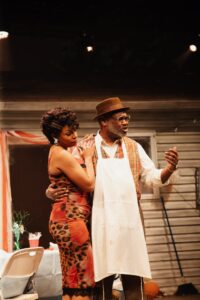
Tamiko Robinson Steele’s Tedra, the Queen Gertrude counterpart, is a sheer joy to behold from her first entrance on. She exudes sensual confidence and the unapologetic energy of a woman determined to find happiness on her own terms. One of my longtime favorite regional actresses, Robinson Steele masterfully reveals the emotional compromises beneath that surface. Like Gertrude, Tedra aligns herself with the new man quickly—but here, the choice feels rooted in survival and stability rather than simple obliviousness. Robinson Steele balances humor and depth beautifully, embodying a mother navigating grief, desire, and the societal pressures that center men in her world. And did I spot a bit of gold in that megawatt smile? A fun nod to Queen Gertrude and Tedra’s own status at the Queen of her castle. Nice touch.

Speaking of royalty, the aptly named Bakari J. King indeed commands the stage in the dual roles of Rev (Claudius) and Pap’s ghost (the Ghost of King Hamlet). As Rev, he radiates the swaggering authority of a man who believes the world revolves around him. Think George Jefferson…on steroids.  As Pap, he shifts into something sharper and more unsettling. Gotta love that toothbrush shiv sticking out of his neck. King’s ability to transition between the earthly manipulator and the glittering, vengeful apparition is a testament to his range. In scenes with Stroop, the tension between the two is a thick as the accompanying fog machine—he generational trauma thickening the air like the aroma of pork shoulder on the grill. King grounds both roles in recognizable patriarchal power, avoiding caricature while leaning fully into the characters’ egos.
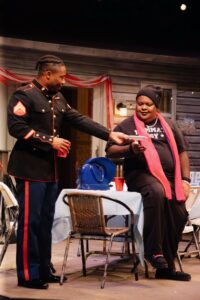
As Larry, the Laertes counterpart, Michael A. McAllister-Spurgeon initially leans into bravado and expected masculinity. But as the story unfolds, he allows vulnerability to seep through the cracks. Like Laertes, Larry is poised to embrace retaliation—but McAllister-Spurgeon reveals the insecurity driving that impulse. His performance underscores how young men inherit scripts of aggression without ever being asked whether they want them. The nuance he brings elevates Larry from stereotype to fully realized human being. And that finale reveal….YAAAAAAS!

Candace-Omnira reimagines Ophelia through Opal with warmth, wit, and agency. Unlike Shakespeare’s more fragile Ophelia, this Opal is emotionally grounded and self-aware. She perfectly balances buoyancy with sincerity, creating a character who feels refreshingly modern. Her chemistry with Stroop is honest and believable, offering Juicy a glimpse of something healthier than the violent expectations placed upon him. Candace-Omnira’s comedic timing shines in ensemble scenes, but it’s her emotional steadiness that leaves a lasting impression.
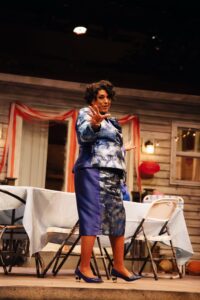
Persephone Felder-Fentress steps into a gender-switched Polonius role as Rabby, Larry and Opal’s mother, with sharp comedic precision. While Shakespeare’s Polonius is verbose and meddlesome, Rabby feels more direct and grounded. Felder-Fentress handles the humor effortlessly, but she also brings a relatable maternal complexity to the role. You know that female relative who always pinched your cheeks as a kid and inevitable asks “when are you getting yourself a girlfriend?” That’s Felder-Fentress’ Rabby. The dynamic between Rabby, Larry, and Opal textbook good christian family facade masking those things we don’t talk about beneath the surface. Y’all, during Rev’s pre-feast prayer, when I noticed Felder-Fentress’s Rabby clicking her bejeweled heels together in prayerful agreement to each thing Rev mentioned, I knew I longed for an invitation to the cookout!
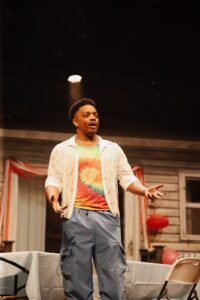
Rounding out the players is Gerold Oliver’s Tio, the Horatio character. Though his stage-time is limited, he is a delight as usual. His comedic timing, pulled facial expressions and overall demeanor a joy to watch. Yet Oliver ensures Tio is more than comic relief. In a climactic, albeit alter-state-induced monologue that begins like a muchie-fueled rambling, but soon climaxes into something unexpectedly profound. Oliver lands the humor and the wisdom with equal finesse as Tio reminds the audience of the play’s core truth: “Far as we know, we are in the only place in the cosmos that welcomes our particular brand of life. Why waste it trying to be miserable cause it’s gonna make somebody else happy?”

Behind the scenes, the crew of Fat Ham is just as stacked. From the beginning, it’s evident that director Mikael Burke understands the world of this play down to its bones. There’s an easy authenticity to the staging that makes the backyard feel lived-in and immediate. Director Burtke’s stage direction keeps the audience’s attention and the action moving, while never becoming too chaotic. The show’s more intimate moments are perfectly choreographed down to the most dramatic sneer or the subtlest caress.

Once again Nashville Rep’s resident Scenic Designer Gary C. Hoff’ has created a set I could live in. With what appears to be a modular home set on a brick-o-block basement—complete with grill, patio furniture, and a sliding glass door (complete with time-worn smudges) offering a glimpse into the house, and even the inclusion of fallen leaves on the rooftop— it feels less like a theatrical construct and more like an actual family gathering you’ve stumbled into. I absolutely loved the little detail of the “Happy” half of an old “Happy Birthday” banner hanging with balloons as the last-minute party decor, while the “Birthday” half of the banner is visible discarded in the trash can by the basement door, just another way in which this set looks lived in and real, not simply constructed for the show. Ijames’ script heightens the immersive aspect by including a few fourth-wall breaking lines like “what are you telling them” as actors nod toward the audience in acknowledgement. The echoes of real-life cookouts: home-cooked food and fun with a side order of judgment from elders, unlocking palpable memories.
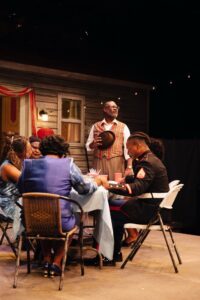
Amber Whatley’s lighting brilliantly shifts from warm afternoon glow to something cooler and more spectral when Pap’s ghost appears, then changing throughout from the familiarity of a family gather to the intensity of truths revealed. Nivedhan Singh’s sound design underscores both the humor and the haunting without overwhelming the text and lifting the mood when called for.

Melissa K. Durmon’s costume, hair, and makeup design ground each character in specificity—these are people you recognize, rendered with care and intention. Gotta love Durmon’s attention to detail fully on display in the color palate of each cast member’s wardrobe. Tedra and Rev are regal and grounded in traditions of marriage and conformity in shades of red and earth tones, while Tedra’s more animalistic urgers are represented in the addition of an animal print. Juicy’s uncertainty is isolation visually present in his monochromatic wardrobe, but his love of his mother, a message literally emblazoned across his chest, while his sarcasm and flair evident in an added accessory. Rabby’s family ties are representing in all three members in shades of blue, a symbol of loyalty and nobility. Durmon again highlights individuality among these three from Larry’s rigid uniform and Opal’s subtle defiance pairing a forced dress with combat boots, while the matriarch presents authority and perceived (or hoped-for) regality in her royal blue ensemble complete with matching church lady hat, purse and bejeweled heels. Then there’s Tio, whose casual colorful style remind us all that there is lightness around, we just have to be willing to see it.

What makes Fat Ham so powerful, and ultimately relatable to modern audiences is its refusal to follow Shakespeare to the grave. Where Hamlet ends in bloodshed, Fat Ham asks whether that ending is inevitable—or merely inherited. By centering Black culture, queer identity, and the specificity of a backyard cookout, Ijames expands the original rather than replicating it.

Fat Ham treats Shakespeare as a blueprint, a playbook—ripe for reinterpretation, reclamation, and joy. A great reminder that the themes of revenge, masculinity, grief, and identity are universal, whether played out in Danish castles, Elizabethan stages or right in our own back yard. Themes that are found in every backyard, every family, every life. Like I told my friend who accompanied me to Nashville Rep’s Opening Night of Fat Ham, “Who knew Willie Shakes could be so fun?”

Nashville Rep‘ and Nashville Shakes‘ co-production of FAT HAM continues with performances through Sunday, February 22. CLICK HERE for tickets. Next up at Nashville Rep will be SISTER ACT April 10-19. Closing out the season will be Amy Tofte‘s BLOOD SUCKING LEECH, as part of Nashville Rep‘s New Works: Next Stage, after having presented a staged reading of Tofte’s work just last season. CLICK HERE to purchase tickets.

As always, check out Nashville Rep online and follow them on Facebook, X, YouTube and Instagram.

If you wanna follow JHPEntertainment to find out who I’m chatting with for my next Rapid Fire Q&A, or for my take on the latest local and national theatre, music and movie offerings, find us at JHPEntertainment on Facebook JHPEntertainment on Instagram  and JHPEntertainment on Twitter. Got an event or show we should know about, drop us a line at the Contact tab. Till then, #GoSeeTheShow!
Filed Under: Entertainment, Theare, Theatre Review Tagged With: 2026, Fat Ham, Nashville Rep, Nashville Shakespeare Festival

Theater Review: Keeton Dinner Theatre Hooks Delightful Tall Tale with ‘Big Fish’; on Stage Through February 22

February 13, 2026 by Jonathan


From the first triumphant notes of the all-in opening number Be the Hero, The Keeton’s production of “Big Fish” announces itself with confidence, color, and heart. Andrew Lippa and John August’s Drama Desk–nominated musical has always walked a delicate line between spectacle and sincerity, and under the direction of Aaron Gray, this staging embraces both.

Gray keeps the father–son relationship firmly at the center. Even as witches appear, giants roam, and daffodils bloom by the hundreds, the emotional throughline never wavers: this is a story about legacy, about listening, and about what we choose to believe.

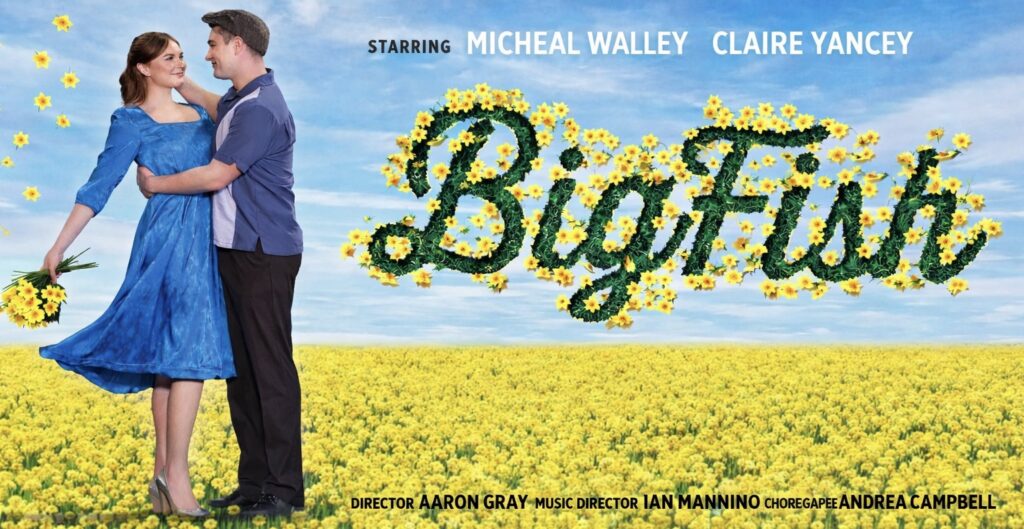
As Edward Bloom, Micheal Walley bursts onto the stage with charisma and conviction. From his first entrance, his speech pattern and delivery lands near Mark Twain’s distinctive Southern storytelling drawl — deliberate, charming, measured — and for some reason put me in mind of French Stewart’s Harry Solomon from “Third Rock from the Sun”, quick with an unexpected sarcastic bite. The blend gives Edward both homespun authenticity and razor-edged comedic timing, a balance that keeps the character from drifting into caricature. The subtle but effective vocal change between younger Edward to his more frail self in later years is quite interesting to take in.
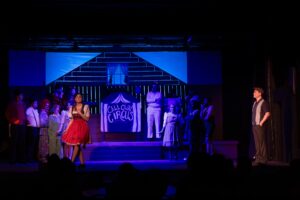
Be the Hero sets the tone — brassy, buoyant, unapologetically theatrical — and Walley meets the marathon demands of Lippa’s eclectic score with stamina and emotional nuance. As Walley revealed in my recent Rapid Fire 20Q with the show’s director, Walley and two of his fellow cast members, he’s a self-proclaimed “actor who sings”. That said, his Edward isn’t simply performing for applause; he’s inviting us into possibility.

Edward’s early adventures unfold with theatrical flourish. Miya Nicole Burt delivers a bewitching — and yes, pun entirely intended — turn as The Witch. Her presence is equal parts playful and ominous, her vocals slicing cleanly through Lippa’s driving rhythms while maintaining an alluring mystique. In particular, during her early solo during The Witch, hers is a performance that anchors one of the show’s most pivotal revelations.

Then there is Karl. Portrayed by Gray Miller, the gentle giant is, quite literally, larger than life. Miller commands the stage both physically and emotionally, bringing warmth and childlike innocence to the towering role. Remarkably, he had never walked on stilts before rehearsals began — a fact that makes his comfort and control in performance all the more impressive. What could have been a novelty becomes a fully realized character, and one the audience revels in seeing.

Musically, the production is in confident hands. Under the direction of Ian Mannino, the orchestra navigates Lippa’s stylistic range — from Broadway brass to tender balladry to gospel-infused exuberance — with clarity and cohesion. Mannino ensures the score supports the storytelling rather than overpowering it.

Choreographer Andrea Campbell, working in clear collaboration with director Aaron Gray, makes masterful use of The Keeton’s intimate stage. With a cast of twenty, filling the space without overwhelming it is no small feat, yet the production never once feels crowded. Instead, it feels alive. From kick lines to tap and everything in between, the variety of choreography reflects the musical’s tonal shifts while showcasing the ensemble’s versatility. One can only imagine the rigor of rehearsals required to master such range within spatial constraints, and the ensemble rises to the challenge with precision and enthusiasm. Director Gray deserves equal praise for staging that maximizes every inch of the performance area, creating dynamic stage pictures that feel expansive, an appropriate nod to the story’s 2003 cinematic retelling courtesy Tim Burton‘s film adaptation, despite the venue’s modest footprint.
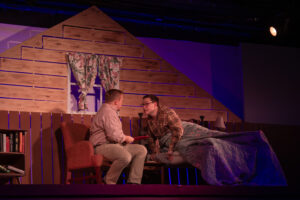
Equally essential to that visual storytelling is Kevin Driver‘s set design. From the opening scene in which the backdrop of the Bloom family house and picket fence appear in mostly in silhouette, there’s an immediate storybook feel to the actors’ surroundings. Balancing storybook whimsy with practical fluidity, the stage elements allow scenes to transition seamlessly from small-town Alabama to mythic landscapes without interrupting the show’s pacing or emotional rhythm. The stage area’s aquatic element…quite effective and fanciful.

If Walley’s Edward provides the fireworks, Claire Yancy as Edward’s lifelong love, Sandra provides the stillness — and the soaring vocals. Yancey’s vocal prowess is undeniable. Her tone is rich, controlled, and emotionally open, particularly in Time Stops, where the courtship unfolds in suspended romantic glow. As Sandra matures into the family’s emotional anchor, Yancey deepens the portrayal beautifully. Her performance of I Don’t Need a Roof becomes one of the evening’s most affecting moments — restrained, resolute, and vocally luminous.

Jacob Hinnen as Edward’s adult son, delivers a fully believable, emotionally grounded portrayal of Will Bloom. Hinnen never pushes for sympathy; instead, he allows Will’s frustration and skepticism to emerge organically. The result is authenticity. As Will prepares to become a father himself, the shift in perspective is subtle yet powerful. You believe him — every step of the way.
With an ensemble of twenty actors, it would be nearly impossible to single out every strong performance, but several deserve special mention. Audrey Bagley, as Josephine, perfectly portrays her devotion to Will while balancing a genuine fascination with her seemingly eccentric future father-in-law. Her warmth and quiet curiosity add texture to the generational dynamic at the heart of the story.

Ryman Stanton, portraying Young Will, delivers a heartfelt performance that marks his third production with the company, further securing his place as a full-fledged member of The Keeton family. His enthusiastic appreciation of his father’s tall tales strengthens and perfectly exemplifies the emotional bridge between past and present.

In the supporting but pivotal role of Jenny Hill, Jessica Fonville makes an impressive Keeton debut, convincingly aging nearly forty years over the course of the production. Her transformation, while only slightly visually different, is emotional and understated, grounding one of the show’s most poignant and surprising storylines to life.

There are also delightful scene-stealers throughout the ensemble. Among them, Wanderson Rezende, who has the rare ability to catch the audience’s eye with a subtle facial flex or an intentionally flamboyant gesture, commanding attention in both restraint and exuberance. Meanwhile, Tommy Anglim, another Keeton favorite, repeatedly makes audiences double-take with the quickness of his rapid costume changes,  shifting characters — including Dr. Bennett — with ease and in record time.

As the story moves toward its conclusion, fantasy and reality stop competing and begin coexisting. The final sequences land with earned emotional resonance. YES, my eyes began to sweat! Walley softens into fragility without losing Edward’s spark. Hinnen allows Will’s understanding to shift naturally. Bagley’s support, a needed comfort. Yancey’s quiet strength anchors it all.

What makes The Keeton’s “Big Fish” succeed is not simply its theatrical flourish, inventive choreography, cohesive musical direction, or imaginative scenic design — though all are present in abundance. It is the belief at its center, and the message at its core: Heroes are not defined by perfection. They are defined by the stories that outlive them. In this heartfelt, thoughtfully crafted production, those stories will certainly swim long after the curtain falls.

BIG FISH continues at The Keeton through Sunday, February 22. Thursday performances are show only with Doors at 6:30pm and Show at 7pm. Friday & Saturday Doors at 5:45pm/Dinner at 6pm and Show at 7pm. Sunday matinee Doors at 12:45pm/Meal at 1pm and Show at 2pm. Show Only Tickets: $30.00 (Thursday performances), Adult Dinner and Show: $40.00, Child Dinner and Show: $35.00. CLICK HERE for tickets.

Following BIG FISH, The Keeton will present “The Play That Goes Wrong” with performances April 10-26. So you don’t miss out on upcoming shows at The Keeton Dinner Theatre, follow them on Facebook, X and Instagram.

Interested in coverage for your latest entertaining endeavor? Click the contact page and drop me a note. You can also follow JHP Entertainment on Instagram and Facebook. In the meantime, #GoSeeTheShow!

Filed Under: Entertainment, Theatre Review Tagged With: 2026, Big Fish, The Keeton, The Larry Keeton Dinner Theatre, Theatre Review

Rapid Fire 20Q with Director and Cast of Playhouse 615’s ‘A Bad Year for Tomatoes’; On Stage Through February 22

February 13, 2026 by Jonathan


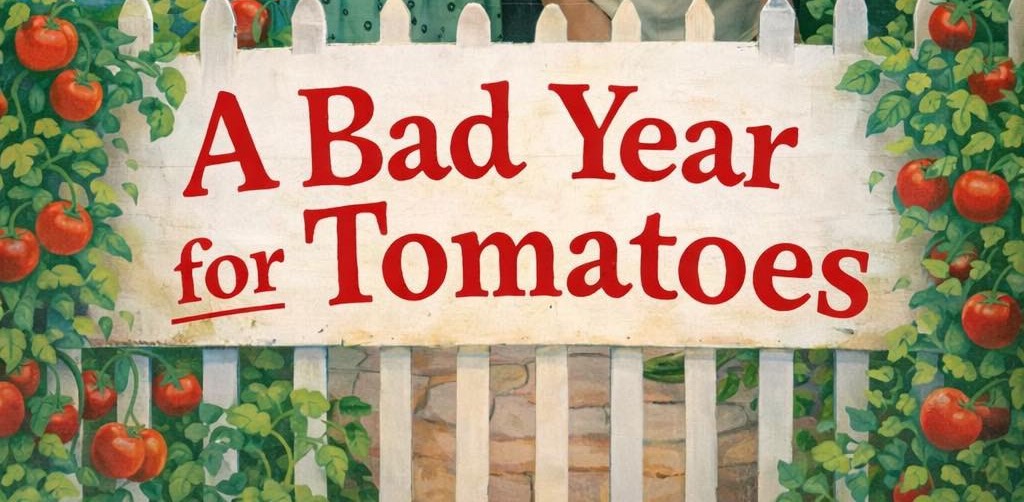
Last weekend, Playhouse 615 opened their current production, A Bad Year for Tomatoes, the classic farce by John Patrick that proves small towns, big secrets, and sudden chaos are a recipe for nonstop laughs. Now on stage through February 22, this fresh Nashville staging brings together returning-to-the-stage performers, fearless comedic timing, and a creative team eager to let the absurdity bloom. In this Rapid Fire 20Q, we chat with stars Michele Geller-Crain, Melissa Peduzzi, Katarie Herman, and director Preston Raymer , touching on everything from embracing farce to Uta Hagen!

—–

RAPID FIRE 20 Q WITH DIRECTOR & CAST OF A BAD YEAR FOR TOMATOES

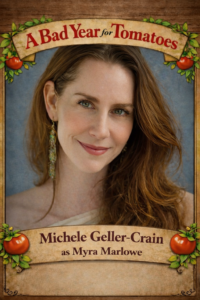
RAPID FIRE WITH A BAD YEAR FOR TOMATOES’ MYRA, MICHELE GELLER-CRAIN
JHPENTERTAINMENT: Myra Marlowe is a star, a recluse, and a walking contradiction — what was the first thing that clicked for you about her

MICHELE GELLER-CRAIN: What first clicked for me was the contradiction at the heart of Myra. She lives under a spotlight she never fully chose, yet all she really wants is control over her own life. I’ve always been somewhat feisty and a people pleaser myself, and I know how easy it is to get lost in the persona you present to the world instead of staying connected to who you really are.

I also tend to attract people who want to take care of me, and Myra does too. There’s something powerful and enjoyable about feeling like the star, as long as you remember to share the stage.

JHPENTERTAINMENT: As Myra (and her assumed identity, Sadie) balance elegance and absolute absurdity in this role — how do you keep Myra grounded while the farce spirals?

MICHELE GELLER-CRAIN: Myra uses humor to stay grounded. Her life is a nonstop cycle of lights, camera, action—parties, paparazzi, scandal, and always answering to someone else. With so little control, her drive for privacy and self-determination is essential. Reclaiming that control and discovering who she really is is the fire that keeps her grounded.

JHPENTERTAINMENT: You’ve directed and taught for years — does leaving those responsibilities to your director feel freeing, challenging, or both?

MICHELE GELLER-CRAIN: It’s both freeing and challenging. I may have a million ideas that I may think are better, but I have to stay in my own lane and remind myself to keep my mouth shut. The fun is in letting go, trusting the director’s vision, and diving fully into the acting—even when every instinct is screaming, “Here’s what I’d do!”

JHPENTERTAINMENT: You play both the glamorous Myra and her very different fictional sister Sadie — how did working with Costuming Consultant Gwendolyn Clinton help you physically and psychologically separate those two women?

MICHELE GELLER-CRAIN: First of all, Gwendolyn is amazing! She gave me some classic notes—like, “Maybe wear pants under that dress,” which, yes, probably should’ve thought of that myself. As for Sadie? Oh, she’s a little mix of all four of my kids, and a sprinkle of the crazy from Brittany Murphy’s character in Don’t Say a Word. Basically, just a hot mess with a lot of heart—and I love playing her. Distinguishing between Myra and Sadie is basically separating the rose from the thorn.

JHPENTERTAINMENT: If Myra were write YOUR autobiography, what do you think she’d focus on that you might rather she leave out?

MICHELE GELLER-CRAIN: I’m pretty much an open book, so I’m not sure there’s anything she could write about that I wouldn’t want her to. I wear my heart on my sleeve, ask questions that are probably none of my business, and love my husband and children with every ounce of my being—let her tell the world on every page!

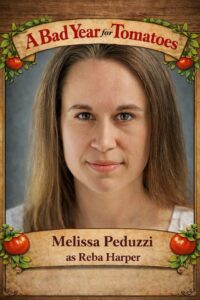
RAPID FIRE WITH A BAD YEAR FOR TOMATOES’ REBA, MELISSA PEDUZZI
JHPENTERTAINMENT: After a 25-year break, what was the moment in rehearsal when you thought, “Oh yeah — this is why I missed this”?

MELISSA PEDUZZI: From the very first read-through, it was like a part of me I didn’t even realize was missing clicked back into place. Being in the room with such a talented cast, hearing them breathe life into this script, and getting to tell the story set in this small town in Beaver Haven was such a gift. Not to get too sentimental, but every rehearsal since has built on that, and I look forward to showing up every night to see what magic is created!

JHPENTERTAINMENT: How do you balance sincerity with comedy within Reba?

MELISSA PEDUZZI: I think sincerity and comedy go hand in hand. The more reality and depth we can bring to these characters, the more the comedy hits. I just try to embody Reba each show and let the absurdity of life be the comedian.

JHPENTERTAINMENT: Tomatoes…fruit OR vegetable?

MELISSA PEDUZZI: Both! Tomatoes belong everywhere for every occasion. They’re too delicious to keep contained in one category.

JHPENTERTAINMENT: This show features some strong female characters, but was written by a man and Playhouse 615’s production is being directed and assistant directed by men. How’s that working out?

MELISSA PEDUZZI: I feel like the actresses in this show have been heard, celebrated, and given so much creative space to make these characters jump off the page and shine. It’s been an incredibly safe and collaborative environment, and I’m grateful to have been part of it!

JHPENTERTAINMENT: If Reba Harper were to give you one piece of life advice, what do you think it would be?

MELISSA PEDUZZI: Always bring your crochet – you never know when you might need to sit a while with someone who needs you, and idle hands are the devil’s handiwork, after all!

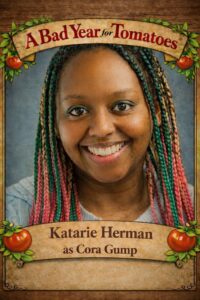
RAPID FIRE WITH A BAD YEAR FOR TOMATOES’ CORA, KATARIE “KAT” HERMAN

JHPENTERTAINMENT: This is your return to the stage after 15 years — what finally pulled you back into theatre?

KATARIE HERMAN: Actually my partner pushed me to do it. She told me that if I love acting so much I should just put myself out there. She inspires me so much.

JHPENTERTAINMENT: Cora Gump has opinions, suspicions, and zero filter — what part of her do you secretly enjoy the most?

KATARIE HERMAN: Cora is definitely ADHD and I love that she just says what comes up in her brain.

JHPENTERTAINMENT: How did it feel jumping into this farce where timing, listening, and reaction are everything?

KATARIE HERMAN: Oh my goodness it’s hectic because there is so much going on and I tend to focus on something new every time. That makes every single rehearsal and run through different so different reactions. It’s fun though.

JHPENTERTAINMENT: Cora spends a lot of time observing — how has Wanderson Rezende’s set design help inform where Cora places herself, what she notices, and how she inserts herself into the action?

KATARIE HERMAN: It’s fun moving around the set and kind of just interacting with everything. I’m always just everywhere so there’s always something new to play with.

JHPENTERTAINMENT: What’s it like sharing scenes with Michele?

KATARIE HERMAN: Working with Michelle has been joyous. I’ve learned so much from her. She leaves me in awe.

RAPID FIRE WITH A BAD YEAR FOR TOMATOES’ DIRECTOR, PRESTON ALEXANDER RAYMER
JHPENTERTAINMENT: IF my research and memory serve me, A Bad Year for Tomatoes hasn’t been seen in Nashville in over a decade since a much-loved production at the now-defunct Chaffin’s Barn Dinner Theatre— what makes now feel like the right moment to bring this farce back to local audiences?

PRESTON ALEXANDER RAYMER: I think it’s a show that everyone can relate to. As humans, we are constantly evolving and embracing whatever “chaos” comes our way, and it’s up to us to decide how we handle it. It makes me think of the Bear Grylls quote, “Improve, Adapt, Overcome”.

JHPENTERTAINMENT: You show bio boldly touts your directing style as blending Constantine Stanislavsky and Uta Hagen techniques — how exactly do those methods show up in a fast, physical comedy like this?

PRESTON ALEXANDER RAYMER: Because in a Comedy, you cannot “play the comedy”. As Uta says, you must play a comedy like a drama, and in order to do that you must find and play your “Objectives, Obstacles, and Actions” (Stanislavsky).

JHPENTERTAINMENT: This is your first show as director at Playhouse 615 — what surprised you most about stepping into that role in this space?

PRESTON ALEXANDER RAYMER: What surprised me the most was the new talent that came out to audition.

JHPENTERTAINMENT: You’ve worked with Playhouse 615 cofounder Joel Meriwether a few times over the last year. As an actor, he directed you in The Haunting of Hill House and you served as his assistant director in two shows. Now he’s your assistant director. How have previous collaborations shaped your approach to directing A Bad Year for Tomatoes and working with Joel with you at the helm of this production?

PRESTON ALEXANDER RAYMER: It helped me to know the “atmosphere” of Playhouse 615 and how they operate.

JHPENTERTAINMENT: If audiences walk away with one thing stuck in their heads after curtain call, what do you hope it is?

PRESTON ALEXANDER RAYMER: I hope they walk away reflecting on the “chaos” in their own life and recognize what things are truly important to them.

—–

A Bad Year for Tomatoes is now on stage at Playhouse 615 (1190 Lebanon Road, Mt. Juliet, TN) and continues through Sunday, February 22. Friday and Saturday evening performances begin at 7:30pm, with Sunday matinees at 2:30pm. Tickets are $17 for Military and Seniors, and $20 for Adults. All seating is General Admision/First Come First Served. CLICK HERE for tickets. For more on the show — and to keep up with what’s next at Playhouse 615, including their upcoming production of The Little Foxes on stage March 20–April 5 — check out their website or follow them on Instagram and Facebook.

As always, if you wanna follow JHPEntertainment to find out who I’m chatting with for my next Rapid Fire Q&A, or for my take on the latest local and national theatre, music and movie offerings, visit JHPENTERTAINMENT.com or find us on Facebook, Insta and Twitter. Till then #GoSeeTheShow!

Filed Under: Entertainment, Rapid Fire 20 Q Tagged With: 2026, A Bad Year for Tomatoes, Playhouse 615

Theatre Review: ‘SIX: the musical’; Henry VIII’s Wives Hold Court and Reign Supreme as National Tour Continues

February 6, 2026 by Jonathan

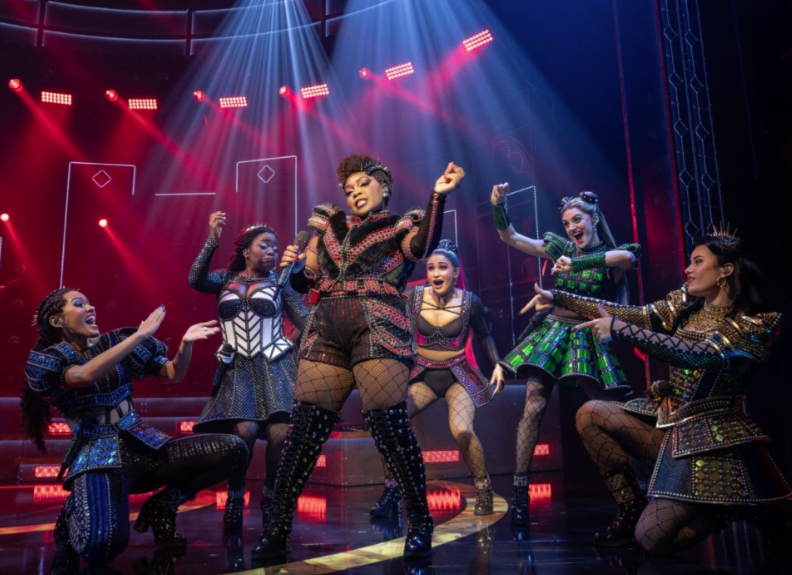
The Queen of ‘SIX’ US National Tour (all photos by Joan Marcus, courtesy SIX on Tour)

As I mentioned in my recent Rapid Fire 20Q with the show’s Alternates the premise of SIX cheekily presents the history—or should I say HERstory—of King Henry VIII’s wives through a modern pop lens. Think: what if the Spice Girls were competing against each other on American Idol, but make it Tudoresque. That’s SIX in a rhinestoned corset, and it knows exactly how ridiculous—and how brilliant—that sounds.

From its opening beat drop to its final glitter-soaked mic pass, SIX wastes no time announcing exactly what it is: a Broadway musical engineered like a pop concert. Now playing Nashville’s TPAC Jackson Hall, the national tour of the Tony-winning hit delivers history as a high-gloss remix—loud, funny, and meticulously attuned to modern pop and R&B influences. Performed without an intermission, SIX unfolds as a 90-minute showdown where heartbreak, harmony, and bass drops battle for supremacy.

Tuesday’s opening night of the Music City tour stop featured all six primary cast members, giving Nashville audiences the full force of the tour’s leading Queens right out of the gate. While it was undeniably thrilling to see the principals in action, I’ll admit to a slight pang of disappointment that none of the four alternates I recently interviewed for the Rapid Fire 20Q were onstage that evening—a very specific kind of theater-nerd heartbreak.

The show kicks off with “Ex-Wives”, an all-in girl-group manifesto disguised as a history lesson, instantly embedding the now-iconic refrain “Divorced, beheaded, died / Divorced, beheaded, survived” into the audience’s collective brain. The Queens emerge in a unified visual language —Tudor corsetry fused with pop-star silhouettes, metallic finishes, studs, and platform boots—each Queen’s attire color-coded yet cohesively styled courtesy costumer Gabriella Slade. Tim Deiling‘s Concert lighting pulses like a stadium opener, making it clear these women are here to headline, not footnote.

Emma Elizabeth Smith (Catherine of Aragon) steps forward first with “No Way”, clad in commanding yellow and gold with accents of black—a direct references to her Spanish roots, the wealth of the Spanish crown, and the opulence of the Catholic Church. The regal palette reinforces Catherine’s authority as the original Queen, while the structured corset and bold detailing give visual weight to her refusal to be dismissed. As Smith belts “I’m not sorry for my honesty,” the look radiates righteousness and resolve.
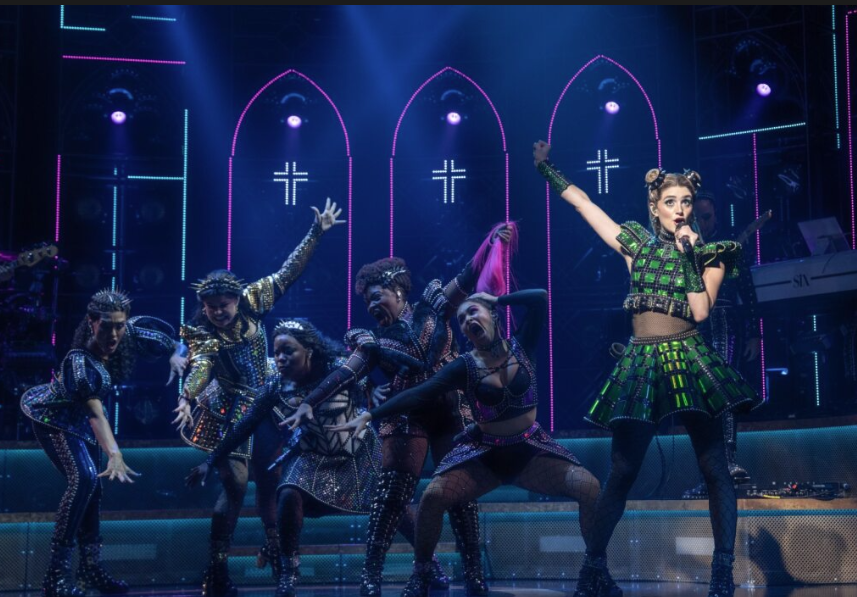
The mood flips into mischievous rebellion with Nella Cole (Anne Boleyn) and “Don’t Lose Ur Head”. Draped in unmistakable green, Boleyn’s costume offers an obvious nod to “Greensleeves”, despite the enduring myth that Henry VIII wrote it for her—a bit of historical irony the show knowingly side-eyes. Punk-pop detailing and playful asymmetry reinforce Anne’s flirtatious chaos. It’s bubblegum pop as survival tactic—a little Katy Perry, but with the very real threat of the axe.

The evening’s emotional pivot arrives with Kelly Denice Taylor (Jane Seymour) and “Heart of Stone”. Her corseted white costume trimmed in black, complete with sleeves and skirt panels reminiscent of chainmaille armor, signals purity without fragility and strength without aggression. The design quietly reinforces Seymour’s emotional fortitude as Taylor laments “Soon I’ll have to go / I’ll never see him grow,” allowing stillness and restraint to become some of the most powerful choices of the night.

Before the competition resumes, SIX detonates into full high-camp absurdity with another all-in. “Haus of Holbein”, with its neon accents, blacklight, exaggerated silhouettes, and stylized poses turn the stage into a Renaissance runway on rave mode. Sonically, the number leans hard into Madonna’s club-era maximalism, evoking the relentless pulse and fashion-as-performance-art ethos of “Ray of Light”–era remixes (with a little SNL‘s Dieter accent exaggeration thrown in)—less spiritual awakening, more high-fashion satire. It’s ridiculous, deliberate, and exactly the reset the show needs.

Swagger floods the stage with Hailey Alexis Lewis (Anna of Cleves) and “Get Down”. Dressed in unapologetic red, Cleves’ costume signals defiance—she is, after all, one of only two wives to divorce Henry and live. Rolled fabric at the shoulders cleverly references her infamous portrait, reframed here as armor rather than flaw. The Euro-pop anthem pulls heavily from Atlanta trap-pop energy, particularly the minimalist bounce and swagger-forward attitude that put me in mindof Beyoncé’s “7/11”. When Lewis declares “I’m the Queen of the castle, Get down you dirty rascal,” the lyric lands as deserved prophecy, not threat.

There’s an interesting shift in tone with Alizé Cruz (Katherine Howard) and “All You Wanna Do”. Her pink-and-black costume reflects youthful vitality layered with looming danger—the sweetness of pink undercut (no pun intended) by the severity of black. What begins flirtatious quickly curdles as the repetition of “All you wanna do, baby” exposes the song’s darker truth. As the lighting cools and the meaning sharpens, the visual contrast underscores just how trapped Howard truly is. It’s Britney‘s “Womanizer”, sing-songy and fun, but if the aggressor had access to the guillotine.

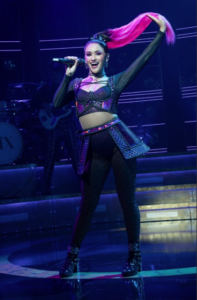
The competition’s final turn belongs to Tasia Jungbauer (Catherine Parr), who reframes the entire premise (what are they competing? Who would even remember Henry were it not for them?) with “I Don’t Need Your Love”. Wearing black and blue, and notably incorporating pants, Parr’s look subtly nods to shifting fashions centuries after her lifetime while underscoring her independence as the Queen who survived. Clean lines and minimal ornamentation allow Catherine to declare “I don’t need your love / I just need to tell my story”.

When the Queens reunite for “Six,” individuality gives way to collective power. Costume reveals heighten each look—more shimmer, more shine—while maintaining the shared design language that has bound them from the start. Concert lighting, synchronized choreography, and wall-of-sound harmonies transform the finale into a euphoric pop encore rather than a winner-take-all ending.

Anchoring the entire experience and elevating Toby Marlow and Lucy Moss‘ clever score and pop lingo-filled lyrics is the onstage band, The Ladies in Waiting, who are far more than musical accompaniment. Tuesday’s opening night performance was conducted by Lizzie Webb, whose steady leadership kept the score’s pop precision razor-sharp. Music Director and Keyboardist Valerie Maze drives the sound, supported by Yonit Spiegelman on bass, Rose Laguana on guitars, and Camila Mennitte Pereyra on drums. Visually, their sleek black styling mirrors the Queens’ aesthetic, reinforcing the concert vibe while keeping the spotlight exactly where it belongs.

SIX doesn’t aim for subtlety—it thrives on impact. Pop culture becomes narrative shorthand, feminism arrives wrapped in corsets, combat boots, and beats you can feel in your chest, with a message you can feel in your heart as HERstory becomes a remix. SIX proves once again that this show isn’t just clever—it’s culturally fluent. Long live the Queens!

At TPAC, though Sunday February 8 as the national tour continues, CLICK HERE to purchase tickets. Not in Nashville? No problem. You can catch these royals as their empowering processional continues its U.S. takeover with upcoming tour stops in Fort Worth, Los Angeles and a couple dozen more cities as the National Tour continues through early 2027. CLICK HERE for the full tour schedule or follow SIX on Facebook, X, YouTube, Instagram & TikTok. 

Following SIX, next up at TPAC, it’s SUFFS: The Musical with shows March 3 thru 8. CLICK HERE for more info and follow TPAC on Facebook, Instagram, YouTube & TikTok. 

As always, if you wanna follow JHPEntertainment to find out who I’m chatting with for my next Rapid Fire Q&A, or for my take on the latest local and national theatre, music and movie offerings, visit JHPENTERTAINMENT.com or find us on Facebook, Insta and Twitter.

 JHPEntertainment.com
(Facebook, Instagram, Twitter)

Filed Under: Entertainment, Theatre Review Tagged With: 2026, Broadway, Broadway at TPAC, Musical, National Tour, Six, TPAC

Rapid Fire 20Q with the Storytellers of ‘Big Fish’; on stage at The Keeton February 6-22

February 5, 2026 by Jonathan

Few musicals capture the space between truth and imagination quite like BIG FISH, the 2014 Drama Desk–nominated musical by Andrew Lippa with a book by John August. Based on Daniel Wallace’s novel Big Fish: A Novel of Mythic Proportions and the 2003 film written by John August and directed by Tim Burton, the story explores the myths we create, the legacies we leave behind, and the love that binds families together.

Now swimming onto the stage at The Keeton beginning Friday, February 6, Big Fish blends soaring music, theatrical spectacle, and deeply human storytelling as it follows Edward Bloom — a man whose life is told through towering tales — and his son Will, who must learn how to listen beyond facts to understand the heart of his father’s stories. JHPENTERTAINMENT sat down with the artists bringing this mythic journey to life for a Rapid Fire 20Q conversation about imagination, family, and the power of storytelling.

RAPID FIRE 20Q WITH CAST AND DIRECTOR OF THE KEETON’s BIG FISH

RAPID FIRE WITH MICHAEL WALLEY, EDWARD BLOOM IN BIG FISH

JHPENTERTAINMENT: Edward Bloom is a man of myth, magic, and tall tales—what excited you most about stepping into his larger-than-life shoes?

MICHEAL WALLEY: The music of BIG FISH is absolutely gorgeous. This past fall, I was driving when Fight the Dragons came on the SiriusXM Broadway channel, and it completely stopped me in my tracks. I already knew BIG FISH was in The Keeton’s season, and I made plans to audition immediately. I’d describe myself as more of an “actor who sings” than a traditional vocalist, and Edward’s music stretches across haunting ballads, twangy pop, and everything in between. Bringing his character to life through that musical range has been both thrilling and demanding. Truthfully, I feel like I’ve been training for a marathon. My hope is that through every note, Edward’s larger-than-life heart and spirit come through loud and clear.

JHPENTERTAINMENT: A quick perusal of your theatre credits reveals your previous Keeton roles as Singin’ in the Rain’s Cosmo Brown and White Christmas’ Phil Davis share the common thread of being the comic foil to those show’s leading men—what sets Edward apart from roles you’ve played before?

MICHEAL WALLEY: At the end of our run of Singin’ in the Rain, my good friend Matthew Roberts, who played Don Lockwood, said something like, “I think you need the chance to play a leading man with some substance.” While I absolutely loved playing comic sidekicks like Phil and Cosmo (and I’d happily play either role again! Hint hint to any theatre company who needs a comic-dancer-goofball), Edward’s journey is overflowing with depth and meaning. I still get the chance to make ’em laugh, but this time I also get to take The Keeton audience on a much deeper emotional journey. Truly, I’ve never played a character anything like Edward.

JHPENTERTAINMENT: Edward’s stories often say more about love than facts. What do you think Edward is really trying to pass on?

MICHEAL WALLEY: Without giving too much away, a character near the end of the show realizes that Edward’s tall tales were always meant to inspire. I grew up in a small town in Mississippi, much like Edward’s Alabama hometown, and I always had this sense that there was something bigger out there. I wasn’t satisfied unless I was chasing it, and even now, in my 30s, that feeling hasn’t gone away. Edward is the same because he’s always chasing the next big dream, and his stories become a way to invite others into that sense of possibility. Facts may fade (and we live in 2026, does anyone really care about facts?), but inspiration is what lasts.

JHPENTERTAINMENT: As a writer, puppeteer, and voiceover artist, how have your many creative hats informed your approach to this role?

MICHEAL WALLEY: This role has flexed creative muscles I didn’t even know I had. I get to play Edward at multiple stages of his life, moving from wide-eyed teenage heartthrob to cranky old man. Jumping between different voices, physicality, and energy levels is something all my creative side-quests have really prepared me for. It also helped me better understand what John August was trying to convey. Edward evolves throughout his life, but his spirit stays consistent even as his body and circumstances change.

JHPENTERTAINMENT: If Edward Bloom were telling your life story, what detail would he absolutely exaggerate?

MICHEAL WALLEY: First of all, I’m 100% positive Edward would describe me as six-foot tall, wildly muscular, rich enough to buy a tall-and-skinny in 12 South, and effortlessly hitting every high note in Andrew Lippa’s score. But for real, I like to think he’d tell the story of a small-town Mississippi boy who loved theatre, set it aside during college and early adulthood to focus on what mattered, and then realized in his late 20s that his dreams and passions really mattered too. He’d talk about Micheal jumping into the Nashville theatre scene, making meaningful art, building lasting relationships, and getting to tell stories that truly matter, like Edward Bloom’s.

RAPID FIRE WITH CLAIRE YANCEY, SANDRA BLOOM IN BIG FISH
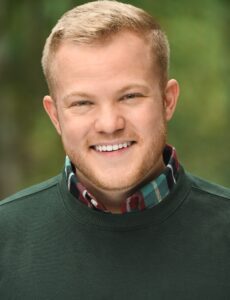
JHPENTERTAINMENT: This marks your Keeton debut—what made Big Fish the perfect first dive into this community?

CLAIRE YANCEY: The Keeton has been such a positive space from day one. Even at auditions, I felt immediately welcomed and comfortable, and it was clear how much heart and dedication everyone brings to make this not only a great production but a great experience for everyone involved. I feel deeply connected to this cast and genuinely look forward to coming to the Keeton for every rehearsal. This community has welcomed me with open arms, and I could not have asked for a better first show at this theatre.

JHPENTERTAINMENT: With a background in classical piano and voice, how does Lippa’s score speak to you as a musician?

CLAIRE YANCEY: As a musician, learning Lippa’s score has been one of my favorite parts of this process. There is something really special about working through the more intricate and challenging moments of the music together as a cast and watching it all click. Hearing songs you have listened to countless times come to life in the room with the people around you is incredibly satisfying. I love the rich harmonies and the wide range of musical styles throughout the show, which makes the score both exciting and deeply rewarding to perform.

JHPENTERTAINMENT: What’s one moment in the show where you feel Sandra’s heart most clearly?

CLAIRE YANCEY: This may feel like an obvious answer, but it is definitely during I Don’t Need a Roof. This is the moment where Sandra is seen most clearly and vulnerably. Throughout the show, she works hard to be strong for Edward and their family, often hiding how deeply his illness is affecting her.

JHPENTERTAINMENT: Sandra’s love story spans a lifetime—what do you find most beautiful about her journey?

CLAIRE YANCEY: From the very first moment they see each other, there is something magical about the way Sandra and Edward recognize something special in one another. Throughout the show, you can see that their relationship never loses its youthful spirit, even as the magic and adventure settle into the reality of growing old together. They remain deeply in love, still carrying that sense of playfulness and joy with each other.

JHPENTERTAINMENT: Sandra is the emotional anchor of Edward’s wild imagination. How do you ground her while still letting the magic exist?

CLAIRE YANCEY: I think Sandra is grounded because she is fully present and deeply attentive to the people she loves. She allows Edward, with his wild imagination, and Will, who is more grounded, to be fully themselves. Sandra has a beautiful ability to meet people exactly where they are and offer them steady love and support. While she still carries that same sense of wonder and adventure that connects her to Edward, she is also able to see the world clearly and hold space for both perspectives.

RAPID FIRE WITH JACOB HINNEN, WILL BLOOM IN BIG FISH

JHPENTERTAINMENT: Will Bloom is caught between frustration and wonder—what’s been the biggest challenge in telling his story?

JACOB HINNEN: The biggest challenge has been living in the tension between frustration and hope, especially as Will wrestles with what it means to be a father himself. He’s demanding truth from Edward, but underneath that is a deep need to understand the man behind the stories before he becomes a father himself. That tension drives every interaction. Hope is always present, but it’s tested, stretched, and reshaped as Will tries to reconcile who his father is with who he needs to be.

JHPENTERTAINMENT: You’ve played romantic leads and comedic roles—how does Will stretch you differently as a performer?

JACOB HINNEN: Playing Will stretches me differently because his confidence is paired with constant questioning. Unlike roles where the character’s path is clear or emotions are outwardly expressed, Will is always wrestling with what it means to be a son and a future father. I’ve had to channel that drive, balancing certainty with curiosity, so the audience can feel both his boldness and the weight of his internal journey.

JHPENTERTAINMENT: The father–son relationship is the emotional spine of BIG FISH. What has portraying Will taught you about listening?

JACOB HINNEN: Will has taught me that listening isn’t just about extracting answers and simply responding; it’s about recognizing intention. Edward is telling the truth in his own way, and Will has to learn that fatherhood isn’t always taught through facts, but through meaning. Playing this role has reminded me that listening sometimes means setting aside your expectations long enough to hear what someone is really trying to convey.

JHPENTERTAINMENT: This performance is dedicated to your dad. How does that personal connection shape the way you step onstage each night?

JACOB HINNEN: My dad always believed in me, even when we didn’t fully understand each other. I carry his presence with me onstage, feeling the push and pull of tension, hope, and love in every moment. It’s shaped how I tell this story: a story of love conquering death, of listening to understand rather than listening to simply respond, and of never giving up hope. Every night, stepping into Will’s shoes feels like honoring him while exploring what it truly means to be a son and eventually, a father.

JHPENTERTAINMENT: If Will could rewrite one of Edward’s stories, which moment would he finally see differently?

JACOB HINNEN: Will wouldn’t change the events themselves; he’d change the way he sees them. He’d recognize that Edward’s stories weren’t just embellishments, but expressions of love, courage, adventure and guidance. They were a father’s way of teaching him how to live fully, love boldly, and carry hope even in uncertainty. 

RAPID FIRE WITH AARON GRAY, DIRECTOR OF BIG FISH
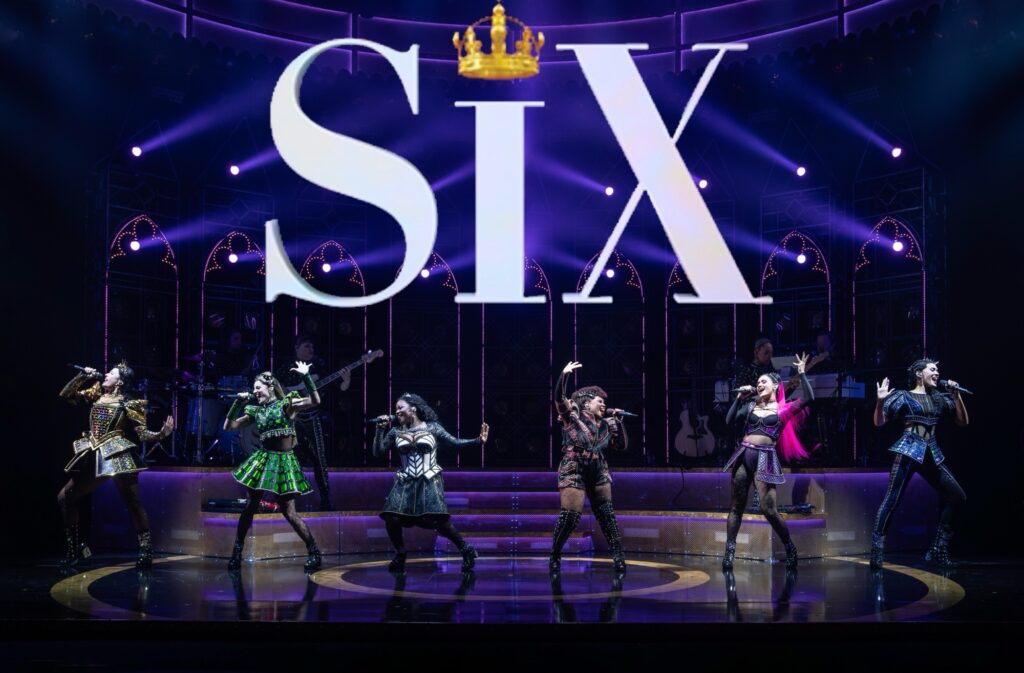
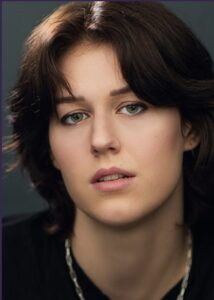
JHPENTERTAINMENT: What was the very first image or moment from BIG FISH that made you say, “I have to direct this show”?

AARON GRAY: The first time I saw BIG FISH, there were several moments that brought me to that realization, but they all came back to the father–son relationship at the heart of the show. As a father of a six year old son, that dynamic hit me in a very immediate way, especially the moment when Will realizes he’s about to become a father himself, and suddenly his relationship with his own dad begins to change. That felt incredibly honest and personal to me.
 
I was also deeply moved by the love story. The way Edward loves Sandra, with imagination, devotion, and unwavering certainty, is something I think every romantic partnership should strive for. It’s romantic, but it’s also rooted in commitment and choice.
What ultimately made me say I had to direct this show is that it truly has everything! Romance, comedy, drama, and moments of theatrical magic, but at its core, it’s just a beautifully told story about family, love, and how we come to understand one another.
 
JHPENTERTAINMENT: BIG FISH lives in the space between reality and imagination—how did you approach balancing spectacle with emotional truth onstage?
 
AARON GRAY: The magic in BIG FISH only works if it’s grounded in emotional truth. We always let the relationships lead, and allowed the spectacle to grow out of what the characters are feeling, rather than the other way around.
 
JHPENTERTAINMENT: What can you tell me about your creative discussions with Ian Mannino, this production’s musical director, in regard to bringing Andrew Lippa’s whimsical score to life?
 
AARON GRAY: John August includes a note to the director in the script that points to a video Andrew Lippa created, where he dives deeply into the score,  showing how the songs function dramatically and emotionally. Having that level of insight directly from the composer was an incredible resource, and it became a foundational tool in my conversations with Ian. 
 
From there, our discussions were really grounded in respect for Andrew Lippa’s writing. Our shared goal was to keep the music true and honest to what he wrote. The score already contains so much whimsy, warmth, and emotional clarity that we never felt the need to overcomplicate it. Instead, Ian focused on letting the music breathe and supporting the storytelling, while I concentrated on how the songs live inside the characters and the moment.
 
What emerged from that collaboration is a score that feels both playful and deeply sincere. When the music is treated with that kind of care, its beauty really speaks for itself, and it becomes a powerful emotional guide for the audience throughout the show.
 
JHPENTERTAINMENT: In your show bio you describe this as a dream project. What part of your own storytelling sensibility feels most at home in BIG FISH?
 
AARON GRAY: At its heart, BIG FISH asks two questions that feel very personal to me: “What makes a good father?” and “How do heroes live on?” As a father, I connect deeply to the first question. The show shows us that being a good father isn’t about perfection, it’s about listening, showing up, and creating a space where your children can grow into themselves. Watching Will navigate his relationship with Edward while stepping into fatherhood himself felt incredibly real to me, and it’s a story I wanted to bring to life onstage.
 
The second theme, how heroes live on, is really about memory and storytelling. Edward becomes a hero not because he’s flawless, but because of the way his stories shape Will’s understanding of him and, in turn, the person Will becomes. That idea, that our loved ones live on through the stories we carry, is central to the show, and it resonates deeply with my own sense of storytelling. I’ve always been drawn to stories that exist somewhere between reality and imagination, where emotion comes first and spectacle serves the heart of the story.
 
For me, BIG FISH perfectly blends those elements: family, love, myth, and imagination. It allows wonder and sincerity to coexist, and that balance is exactly why it feels like a dream project, it’s a story that is both fantastical and deeply human, and it’s a story I truly love. 
 
JHPENTERTAINMENT: What do you hope audiences carry with them long after they leave The Keeton and the curtain comes down on BIG FISH?
 
AARON GRAY: I hope audiences leave remembering the power of storytelling and the people they love. Big Fish reminds us that family and connection aren’t perfect, but they’re profound, and that our stories keep those we care about alive. I want them to feel the magic, the wonder, and the joy in seeing life, and love, through a lens of imagination, and to carry that feeling with them long after they leave the theatre. 

BIG FISH opens at The Keeton on Friday, February 6 and continues through Sunday, February 22. Thursday performances are show only with Doors at 6:30pm and Show at 7pm. Friday & Saturday Doors at 5:45pm/Dinner at 6pm and Show at 7pm. Sunday matinee Doors at 12:45pm/Meal at 1pm and Show at 2pm. Show Only Tickets: $30.00 (Thursday performances), Adult Dinner and Show: $40.00, Child Dinner and Show: $35.00. CLICK HERE for tickets. 

Following BIG FISH, The Keeton will present The Play That Goes Wrong with performances April 10-26. So you don’t miss out on upcoming shows at The Keeton Dinner Theatre, follow them on Facebook, X and Instagram.

Interested in coverage for your latest entertaining endeavor? Click the contact page and drop me a note. You can also follow JHP Entertainment on Instagram and Facebook. In the meantime, #GoSeeTheShow!


Filed Under: Entertainment, Rapid Fire 20 Q, Theare Tagged With: Big Fish, Interview, Live Performance, live theatre, Music CIty, Musical, Musical Theatre, Nashville, Nashville Theatre, Rapid Fire, Rapid Fire 20 Q, The Keeton, The Larry Keeton Dinner Theatre

Rapid Fire 20Q with SIX MUSICAL’s Four Alternate Queens; National Tour at TPAC February 3 thru 8

February 3, 2026 by Jonathan

It’s been almost three years to the date since Music City theatre goers were first privy to experience a live audience with the Queens of SIX, the two-time Tony-winning musical that explores the stories of the women behind that morbidly fun sing-songy rhyme “Divorced, Beheaded, Died, Divorced, Beheaded, Survived”. As of Tuesday, February 3, that all changes as the Queens return to Nashville to hold court at Tennessee Performing Arts Center’s Andrew Jackson Hall with eight performances the through Sunday, February 8. 

As expected, an audience with the Queen is an almost impossible task, let alone six of them, and let’s face it—without the use of a guillotine, 20 Questions don’t exactly divide by six evenly, so rather than interviewing the leads, I had the unique opportunity to chat with four members of the royal court known as The Alternates (more about that below in my first question) as the regal company of SIX prepared for their Music City reign.

——-

RAPID FIRE 20Q WITH SIX’s FOUR ALTERNATE QUEENS 

RAPID FIRE WITH SIX ALTERNATE REESE CAMERON

JHPENTERTAINMENT: To start, while I’m pretty certain I know, for those who might not, What’s the basic difference between an alternate, understudy, swing and standby?

REESE CAMERON: An “alternate” is typically an on or off-stage cast member who will have weekly guaranteed performances to take over for a principal role— usually one that is very physically or vocally demanding (e.g. Tina Turner, Elphaba, Fanny Brice every Thursday is played by an “Alternate”). But in the SIX world, an Alternate means an off-stage cast member who understudies 3-4 Queens (our union caps us at 4 in the U.S., anywhere from 3-6 in the U.K. and elsewhere) The reasoning behind making us called “Alternates” instead of “Standbys” “Swings” or “Understudies” was because the team wanted us to feel just as important as our on-stage Queens. They emphasized that the reason we are off-stage is not because we are inferior or less talented, but rather that we have the capability of playing 1 or more On-stage Queens if we wanted to, therefore they wanted to give us a title with more respect. Oftentimes understudies, swings, and standbys are not given the same treatment or careful attention as onstage cast members and that’s something we’re constantly fighting for more rights about with other shows.

Understudies are on-stage cast members who play a character every night and also cover a principal role

Swings are typically off-stage members who cover several or all of the ensemble members — sometimes divided by gender and sometimes not. Swings can also be on-stage but it’s far more rare, usually because two of the swings are Dance Captain and Assistant Dance Captain and need to watch the show every week to note it and make sure the choreography upholds the integrity of the choreographer. 

Standby’s are hired to be specifically off-stage but ready at a moments notice to go on for a principal role. I like to call standby’s the principal swings haha. If a principal calls out of a show, either the standby or the understudy will go on. It depends on the show which one is chosen.

JHPENTERTAINMENT: A quick perusal of your socials in preparation of our chat revealed you debuted as three of the queens within three weeks of each other— whose boots were the hardest to step into that first time?

REESE CAMERON: The hardest was most definitely Aragon because I learned her 2nd. I had a month of rehearsals with Cleves, 2-3 weeks with Boleyn, and only 5 days with Aragon and she has the most lines in the show and fires out of a cannon with her aerobic song and dance number right after an exciting and dynamic almost 6 minute opening of Ex-Wives which is a huge challenge of stamina. 

JHPENTERTAINMENT: What has been the most gratifying aspect of tackling these roles on tour?

REESE CAMERON: I am simply so proud of myself and my Alternate family for having the mental professionalism and preparedness required to memorize 3 different principal characters for an 80 minute non-stop show. There is no time to check your notes for the next number like a swing might be able to do with a few song and dance numbers in between their next onstage moment, but for us? This 80 minute train doesn’t stop. And being prepared and CONFIDENT is such a huge accomplishment not just for 1 Queen, but for 3!!! I’ve loved playing 3 completely different characters and have unlocked parts of myself and my inner child that I have never gotten before with any other show.

JHPENTERTAINMENT: Which do you admire most? Aragon’s power or Cleves’ confidence?

REESE CAMERON: Aragon’s power for sure! Cleve’s confidence is something I definitely need and aspire to have, but Aragon historically endured starvation and abuse from Henry’s father even before her marriage to Henry the VIII, and then after 24 years of marriage when Henry cheated on her, she had the strength to do what no woman at this time had ever done which was 1) speak in court 2) make her own court case and 3) represent herself in court against his misinterpretation and manipulation of Biblical word to prove the marriage was just and 4) WIN! And even after he abusively sends her away and separates her from her daughter, she remained emotionally strong, devoted to justice, a role model for the people of England, and remained the beloved Queen for many decades after her death. She endured some of the hardest trials and tribulations a person can go through and she did it with grace. I highly recommend reading more about her life. Aragon is a powerhouse of a human being and an outstanding woman.

JHPENTERTAINMENT: As a non-binary performer, what would you say to the queer kid sitting in the balcony?

REESE CAMERON: As I say in my bio “to the queer non-binary kid in the audience: you belong here”. In a hateful and divisive world, trans children need to know they have an accepting and loving family in the theatre community and especially in major cities like New York and LA. Trans actors belong in theatre, tv, and film just as much as cis actors. Theatre is a safe space for queer and trans people and there are so many roles and opportunities to be had in our industry that don’t require you to change yourself in order to fit into a show or a role. Theatre does not have to be gender dysphoric. My biggest recommendation is that trans and queer people start writing our own stories and musicals and films and TV shows and share it with the world because there are so many people who don’t know that they are queer or trans yet that watch media on Netflix and Spotify and go to see a Broadway show, and that may be the moment that they find themselves and discover who they are.  Just look at how The L Word became a Sapphic Bible, or how Heated Rivalry is opening doors for athletes to come out or even for their stories to be heard. Trans and queer media changes the world and spreads love and Empathy. We need more trans and queer media. 

RAPID FIRE WITH SIX ALTERNATE & DANCE CAPTAIN CARLINA PARKER

JHPENTERTAINMENT: You’re not only a performer in SIX, but also the tour’s Dance Captain. What does that added responsibility entail?

CARLINA PARKER:  As Dance Captain, it’s my job to be a point person for choreography team while we’re on tour. I watch the show once or twice a week  and write notes to make sure both the movements and the story behind them are being executed. I’m also available should anyone have any questions or concerns. We have an amazing choreography team based in New York that I’m in constant communication with, and the original choreographer will even pop in from London from time to time!

JHPENTERTAINMENT: Of the SIX, only one survived King Henry VIII. How would you describe Catherine Parr’s energy as portrayed in the musical in six words?

CARLINA PARKER: Honest, Kind, Intelligent, Empathetic, Inspiring, Powerful.

JHPENTERTAINMENT: SIX is resplendent with clever lyrics courtesy Book and Music collaborators Toby Marlow & Lucy Moss. What’s among your personal favorites?

CARLINA PARKER: Some of the script is written how some people text, and the audience would never know, but there’s one Parr line that’s written “R U 4 real?”and it’s SO funny. Also, “Okay ladies, lets get in reformation” -Cleves

JHPENTERTAINMENT: Touring perk you didn’t expect to love?

CARLINA PARKER: I expected to love the travel, I expected to love meeting the different fans from all over, but what surprised me is probably really silly. Since we don’t always have kitchens, I never have to feel guilty for ordering DoorDash.

JHPENTERTAINMENT: Beyond the inherent closeness of a touring company, have you also developed an extra bond with your fellow alternates?

CARLINA PARKER: Yes! Arguably, the alternates are spending the most time together, between weekly rehearsals and (more often than not) sharing a dressing room with each other. The support you get from another alt is unmatched. We all know the joys and struggles of being an offstage cover in this show, covering multiple Queens, and we can be there for each other in the highs and the lows. It’s also so nice that we get along. I adopted the term “swing siblings” from another contract of mine, and it couldn’t be more true.

RAPID FIRE WITH SIX ALTERNATE ANNA HERTEL

JHPENTERTAINMENT: National Tour debut…how does that feel?

ANNA HERTEL: This tour is an absolute BLESSING! It truly feels like a pinch-me moment—this is my dream show, and getting to tell this story around the country is such a gift. I’m also so grateful for the opportunity to explore so many incredible cities along the way. 

JHPENTERTAINMENT: Is it just me? Or does Boleyn’s costume include a couple Easter eggs in its design? I mean…the neckline has what looks like a dotted line, as in ‘cut here’. Is that a reference to her demise by way of beheading or am I just overthinking it? AND…What’s your personal favorite detail in costumer Gabriella Slade ‘s Tony-winning creations?

ANNA HERTEL: There are so many Easter eggs woven into Anne Boleyn’s costume. My favorite is her iconic “B” necklace, symbolizing her pride in her family name. She wore it openly in court—something no woman had ever done at the time. After her execution, the “B” became a powerful symbol of strength, defiance, and legacy. I also love how Gabriella Slade incorporated Anne’s green sleeves into the design, a subtle nod to a love poem Henry VIII once wrote for her.

JHPENTERTAINMENT: You’re a Jimmy Awards Best Dancer honoree— how much did it mean to you to be honored for your talent in high school AND did that shape the way you approach each role in the time since?

ANNA HERTEL: The Jimmy Awards will always be one of the most meaningful moments in my career. Being able to perform on a Broadway stage alongside so many passionate, aspiring artists was truly unforgettable. The relationships I formed that week are still thriving, and I’m constantly reminded of how supportive and uplifting that community is. That experience gave me the confidence, perspective, and tools I needed to continue chasing this dream.

JHPENTERTAINMENT: Researching to pose questions to you and your cast mates, I discovered you’re a bit of a newlywed, and will be celebrating your wedding anniversary in a few months. Your husband has come to see you on tour a few times, right? What’s been the most challenging aspect of touring while simultaneously starting such an exciting chapter in your personal life?

ANNA HERTEL: My husband, Brendan Coulter, is truly the biggest blessing in my life. We’ll be celebrating our 2-year wedding anniversary on March 23rd, and I’m feeling extra grateful reflecting on our journey. We met in college at Elon University studying Musical Theatre, and not long after, moved to NYC to chase our shared love for performance.

A year later, we became an acoustic duo called Honey I Duo, performing all around Manhattan — some of my favorite memories. He has been the most supportive husband throughout this tour (and has seen the show 10 times already). Long distance was hard at first, but then he joined the tour, working remotely and pouring his heart into writing his own music.

His music is truly incredible and is out now on all platforms — go listen.

JHPENTERTAINMENT: What’s one word that defines SIX for you?

ANNA HERTEL: ELECTRIC!

RAPID FIRE WITH SIX ALTERNATE ABIGAIL SPARROW

JHPENTERTAINMENT: First time I heard about SIX was from friends who saw it during its pre-Broadway trial run aboard a cruise ship.  My research in anticipation of chatting with you and your costars revealed you first performed in SIX on the high seas as Katherine Howard in Norwegian Cruise Line’s production of SIX aboard the Breakaway luxury ship — so, I gotta know — performing a Broadway musical at sea — wild or wonderful?

ABIGAIL SPARROW: You’ve done your research! It was BOTH: wild AND wonderful. Working on SIX with Norwegian was my first professional job straight out of college. I learned a LOT about being a working professional actor and there was absolutely a learning curve of living on a floating vessel for 9 months. Doing performances on a rocky boat during the stormy weather patches was certainly an experience I will not forget, haha. I met some of my closest friends to this day on that cruise ship, and am very grateful that I have been able to stay in the SIX family for years to follow.

JHPENTERTAINMENT: After seeing SIX for the first time a couple of years ago during the first national tour, I described it as American Idol meets Spice Girls meets The Tudors. Fair assessment? AND How do you describe it?

ABIGAIL SPARROW: You’re definitely hitting the nail on the head with that assessment, totally! I’d add a little bit of K-POP flair into that description too, for my two cents. It’s certainly not your average Broadway musical, that’s for sure. A 90 minute high energy pop concert with killer costumes, lighting, and choreography that everyone is sure to enjoy no matter their background or connection to Tudor history.

JHPENTERTAINMENT: In addition to your current SIX responsibilities, you’re also working an album — what can you tell me about that?

ABIGAIL SPARROW: Thank you for asking! Yes, I am currently working on my first full length album set for release in Fall 2026. Back in March of 2025 I was incredibly honored to be awarded a $30,000 dollar grant from the Posthumous Prodigy Productions Fellowship for the album. Being on the road has allowed me lots of free time to write music and work with different producers across the country. Actually, I’m meeting with a producer right here in Nashville, the Music City! Which felt very fitting. I’m very excited to share it with the world this year. I also recently released my first EP on December 5th, 2025 called Jacaranda Trees. My music style is indie pop, think Muna meets Gracie Abrams meets The 1975. My music is available on all streaming platforms! I hope you check it out. 

JHPENTERTAINMENT: Since you have a bit of history with her — Katherine Howard — misunderstood or simply iconic?

ABIGAIL SPARROW: Oh, K Howie. Certainly misunderstood, and definitely iconic. The real Katherine Howard was known as the most promiscuous Queen back in her day, which feels like an unfair assessment given she was only 13 when the King took notice of her (ew). Her story is very reminiscent of the victim blaming stories of the modern day, where we look for errors in the victim rather than condemn the perpetrators of abuse and violence towards them. Of course we will never know for certain without asking her directly, but I feel she never had ill intentions towards the people she was involved with, and was taken advantage of by much older and more powerful men. In our show, Katherine takes back her power and changes the narrative to prove her intelligence and strength in her femininity. Which I definitely would say is… simply iconic. 

JHPENTERTAINMENT: What do you hope audiences take with them after seeing the show for the first time?

ABIGAIL SPARROW: I hope that audiences leave with a new sense of empowerment to stand up to the Henry‘s in their own lives! We all have come across someone who has tried their hardest to make us small and powerless. And we all need to find that power within ourselves to rise up and fight back against those people. I hope people leave feeling inspired, and perhaps humming our songs on the way home with a little extra pep in their step. 

——-

Whether they’re commanding the stage or waiting to rule from just offstage, these four Alternates prove that SIX isn’t just about crowns and costumes—it’s about resilience, community, and unapologetic power. Their own stories add yet another layer to an already exhilarating night at the theatre, reminding us that every Queen has a voice, whether they’re front and center or just off-stage ready to step into a regal role. Catch SIX as it storms back into Nashville at TPAC’s Andrew Jackson Hall Tuesday through Sunday, February 3-8, and come ready to cheer, sing along, and maybe leave feeling a little more emboldened than when you arrived. After all, these Queens aren’t loosing heads, they’re dropping mics! CLICK HERE to purchase tickets. Not in Nashville? No problem. You can catch these royals as their empowering processional continues its U.S. takeover with upcoming tour stops in Fort Worth, Los Angeles and a couple dozen more cities as the National Tour continues through early 2027. CLICK HERE for the full tour schedule or follow SIX on Facebook, X, YouTube, Instagram & TikTok. 

Following SIX, next up at TPAC, it’s SUFFS: The Musical with shows March 3 thru 8. CLICK HERE for more info and follow TPAC on Facebook, Instagram, YouTube & TikTok. 

As always, if you wanna follow JHPEntertainment to find out who I’m chatting with for my next Rapid Fire Q&A, or for my take on the latest local and national theatre, music and movie offerings, visit JHPENTERTAINMENT.com or find us on Facebook, Insta and Twitter.


Filed Under: Entertainment, Rapid Fire 20 Q, Theare, Uncategorized Tagged With: 2026, Broadway at TPAC, Broadway Tour, Celebrity Interview, Interview, Live Performance, live theatre, Music CIty, Musical, Musical Theatre, Nashville, National Tour, Q&A, Rapid Fire 20 Q, Six

Copyright © 2026 · News Pro on Genesis Framework · WordPress · Log in