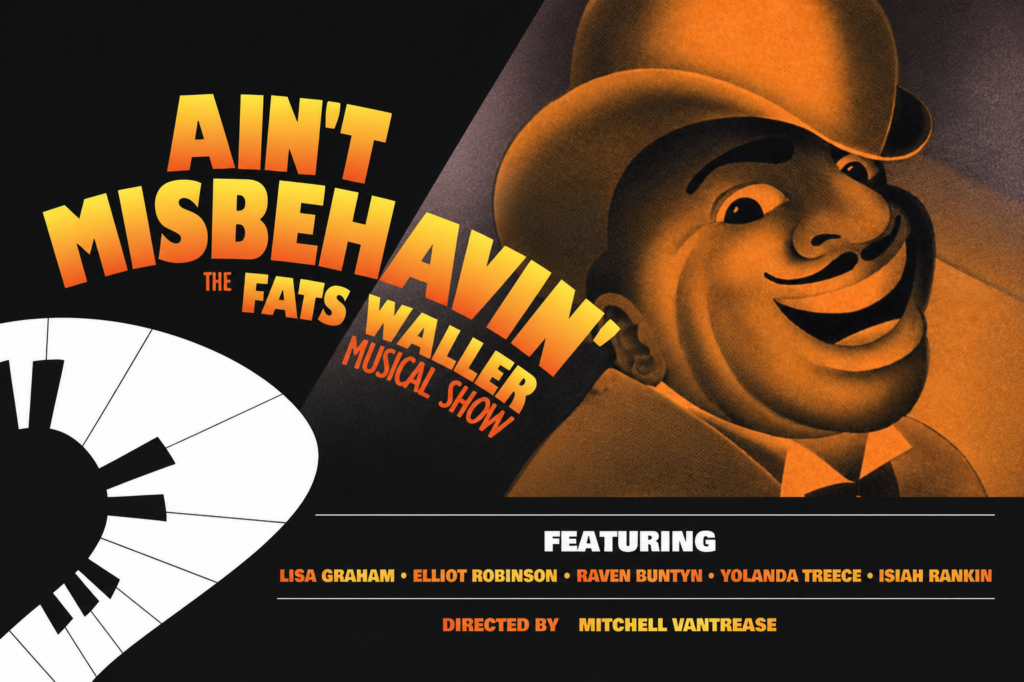
When Ain’t Misbehavin’ opened on Broadway in 1978, it introduced audiences to a joyous celebration of the music, humor, and spirit of jazz legend Thomas Wright “Fats” Waller. Now, Playhouse 615 brings the Tony-winning musical revue to Middle Tennessee audiences June 5-21 with a talented cast, live onstage musicians, and plenty of swing.
Before the curtain rises, JHPENTERTAINMENT caught up with director Mitchell Vantrease and cast members Elliott Robinson, Lisa Graham, Isiah Rankin, Raven Buntyn, and Yolanda Treece for another installment of our Rapid Fire 20Q feature.
RAPID FIRE 20Q WITH THE CAST AND DIRECTOR OF PLAYHOUSE 615’s AIN’T MISBEHAVIN’
 RAPID FIRE WITH AIN’T MISBEHAVIN’’s ISIAH RANKIN
JHPENTERTAINMENT: Ain’t Misbehavin’ celebrates the music and spirit of Fats Waller without being a traditional biography. What do you think makes that approach so timeless?
ISIAH RANKIN: Traditionally, I’ve seen that these stories focus around the person’s upbringing and what drew them to do what they did. This show, on the other hand, takes a different approach in telling various stories of each character through the music while also incorporating some important information about the musical style itself, such as the introduction to “Your Feet’s Too Big”. As many say, music is a universal language that will continue to defy the confines of time and trends. I think these stories and the music will continue to connect to individuals in the years to come.
JHPENTERTAINMENT: You’re pulling double duty as both performer and music director. I understand for this production, Playhouse 615 has opted to have three musicians on stage with the cast instead of the usual spot behind the audience. As music director and performer, how does that enhance your energy and performance?
ISIAH RANKIN: Funny enough, this is my first community theater opportunity to music direct a show on my own which has been a great honor and privilege. I previously music directed a high school show that ran on tracks, which was a unique experience. Having a live band for this experience, from both sides (MD & performer), creates an immersive experience that really creates new moments each performance. Though the music is there and learned, as you continue to connect with one another along with each audience, you begin to create new moments in each show. So, I believe it creates this organic experience that tracks and some other shows with live musicians don’t always allow.
JHPENTERTAINMENT: What’s been the biggest challenge musically in bringing these iconic songs to life?
ISIAH RANKIN: The biggest challenge in this process has been staying true to the style and character of the music. Not being as familiar with this style of music, I was very intentional about listening to the various aspects of different versions of the show and songs to ensure I maintained the integrity (to the best of mine and each singer’s abilities) of each song and story. I believe that each rehearsal has brought more and more connection to the messages weaved throughout this show and will cause the show to continue to evolve in each performance.
JHPENTERTAINMENT: If Fats Waller himself were seated in the audience, at which aspect of this show do you think he’d flash his notoriously joyful smile?
ISIAH RANKIN: I think he would be very proud of our presentation of “Black and Blue” because of all of the recent events over the last few years. I think that it is a timely song and our connection to the material feels highly authentic because of our understanding and close proximity to a lot of the concepts in the song, so I think he would be very pleased with our performance and presentation of this song.
 RAPID FIRE WITH AIN’T MISBEHAVIN’’s YOLANDA TREECE.
JHPENTERTAINMENT: The original 1978 Broadway production won a Tony Award for Best Featured Actress for Nell Carter. Years later, I was fortunate enough to see the mid-90s revival starring R&B and Pop legends The Pointer Sisters, in which Anita Pointer took on the role Carter had originated. In Playhouse 615’s production, that honor falls to you. Does knowing the legacy attached influence you in any way as you step into this world?
YOLANDA TREECE: Nell Carter? Yes! I have definitely been influenced. With her larger -than-life persona and this role, I have big shoes to fill! Paying homage to her in this iconic role while trying to bring my own flavor to this role has challenged me beyond measure. But I hope I’ve made her proud and I do her justice!
JHPENTERTAINMENT: With just over two dozen songs featured in Ain’t Misbehavin’, do you have favorites, or does that vary each time you and your cast mates perform them?
YOLANDA TREECE: Yes. Two of my favorites are “Black and Blue” and “Mean to Me”. “Black and Blue” is the soul stirring cry of truth to explain how it was, how it has been and how it will continue to be Black in this world while dealing with the inner struggle and repercussions of being Black. This song speaks volumes and ehen we as a people can’t say a word. This song is so relevant in today’s divided, messed up world and I am so thankful that Fats Waller gave this sing life. I am honored.
My other favorite song from the show is “Mean to Me”. Everyone at some point in life has or will experience heartbreak. It is especially difficult if it’s someone we shouldn’t have been attached to to begin with. Just because the heart wants what the heart wants doesn’t mean that person is meant for us. That is a difficult lesson to learn and heal from. But you can heal.
JHPENTERTAINMENT: On your off-time, what song on your personal music playlist gets your ‘joint jumpin’?
YOLANDA TREECE: I have an eclectic mix of music and it just depends on what I’m feeling or what is stuck in my head. My list includes contemporary gospel like Tye Tribbett, Kirk Franklin, Pastor Mike to Stevie Wonder, Earth, Wind and Fire, Queen, Prince, Ms. Aretha Franklin, Patti LaBelle, to name a few…I am all over the place. I love music!

RAPID FIRE WITH AIN’T MISBEHAVIN’’s ELLIOTT ROBINSON
JHPENTERTAINMENT: Ain’t Misbehavin’ serves as a reunion of sorts for you and director Mitchell Vantrease, having appeared in his 2025 production of Ragtime at The Keeton. So a two-part question for you…What do you most enjoy about Vantrease’s directing style? AND…Did his involvement in the show sway your interest in auditioning?
ELLIOTT ROBINSON: Like most great directors, I love the way Mitchell trusts his actors to make choices. No actor wants to be instructed how to do every little thing about their character, because we want to bring in our own interpretation of who that character is, to integrate whatever research and work we’ve done in developing and eventually embodying it. If I were to get too far afield from where he wanted his vision of the show to land, I’m sure he would let me know (LOL)! I’m a big fan of the selections he chooses to direct, too; stories with great cultural and/or historical significance, or featuring depictions of societal issues that still linger with us from days gone by. Ragtime, Memphis, Guess Who’s Coming to Dinner?, The Piano Lesson, and Master Harold and the Boys all fit that template. I surely would have auditioned for this great piece no matter who was directing it, because stuff like this doesn’t come around a lot. I’ll admit I was super happy to see that it was my baby brother at the helm!
JHPENTERTAINMENT: By day you work in Nashville Library’s Civil Rights Room sharing important history with visitors. Considering your day job, does performing a show rooted in such iconic Black artistry carry extra meaning for you?
ELLIOTT ROBINSON: Yes, at work I get to share our great local Civil Rights history with people from all over this planet; you need to come down for a tour! Fats Waller represents the history of the Harlem Renaissance, and we know how influential that era was in the growth and development of Black artistic expression in America, in music, as well as in literature, dance and visual art. Between that and the very true phrase, “they just don’t write songs like they used to,” I am very excited to bring these songs to life! Extra significance is layered on by this being Black Music Month, a time dedicated to the celebration and remembrance of the greatness and influence of artists from back in the day. Then, to stack more historical significance on top of all that, we even get to do a show on the night of Juneteenth!
JHPENTERTAINMENT: In your show bio, you promise audiences a “rip-roaring, jumpin-jammin-jivin good time.” Is there a particular section of the score that you feel embodies that sentiment or is it simply a culmination of the entire vibe of the piece?
ELLIOTT ROBINSON: “It’s gonna be a whole vibe, man!” I can’t wait to see how it feels in there with a sold-out house! The good time comes first from the audience enjoying the songs, whether they be comical, romantic, or social commentary. We are accompanied by a great live trio, which is special, too. More than anything, though, folks will also get to be more than spectators. I had not initially imagined how much of an interactive experience it would be! We just might break the fourth wall sometime, and we might need you to help us, in a kind of call-and-response way. It’s not gonna be your quiet, reserved night at the theatre, I tell you that! Get ready for some hand clappin’ & toe tappin’! I envision it as a kind of a speakeasy feel: small, intimate setting, maybe a few beverages flowing. Maybe we should have a code word for the door! LOL!
 RAPID FIRE WITH AIN’T MISBEHAVIN’’s RAVEN BUNTYN
JHPENTERTAINMENT: Your journey from a career in STEM recently took what could be considered a full 180 when you decided to pursue a full-time career in the arts. As one of Ain’t Misbehavin’’s songs suggests, it ‘Tain’t Nobody’s Biz-ness’, but I gotta ask, When was your “Yep…this is exactly where I’m supposed to be” moment?
RAVEN BUNTYN: I wouldn’t say there was a singular moment. It was a culmination of multiple moments that, over time, added up to me knowing this was for me. No matter what I did, I couldn’t stay away from the stage. But when I started acting classes last November, it cemented in me that being on stage was my calling. No matter how anxious I became or how many limiting beliefs I had to battle, it didn’t matter because I was allowing myself to be vulnerable in a way that I’d always craved before. Being secure enough within myself to open myself up to an audience and allow them to hopefully feel what I feel, is an honor I’m grateful to live.
JHPENTERTAINMENT: I’ve heard that the staging for this show is a little different for most shows at Playhouse 615, in that there’s a few cocktail tables in the front row of the audience area, giving this production more of a club feel. As a performer, what challenges/advantages does this setup present?
RAVEN BUNTYN: Being able to interact with the audience for a show is always somewhat a blessing and a curse depending on how you look at it. Sometimes, depending on the material, it’s easier to perform in front of an audience because you’re essentially pretending they aren’t there. But with this show, the audience is a part of the club and the show itself, which can be intimidating, but also very freeing. There’s no 4th wall, so we’re all in this universe together and that makes it fun and exciting.
JHPENTERTAINMENT: What advice would you give someone sitting in the audience who has a creative dream they’ve been too nervous to chase?
RAVEN BUNTYN: The advice I would give is to trust. When you take a leap of faith, the thing that gets you through moments of doubt is trusting— trusting yourself, trusting your own timing, trusting your gut, and trusting that what you feel drawn to is right and true. Learn to trust your inner voice above anyone else’s. After all, it’s your life, and you deserve to live it exactly as you see it.

RAPID FIRE WITH AIN’T MISBEHAVIN’’s LISA GRAHAM
JHPENTERTAINMENT: What excites you most about stepping into this jazz-infused world?
LISA GRAHAM: What excites me the most is the music itself! It is challenging, funny, haunting, gorgeous- all the things. I love singing harmonies, so it was thrilling to work on the jazzy four and five part harmony and bring it all together. The lyrics, too, are so much fun.
JHPENTERTAINMENT: When not performing, in your day-to-day life, you work as a school librarian where you’re surrounded by stories every day. As the son of a retired high school librarian, and a former longtime bookstore employee myself, I love knowing this about you. What story does this production tell audiences beyond the music itself?
LISA GRAHAM: Yes! That’s so cool Jonathan- I love meeting other bibliophiles. Well, it’s definitely telling stories of Black culture- ways that we celebrate ourselves, express ourselves, and process the discrimination we experience. When you hear the song “Black and Blue” late in Act Two, it really frames the entire show. But for me, this production more than anything else tells the story of love, from first meetings, to falling in love, to dealing with issues in relationships. That’s what makes it so universal.
JHPENTERTAINMENT: This cast is stacked. What’s your favorite part of performing with this talented group of people?
LISA GRAHAM: This cast is very kind and very supportive. Everyone works so hard- we are all invested in this show and want it to be great. It really is a joy to go rehearse with these folks!

RAPID FIRE WITH AIN’T MISBEHAVIN’ DIRECTOR MITCHELL VANTREASE
JHP ENTERTAINMENT: After the success of directing The Keeton’s Ragtime last year, what attracted you to taking on helming Ain’t Misbehavin’ at Playhouse 615?
MITCHELL VANTREASE: Ain’t Misbehavin’ has always been on my bucket list, whether as a performer or a director. So when the opportunity came up to take the helm of this production, there was no doubt in my mind that I was saying yes. I’ve always known the show as the production that really put Nell Carter on the map. There would be no Gimme a Break! without this show and her Tony Award-winning performance.
I also love jazz, and it doesn’t get much better than Fats Waller. He created and performed some of the greatest standards of all time, and this show puts that music fully on display.
JHP ENTERTAINMENT: This show is more revue than traditional book musical. How does that shift your approach as a director?
MITCHELL VANTREASE: It definitely shifts my approach a little, but I’m no stranger to musical revues. I actually crafted and co-created a revue in Arizona called The Soul of Broadway, which celebrated the music of African American musicals and characters. That production won an AriZoni Award, which is basically the state’s version of the Tony Awards, for Best Musical.
One of the biggest differences with this production is that I not only directed it, but I also choreographed most of the revue myself. Usually, I direct and have a choreographer working alongside me the entire time, but with this show I wanted to challenge myself and level up as an artist. Growth is important, and I wanted to push myself creatively.
I was definitely nervous at first, but I studied dances from that era and found a lot of inspiration there. I ended up creating choreography that feels clean, simple, and authentic while complementing both the actors and their incredible voices.
For me, the key to directing a musical revue is making sure every song tells a story. These numbers aren’t just performances — they’re mini stories. The cast isn’t only singing; they’re acting through every lyric and every moment. But make no mistake, it’s all about the music.
JHP ENTERTAINMENT: Having the musicians on stage changes the entire visual energy of the production. What excites you most about that choice?
MITCHELL VANTREASE: There’s nothing like having live music onstage. Since the show is set in a club, I wanted the audience to truly feel that atmosphere the second they walk in. Putting the band onstage immediately elevates the energy and creates a more authentic nightclub experience. It brings the production to life in a completely different way.
JHP ENTERTAINMENT: What do you hope Nashville audiences feel walking out of the theater after this production?
MITCHELL VANTREASE: I hope audiences walk away with a deeper appreciation for Fats Waller, his music, and the legacy he left on the music industry. It’s especially meaningful that we’re presenting this show in June during National Black Music Month and around Juneteenth celebrations. There really couldn’t be a more perfect time to celebrate this history, this music, and such a phenomenal artist.
Whether you’re already a fan of Fats Waller’s music or discovering these timeless songs for the first time, Ain’t Misbehavin’ audiences at Playhouse 615 can expect an evening filled with laughter, incredible vocals, unforgettable musicianship, and the infectious energy that has made this show a favorite for nearly five decades. , settle in, and get ready for a jumpin’, jammin’, swingin’ celebration of one of Broadway’s most beloved musical revues.
Ain’t Misbehavin’ runs June 5-21 at Playhouse 615 (11920 Lebanon Rd, Mt. Juliet, TN 37122) with Friday and Saturday evening performances at 7:30pm and Sunday matinees at 2:30pm. General Admission tickets are $22 for Seniors/Military and $25 for Adults. As mentioned above, there are a limited number of cocktails tables near the front of the stage adding to the nightclub atmosphere of the show. Those VIP seats are available for $35. CLICK HEREto grab your tickets.
Following Ain’t Misbehavin’, Playhouse 615‘s season continues with Agatha Christie’s The Unexpected Guest on stage July 17-August 2. CLICK HERE for ticket. For more from Playhouse 615, check out their website or follow them on Instagram and Facebook.
As always, if you wanna follow JHPEntertainment to find out who I’m chatting with for my next Rapid Fire Q&A, or for my take on the latest local and national theatre, music, arts and more, visit JHPENTERTAINMENT.com or find us on Facebook, Insta, Threads and X. Till then #GoSeeTheShow!
 RAPID FIRE WITH MANUAL CINEMA CO ARTISTIC DIRECTOR JULIA MILLER
 RAPID FIRE WITH MANUAL CINEMA CO ARTISTIC DIRECTOR JULIA MILLER
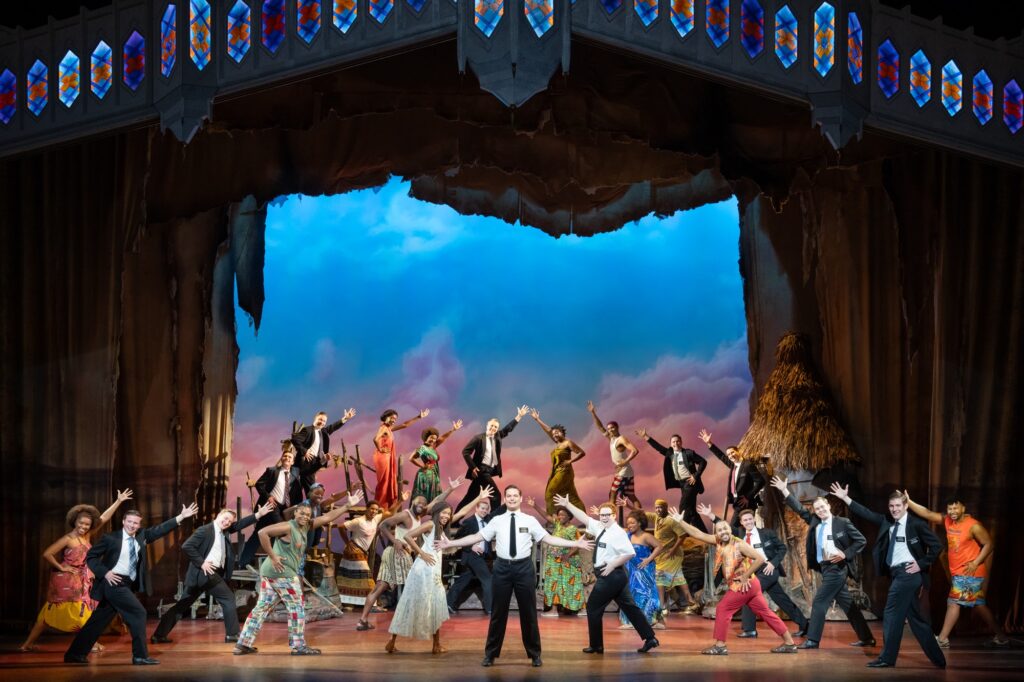
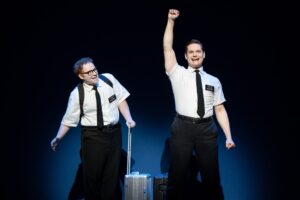 Leading the charge is Ethan Davenport, who takes on the pivotal role of Elder Price in this engagement. As Elder Price, Davenport embodies the character’s confidence, ambition and occasional arrogance with effortless charm. Blessed with a powerful Broadway tenor and an all-American leading man presence, he delivers “You and Me (But Mostly Me)” and the Act Two anthem “I Believe” with the kind of vocal confidence that anchors the entire production.
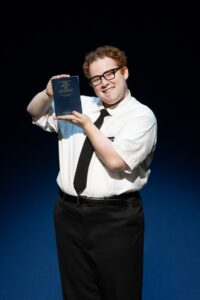 Opposite him, Jacob Aune’s Elder Cunningham is everything the role demands—awkward, lovable, wildly inappropriate and impossible not to root for. Cunningham is essentially a walking collection of half-remembered science fiction plots, social anxiety and misguided optimism & a bit of a walking, talking South Park character in human form, and Aune embraces every glorious second of it.
 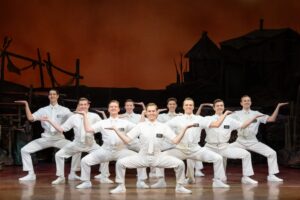 Yet it’s Craige Franke as Elder McKinley where Franke truly steals scenes. His performance of “Turn It Off” is a masterclass in comic timing, complete with dazzling choreography, impeccable facial expressions and enough jazz hands to illuminate Broadway itself. Heck, the featured ensemble during “Turn It Off” is simply tap-tactic. Having spent years with the company in multiple capacities, Franke understands this material inside and out, and it shows. His cheeky, campy cameo in “Scary Mormon Hell Dream”, helps make it a
 As The General, Shafiq Hicks delivers one of the production’s most commanding performances. Possessing a booming stage presence and undeniable authority, Hicks makes an immediate impression from the moment he appears. His performance of “Hasa Diga Eebowai” earns exactly the reaction one hopes for from first-time audiences: gasps, nervous laughter and a collective realization that The Book of Mormon intends to push every button it can find. Yet Hicks doesn’t just play the role as a caricature. Instead, he grounds the character in a reality that gives the surrounding comedy greater impact.
 What continues to impress most about The Book of Mormon, however, is how successfully it balances satire with sincerity.
 RAPID FIRE WITH MERRILY WE ROLL ALONG‘s FRANKLIN SHEPHARD, GRAY MILLER
 RAPID FIRE WITH MERRILY WE ROLL ALONG‘s CHARLEY KRINGAS, ELIJAH WALLACE
 RAPID FIRE WITH MERRILY WE ROLL ALONG‘s MARY FLYNN, McKENZIE BRYAN
 RAPID FIRE WITH MERRILY WE ROLL ALONG DIRECTOR JACOB WAID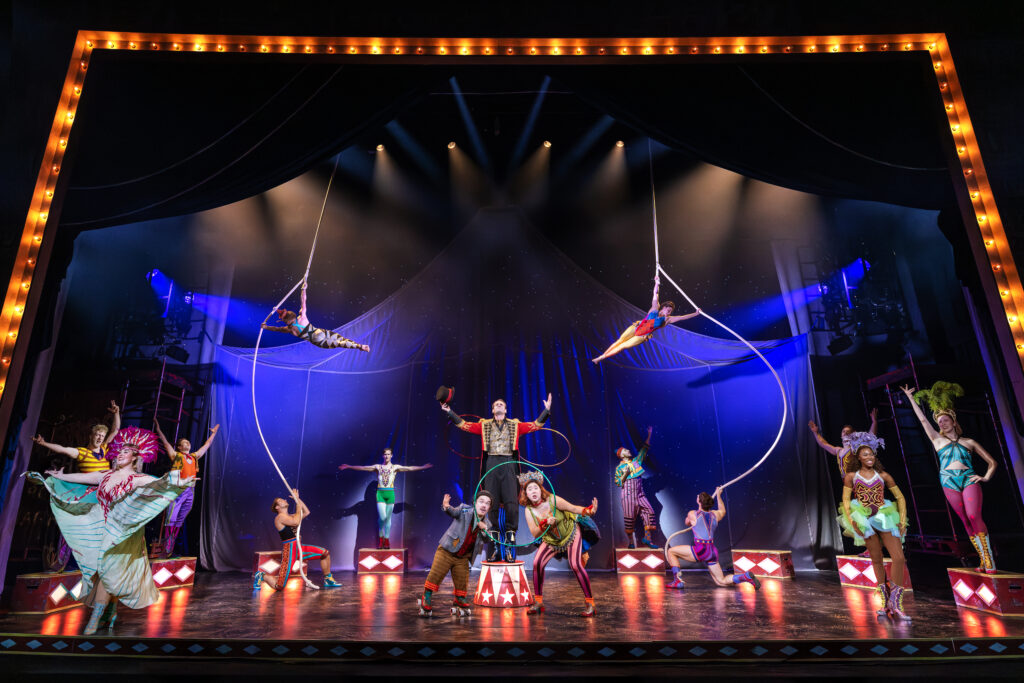
 JHPENTERTAINMENT:
 RAPID FIRE WITH WATER FOR ELEPHANTS‘
  RAPID FIRE WITH WATER FOR ELEPHANTS‘ ELLA HUESTIS
 RAPID FIRE WITH WATER FOR ELEPHANTS’
  RAPID FIRE WITH WATER FOR ELEPHANTS‘ CHRIS MARTH
 At the center of the production is Zachary Keller as Jacob Jankowski, the grieving veterinary student who impulsively abandons his former life and jumps aboard the Benzini train. Keller anchors the production with a grounded sincerity and a soaring vocal performance that gives emotional weight to Jacob’s internal struggle between safety and risk, logic and passion. His voice carries a warm ache throughout the evening, particularly in moments when Jacob wrestles with the moral compromises surrounding the circus and his growing connection to Marlena. There are moments within Keller’s performance that the entire audience falls in love with his Jacob. Heck, there are moments his near-perfect pitch vocals fill the venue so melodically that you even wonder if he needs a mic. A true testament to his skills and those of the show’s sound designer Walter Trarbach and the entire technical team.
 Opposite Keller (and Tully), Helen Krushinski delivers a luminous performance as Marlena, the circus star trapped inside an increasingly dangerous marriage. Krushinski possesses the kind of voice that cuts cleanly through the orchestrations without ever losing emotional nuance. She brings both fragility and fierce determination to Marlena, avoiding cliché and instead presenting a woman desperately searching for dignity and freedom amid chaos. Like so many of her ensemble cast mates, Krushinski also demonstrates a bit of impressive arial skills, adding a literal and figurative extra layer to her performance.
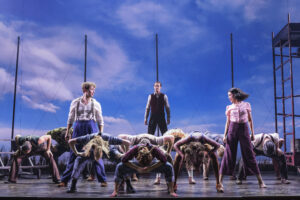
 And yes — the aerial and acrobatic work is extraordinary. This production understands that circus artistry should not simply interrupt the narrative; it should become the narrative. Silks, balancing acts, lifts, and gravity-defying choreography emerge organically from the emotional life of the story. The transitions feel seamless rather than showy for the sake of applause. From the jump, as the circus ‘crew’ is setting up shop at their latest stop, even the pounding of the tent-stakes into the ground and the raising of the tent becomes a cadenced ballet of movement, acrobatics and mind-boggling balance and strength. This elegance of motion and bodily discipline becomes another character throughout.
 Particular praise belongs to Yves Artières, whose physical performance as Silver Star, Marlena’s beloved show horse, becomes one of the evening’s unexpected emotional centerpieces. Through movement alone, Artières creates personality, loyalty, exhaustion, and tenderness in a way that feels almost impossibly expressive. In a key scene when Silver Star reaches his untimely end, the visual of his spirit leaving his body, by way of Artières ascending silks hanging from the rafters above the stage, then dramatically unfurling the silks as he descends to return to the earth–simply breathtakingly beautiful. The puppetry/animal work throughout the production is remarkably inventive, but Silver Star’s presence lingers long after curtain call.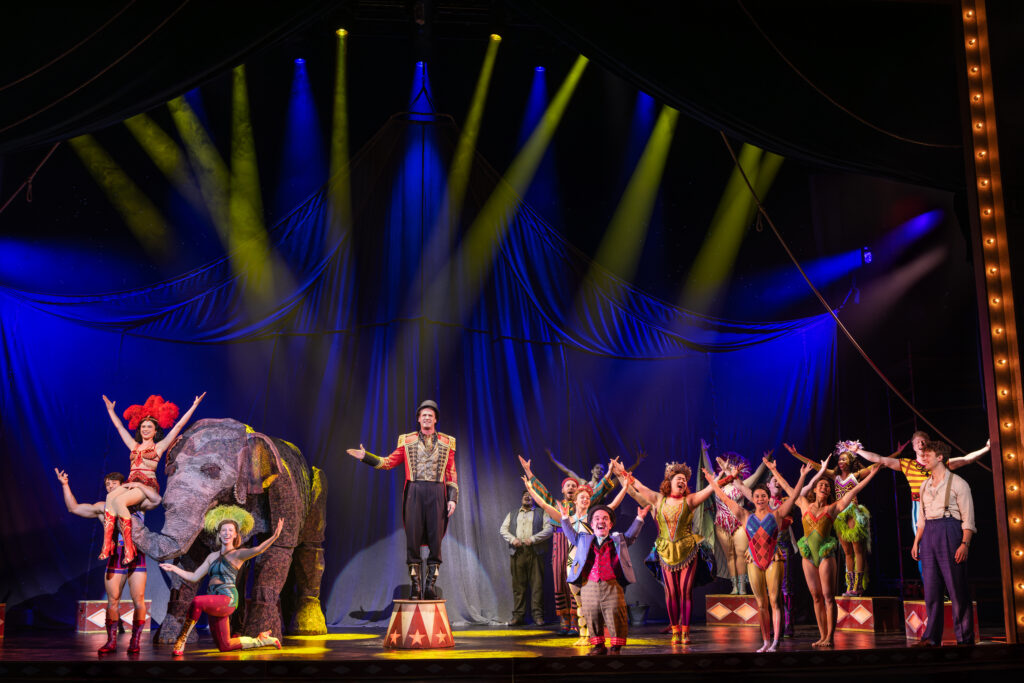
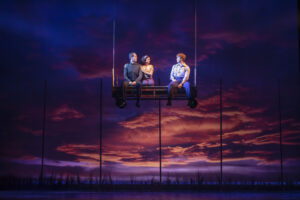 The lighting design deserves enormous credit for shaping the show’s emotional landscape. Warm ambers, smoky blues, and stark silhouettes constantly shift the atmosphere from romance to danger to wonder. Combined with a richly textured sound design that captures both the intimacy of whispered confessions and the thunder of circus chaos, the technical package immerses the audience completely without ever feeling excessive.
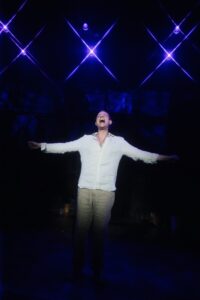
 Opposite him, Grammy nominee Mykal Kilgore delivers a mesmerizing Judas. From the opening notes of “Heaven on Their Minds,” Kilgore refuses to portray Judas as a simple villain. Instead, his Judas feels conflicted, frightened, frustrated, and heartbreakingly human as he watches events spiral beyond anyone’s control. His powerhouse vocals soar effortlessly through the score, but it is the emotional vulnerability beneath the performance that lingers longest.
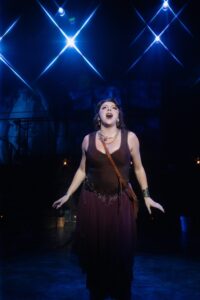 As Mary Magdalene, powerhouse vocalist Olivia Valli comes by her talents naturally. Granddaughter of The Four Season‘s founding member Fankie Valli, she’s a legacy entertainer. As Mary Magdalene, Valli brings warmth and aching sincerity to the role. Early on During “Everything’s Alright,” Valli’s calming presence provides a needed emotional balance amid the increasingly chaotic atmosphere surrounding Jesus. Soon after, her rendition of “I Don’t Know How to Love Him” avoids unnecessary theatrics in favor of emotional honesty, allowing the heartbreak within the song to quietly unfold. Under Cassidy’s direction, Valli explores the often-avoided attraction between Mary the woman and Jesus the man, once again offering yet another layer to the humanity of the piece.
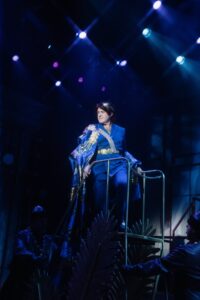 As Pontius Pilate, Geoffrey Davin offers one of the evening’s smartest tonal shifts . Presented as a gaudy, self-important joke of a man sporting an intentionally terrible hairpiece (kudos to the show’s wig designer Meredith Schieltz for just simply going for it), Davin leans fully into the absurdity of performative power. The portrayal initially earns plenty of laughs, but underneath the comedy lies another sharp reflection of the production’s larger themes—people desperate to appear more important than they truly are. His “Pilate’s Dream” balances nervous humor with growing dread, while sinisterly daunting presence during “Trial Before Pilate/39 Lashes” becomes genuinely unsettling.
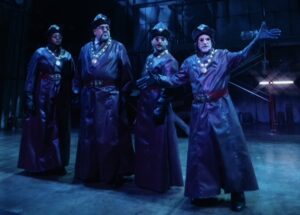 W. Scott Stewart’s thunderous bass vocals as Caiaphas roll in like a deep fog, brilliantly setting the stage for the dread and darkness to come. Robert Parker Jenkins‘ Annas perfectly snarky glances peering over those disturbingly small, dark glasses, brings an unspoken self-righteousness to his role as a high priest. As other members of Caiaphas’ doom squad, Garris Wimmer‘s sinister voice and Jennifer Whitcomb-Oliva‘s snide presence all come together perfectly to present a united and terrifying quartet who initiate the plot to end Jesus.
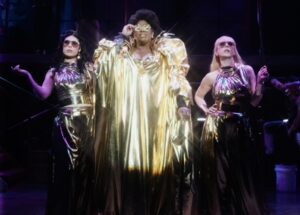 Then there’s the most intriguing of Whitcomb-Oliva’s multiple roles, her dazzlingly, gloriously commanding presence as King Herod. Landing somewhere firmly between Tina Turner’s Auntie Entity from Mad Max: Beyond the Thunderdome and Elton John’s Pinball Wizard from yet another rock opera, Tommy, Whitcomb-Oliva’s Herod is the true definition of the villainous character we know we’re not supposed to love, but we just can’t help ourselves. Combine the stage presence and spectacular wardrobe with Whitcomb-Oliva’s undeniable talents and you’ve got yourself a show-stopping performance and another of Studio Tenn‘s Jesus Christ Superstar‘s truly magical cast members. There is no role this mega-watt talented performer can’t handle and she proves it show after show after show.
 Other ensemble members like Bakari King, Garris Wimmer, Maya Antoinette Riley, Matthew Hayes Hunter, Savannah Stein, Lane Adam Williamson, Victoria Griffin, Emma Rose Williamson, Connor Adair, Nikki Berra, Christina Ledbetter and Patrick Jones each contribute to the overall energy, emotion and beauty of the piece. From the full ensemble Act 1 favorite, “What’s the Buzz’ to a shining, glittering all-in late-hour moment, the entire cast brings everything they’ve got, resulting in a feast for the eyes, the mind, the heart and soul.
 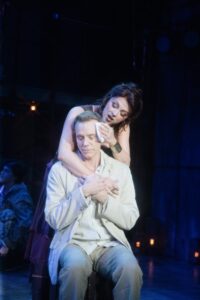 Likewise, Joi Ware’s choreography injects continuous movement and urgency into the production. There are moments where subtle Bob Fosse-inspired isolations seem to collide with flashes of Michael Jackson-inspired movement during larger ensemble sequences, creating choreography that feels simultaneously nostalgic and contemporary. Even those ensemble moments reinforce the power-in-numbers juxtaposed to the isolation of one theme found throughout the piece. Coupled with Cassidy’s direction, Ware’s choreography fills the stage with passionate movement, whether the entire company is on stage for a group number, or the action slows for a solitary moment from Pascal, Kilgore or Valli.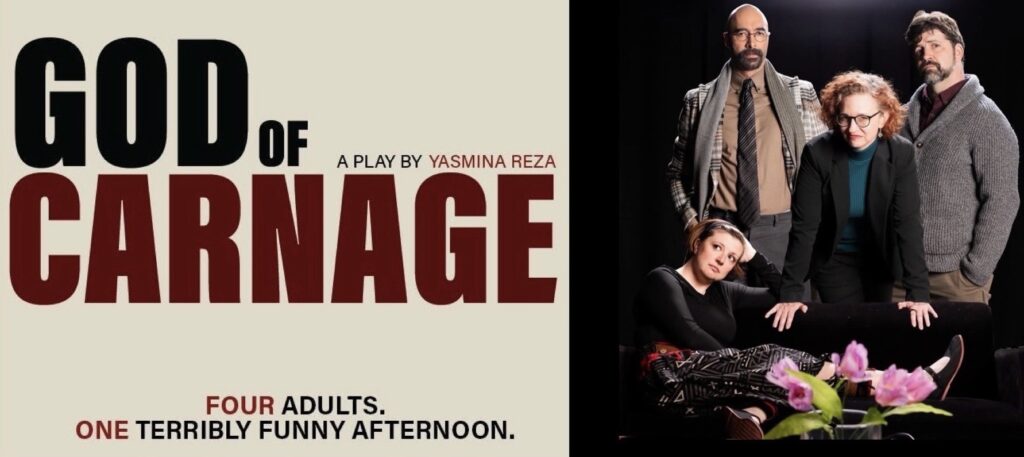
 RAPID FIRE WITH GOD OF CARNAGE’s ALAN, WANDERSON REZENDE
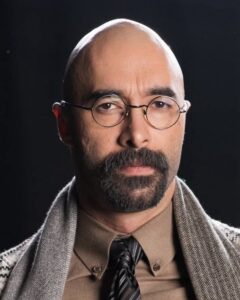 WANDERSON REZENDE: I don’t think Alan is pretending. I think he does everything but pretend. And yes, I do think he’s the most honest person in the room. I had conversations with our director Diane Bearden and with Ben, Abby, and Beth about this. Alan understands that children and adults have fundamentally different tools for solving conflicts. He’s interested in the adult dimension of what happened between their sons: the dentist, the insurance, and giving the kids space to work it out themselves. What he refuses to do is inject adult morality into a children’s fight. He knows that life and time will already do that job. Alan is the kind of parent who wouldn’t stop his kid from sticking a fork in an outlet. He’d say, “Go ahead, then let’s talk about what happens next.” There’s actually a twisted kind of respect in that.
 RAPID FIRE WITH GOD OF CARNAGE’s ANNETTE, BETH HENDERSON
 JHPENTERTAINMENT: By the end of the play, who holds the most power in the room—and does Annette ever truly lose hers?
 RAPID FIRE WITH GOD OF CARNAGE’s MICHAEL, BEN GREGORY
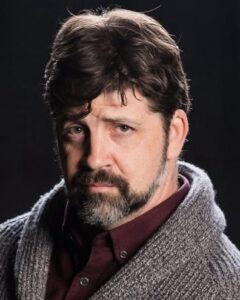 BEN GREGORY: To avoid letting the degree of his resentment reveal itself too quickly, I focus on his attempts to make light of things, his efforts to be a peacemaker. He wants so badly to avoid conflict. Though the tension eventually breaks, he tries to restrain it as much as possible, often with offhand remarks intended to make light of things.
 RAPID FIRE WITH GOD OF CARNAGE’s VERONICA, ABBY WADDOUPS
 The tension is high and rehearsing is exhausting, draining, but fun. I feel like I’m in college again, doing an intensive character study in a cutting edge drama. Shows like this, roles like Veronica and working with these wonderful people – are all what I love most about acting. We are always in good hands with Diane and her expertise.
 RAPID FIRE WITH GOD OF CARNAGE DIRECTOR, DIANE BEARDEN-ENRIGHT
 RAPID FIRE WITH JAGGED LITTLE PILL‘s MARY JANE, LEE CHAIX MCDONOUGH
 RAPID FIRE WITH JAGGED LITTLE PILL‘s FRANKIE, SHALIA FUENTES-MATTHEWS
 RAPID FIRE WITH JAGGED LITTLE PILL‘s JO, ANNA MARSHBURN
 RAPID FIRE WITH JAGGED LITTLE PILL DIRECTOR, BRADLEY MOORE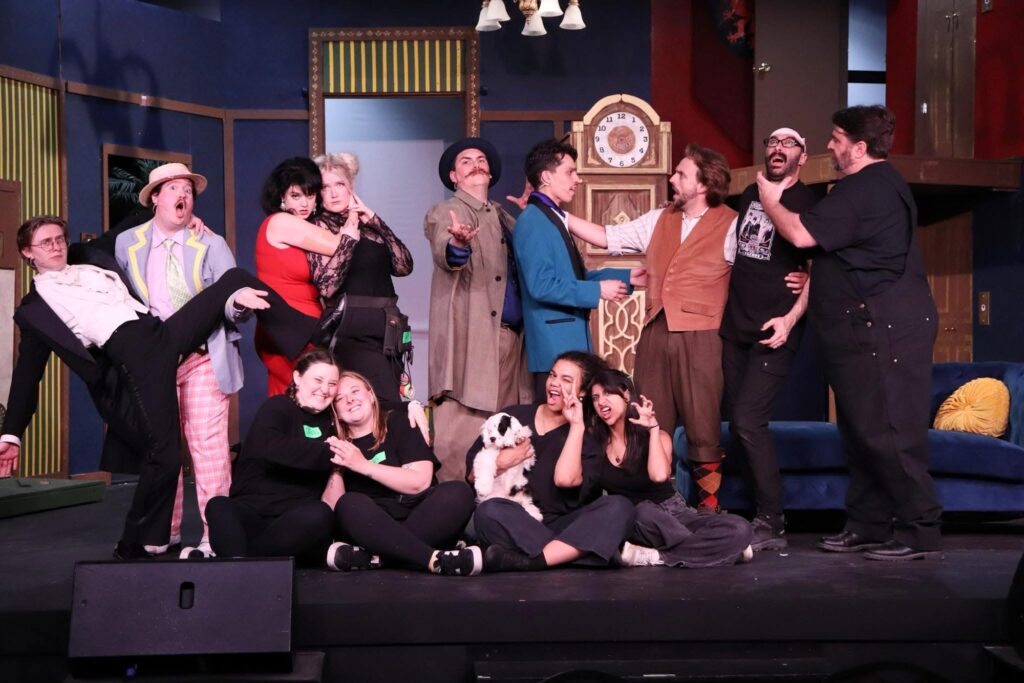
 Leading this beautifully doomed endeavor is Joshua Mertz as Chris, the director/star/producer/everything-else of the show-within-the-show. Mertz plays Chris with just the right mix of puffed-up authority and slow-burn panic. As The Inspector within the mystery, watching him try to maintain control as things unravel faster than a cheap sweater is half the fun—and when he finally snaps, it’s worth the wait. Mertz, in his sixth show at The Keeton is proving himself to be a valuable asset the the company.
 Aaron Gray’s Robert is the kind of community theatre actor who clearly believes he’s performing in Masterpiece Theatre, even as the world collapses around him. The fact that Gray is in or involved with nearly every Keeton production somehow added a if you know you know aspect to his role as Robert. As Thomas Collymoore, his dead-serious commitment in the face of utter nonsense makes every moment land harder, especially as the physical comedy ramps up and refuses to let him off easy. Kudos to his library scene. While the Keeton stage area does limit the intensity of the prospect of the second floor of the set completely collapsing, Gray’s physicality while keeping himself and all the props around his from falling away as the floor beneath him gives way, is gasping, belly-laughing joy to behold.
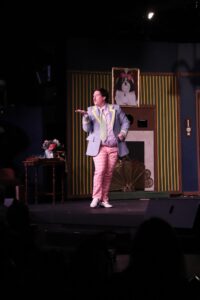 Keeton newcomer, Connor Boggs is tasked with the key role of Max. Initially cast in another role, Boggs stepped into the role of Max after the original actor had to drop out of the show. As Max and his mystery counterpart, Cecil, he figures out very early on that subtlety is overrated. Within the supposed seriousness of the murder mystery, for Cecil, once he gets a taste of audience laughter, it’s game over. He milks every moment for all it’s worth, turning even the smallest slip into a full-blown bit. That said, dressed in wardrobe that can only be described as a technicolor travesty—yes, the character is typically a bit of a dandy, but not quite so…flamboyant. Usually played as an overly confident community theatre actor with at least an initial modicum of subtlety, Bogg’s Cecil starts at 100mph and never slows down doing everything short of cartwheels from his stage entrance right on through to the final curtain. Under the direction of Bailey, Bogg’s Cecil is amped up and definitely played for laughs so much so that it runs the risk on a SNL skit that just doesn’t know when to
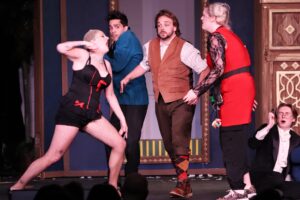 demanding physical comedy without ever dropping character. In one scene in particular, she’s pulled and flopped around by her cast mates as if her joins are made of bendy straws. Her physicality is slapstick at its best.
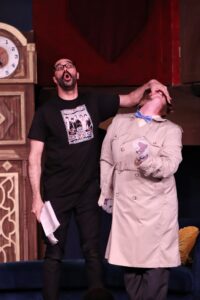 Wanderson Rezende’s Trevor Watson, stationed at the tech booth, proves that sometimes less is more. His distracted, couldn’t-care-less approach to running the show results in some of the night’s most perfectly timed “mistakes,” and when he’s finally dragged into the action, it’s awkward brilliance. And yes, Denese Rene’ Evans (the show’s costumer) I did indeed appreciate that Trevor is sporting a Duran Duran t-shirt!
 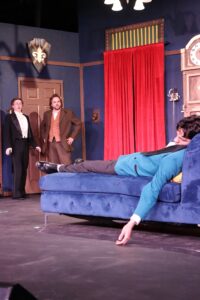 name, by the way), tasked with playing a corpse who…isn’t exactly great at the whole “lying still” thing. Fonville’s physical comedy—mistimed reactions, missed cues, and all—adds an extra layer of delightful absurdity to a role that could just be…well, dead.
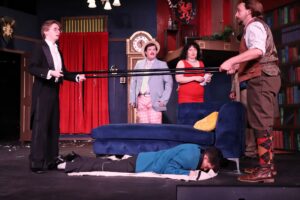 Bottom line, if you like your theatre polished, pristine, and predictable…this ain’t it. But if you’re in the mood to laugh until your face hurts while watching a cast absolutely commit to the bit—even as the set tries to take them out—The Play That Goes Wrong at The Keeton is exactly the kind of beautifully disastrous night out you’re looking for. Just don’t expect anything to go right, because…Where’s the fun in that?