In a recent press release, OZ Arts’ Artistic Director Mark Murphy reaffirmed his long-standing admiration for Tokyo-based multimedia artist Hiroaki Umeda—and why audiences are about to witness something truly extraordinary as the remarkably inventive visual performer returns to Music City, this time bringing his captivating program assimilating and Moving State 1 to Nashville for the first time ever.
It was back in 2019, not long after Murphy stepped into his role at Oz Arts that he first invited Umeda to perform. As Murphy says, “the future of performance”—a bold statement, indeed, but one that feels earned the moment you begin to understand Umeda’s work.
 Blending choreography, sound design, lighting, and digital projection into a single, seamless vision, Umeda doesn’t just create dance—he builds entire worlds. A true one-man creative powerhouse.
Performing with nothing more than a laptop as his control center, Umeda simultaneously directs lighting, sound, multiple video projections in real time and entrancing motion. The result is a fully immersive environment where movement and technology are in constant conversation.
It’s a style that has captivated critics across the globe. The New York Times comparing the artist to, “a tin man with oil flowing freely through his veins.” Of Umeda’s style, The Guardian lauded, “dazzling…dancing through a perfect storm of light, video and sound,” while Infinite Body praised his work as “cool, minimalist, high-tech hip hop…a dance of total theatre.”
Still, I’ve a feeling those accolades barely scratch the surface of what Umeda has in store for Music City. Closing out a rare five-city U.S. tour, with his Oz dates, Umeda’s dynamic work assimilating and Movie State 1 begins, as assimilating suggests, with a visually explosive solo that places Umeda inside a constantly shifting digital landscape. Then, Moving State 1 presents a striking group work featuring four female dancers from Umeda’s Somatic Field Project, blending precision movement with cinematic intensity. Together, the pieces highlight what the Scotland Herald calls his “virtuoso melding of technology and movement,” blurring the lines between concert dance, visual art installation, and experimental theater.
 In a note from Oz’s Artistic Director, Murphy recalls first presenting Umeda in Los Angeles in 2013, where the work left a lasting impression—earning praise from the Los Angeles Times for “a defining artistic vision for our time.” Now, that same boundary-pushing artistry returns to Nashville with a program locals haven’t witnessed before. I’m certain that my readers know: every now and then, a performance comes along that genuinely shifts your expectations. This is one of those moments.
Umeda’s work isn’t about narrative or tradition—it’s about sensation. It’s about what happens when light, sound, and the human body collide in real time. And it’s about experiencing something you simply can’t replicate unless you witness it in the flesh. As Murphy puts it, this is an artist whose work must be seen firsthand. For Nashville’s creative scene, this isn’t just another visiting performance—it’s a rare opportunity to experience an artist who is actively redefining what live performance can be. And for three nights only, that future is playing out right here at OZ Arts.
Hiroaki Umeda: assimilating and Moving State 1 runs Thursday through Saturday, March 26–28 at 8 PM (doors open at 7 PM) at OZ Arts (6172 Cockrill Bend Circle, Nashville, TN 37209)
Ticket options include:
- Artist & Creative Community (discounted, no code required)
- General Admission
- Generous Admission (I love this one!)
Pricing by night:
- Thursday: A&CA $20 / GA$30 / Generous Admission$40
- Friday: $25 / $32 / $42
- Saturday: $30 / $37 / $47
CLICK HERE for tickets.
Next up at Oz Arts is Australian cabaret darling Meow Meow April 11. CLICK HERE for more info or to purchase tickets. To keep up with all things Oz Arts, follow them on Facebook, X, YouTube and Insta.
As always, If you want to read our latest on Music, Movies, Performing or Visual Arts, please check out JHPEntertainment online or socials at Facebook, Insta, X and Threads. Till then…. #GoSeeTheShow!
 RAPID FIRE WITH TEV’s GERALD JOSEF
 RAPID FIRE WITH TEV’s J BOOTH
 RAPID FIRE WITH TEV’s WES BISHOP
 RAPID FIRE WITH TEV GUEST VOCALIST, JENNIFER McLANE

 Then there’s Doc. David Josefsberg’s take on the eccentric inventor is where the show truly locks into place. Wonderfully unhinged in the best way, his Doc balances manic comedy with genuine heart. His early numbers are the turning point where the audience collectively leans in and says, “Okay, I’m in.” Josefsberg doesn’t imitate—he reinvents, while still honoring what makes Doc such an iconic character.
 And then there’s Cartreze Tucker as Goldie Wilson (and Marvin Berry), who nearly steals the entire show. From the moment he steps onstage, Tucker commands attention. His big number earns one of the largest audience responses of the night, and for good reason—his vocals are powerhouse-level, and his charisma is off the charts. It’s a star-making turn that injects an extra jolt of electricity into an already high-energy production.
 Visually, the production is stunning. The use of projections, layered with practical effects and good old-fashioned stage magic and some mind-blowing state-of-the-art new theatrical tricks, the effects become a character in its own right. Whether it’s the clock tower sequence or the time-travel effects, the technical execution is nothing short of jaw-dropping. It’s the kind of design work that reminds you how thrilling live theatre can be when all the elements are firing.
 Act Two does bring one of the more head-scratching moments in the show—a neon-soaked, new wave-inspired “21st Century” opening number featuring Doc and a troupe of backup dancers. It’s flashy and fun, but also feels a bit unnecessary and tonally out of sync with the rest of the piece. And on opening night in Nashville, it was followed by a rare hiccup: the hoverboard didn’t quite cooperate. Still, the moment was handled with total professionalism, and honestly, it was quickly forgiven given the sheer volume of technical wizardry the show gets right. Because when it works—and it mostly does—it really works.

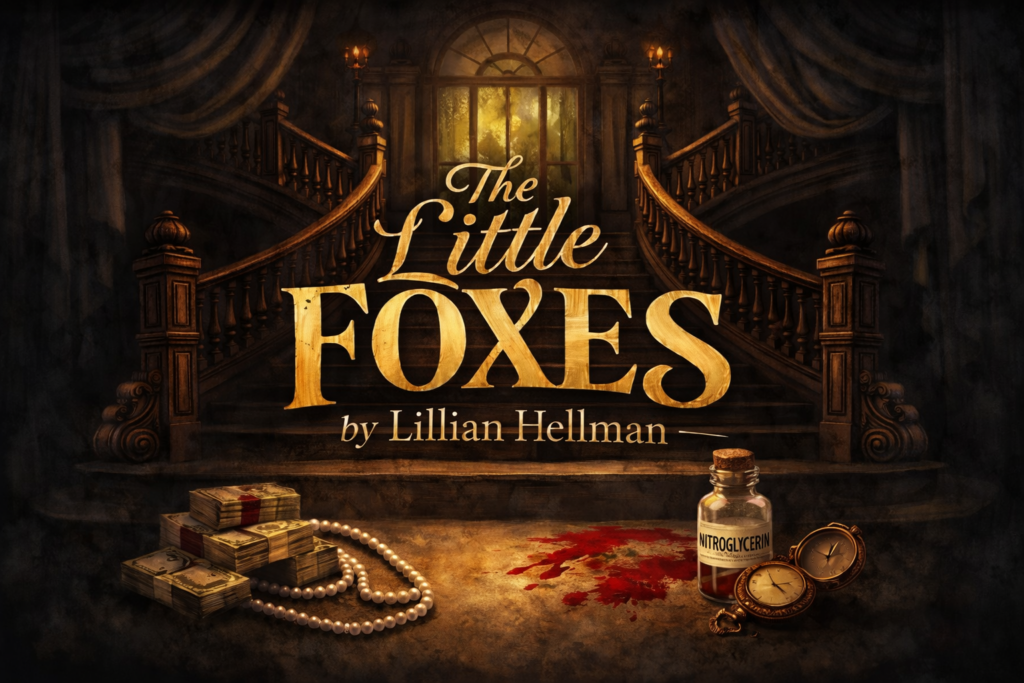
 RAPID FIRE WITH THE LITTLE FOXES’ REGINA GIDDENS, ANN STREET-KAVANAGH
 RAPID FIRE WITH THE LITTLE FOXES‘ ALEXANDRA GIDDENS, ZOË GARNER
 RAPID FIRE WITH THE LITTLE FOXES‘ OSCAR HUBBARD, PHIL BRADY
 RAPID FIRE WITH THE LITTLE FOXES’ ADDIE, GWENDOLYN CLINTON
 RAPID FIRE WITH BACK TO THE FUTURE’S MARTY MCFLY, LUCAS HALLAUER
 JHPENTERTAINMENT: Marty’s wardrobe—from the puffer vest to the sneakers, perfectly reimagined for the stage by scenic and costume designer Tim Hatley—is instantly recognizable. What’s it like to put on that iconic costume each night and step into such a visually legendary look?
 RAPID FIRE WITH BACK TO THE FUTURE’S LORRAINE BAINES, KATHRYN ADELINE
 RAPID FIRE WITH BACK TO THE FUTURE’S BIFF TANNEN, NATHANIEL HACKMANN
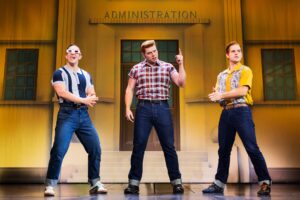 JHPENTERTAINMENT: After originating the role on Broadway, what lured you back to Hill Valley for year two of the National Tour?
 RAPID FIRE WITH BACK TO THE FUTURE’S DOC BROWN, DAVID JOSEFSBERG
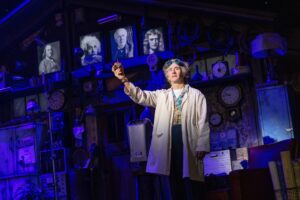 JHPENTERTAINMENT: Speaking of energy, one of the most entertaining elements of Back to the Future on stage is the theatrical magic courtesy the collaborative efforts of the show’s lighting designers Tim Lutkin & Hugh Vanstone, video designer Finn Ross, sound designer Gareth Owen and illusion designer Chris Fisher. Without giving away too much, what can you tell me about your favorite moment in the show where these elements all come together perfectly?
 RAPID FIRE WITH FOOTLOOSE‘s REN, JONNY CHILD
 JHPENTERTAINMENT:
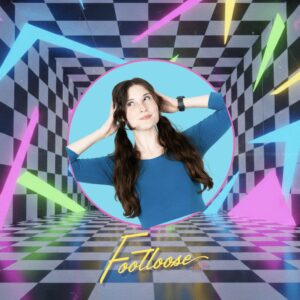 RAPID FIRE WITH FOOTLOOSE‘s ARIEL, CLAIRE BILLINGSLEY
 JHPENTERTAINMENT: Ariel has some unforgettable musical moments. Which song in the show do you think will be part of your playlist long after the final curtain?
 RAPID FIRE WITH FOOTLOOSE‘s REVEREND MOORE, STEPHEN KRASKI
 JHPENTERTAINMENT: The relationship between Reverend Moore and Ariel sits at the emotional heart of the story. What has it been like building that dynamic with Claire Billingsley?
 RAPID FIRE WITH FOOTLOOSE DIRECTOR, LESLIE BERRA
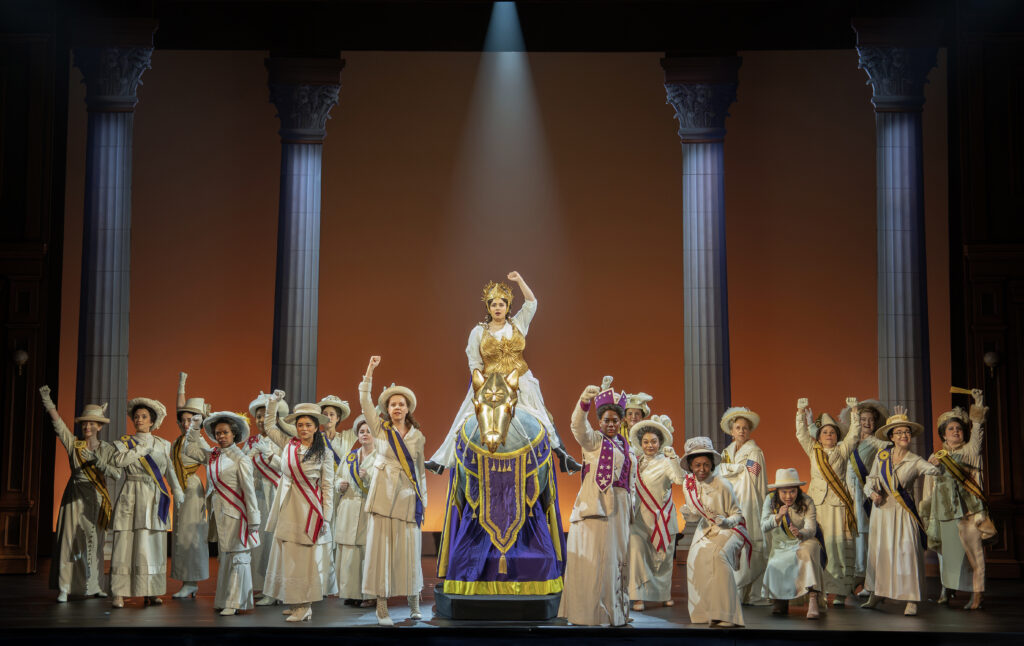
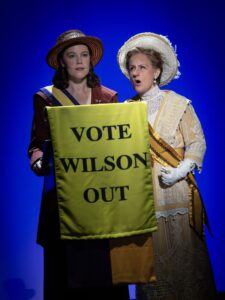 From the opening strains of the period-perfect ragtime-syncopated “Let Mother Vote,” maternally led by Mary Grandy‘s Carrie Chapman Catt and backed by a vocally powerful ensemble, Suffs makes it clear: this isn’t a museum piece. It’s a movement. The storytelling feels urgent, strong, and emotionally immediate—never preachy, always human.
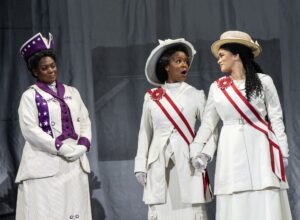 As Ida B. Wells, Danyel Fulton commands attention with moral clarity, emotional precision and powerhouse vocals to rival a certain recent Broadway Gypsy. “Wait My Turn” simmers with justified frustration, and when she returns in “I Was Here,” alongside Mary Church Terrell (Trisha Jeffrey) and Phyllis Terrell (Victoria Pekel), the moment lands as a declaration of presence that resonates well beyond the period setting. Speaking of Fulton’s co-stars, Jeffrey brings elegance and resolve to Mary Church Terrell, particularly in “Hold It Together,” serving as an emotional anchor amid political fractures. Meanwhile, Pekel’s Phyllis as well as a later turn as Robin, reinforce the vitality of youthful exuberance necessary for any movement to continue into the next generation. Whenever any of these three talented performers are on stage, the audience is mesmerized and treated to stunning vocals.
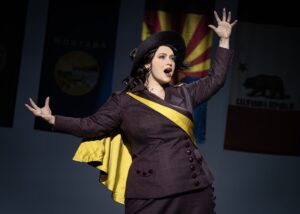 Monica Tulia Ramirez’s Inez Milholland radiates charisma in “The March (We Demand Equality),” which she leads alongside Fulton’s Ida and the ensemble in one of the production’s most visually arresting sequences. Act I’s “Show Them Who You Are” showcases Ramirez’s sass while Act II’s reprise flips the script to haunting results. Milholland’s personal life and sacrifices poignantly reveal the true dedication these powerful, but often unsung heroes of the moment possessed.
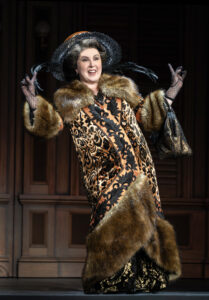 Laura Stracko‘s Alva Belmont is boisterously brilliant. Gotta love a socialist socialite. Act I’s “Alva Belmont” introduces the character in a big way. With another period-nod, “Alva Belmont” is presented as a toe-tappin’ Tin Pan Alley-style ditty complete with playful, yet pointed lyrics: “I divorced my husband for philandering. Now I’ve got his millions for philanthropy.” Flawlessly introducing the character. Interestingly, while not really relevant to the plot, I discovered while researching to interview some of the cast that the real Alva Belmont, a native of Alabama, has ties-by-association to Tennessee. Her maternal grandfather, Robert Desha was a U.S. House of Representatives for the state of Tennessee. In the years before her political activism, she was first married to William Kissam Vanderbilt, the grandson of Commodore Cornelius Vanderbilt (for whom Nashville’s Vanderbilt University was named).
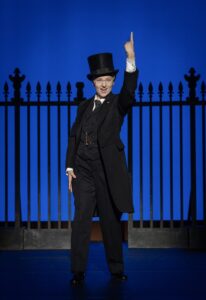 As President Woodrow Wilson, Jenny Ashman offers a sharply drawn portrayal. “Ladies” drips with calculated condescension (and sadly echoes a little too closely our current administration’s views on the arguably stronger sex, but I digress). Later in the show, Ashman’s Wilson attemps to placate with “Let Mother Vote (reprise)”, which lands with pointed irony. On Opening Night in Nashville, Ariana Burks stepped into the role of President Wilson’s Third Assistant Secretary of State Dudley Malone, a role usually played by Brandi Portert. Covering the role, Burks shines in “Respectfully Yours, Dudley Malone,” blending romantic sincerity with political awakening. Her chemistry with Marcus’ Doris in “If We Were Married” and its reprise adds warmth and texture to the broader narrative. Just one of a handful of relationships, while not at the center of the narrative, a wonderful aside. Other notable personal relationships alluded to within Suffs include sorority sisters Ida B. Wells and Mary Church Terrell, friends Alice Paul and Lucy Burns and longtime partners Carrie Chapman Catt and Mollie Hay.
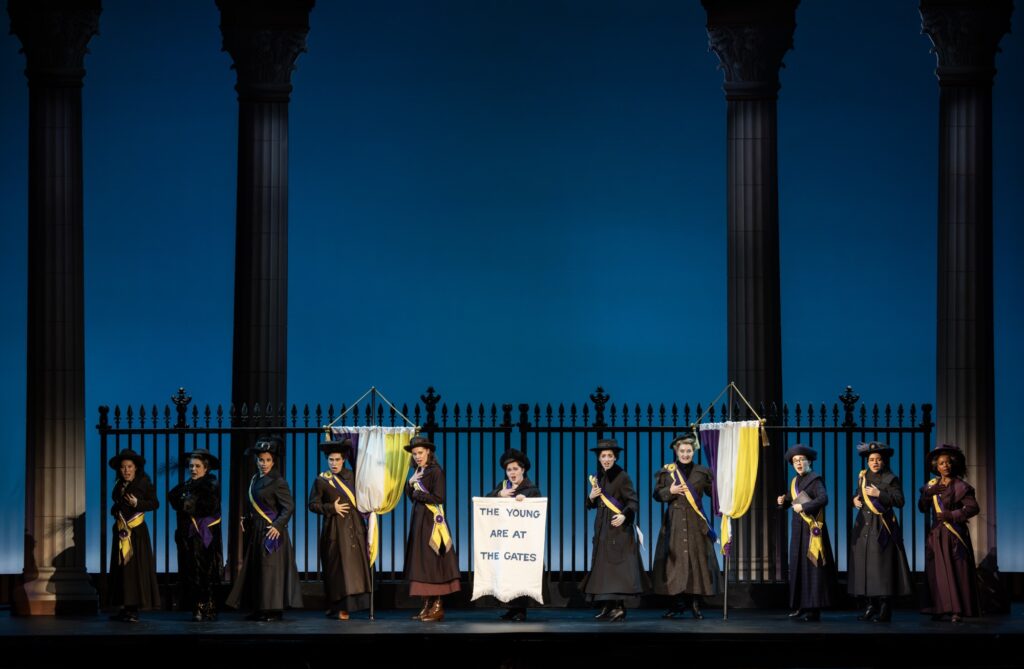
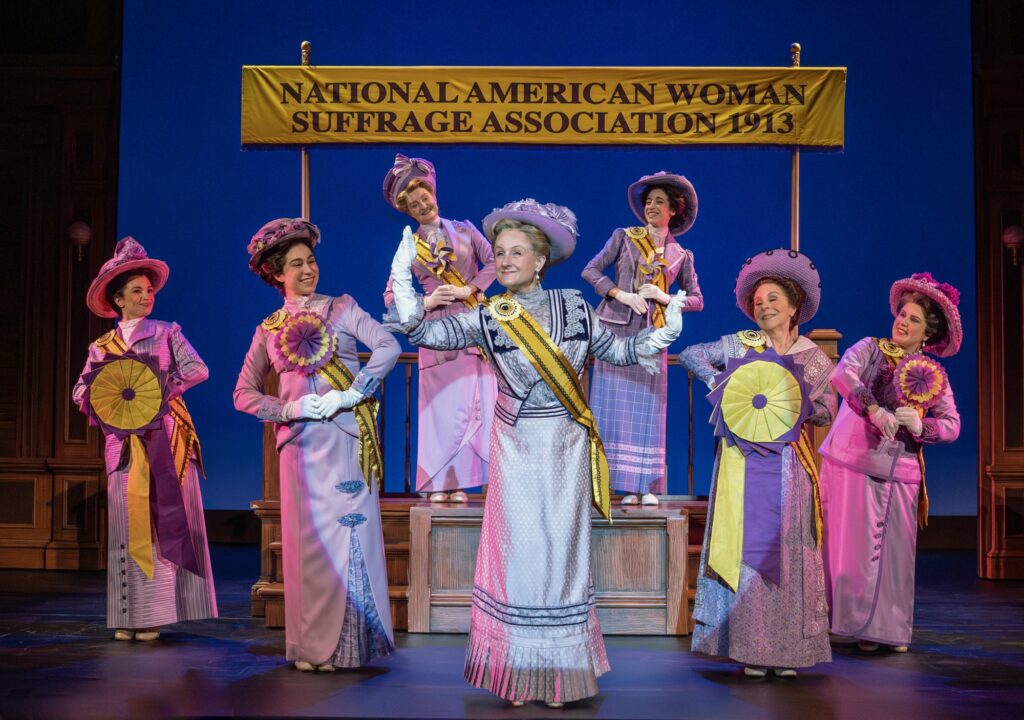
 RAPID FIRE WITH SUFFS‘ Carrie Chapman Catt, ACTRESS MARYA GRANDY
 RAPID FIRE WITH SUFFS‘ Mary Church Terrell, ACTRESS
 RAPID FIRE WITH SUFFS‘ Phyllis Terrell and Robin, ACTRESS VICTORIA PEKEL
 RAPID FIRE WITH SUFFS‘ Mollie Hay, ACTRESS TAMI DAHBURA
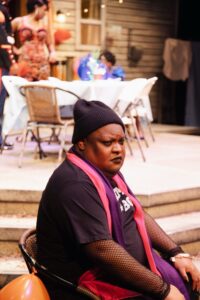 As Juicy, this retelling’s Hamlet, Julian “Joolz” Stroop delivers a performance that is instantly mesmerizing. Dressed in black, but with flare that lets us know they’re their own person deep down, Stroop’s Juicy is a stark contrast to the bright, bustling energy around them, Stroop embodies what it means to feel different within your own family. Their Juicy is wickedly sarcastic, deeply unsure of themself, yet painfully self-aware. Where Shakespeare’s Hamlet spirals toward destruction, Juicy wrestles with whether violence is the only inheritance available. Stroop captures the tension between rage and restraint with remarkable control. You can see the weight of expectation pressing in—the desire to prove themself to a father who was cruel in life and demanding in death. Stroop’s performance reflects the universal burden of feeling unseen, and when ultimately questioning the necessity of revenge, it lands with emotional clarity. Whether performing a telling karaoke number at the BBQ, sharing a laugh with friends, a more intimate moment with a lifelong crush or tense scenes with parental figures, Stroop steps up and shows out in a memorable Nashville Rep debut performance.
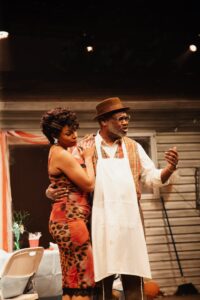 Tamiko Robinson Steele’s Tedra, the Queen Gertrude counterpart, is a sheer joy to behold from her first entrance on. She exudes sensual confidence and the unapologetic energy of a woman determined to find happiness on her own terms. One of my longtime favorite regional actresses, Robinson Steele masterfully reveals the emotional compromises beneath that surface. Like Gertrude, Tedra aligns herself with the new man quickly—but here, the choice feels rooted in survival and stability rather than simple obliviousness. Robinson Steele balances humor and depth beautifully, embodying a mother navigating grief, desire, and the societal pressures that center men in her world. And did I spot a bit of gold in that megawatt smile? A fun nod to Queen Gertrude and Tedra’s own status at the Queen of her castle. Nice touch.
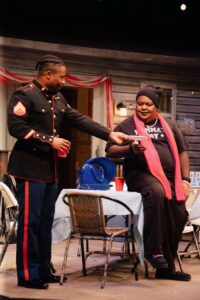 As Larry, the Laertes counterpart, Michael A. McAllister-Spurgeon initially leans into bravado and expected masculinity. But as the story unfolds, he allows vulnerability to seep through the cracks. Like Laertes, Larry is poised to embrace retaliation—but McAllister-Spurgeon reveals the insecurity driving that impulse. His performance underscores how young men inherit scripts of aggression without ever being asked whether they want them. The nuance he brings elevates Larry from stereotype to fully realized human being. And that finale reveal….YAAAAAAS!
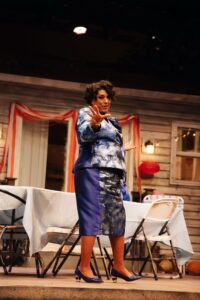 Persephone Felder-Fentress steps into a gender-switched Polonius role as Rabby, Larry and Opal’s mother, with sharp comedic precision. While Shakespeare’s Polonius is verbose and meddlesome, Rabby feels more direct and grounded. Felder-Fentress handles the humor effortlessly, but she also brings a relatable maternal complexity to the role. You know that female relative who always pinched your cheeks as a kid and inevitable asks “when are you getting yourself a girlfriend?” That’s Felder-Fentress’ Rabby. The dynamic between Rabby, Larry, and Opal textbook good christian family facade masking those things we don’t talk about beneath the surface. Y’all, during Rev’s pre-feast prayer, when I noticed Felder-Fentress’s Rabby clicking her bejeweled heels together in prayerful agreement to each thing Rev mentioned, I knew I longed for an invitation to the cookout!
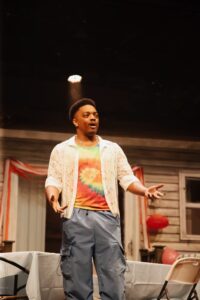 Rounding out the players is Gerold Oliver’s Tio, the Horatio character. Though his stage-time is limited, he is a delight as usual. His comedic timing, pulled facial expressions and overall demeanor a joy to watch. Yet Oliver ensures Tio is more than comic relief. In a climactic, albeit alter-state-induced monologue that begins like a muchie-fueled rambling, but soon climaxes into something unexpectedly profound. Oliver lands the humor and the wisdom with equal finesse as Tio reminds the audience of the play’s core truth: “Far as we know, we are in the only place in the cosmos that welcomes our particular brand of life. Why waste it trying to be miserable cause it’s gonna make somebody else happy?”
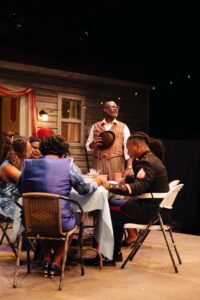 Amber Whatley’s lighting brilliantly shifts from warm afternoon glow to something cooler and more spectral when Pap’s ghost appears, then changing throughout from the familiarity of a family gather to the intensity of truths revealed. Nivedhan Singh’s sound design underscores both the humor and the haunting without overwhelming the text and lifting the mood when called for.
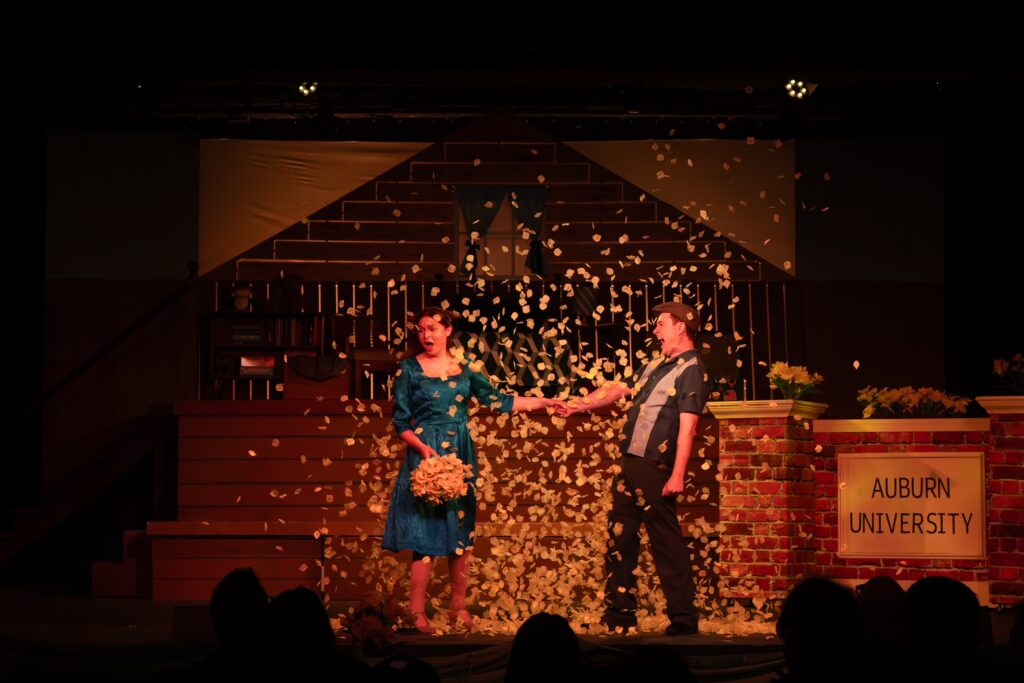
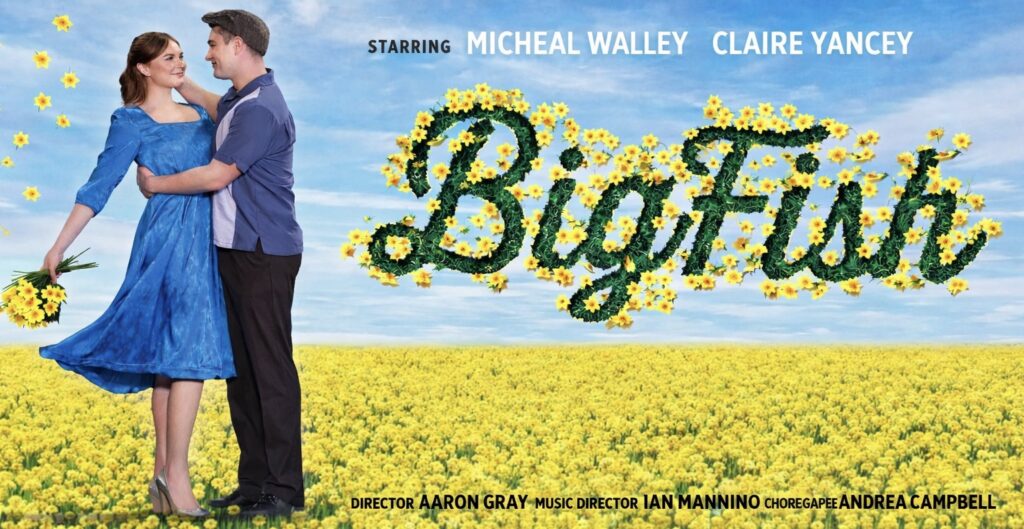
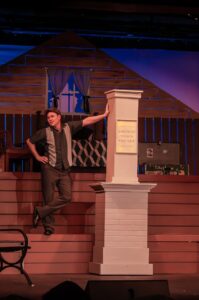 s Edward Bloom, Micheal Walley bursts onto the stage with charisma and conviction. From his first entrance, his speech pattern and delivery lands near Mark Twain’s distinctive Southern storytelling drawl — deliberate, charming, measured — and for some reason put me in mind of French Stewart’s Harry Solomon from “Third Rock from the Sun”, quick with an unexpected sarcastic bite. The blend gives Edward both homespun authenticity and razor-edged comedic timing, a balance that keeps the character from drifting into caricature. The subtle but effective vocal change between younger Edward to his more frail self in later years is quite interesting to take in.
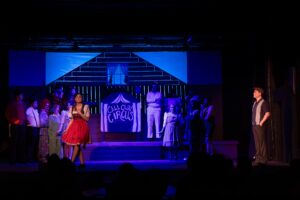 Choreographer Andrea Campbell, working in clear collaboration with director Aaron Gray, makes masterful use of The Keeton’s intimate stage. With a cast of twenty, filling the space without overwhelming it is no small feat, yet the production never once feels crowded. Instead, it feels alive. From kick lines to tap and everything in between, the variety of choreography reflects the musical’s tonal shifts while showcasing the ensemble’s versatility. One can only imagine the rigor of rehearsals required to master such range within spatial constraints, and the ensemble rises to the challenge with precision and enthusiasm. Director Gray deserves equal praise for staging that maximizes every inch of the performance area, creating dynamic stage pictures that feel expansive, an appropriate nod to the story’s 2003 cinematic retelling courtesy Tim Burton‘s film adaptation, despite the venue’s modest footprint.
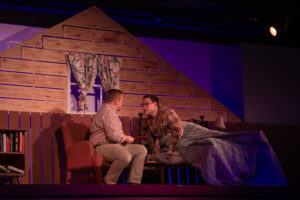 Jacob Hinnen as Edward’s adult son, delivers a fully believable, emotionally grounded portrayal of Will Bloom. Hinnen never pushes for sympathy; instead, he allows Will’s frustration and skepticism to emerge organically. The result is authenticity. As Will prepares to become a father himself, the shift in perspective is subtle yet powerful. You believe him — every step of the way.